The global magazine and marketplace for classic car enthusiasts, by enthusiasts.


Filter
Classic Star, Bentley for sale - Star, Bentley cars for sale
-

1936 Bentley Derby 4.25 Sedanca by Thrupp & Maberly
1936 Bentley Derby 4.25 Sedanca by Thrupp & Maberly Chassis number: B-36-GA Registration Number: CXE213 A stunningly beautiful car which wows onlookers wherever it is seen, this 4.25 Litre Derby Bentley Sedanca Coupe has fabulous and possibly unique aluminium Sedanca coachwork by Thrupp and Maberly... -
1930 Bentley Speed Six
1930 Bentley Speed Six Chassis Number: SB2774 Engine Number: SB2772 Reistration Number: GH8974 New to market & freshly restored to perfection. This car has over the past two years been fully rebuilt & built up as a LeMans style tourer by noted Rolls Royce &.. -
1923 Bentley 3 Litre
Bentley 3-Litre, built in 1923. Chassis number 110, engine number 104. License plate KLY 3, nickname “Wilfred”. This Bentley was delivered new on June 4, 1923. The first dated work order reads: “Stripped for racing”. This Bentley 3-Litre won a race at Brooklands in the hands of Captain Cecil Wingfield Tw.. -
1924 Bentley 3 Litre Speed Model 2 Seater By Gurney Nutting
Chassis No:612 Engine No: 628 Current Engine No: U.K. Registration No: NN 8126 Coachwork Sports 2 Seater By Gurney Nutting Chassis No 612 was delivered to A.B.Spencer who specified saloon coachwork by Gurney Nutting. Within two years, however, the car passed to his brother George Spencer who returned the car to Gurney Nutting with instructions to .. -
Bentley 4¼ Litre Sedanca 1938
Technical Specifications: Mark & Model: Bentley 4¼ Litre SedancaYear: 1938Registration plate: Guernsey registeredChassis Number: B-153-KUEngine Number: Z-3-BMEngine Capacity: 4257 ccTransmission: 4-speed manualMileage: Body style: 2-door SedancaInterior color: Black leathe.. -
1938 Bentley 4¼ Litre Sedanca
Technical Specifications Mark & Model: Bentley 4¼ Litre SedancaYear: 1938Registration plate: Jersey registeredChassis Number: B-187-LEEngine Number: E-9-BJEngine Capacity: 4257 ccTransmission: 4-speed manualMileage: Body style: 2-door SedancaInterior color: Cream le.. -
1923 Bentley 3 Litre TT Short Chassis Roadster
1923 Bentley 3 Litre TT 2-Seat RoadsterCoachwork by A.H. Storey & Sons Chassis No. 339Engine No. 719 - An original bodied 3 Litre with desirable one-off coachwork - Desirable short-chassis Tourist Trophy specification- Fantastic history including significant BDC racing- Wonderful.. -
1937 Bentley 4 ¼ Litre Vanden Plas 'Allweather' Tourer B179JY
An unusual and very interesting, attractive, practical four door open cabriolet configuration make this a particularly desirable Derby Bentley, being easy to access through large doors, and ‘wide-bodied’, giving increased spaciousness and elbow room, and nicely weather resistant, with well-constructed hood, wind up windows, tonneau cover, etc, i.. -
Have you seen this Bentley Le Mans Special? - Brooklands Birkin Racer
Who can tell me more about the whereabouts of the following car? I’m looking for information about a “Red Bentley” replica with a Mark VI chassis and a RR straight-8 B81 engine. The car was built in the Netherlands and was for sale roughly 25 years ago at Imparts in Ede. I even test-drove it there at the time. After that, it was exported to the .. -
1928 Bentley 4.5 Litre Lemans style tourer.
1928 Bentley 4.5 Litre Chassis No. KM3083 Engine No. KM3086 Registration No. UC 8791 Mint restored condition and all ready for some serious fun. This 4.5 Litre Bentley started life as a Martin Walter Saloon. in 2011 it was rebuilt to Lemans spec by the late Stanley Mann. Since converion it has ..


Star
GB, 1898 – 1932
Star/ Starling/ Stuart
(1) Star Motor Co, Wolverhampton, Staffs., 1898 – 1902
(2) Star Engineering Co, Wolverhampton, Staffs., 1902 – 1909
(3) Star Cycle Co, Wolverhampton, Staffs., 1905 – 1909
(4) Star Engineering Co Ltd, Wolverhampton, Staffs., 1909 – 1928
(5) Star Motor Co Ltd, Wolverhampton, Staffs., 1928 – 1932
Edward Lisle Sr’s Star Motor Co, an offshoot of the Star Cycle Co, produced its first Star car in 1898, and offered the Star car for sale in the following year. The Star car was a Benz-based machine, with a single-cylinder, water-cooled 3½hp engine, belt primary drive and chain final drive. It was an improvement in that water circulation on the Star car was assisted by a pump. In 1900 there followed a 2-cylinder Star car with 3 forward speeds, still on Benz lines. 1901 brougth De Dion-engined single-cylinder Star cars, and 1902 an 8hp twin of Panhard type in addition. Other, larger Star cars of Panhard ancestry joined the 8hp, up to a 20hp four Star car. By 1904, although a De Dion-powered single and Panhard-type twin were still there, the bigger machines were of Mercédès pattern, these Star cars came with honeycomb radiators, mechanically-operated inlet valves and pressed-steel frames. All veteran Star cars up to 1914 were extremely well-made, well-furnished, conventional, rather expensive cars lacking in technical originality, showing a line of development appearance in the 1907 range. The best-known Star car of the veteran period was the excellent 15hp Star car of 1909, a shaft-driven 2.8-litre four which had become the 3-litre 15.9hp by 1914. A great variety of other Star cars, basically similar models were turned out, not only by Star but also by the Star Cycle Co. The latter, run by Edward Lisle Jr, had made motor tricycles and bicycles, and produced the Starling car in 1905. It had 2 forward speeds and a De Dion single-cylinder engine, but was otherwise of Panhard type, with armoured wood frame and chain drive. One year later the Star car company supplemented it with the more modern Stuart car, which had 2-cylinders, 3-speeds and shaft drive. This name was dropped in 1908, all models being called Starlings, but these too, disappeared in 1909 when Star cars cheaper line was entrusted to the new Brion Motor Co, a more indepented concern that was still run by Edward Lisle Jr. So popular was the Star car that its makers were among the six largest in the country before 1914.
The 15.9hp Star car was continued after World War 1, together with another sv four Star car of pre-war origin, the 20hp Star car of 3.8-litres. A modern light Star car of fashionable type, the 11.9hp, arrived in 1921. This Star car used a 1.795cc sv engine with a detachable head, made in unit with a 3-speed gearbox which had central change. By 1924, the 11.9 Star car had grown up into the 2-litre 12/25hp Star car. It shared cylinder dimensions with the 18hp Star car, which was a new 3-litre six. The 12/25 Star car could be had as a very fine fast touring car with overhead valves and 54bhp, in which form the Star car was called 12/40hp. Thereafter, the Star car range reverted to its pre-war complexity. By 1927, there were three sv Star car models and two additional and more up-to-date Star cars with overhead valves. The 14/40hp Star car, new in 1926, was a solid 2-litre, ohv machine which in spite of having only 4-cylinders and 3 forward speeds, this Star car was a notably smooth and flexible car, thanks to a 5-bearing crankshaft. The ohv 20/60hp Star car, a 2½-litre six with the same bore and stroke as the 14/40 and a 7-bearing crankshaft, was the most luxurious Star car. A light six, the popular ohv 18/50hp, joined the Star car range in 1928, the year of the Star car company’s acquisition by Guy, and replaced the 14/40 Star car for 1929. By this time, the sv Star cars had gone, leaving the two sixes. As the 18hp Star Comet and the 21hp Star Planet, these Star cars were revised with handsome bodies and very full, luxurious equipment, including one-shot chassis lubrication, thermostatically-controlled radiator shutters and a built-in jacking system. Two other engines, of 14hp (2-litres) and 24hp (3.6-litres) were also obtainable in Star cars for 1932, as alternative Comet and Planet power units. These Star car were the last new Star cars, for they were too expensive to make, and the times favoured the mass-produced economy car. Production of Star cars ended in March 1932, but the unsold stock was sold by McKenzie and Denley of Birmingham, and the Star car was quoted in the Buyer’s Guide lists until 1935.
US, 1903 – 1904
(1) Star Automobile Co, Cleveland, Ohio
(2) H.S. Moore, Cleveland, Ohio
This Star car was driven by a single-cylinder, watercooled engine of 1.9-litres, mounted beneath the front seat, with false bonnet and coil radiator in front. A champion planetary transmission and double chain drive was used on this Star car. Both two- and five-seater Star cars were made, the latter with rear entrance.
US, 1908
Star Automobile Co, Chicago, Ill.
Star runabouts were offered in three models, selling for $500, $600 and $700 respectively. The smallest Star car was an open two-seater, and shaft drive was employed on all Star cars.
US, 1908
Model Automobile Co, Peru, Ind.
The short-lived Star car from Peru was offered in conventional 2- and 4-cylinder forms. The twin was chain-driven, while the big, expensive four Star car ($4.000) had shaft drive.
US, 1922 – 1928
Durant Motor Co of New Jersey, Elizabeth, N.J.; Lansing, Mich; Oakland, Calif.
William Crapo Durant’s Star Four was one of the most serious attempts to take away some of the Model T Ford’s market, for the cheapest practical car. Unlike the Ford, the Star car was an assembled machine.The Star car had a 2.2-litre, 4-cylinder engine by Continental, and was conventional in design in every way except the gearbox, which was separate; a feature common to all the vehicles in Durant’s empire, but very unusual in American mass-produced cars by the early 1920s. The touring Star car cost only $443 in 1923, which helped Star to be the seventh biggest seller in America that year. The Star car was sold outside the United States as the Rugby. In 1926, a 2.8-litre six Star car was introduced. Front wheel brakes appeared in 1927 but a year later the Star car make disappeared in the collapse of the Durant interests. By this time, 250 Star cars a day were being turned out. Only the Four was still called the Star car for the 1928 model year, as the Six was now known as the Durant Model 55.
Source: Georgano, encyclopedia of motorcar; TRN, GMN, MJWW, TRN
The information is written with the greatest of care. However, if you have any suggested amendments please contact us at office@prewarcar.com
Bentley
GB, 1920 to date
(1) Bentley Motors Ltd, Cricklewood, London N.W.2., 1920 – 1931
(2) Bentley Motors (1931) Ltd, Derby, 1933 – 1945
(3) Bentley Motors (1931 Ltd, Crewe, Cheshire, 1946 to date
W.O. Bentley was already well-known as the importer of the D.F.P. car, a pioneer of aluminium pistons and a designer of successful rotary aircraft engines when his first Bentley 3-litre car for sale appeared at the 1919 London Show. This Bentley model, indelibly imprinted in the layman’s mind as the archetype of the Vintage sports car, had a long-stroke (80x149mm) single ohc engine with fixed head and dual magneto ignition developing about 70bhp in its early form. The Bentley 3-litre was at its best in long-distance events; a team of Bentley 3-litres with flat radiators (the only instance of this apart from the same year’s Indianapolis car) finished 2nd, 3rd, and 5th in the 1922 T.T., and the model accounted for the first two of the marque’s Le Mans wins, those of Duff/ Clement in 1924 and Davis/ Benjafield in 1927 on the badly damaged ‘Bentley Old No. 7’ – one of the legends of motor-racin history. Up to 1929 1.630 3-litres Bentley motorcars were made. 1924 saw the introduction of front wheel brakes and also the famous sports four-seater ‘Bentley Speed Model’ by Vanden Plas. Bentley cars are popularly known by the colours of the enamel on their radiator badges – ‘Bentley Red Label’ signifying a Speed Model short-chassis 3-litre, ‘Bentley Blue Label’ the early short, and long chassis which could and sometimes did carry limousine coachwork, and ‘Bentley Green Label’, a special 100mph Bentley type made in very small numbers.
In 1926 the Bentley company made a bid for the carriage trade with a big Bentley 6½-ltre six for sale on similar lines. A chassis cost £1.450, but the Bentley image made no impression in this market. However, the model was developed into the 180bhp ‘Bentley Speed 6’ of 1929, considered by many to be the best of the old-school Bentleys for sale, and responsible for the firm’s last two Le Mans wins – Barnato/ Clement in 1929, and Barnato/Kidston in 1930. In 1927 the Bentley 3-litre was developed into the Bentley 4½-litre, still with four cylinder, but with a 100bhp engine which was giving 130bhp by the time production ended. This admirable car could exceed 90mph in standard form, and was used by Barnato and Rubin to win LeMans in 1928. A supercharged version was listed in 1930; it had 182bhp, and did not have the approval of Bentley himself, but it was an excellent if thirsty road car, and won Sir Henry Birkin an unexpected 2nd place in the formule libre French G.P. of 1930. Bentley finances were always shaky, and even Woolf Barnato’s aid of 1927 did not last long; the Bentley company went down in the early summer of 1931 to the accompaniment of a splendid gesture – a 220bhp ohc Bentley 8-litre six, made in two wheelbase lengths, 12ft and 13ft. Only 100 of these eight-litres Bentleys were made, plus 50 examples of a rather uninspired inlet over exhaust valve 4-litre car.
Napier made an unsuccessful bid for the assets of the Bentley company, but were beaten by Rolls-Royce, who introduced their version of the Bentley at Olympia in 1933. This was an entirely different type, based on Derby’s contemporary 3.7-litre ohv push-rod ’20-25’. It had a 4-speed synchromesh gearbox, Rolls-Royce servo brakes, and sold for £1.460 with saloon bodywork. In this form, it could reach 90mph and merited its slogan ‘The Silent Sports Car’. It was not raced, of course, apart from E.R. Hall’s three consecutive second places in the T.T. (1934, 1935 and 1936). By 1936 it had grown into a Bentley 4¼-litre, the increase of capacity being necessitated by the rising weight of bespoke coachwork. An overdrive gearbox was standardized in 1939, and the 1940 Bentley Mk V had independent front suspension, though only a handful were made because of the war. The Derby Bentley car’s swansong was a creditable 6th place by H.S.F. Hay at Le Mans in 1949, on a ten-year-old machine with 60.000 road miles behind it. Cylinder capacity was unchanged at 4.257cc in 1946, but independent front suspension, was standard, and Bentely, like Rolls-Royce, had gone over to inlet over exhaust valves. Prices for the Bentley motorcars for sale rose from £2.997 to £4.474 in 1951 for the standard steel saloon, the first Rolls-Royce product to have a regular series-produced factory body.
Thereafter the Rolls-Royce and Bentley identities merges, though in 1952 there was a special ‘Bentley Continental’ version of the latter with fastback 2-door saloon body by H.J. Mulliner which gave 120mph on a 3.077:1 top gear. Capacity went up to 4.6 litres in 1952 and 4.9 litres in 1955. Automatic transmissions, already optional, became standard that year; power-assisted steering and air conditioning followed In 1957, and for 1960 the old six at long last gave way to a 6.2-litre V8 with full overhead valves, by which time only the radiator style distinguished one make from the other. The ‘Bentley Continental’ with separate chassis was discontinued at the end of 1966; 1972 Bentleys were the 6.745cc Bentley T saloon and the Bentley Corniche 2-door saloon and convertible. Even the price differential between the two sister makes was now a thing of the past, the Bentley T-series selling for the same £10.455 as the Rolls-Royce Silver Shadow.
Source: Georgano, encyclopedia of motorcar; MCS
The information is written with the greatest of care. However, if you have any suggested amendments please contact us at office@prewarcar.com


Featured
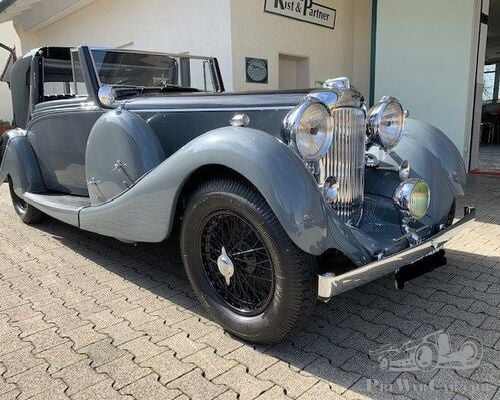
Lagonda LG 45 Coupe de Ville Sedanca by Mayfair
The successor to the M45, the LG45 was built around the same highly capable, competition-proven 4.5-litre Meadows inline-six engine, but featured r..
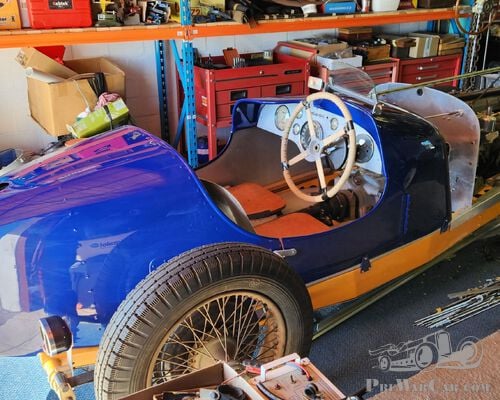
Riley TT Sprite
1935 6-cylinder TT Sprite replica. Chassis # 46A2722. Engine # 6A2722. Original Ulster Imp body. Restoration nearing completion. Engine, G..
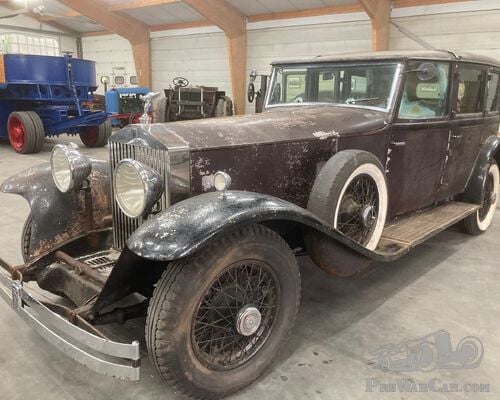
Rolls-Royce
Rolls-Royce Phantom ll chassisnummer 287 AJS. bouwjaar 1932, Links gestuurd, Brewster Keswick Sedance Towncar