The global magazine and marketplace for classic car enthusiasts, by enthusiasts.


Filter
Classic Benz, Chalmers for sale - Benz, Chalmers cars for sale
-

1886 Benz Patent Motorwagen
The Benz Patent-Motorwagen (or motorcar), built in 1886, is widely regarded as the world's first automobile. The original cost of the vehicle in 1885 was $1,000 (equivalent to $26,337 in 2016). This is an exact replica of the original painstakingly constructed with reference to the original plans. The quality is superb & the car easy to driv.. -
1899 Benz Velo 3.5HP Dogcart - VCC Dated
1899 Benz Velo 3.5HP DogcartRegistration No. ST5979Chassis No. 1577 Engine No. 1472VCC Dating Certificate No. 3899 After developing a successful gasoline-powered engine in 1873, Benz focused on developing a motorised vehicle. Following disputes, he spli.. -
1886 Benz Patent Motor Wagen Replica
1886 Benz Patent Motor Wagen Replica.Chassis number: TBARegistration number: TBAVintage and Prestige Fine Motor Cars are proud to be offering this 1886 Benz Patent-Motorwagen Replica for sale. The Benz Patent-Motorwagen (or motorcar), built in 1886, is widely regarded as the world's first automobile. The original cost of the vehic..


Benz
D, 1885 – 1926
(1) Benz & Co, Rheinische Gasmotorenfabrik, Mannheim, 1885 – 1899
(2) Benz & Cie, Rheinische Gasmotorenfabrik AG, Mannheim, 1899 – 1911
(3) Benz & Cie, Rheinische Automobil- und Motorenfabrik AG, Mannheim, 1911 – 1926
Karl Benz is honoured throughout the world as the man who designed and built the first workable motor car driven by an internal combustion engine. It is established that in 1885 his first Benz car was ready and made its first trials. Benz’s ideas were concentrated from the beginning on a car as an organic unit of chassis and engine, not on motorization of existing vehicles. The first Benz car was a three-wheeler with two driven rear wheels. The engine was a horizontal single-cylinder with a vertical crankshaft which had a horizontal flywheel. It developed ¾hp and a speed of 8mph is recorded for one of the first trial runs. This prototype Benz car had some featured which are still very extensively used in automobile construction: the water-cooled engine, electric ignition, mechanically operated inlet valve, and a differential gear. This first Benz car still exists and belongs to the Deutsches Museum, Munich, to which it was presented by its inventor. Several Benz Patentwagen replicas were built and are now in different museums.
Only a few Benz cars were produced and for sale in the following years. At the Munich Exhibition of 1888 Benz had the opportunity of showing his improved Benz car to a wider public. Instead of the wire wheels of the first Benz Patentwagen the later models had wooden-spoked wheels. Engine output was increased to 2hp. Sales of Benz’ stationary gas engines were quite satisfactory, while interest in Benz motor cars was very limited and it was not until 1890 that Benz started a real, if small, ‘to order’ production. This was partly a result of exhibiting his Benz car at the Paris World Fair in 1889 which led to increasing sales by his French agent Emile Roger, who already sold Benz stationary engines. The other important factor was that Benz was joined by two new partners in 1890. These two men who possibly saved Benz from the fate of numerous other inventors, driven aground by financial difficulties, were Friedrich von Fischer and Julius Ganss. Fischer took over internal administration and Ganss became responsible for sales. Benz himself was free for further developments on the technical side of the business, which made sound progress. 1893 saw the production of the first 4-wheeled Benz car, the Benz Victoria. This model was also the basis for the first Benz van and Benz bus in 1895; its technical conception was also adopted for the Benz Velo of 1894. This model has a place in the history of motoring as the world’s first production car. Production figures for 1885 to 1893 were 69 cars. 67 cars left the factory in 1894, mainly Benz Velos. These figures increased to 135 cars in 1895 and 181 in 1896.
In 1896 the first Benz Kontra-Motor appeared, an engine with two horizontally opposed cylinders. The first Benz lorry was produced in the same year. In 1898 pneumatic tyres were adopted for the Benz Comfortable. Production in 1899 was 572 cars, which brought Benz into the first rank of car producers. This number was surpassed in the following year with a production of 603 units. The first Benz racing car appeared in 1899 and was the start of numerus racing successes.
After 1901 sales of Benz cars declined as Benz stuck to his now outdated designs. Mercedes’ successes led him to evolve new concepts of construction; the result was the 2-cylinder front-engined Parsifal presented in 1903, available with cardan or chain drive and various engine outputs. In the same year a new 4-cylinder engine appeared and was used in all subsequent Benz models. A 1903 racing car developed 60hp and participated in the Paris-Madrid race. Karl Benz himself left the company in 1903 although he rejoined shortly afterwards. In 1906 he joined his sons in the firm of C. Benz Söhne.
1906 saw Benz gaining a second place in the Herkomer Trial while in the same event in 1907 a 5hp Benz finished first. Second and third place in the Coppa Florio, 1907, first place in the Florida 100-Miles Race, 1908, second and third place in the French Grand Prix, 1908, and second and fourth place in the American Grand Prix, 1908, led the world records which were set with 150hp and 200hp Benz cars by Bruce-Brown, Robertson, Oldfield and Hémery. With the 200hp Blitzen Benz Burman covered a mile in 25.4 seconds from a flying start at Daytona Beach in 1911. This was a speed of 140.8mph, but was not recognized internationally as a Land Speed Record.
In 1910 Benz acquired the Süddeutsche Automobil-Fabrik of Gaggenau. Production of private Benz cars in this factory was given up and in the following years Benz concentrated on commercial vehicles there.
A wide range of Benz cars for sale was marketed in the 1910-1914 period, ranging from the 2-litre Benz 8/20ps up to really big machines like the 10.1-litre Benz 39/100ps, all with side valve engines and shaft drive. However, the 22-litre Benz 200hp (which cost £1800 in England in 1912, and must have been the largest-engined private car to go on the market) had ohv and final drive by side chains. Benz were successful in the Austrian Alpine Trials, the Tatra-Adria Trial and various trials in Russia, to name only a few. The great promoter of German motoring, Prince Henry of Prussia, used only Benz cars.
The first Benz 6-cylinder car was produced in 1914 with the type Benz 25/65ps 6.5 litre. In 1918 the Benz 6/18ps 4-cylinder 1540cc appeared, a type developed during the war. A very important Benz development was the precombustion chamber diesel engine. It was first used in 1922 for Benz Sendling agricultural tractors, and the first diesel-engined lorry by Benz appeared in 1924. These were steps towards later Mercedes-Benz diesel-engined cars. Another idea introduced by Benz which also appeared in later Mercedes-Benz cars was the swing axle. It was one feature of the 2-litre 6-cylinder Benz ‘teardrop’ racing car designed on Rumpler principles. However, this car was not a great success either in its racing or in its sports version. In the Grand Prix of Italy in 1923 they gained fourth and fifth place. In 1924 Benz and Mercedes began to combine their interests, amalgamating in 1926.
Source: Georgano, encyclopedia of motorcar; HON
The information is written with the greatest of care. However, if you have any suggested amendments please contact us at office@prewarcar.com
Chalmers / Chalmers-Detroit
US, 1908 – 1924
Chalmers Motor Car Co, Detroit, Mich.
The Chalmers was one of the most popular automobiles made in the United States for more than a decade. The Chalmers was the successor to the Thomas-Detroit which was built by a company which had been founded in 1906 by E.R. Thomas (builder of the Thomas car in Buffalo, N.Y.), Roy D. Chapin and Howard Earle Coffin; the two latter had previously served at Oldsmobile. The Thomas-Detroit of which some 500 were sold during the first year of production, was marketed through the parent firm in Buffalo which manufactured a larger line of cars under the Thomas emblem. The Thomas-Detroit was a medium priced four-cylinder car which had been designed by Coffin. In 1907, Hugh Chalmers, vice president of the National Cash Register Co and a noted salesman, entered the firm. Shortly after, he bought a half of E.R. Thomas’ stock and became president of the company which became the Chalmers-Detroit Motor Company. The Thomas-Detroit became the Chalmers-Detroit in 1908 and in 1910, the Chalmers. Open and closed Chalmers models in two lines comprised the Chalmers four-cylinder cars, with self-starters appearing in 1912. Chalmers (as Chalmers-Detroit) had distinguished itself in road races as early as 1908 when W.R. Burns won the Motor Parkway Sweekstakes at Jericho, N.Y., averaging 48.7mph in the six-lap 140.76 mile run.
In 1913, the Chalmers brought out its first 6-cylinder model, as well as the four and apart from small mechanical and design changes, continued both until 1914. The Chalmers four was dropped from the 1915 line, however, and sixes were to be used exclusively in Chalmers until the ending of manufacture. By 1915, some 20.000 Chalmers cars per year were coming off the Chalmers production line and would even exceed that figure before the advent of World War 1. In 1917, an L-head motor replaced the earlier overhead-valve type and on August 4th, Chalmers again headed racing news when Joe Dawson won the 24-hour stock Car Endurance Run at Sheepshead Bay, N.Y. Sales flagged following the end of the war and Hugh Chalmers, always the salesman, and with the realization that a competitor, Maxwell, wasn’t faring well either, arranged to lease his Chalmers plants to Maxwell, using his salesmanship to promote the two concerns and getting the benefit of Maxwell tooling and manufacturing equipment. By the early 1920s, however, many makes of cars were in financial difficulties due to over-expansion and recession, and Walter P. Chrysler was called in to try and reorganize Maxwell. Chrysler was at this time planning his own corporation and in 1922 Chalmers was taken over by Maxwell which had become a Chrysler subsidiary. The last Chalmer cars for sale were equipped with Lockheed hydraulic brakes but 1923 was the last year of Chalmers production with some 9000 units leaving the factories. The Maxwell survived until 1925 when it became the Chrysler Four.
Source: Georgano, encyclopedia of motorcar; KM
The information is written with the greatest of care. However, if you have any suggested amendments please contact us at office@prewarcar.com


Featured
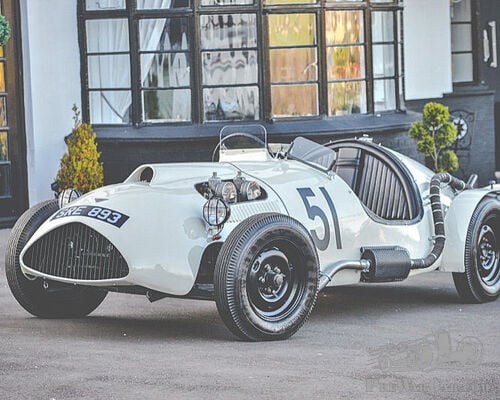
1933 Alvis 3.0 Special - One-Off Alloy Body | Period Competition Car | Featured in “Alvis – A Century of Drivers”
1933 Alvis 3. 0 Special - One-Off Alloy-Body | Period Competition Car | Featured in “Alvis – A Century of Drivers”
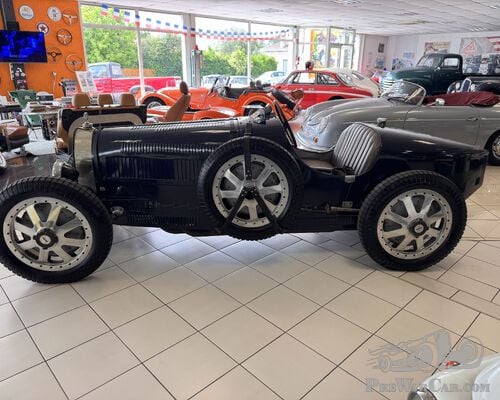
Bugatti 35 B Pur Sang
Bugatti 35 B Pur Sang,importée par un membre délégué de la FFVE il y’a une quinzaine d années.Participation à de nombreux Rallyes Bug..
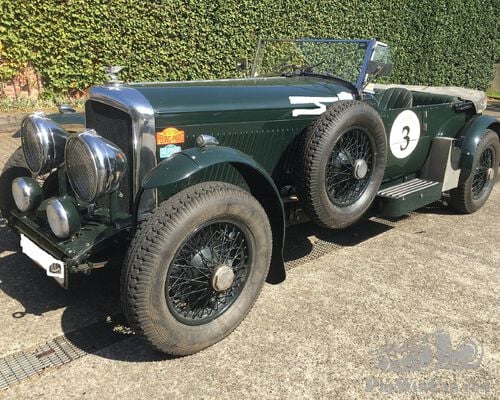
Bentley Derby Special Open Rally Car
This Bentley Derby, manufactured in 1935, has been rebuilt into a short and long-distance rally car. Full rebuilt engine in 2021, Since 2021 low mi..