The global magazine and marketplace for classic car enthusiasts, by enthusiasts.


Filter
Classic Berliet for sale - Berliet cars for sale
-

1921 Rolls Royce 20hp Experimental tourer
1921 Rolls Royce 20hp Experimental tourer. Chassis number: 4G2 Registration Number: CH2892 Sir Henry Royces' personal car used for development of the 20HP chassis. He is pictured in it both at his French house; La Villa Mimosa in Le Canadel & also near his UK home "Elmsted" .. -
Oldsmobile Curved Dash Model 6C 7hp 1904
We have available for sale this exceptionally original 7hp Curved Dash Oldsmobile. Manufactured in 1904. Continuous ownership/history for many years. This is the larger engined motor car with rear brakes & larger hp. These are exceptionally good strong motor cars and can certainly cover some miles without any issues, well built & very go.. -
BMW 326 Cabriolet
AVAILABLE – NEAR PARISRare two-door Convertible version.EU import duties paid, supplied with its US title.Requires a complete restoration. The car is complete and is sold with an additional complete engine. -
Fiat 509 Torpedo / Spider – Exceptionally Original and Complete
A Rare and Highly Original Example with Long-Term Dutch HistoryOffered for sale is an exceptionally original and remarkably complete Fiat 509 Torpedo / Spider, preserved with many of its original components, fittings and period details still intact.For the serious collector of early Italian motor cars, its principal appeal lies not.. -
1929 Delage DMN (6 Cyl.) Tourer
Delage is a marque synonymous with style and a sporting history. This example is no exception, wearing a stunning body in the style of Vanden Plas. Its most adequately powered by its 3.8 liter overhead valve, straight six engine. The DMN offered the larger valves that would be used in the D8 model, and a lightened fly wheel. The 6 cylinde.. -
Singer 9 Le Mans Special Speed in British Racing Green, bouwjaar 1935
Prachtige Singer 9 Le Mans Special Speed. (De Singer 9 Le Mans werd uitgebracht na het succes van Singer in de gelijknamige 24u race.) 4 cilinder in lijn, 972cc, 34 pk met dubbele solex carburators. De special speed heeft een getunede motor met dubbele carburators en een versnellingsbak met kortere overbrenging.De buitenkleur is Br.. -
C1926 DFP open
Rare DFP from c1926Mechanical complet, Missing interior and hood topno documents,can see in LisbonCan help with transportchassis # 40 273 -
Citroën B2, 10hp, 1923 Coupé docteur
Der Typ B2 war ab 1921 das zweite Modell, das der französische Hersteller Citroën baute.Das hier angebotene Fahrzeug von 1923 besitzt eine seltene geschlossene Kabine "Coupé docteur" mit 2 Sitzplätzen plus Notsitz. Es scheint das einzige überlebende Fahrzeug dieser Bauart mit dem stärkeren 10-hp-Motor (1452 ccm) und mit langem Radstand zu.. -
Horch 854 – A Masterpiece of Automotive Craftsmanship (1939)
This Horch 854 represents one of the finest examples of pre-war German luxury engineering. Built on the shorter and more agile 854 chassis and equipped with the more powerful A-engine, this vehicle combines elegance, rarity, and exceptional craftsmanship. Originally, only 7 chassis of the 854 series we.. -
1928 Mercedes Benz SSK Rebuild
A faithful, high-quality rebuild of an SSK, carried out in 2003 by a renowned specialist in GermanySubsequently owned and actively used by a single owner for 20 years Original 1929 supercharged engine with impressive performanceComprehensive documentation availableEligible to participate in numerous histo..


Berliet
France, 1895 – 1939
Automobiles M. Berliet, Lyons
Marius Berliet started modestly in 1895 in a small workshop, his first cars having rear-mounted horizontal engines (easily removable as complete units), 4-speed gearboxes, and left-hand drive with wheel-steering. Even in 1899 annual output was only six Berliet cars. 1.2-litre horizontal-twin engines were being used in 1900. The following year Berliet took over the firm of Audibert-Lavirotte, M. Lavirotte continuing as commercial director. 2- and 4-cylinderBerliet cars with front vertical aiv engines, side chain drive, and armoured wood frames were made, the 4-cylinder design being adopted by T.C. Pullinger as the basis for the 12hp Sunbeam made at Wolverhampton. 1902 brought the emergence of a new type of Berliet on Mercedes lines, with mechanically-operated inlet valves, honeycomb radiator, and pressed-steel frame, and this theme was pursued for several years. Quite big Berliet cars were produced, among them an 8.6-litre Berliet 60hp and Berliet 80hp of over 11 litres’ capacity, and some models had overhead inlet valves in place of the more usual T-head configuration. In 1906 Bablot’s Berliet took 2nd place in the Tourist Trophy, and the American Locomotive Company started to built Berliets under licence under the name of Alco – hence the locomotive emblem introduced in 1909, and still found on present-day Berliet trucks.
The smallest Berliet model listed in 1907 was a 2.4-litre Berliet 14, but new that year were a 4-cylinder shaft-driven taxicab chassis and a 60hp 6-cylinder on accepted lines. 1908 saw an odd Berliet-Mixte, also a six with compressed-air starting and transmission, and shaft drive was now optional on both the Berliet 14 and the 3.8-litre Berliet 22 for sale. The big Berliet 60 in 4-cylinder guise had overhead valves. The 4-cylinder Berliet T.T. cars had pressure lubrication, which was catalogued in 1909, along with three small L-head models, an 8hp twin and two small fours of 1½ litres’ and 2.4 litres’ capacity. 6-cylinder Berliets had conventional gearboxes once more, and in 1911 the 6.3-litre 2-cylinder Berliet model was catalogued with shaft drive at £795. Shaft drive, thermosiphon cooling, and 4-speed gearboxes were universal in 1911, when a new L-head 4.4-litre Berliet 20/25 made its appearance for sale, and in 1912 both this and the Berliet 15hp car could be had with either monobloc or pair-cast cylinders. The 6-cylinder Berliet cars were available only to special order, and by 1914 only monobloc fours were listed. The range consisted of the 1½-litre Berliet 12 for sale, the 2.4-litre Berliet 15 for sale, the 3.6-litre Berliet 18 for sale, the Berliet 25 for sale, and the big 6.3-litre Berliet 40 (types U and R) for sale. De luxe models of the two latter types came with electric lighting and starting as standard.
If the 1914 Berliet cars were conventional, their post-war equivalents were dull, and the new 3.3-litre Berliet Type VB for sale followed American lines, with sv 4-cylinder engine in unit 3-speed gearbox, fixed disc wheels, and detachable rims. It sold in England for £755, and was followed by a very similar 2.6-litre Berliet 12CV car. Front wheel brakes were available in 1923, and the sv cars were still being made in 1925, though 1924 produced two new Berliet models with ohv engines, front-wheel brakes, 4-speed gearboxes, and detachable wire wheels: the 1.2-litre Berliet 10/20, and the big 23/70hp 4-litre Berliet Type VIG. The company also experimented with cross-country, and with imbert gas-producer plants, a line of development which was pursued until 1938. A 2½-litre ohv car with central change appeared in 1925, and in 1927 there came a small six, the Berliet 14/40hp of 1.8 litres’ capacity; this had side valves, pump cooling, a 4-bearing crankshaft, coil ignition, single-plate clutch, 3-speed gearbox and wooden wheels; there were also a bigger 4.1-litre 6-cylinder and a straightforward sv 4-cylinder 1½-litre, rated at 12/25hp. The Berliet 14/40 grew up into a 2-litre in 1929, but no 6-cylinder cars were made after 1932; there was, however, a large sv 3.3-litre 4-cylinder Berliet.
In 1933 came the Berliet Type 944, a more advanced design with X-braced frame, 4-speed silent 3rd gearbox, and a choice of cylinder capacities (1.6 litre and 2 litres). De luxe version had transverse independent front suspension. A saloon cost 24.900fr, and both ohv and sv versions were available, though only the former type was listed by 1936. Last of the line was the 2-litre Berliet Dauphine with with independent front suspension, rack-and-pinion steering, and synchromesh; towards the end it used the same saloon body as Peugeot’s 402. Private Berliet car production was not resumed after World War 2, though Berliet acquired another Lyons firm, Rochet-Schneider, and in 1964 they announced the appointment of Alvis Ltd as United Kingdom concessionaires for their all-wheel-drive military vehicles. The Berliet company came under Citroën ownership in July, 1967.
Source: Georgano, encyclopedia of motorcar; MCS
The information is written with the greatest of care. However, if you have any suggested amendments please contact us at office@prewarcar.com


Featured
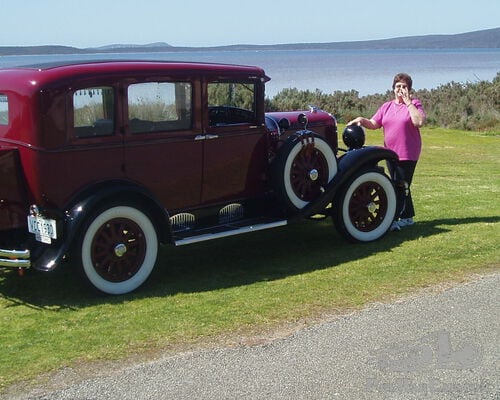
1930 Chrysler 66 Six-Wheel Equipped Royal Sedan
An exceptionally well restored and highly awarded Chrysler 66 Royal Sedan, with only two owners in nearly 97 years.The present owner ..
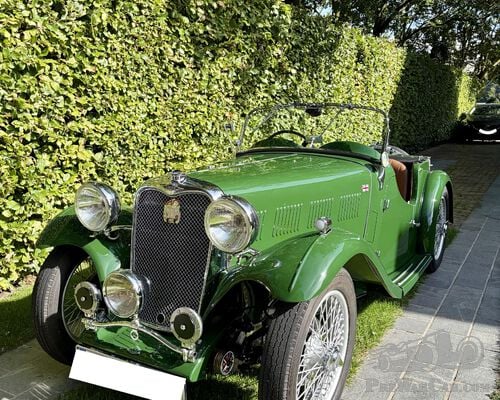
Singer 9 Le Mans Special Speed in British Racing Green, bouwjaar 1935
Prachtige Singer 9 Le Mans Special Speed. (De Singer 9 Le Mans werd uitgebracht na het succes van Singer in de gelijknamige 24u race.) 4 cil..
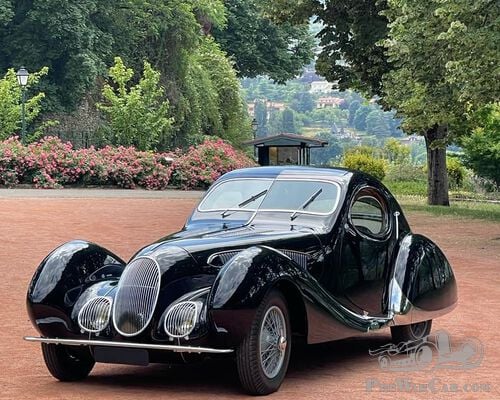
1939 Talbot-Lago T150C “Goutte d’Eau” — Iconic French Coachbuilt Masterpiece
Talbot-Lago T150C ‘Teardrop’ — An Icon of French Automotive Art There are motor cars that define an era. And then there are those tha..