The global magazine and marketplace for classic car enthusiasts, by enthusiasts.


Filter
Classic BMW, Tatra for sale - BMW, Tatra cars for sale
-

BMW 326 Cabriolet
DISPONIBLE PRES DE PARISRare version cabriolet 2 portes douanes EU acquittées, title américainNécessite une restauration totale, Voiture complète vendue avec un moteur complet en plus -
1938 BMW 328 Roadster 1938 for sale
1938 BMW 328 Roadster Chassis number 85316 Registration number: TBA €790,000.00 Part of a small collection of rare BMW cars: This 328 was found as a wreck in the late 1960's with the then Czechslovakian title documents going back to 4th November 1970 when it was registered in Bratislava. The registration lists a succe.. -
BMW 319 Drauz Cabriolet 1936
Beautiful and powerfull BMW 319 CabrioletCabriolet Body build by Drauz from Heidelborn.Engine rebuild by previous owner.Been in a BMW collection for a long preriod in the NetherlandsRegistered in the Netherlands since 1959Now on a Belgium road registration -
B.MW 329 Cabriolet bi-ton 1935
This is an exceptional model I am offering; this magnificent 1935 BMW 329 Cabriolet shows 02,528 km on the odometer. Finished in two-tone cream/blue, it features a full beige leather interior and a navy blue fabric soft top in very good condition, functional dashboard instrumentation, and well-preserved wood trim. Purchased new in 1936 and in Fr.. -
BMW 327/328 Sports Cabriolet
From a real barn find in an old hall with classics, somewhere in the Netherlands, to a totally restored BMW 327 Sports Convertible with the original and fast 328 engine. The restoration of this BMW 327, commissioned by a true enthusiast, was carried out by some well-known and renowned specialists in the Netherlands. Documentation of the restaurati.. -
BMW 319 - 1935 Cabrio/Sport
BMW 319 - 1935 Cabriolet/SportFully Original/Genuine /Engine/gearboxInterior Pristine conditionsCar can drive all distancesRefer to photos/Internet literature (only few dozens built!).Price to discuss (+32478/993635)Car Selected to Villa Cavrois ConcourseAdditional info on request -
1937 BMW 326 Cabriolet by Gläser
Rare convertible from coachbuilder GläserOnly 25 units manufactured, only two known to exist todayFrom a high-calibre collectionColour scheme in two-tone dark red and black with leather interior light beige6-cylinder in-line engine, 1,971 cc, 50 hpEngine “matching numbers”The BMW 326.. -
BMW 327/328 convertible 1939
This BMW left the BMW factory in januari 1939 to BMW Versuchsabteilung. Car was delivered to her first owner in December 1939 through dealer Bovenkamp in Wuppertal. Original color of the car is black. Engine and gearbox ar completely overhauled. Invoices available. Chassis and brake system is overhauled as well. Dashboard and instruments are res.. -
BMW 315/1 Sport Roadster 1935
Charming and rare little sporty roadster, light and fitted with a lively engine. Authentic car most probably sold new to Switzerland. Documented five swiss owners since 1950, the last one for 44 years. Aging restoration with at lot of charm and some patina. Coachbuilder: BMW Sport roadster.Year: 1935.Chassis: 49746..


B.M.W.
D, 1928 to date
(1) Bayerische Motoren-Werke, Eisenach, Munich, 1928 – 1939
(2) Bayerische Motoren-Werke AG, Munich, 1952 to date
The BMW firm developed from the Bayerische Flugzeug-Werke, Munich founded in 1916 for the production of aero engines. In 1922 the name was changed to Bayerische Motoren-Werke, and production of engines for boats, lorries and motor cycles began. In 1923 the first BMW motor cycle appeared. In 1928 the Eisenach Dixi works were acquired and car production began with the BMW-Dixi, an Austin Seven built under license. BMW car production was carried on in Eisenach, while production of BMW motorcycles remained in Munich. The BMW-Dixi was succeeded in 1932 by the 800cc BMW 3/20ps model with tubular backbone chassis and independent suspension.
In 1933 came the first 6-cylinder model, the BMW 303 for sale). The range of sixes continued with the ‘BMW 315’(1.490cc, 34 and 40bhp) and ‘BMW 319’ (1.911cc, 45 and 55bhp). The triple-carburettor sports versions of these BMW cars laid the foundation for the famous BMW sports cars, noted for their speed and appearance. The engine of the ‘BMW 326’ (1971cc, 50bhp) became the basis for the ‘BMW 327’ and ‘BMW 328’. The BMW 327 used the 55bhp engine, while the most successful BMW 328 developed 80bhp. Two of this model’s most remarkable successes amongst many in races, rallies and trials were a class win at Le Mans and the winning of the 1940 abbreviated Mille Miglia. The ‘BMW 327/328’ used an 80bhp engine in the ‘BMW 327’ longer wheelbase chassis and was also very successful in competitions. The last pre-World War 2 model was the ‘BMW 335’ with a 3.485cc 90bhp engine. It was intended for the British market and only a few hundred BMW 335’s were built. From 1935 to 1939 BMW’s were imported into the United Kingdom and marketed under the name of Frazer Nash-BMW.
The Eisenach factory was lost through nationalization in 1945. Production of BMW motorcycles was taken up again in the Munich factory and facilities for BMW car production were prepared. The first Munich-built BMW car appeared in 1952, the ‘BMW 501’ with a 6-cylinder 1.971cc engine, based on the last pre-war designs. This started the range of 6- and 8-cylinder prestige BMW cars. The last of this range was the ‘BMW 3200’ CS 2-door coupé with 3.2-litre 160bhp engine for sale. In 1955 BMW started production of the Isetta bubble car under licence, and this was followed in 1957 by the BMW ‘600’ 4-seater based on it. In 1960 the ‘BMW 700’ appeared with a 697cc air-cooled opposed twin-cylinder engine mounted in the rear. In 1962 BMW began to produce medium sized cars again, bringing out the 4-cylinder ‘BMW 1500’ (80bhp), which was developed into the ‘BMW 1800’(90bhp). The ‘BMW 1800TI’ and the ‘BMW 1800 TI/SA’ were tuned versions developing 110 and 130bhp respectively. In 1965 the ‘BMW 2000 C’ (100bhp) and the ‘BMW 2000 TI’ (120bhp) coupés appeared. In 1966 the ‘BMW 1600’ (83bhp), the ‘BMW 2000’ (100bhp) and the ‘BMW 2000 TI’ (120bhp) with 4-cylinder in-line engines of 1573cc and 1990cc capacity were added to the range. In 1967 the Frazer Nash-BMW name was revived for a special luxury model of the ‘BMW 2000TI’, selling in England for £1830. New for 1968 were the BMW 2002 for sale, combining the 135bhp 2-litre engine with the BMW 1600 chassis, and the BMW 1600GT, which used the body of the former Glas 1700, a result of the BMW-Glas merger of 1967. In 1969 the BMW company produced their first six since 1958, the BMW 2500. Mechanically this derived from the existing fours, but was powered by a 170bhp 2494cc 7-bearing engine. A bigger 2.8-litre version was also available By 1971 BMW were offering a 2985cc version with either twin carburetors or Bosch fuel injection; in the latter form it gave 200bhp. Also new in 1971 was a semi-estate car, the Touring, available in 1600, 1800, or 2000 guise. BMW ran a Formula 2 team in 1969, using special 1.6-litre engines in British Lola chassis, but though there were several victories in 1970, the BMW company retired from his branch of the sport after two seasons. The 1973 range embraced the 1600, 1800, 2000, and the sixes, as well as a new ohc BMW 520 for sale with 1990c 4-cylinder engine, wishbone and trailing-link front suspension, and saloon bodywork in the 2500 idiom. Options included 115bhp twin-carburettor or 130bhp fuel-injection models, and a choice of 4- and 5-speed manual and automatic transmissions. A 200bhp derivative of this unit powered a prototype mid-engined coupé, the turbo, with all-disc brakes.
Source: Georgano, encyclopedia of motorcar; HON
The information is written with the greatest of care. However, if you have any suggested amendments please contact us at office@prewarcar.com
Tatra
CS, 1923 to date
(1) Tatra-Werke AG, Koprivnice, 1923 – 1935
(2) Ringhoffer-Tatra-Werke AG, Koprivnice, 1935 – 1941
(3) Tatra, np, Koprivnice, 1945 to date
At first the Tatra car was a continuation of the Nesselsdorf, producing the pre-war Types T and U Tatra cars, the latter a 6½-litre ohc 6-cylinder. The first real Tatra car of 1923 was completely different from the last Nesselsdorf models. After his return from Steyr, Hans Ledwinka produced a car which became one of the classics in the history of automobile design. This Tatra car was characterized by an air-cooled opposed-twin engine of 1.056cc developing 12bhp, a central tubular frame, and special rear swing axles and differential. It was known as the Type 11, and was the basis of later Tatra car models, commercial vehicles as well as private Tatra cars. Type 12 was identical with the Type 11, but this Tatra car had 4-wheel brakes. The Tatra car design was not intended for sporting events, but nevertheless two of these Tatra cars participated in the 1925 Targa Florio and gained 1st and 2nd place in the 1.100cc class, driven by Fritz Hückel and Kart Sponer. These were standard production Tatra cars, except that two inlet valves instead of one were fitted, and the front transverse-leaf springing was replaced by swinging half axles. Josef Vermirovsky was another competition driver on the small Tatra carmodel; his successes with Tatra cars included winning a 5.000 kilometre (3.107 miles) trial from Leningrad via Tiflis to Moscow in 1925. About 25.000 Tatra cars of Types 11 and 12 were built up to 1930. Some 4-cylinder Tatra cars followed, built on the same lines with air-cooled opposed engines, central tubular frames and swing axles: the Tatra 30 (1.680cc, 40bhp) and Tatra 52 (1.910cc, 40bhp). There were also the in-line 6-cylinder Type 70 Tatra car of 3.400cc and 60bhp, and the 6-litre V12 Type 80 Tatra car with 100bhp, both featuring the same frame construction and swing axles. The Type 80 Tatra car was built only in limited numbers, like the single-cylinder, 528cc 3-wheeler Tatra car (Type 49).
The next important development was the Tatra 57 which appeared in 1932. This Tatra car had the central tubular frame and swing-axles which were traditional by this time, and an air-cooled opposed 4-cylinder engine of 1.160cc developing 22bhp. Engine capacity of the Tatra car was later increased to 1.690cc, and this Tatra car was built until 1938. The German Röhr Junior was the Tatra 57 design built under licence. Under the name of Austro-Tatra the light Tatra cars were also manufactured in Vienna.
Ledwinka and Tatra were destined to make automobile history again with the Tatra Type 77 of 1934. The all-enveloping body of the Tatra car was built strictly to aerodynamic principles. A central box-type frame was used, and in its forked rear end – behind the rear axle – an air-cooled V8 engine of 3.400cc was placed. It developed 70bhp and gave the Tatra car a maximum speed of 95mph. The 1937 Tatra 87 incorporated the same technical principles and this Tatra car used a basically similar body. Engine capacity of the Tatra car was reduced to 2.960cc; output was 75bhp – a result of weight reduction. This Tatra car was capable of 100mph. In the same year the Tatra 97 was introduced with the same body, but an opposed 4-cylinder unit of 1.760cc and 40bhp was fitted. After the district of Koprivnice had come under German occupation, and the restriction of numbers of types which had been introduced in Germany in the 1930s was enforced in Czechoslovakia too, production of the Tatra 97 ceased and only the 87 Tatra car was continued until about 1941. In 1945, after the war, the Tatra car factory were nationalized by the Czechoslovak government, and production of Tatra cars was devoted to the front-engined Type 57B Tatra car and the rear-engined Tatra Type 87. These Tatra car were replaced in 1948 by a single model, the 2-litre rear-engined Tatraplan, derived from the pre-war Type 97 Tatra car. This Tatra car was made until 1954, after which there was a three-year period when no private Tatra cars were made. In 1957 the Tatra 603 was introduced; this Tatra car again had an air-cooled V8 engine of 2.472cc mounted in the rear. The Tatra car is still in production today as the T3-603, with twin-carburettor engine, servo-assisted disc brakes, and powere assisted steering, although Tatra concentrate on commercial vehicles and railway carriages. In preparation for 1973 was the 3.4-litre T613, a development of the existing theme.
Source: Georgano, encyclopedia of motorcar; HON
The information is written with the greatest of care. However, if you have any suggested amendments please contact us at office@prewarcar.com


Featured
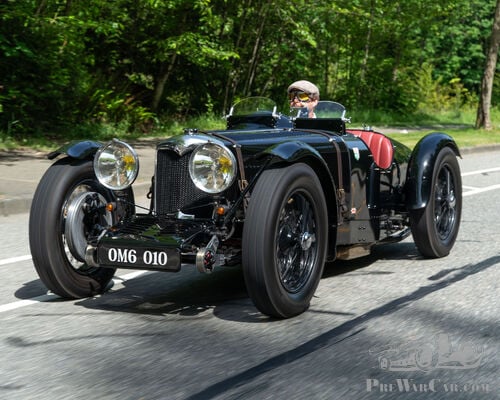
Riley 14/6 Special 1933
The ExperienceStep into the golden age of British motoring. This 1933 Riley 14/6 Special is a masterclass in pre-w..

1915 Rolls-Royce Silver Ghost Barker Tourer
⁃ An exceptionally rare original bodied pre-war Silver Ghost⁃ Desirable Barker tourer in exciting barn find condition⁃ ..