The global magazine and marketplace for classic car enthusiasts, by enthusiasts.


Filter
Classic Bugatti, Crossley for sale - Bugatti, Crossley cars for sale
-

Bugatti Type 30 short chassis roadster. Fully restored on a replica chassis
This car has had a full restoration and is build from a lot of original parts on a replice chassis built in Germany, It has chassis number BC 189 from the UK Bugatti Owners Club. Car has done only about 500km since restoration but health problems dictate that it must go. Please email for fullest details of the source of all the parts and a vide.. -
1936 Bugatti Type 57 Atalante
1936 Bugatti Type 57 Atalante. We have two available, both with european papers. Both are fully matching numbers with complete history from day one. Qualified principals please call Richard Biddulph 0044 7967 260673 for full details. -
Bugatti Brescia type 23 16 soupapes double allumage
Bugatti roadster Brescia type 23 16 soupapes Proposée à la vente, cette remarquable Bugatti Type 23 “Brescia” représente une opportunité rare d’acquérir un exemplaire à l’historique particulièrement intéressant. Produite à la fin de l’année 1923, cette automobile fait partie des quatre véhicules expédiés neufs en Australie p.. -
1931 Bugatti Type 46 'Superprofilée' Coupe
1931 Bugatti Type 46 'Superprofilée' Coupe Chassis no. 46491 Engine no. 345 One of two chassis purchased from Roland Bugatti by Richard Baudens in the 1950s & wearing its first coachwork ever fitted to the car. 5,359cc SOHC Inline 8-Cylinder Eng.. -
1927 Bugatti Type 37A Grand Prix | RM Sotheby's | The Monterey Auction
To Be OFFERED AT AUCTION at RM Sothebys' The Monterey Auction event, 13 - 15 August 2026. $800,000 - $1,100,000 USD The second of 75 examples builtExtremely authentic car featuring the original engine, blower, gearbox, and rear axleContinues to benefit from 1990s restoration by British specialists Crosthwaite & Gard.. -
1929 Bugatti Type 44 Tourer by Ghia.
1929 Bugatti Type 44 Tourer by Ghia. Chassis number: 44477 Registration Number: PA3304 (Italy Palermo.) WE WILL NEVER HAVE ANOTHER ONE LIKE IT!!! Simply the mosty original & untouched Bugatti we have ever had the pleasure of selling. This Glorio.. -
1938 Bugatti Type 57 Atalante by Gangloff | RM Sotheby's | The Monterey Auction
To Be OFFERED AT AUCTION at RM Sothebys' The Monterey Auction event, 13 - 15 August 2026. $1,500,000 - $1,800,000 USD A bespoke example for original owner Fernand CrouzetNumerous unique and special details throughout, as specified by Mr. CrouzetContinuously known ownership history since newWell-preserved concou.. -
Bugatti Type 30 Grand Prix. Interesting history. Genuine Bugatti Molsheim parts
The shape of things to come…The Bugatti Type 30, introduced in 1922, marked a turning point in Ettore Bugatti’s engineering philosophy and it is where he really started to stretch his wings. The Type 30 was the first Bugatti to adopt the company’s new inline eight-cylinder engine, a jewel of engineering born from wartime aero research. At.. -
1937 Bugatti Type 57C
1937 Bugatti Type 57C Chassis Number TBA Freshly serviced & fully gone though by Marque specialist Ivan Dutton. Call For full details & more pictures: Richard Biddulph 07967260673 -
Bugatti 35 B Pur Sang
Bugatti 35 B Pur Sang,importée par un membre délégué de la FFVE il y’a une quinzaine d années.Participation à de nombreux Rallyes Bugatti.Tres bien fiabilisée.Carte grise Française collection.


Bugatti
D:F, 1909 – 1956, 1956 to date
Automobiles E. Bugatti, Molsheim, Bas-Rhin
Ettore Bugatti was perhaps the greatest maker of racing cars until his fellow Italian Ferrari began to dominate the scene in recent years. Born into an artistic family in Milan, Bugatti soon found that the graphic arts were not to his liking and turned to the mechanical. Drawn by speed and racing, at the age of 18 Ettore Bugatti attracted attention in early motorcycle and tricycle races in Northern Italy, enevitably applying his mechanical talent to the improvement and alteration of the machines.
In 1900, at the age of 19 he embarked on the design and production of his own Bugatti 4-cylinder, 90 x 120mm car with the help of Count Gulinelli, and won a medal for it at the Milan Exhibition in 1901. Baron de Dietrich who was attracted by the Bugatti machine and who was searching Europe for designs to produce at his Niederbronn works, signed an agreement with Bugatti to design for him. Bugatti moved to Niederbronn in 1902 to produce in the next two or three years a basic design of 4-cylinder, 114 x 130mm chain-driven chassis with variations, sold commercially as the De Dietrich-Bugatti, or in England as the Burlington, and occasionally raced by Bugatti himself. Engine dimensions varied, as was customary in those days, and larger engines were also listed.
De Dietrich was offering other designs at the same time, particulary the Turcat-Méry, and Bugatti’s car was not a commercial success; the arrangement came to an end around 1904, and Bugatti teamed up with Mathis, moving to Strasbourg, the district where Ettore was to remain for the rest of his active career.
The Mathis collaboration produced the Hermes car, which bore a strong resemblance to the earlier De Dietrich design, certainly in conception – 4 large cylinders, 4-speed gearbox, chain drive, semi-elliptic springs – but by now it had a modern type of radiator with a surrounding shell to replace the earlier exposed film type.
In 1906 Bugatti and Mathis fell out and separated, Bugatti going to the Deutz factory at Cologne to design and produce cars for them. Two chassis were produced, the first another typical 4-cylinder layout with an engine of 145 or 150 x 150mm and chain drive, and later a smaller 92x120mm car with, for the first time Bugatti’s design, a shaft drive.
During this period (about 1908) Bugatti produced at his own expense (and, it is said, in the cellar of his home at Cologne) the miniature Bugatti chassis, with a 4-cylinder, 60x100mm engine, and shaft drive which founded the thoroughbred line of his designs and enabled him later to produce his own car. This prototype (Type 10 in the Bugatti series) is still in existence.
There is at least some evidence that the creation of this Bugatti car owes something to the 1908 Coupe des Voiturettes Isotta Fraschini; it is more than likely that Bugatti saw and was inspired by these beautiful little cars. There is certainly no evidence that the Isotta Fraschini cars owe anything to Bugatti, and their designer Cattaneo has denied the suggestion. The overall conceptual similarity is, however, striking.
Whatever the origins of his thoroughbred, Ettore Bugatti found a backer who would help him to start up production of his own car at the end of 1909, in a disused dye work at Molsheim a few miles west of Strasbourg. Here production was started of the real Bugatti car, with 4-cylinder, 65x100mm, 1327cc and 2 valves per cylinder operated from an overhead camshaft with curved, sliding tappets and three chassis lengths; Bugatti Type 13 with a 6ft 6¾in wheelbase,the Bugatti Type 15, 7ft 10½in, and the Bugatti Type 17, 8ft 4½in and reinforced back springs for heavy bodywork.
Output was a few cars in 1910, but the Bugatti car caused a great deal of favourable comment at the 1910 Paris Salon, and in the early speed events it was entered in; commercial success, in spite of a high price, came immediately and several hundred Bugatti cars had been produced by 1914. During this period Bugatti also sold a licence to Peugeot for an 850cc Baby car(Peugeot Bebe), and kept his interest in large cars by producing a few chassis with a 4-cylinder 5-litre (100x160mm) ohc engine and reverting again to chain drive, for racing. The first chassis went to the aviator Roland Garros and survives as the famous Bugatti Black Bess. Other Bugatti cars competed unsuccessfully at Indianapolis in the 500 mile race in 1914 and 1915.
The early Bugatti 8-valve chassis had conventional semi-elliptic springs and radiators of squarish, 5-sided shape. At the end of 1913, Bugatti introduced his reversed quarter elliptic springs on the two long-length chassis, probably to simplify the fitting of the body: many of Bugatti’s design features show more originality than essential logic. This springs feature was to remain on all Bugatti’s chassis designs produced afterwards. At this time Ettore also introduced his design of oval Bugatti radiator, pearshaped, but later more like an inverted horse shoe.
Just before World War 1 Ettore produced a modified engine for voiturette racing, with 4 valves per cylinder (2 inlet, 2 exhaust), and an enlarged bore (66mm initially, later 68-69mm) giving more power, but the war prevented its use. Molsheim was soon occupied by the Germans and Bugatti found himself spending the next years in Paris working on aero engines.
In 1919 Ettore Bugatti reoccupied the factory himself, finding it happily undamaged, and resumed production of the 8-valve chassis and then the new 16-valve version. Wins at Le Mans in 1920 and at Brescia (1921) in voiturette races once more established his reputation and regular production of the car, now known as the Bugatti Brescia, followed steadily. The long-wheelbase chassis were now known as Bugatti Type 22 (7ft 10½in) and the Bugatti Type 23 (8ft 4½in) but the designation Bugatti Type 13 was retained for the short racing model. Improvements followed such as a crankshaft carried on ball bearings, better crank lubrication, a prettier radiator, and eventually 4-wheel brakes: in spite of these changes the similarity between the last chassis in 1926 and the first in 1910 is striking.
In 1922 Bugatti produced his first 8-cylinder production model, the Bugatti Type 30, with a 2-litre 60x88mm engine, an overhead camshaft and 2 inlet and 1 exhaust valve per cylinder. This 3-valve layout had been seen on the pre-war Bugatti Garros car(Black Bees) and the aero engines. Racing versions were entered in the 1922 French Grand Prix at Strasbourg, Friderich, Bugatti’s faithful mechanic, finishing 2nd. Production continued for the next few years of the 4-cylinder and 8-cylinder cars; an abortive attempt to produce a successful streamlined ‘Bugatti Tank’ with the 2-litre engine was made for the French GP at Tours in 1923 and then for 1924 Bugatti made the successful effort to produce a racing car which combined performance with aesthetic quality – the Bugatti Type 35 was the result.
The new 1924 car had the Bugatti Type 30 engine with its plain bearing crank replaced with a full ball and roller bearing, built-up unit, and a completely new chassis of fine lines carrying a handsome body, and first class brakes inside cast aluminium wheels. Tyre trouble prevented success in its first outing but soon success followed success, culminating in the world championship in 1926.
Although reluctant at first to fit a supercharger as his competitors had, Bugatti eventually in 1926 added one to the car to produce the Bugatti Type 35C (2-litre, 60x88mm), Bugatti Type 35B(2.3-litre, 60x100mm) and Bugatti Type 39 (1.5-litre, 60x66mm). A sports car version (Bugatti Type 35A) used the touring engine, and in 1926 a 4-cilinder (69x100mm, 1.5-litre) engine appeared, similar in layout to the 8-cylinder engine, but with a 5-(plain bearing crankshaft, which when fitted to the GP chassis became the main sports car version (Bugatti Type 37). Later this too had a blower fitted and became very potent (Bugatti Type 37A).
In the period 1926 -1929 a profusion of Bugatti models was listed for sale: racing types T35, T35B, T35C, T39; sports version Types 35A, T37, T37A; the touring model Type 30 replaced with a similar Type 38, later itself replaced by the 3-litre 8-cylinder Type 44 (69x100mm); Type 40 using the 4-cylinder engine from the Type 37; a splendid Bugatti Type 43GP sport four-seater using the Type 35B engine in a long-wheelbase chassis and catalogued as the fastest sports car in the world (110mph) which it was; and to crown all the Bugatti Royale.
The Bugatti Royale (Type 41) was to be Bugatti’s car of kings. It had a 12.7-litre (125x130mm) 8-cylinder engine of typical Bugatti layout producing over 250hp, fitted in an enormous chassis, intended to carry the works of the world’s finest coachbuilders. Although a batch of 25 was projected only six were built and indeed only three were sold (in 1932 – 1933), the financial crisis of 1929 intervening to spoil Bugatti’s plans.
Around 1930 Bugatti continued to produce fine cars mixed with oddities. The Bugatti Type 44 3-litre touring car became the Type 49 with the bore increased from 69 to 72mm, one of the best models. The Bugatti Type 46 5.3-litre with a 3-speed gearbox in the back axle was introduced as a small size Royale and several hundred were produced. A racing Bugatti 16-cylinder (Type 45, 47) was made, having some success in hillclimbs, and later an unsuccessful 4-wheel drive Type 53. The de luxe 5.3-litre had a new twin ohc engine fitted to become the Bugatti Type 50 of 4.9-litres, very exciting and exotic but rather too powerful to be safe, even in the racing version, the Type 54.
The GP Type 35 had a new engine with twin overhead camshafts fitted in 1931 to become the Type 51, a very successful and fine-looking car which was perhaps the most effective racing model Bugatti ever produced, but the search for power and the competition demanded a larger car. Thus in 1933 Bugatti produced the Type 59 3.3-litre racing car which was his last racing production except for specialized single-seaters. Meanwhile a sports version of the Type 51, the Bugatti Type 55, had appeared usually with a roadster body among the handsomest ever fitted to a car.
The touring equivalent of the Type 59, the Bugatti Type 57, was the last Molsheim model to go into production; about 800 T57’s were produced between 1934 and 1939. This had a twin-ohc 72x100mm, 3.3-litre engine, integral 4-speed gearbox, and a conventional Bugatti chassis with semi-elliptic springs at the front and reversed quarter-elliptic at the rear. Later supercharged versions (Type 57C) and sports versions (Type 57S, 57SC) were produced.
Production of Bugatti cars was interrupted by the war, and only sporadic and half-hearted attempts were made ( a few Bugatti Type 101 models were produced) to resume car manufacture after Ettore Bugatti’s death in 1947. In 1956 two Formula 1 GP cars were built. Known as the Bugatti Type 251, they had 2½-litre straight-8 engines mounted transversely behind the driver in a space frame. One was driven by Trintignant in the 1956 French GP at Reims, but retired, and the cars were never heard of again.
Bugatti is now part of the Volkswagen group and is still producing sport cars.
Source: Georgano, encyclopedia of motorcar; HGC
The information is written with the greatest of care. However, if you have any suggested amendments please contact us at office@prewarcar.com
Crossley
GB, 1904 – 1937
(1) Crossley Brothers Ltd, Gorton, Manchester, 1904 – 1910
(2) Crossley Motors Ltd, Gorton, Manchester, 1910 – 1937
The name of Crossley was famous on engines before it was famous on cars; in fact the Crossley company was the first in Britain to make 4-stroke internal combustion engines on the Otto principle. Later, Daimler engines were made under licence. The first Crossley car for sale, a chain-driven 22hp 4-cylinder, appeared for the 1904 season. A Crossley 28hp and Crossley 40hp followed, all three cars being of normal design and foreign inspiration. Their designer was J.S. Critchley, formerly of Daimler. Shaft drive appeared in 1906, and late in 1909, some were fitted with Allen-Liveredge front-wheel brakes, but Crossley cars, though excellent machines, made little impression until after 1910. The 4-litre 20hp Crossley which then made its bow was a well-constructed, durable and very popular car. Designed by A.W. Reeves, it lived on in modified form until 1925. Crossley’s finest hour came in World War 1, when, as the Crossley 20/25hp it achieved fame as a staff car in the Royal Flying Corps, and as an ambulance and light truck. The Crossley model was extremely popular with the British Royal Family after the war in its 25/30hp version. In its early years, however, it was rivalled by the 15hp. The efficiency of the latter’s otherwise conventional engine, a side-valve four like the rest, gave this Crossley a better performance than most cars in its class and encouraged the makers to offer a special sporting variant, the Crossley Shelsley.
The Crossley Fifteen was discontinued after 1914, but a new Crossley arrived for 1921. This Crossley 19.6hp was a rather more modern design, having a detachable cylinder head, and it was cheaper and lighter on fuel than its 25/30hp companion. The performance was about the same. It was also made in sporting form as the Crossley 20/70hp, but this model was heavy, like the ’Crossley 19.6’ itself, and the brakes were not good enough for the 75mph that was available. Crossley did not make a serious attempt to invade the middle-class market until 1923, when the Crossley 12/14hp, later called the Crossley Fourteen, was introduced. Like its brothers, this was a simple side-valve four, in this case of 2.4 litres, but was more modern, with its unit construction of engine and gearbox and central gear-change. The Crossley Fourteen was a very successful model, being flexile and, thanks to its light weight, both roomy and economical. It survived until 1927. By this time the two bigger Crossley cars were giving way to a much more up-to-date car; the Crossley company’s first six and its first overhead-valve machine. This Crossley 18/50hp model was a spacious, heavy 2.6-litre car with good brakes but somewhat lacking in power. Its engine was enlarged to 3.2-litres and 20.9hp for 1928. At the same time a new small Crossley of similar design, the 2-litre Crossley 15.7hp was introduced, to which a sporting alternative reviving the Shelsley name was added in 1929. Lagonda’s 16/80 model used this engine later. The 6-cylinder Crossley 15.7hp continued until 1934 and the Crossley 20.9hp until 1937. Wilson pre-selector gearboxes were fitted from 1934.
In 1932, the Crossley company had introduced a light car, the Crossley Ten. This was an assembled vehicle powered by an 1100cc Coventry-Climax engine with overhead inlet valves. It was too heavy (a drawback compounded by the pre-selector gearbox), it was very low-geared and its brakes were mediocre. Another mistake was Crossley’s attempt to market the Burney rear-engined car with all-independent suspension. It was given a 15.7hp Crossley engine and a Wilson box, but it was too unconventional in appearance and handling. Very few were made. In 1935, Crossley introduced its new Regis range of small cars with handsome bodies styled by C.F. Beauvais. They consisted of the Crossley Ten and a new Crossley 1½-litre six of the same design also powered by Coventry-Climax, both with a new lowered frame. Both cars, together with the last Crossley 20.9s, disappeared after 1937.
Crossley assembled other people’s cars as well as making their own, beginning with the Willys-Overland Model 4 in 1920. The Gorton-produced Willys came to include more and more British-made parts, such as a Morris Oxford engine. A less likely diversion was an attempt of Crossley in 1921 to make the Type 22 Bugatti in England, but only a handful of these Crossley-Bugattis appeared. In 1922-1933 the Crossley factory made the AJS as well.
Source: Georgano, encyclopedia of motorcar; TRN
The information is written with the greatest of care. However, if you have any suggested amendments please contact us at office@prewarcar.com


Featured

K3 Replica on KN Chassis
"The K3 Magnette must rank in the history books as the most famous and successful of all the record breaking MGs. With only 33 examples produced durin..
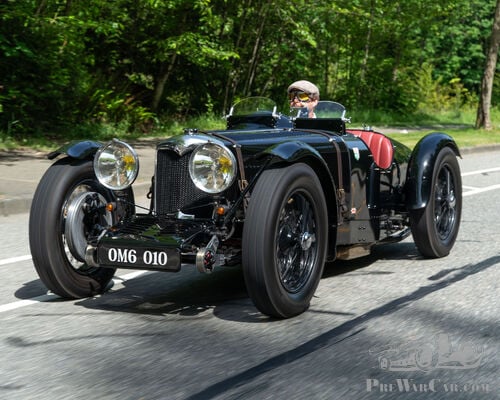
Riley 14/6 Special 1933
The ExperienceStep into the golden age of British motoring. This 1933 Riley 14/6 Special is a masterclass in pre-w..
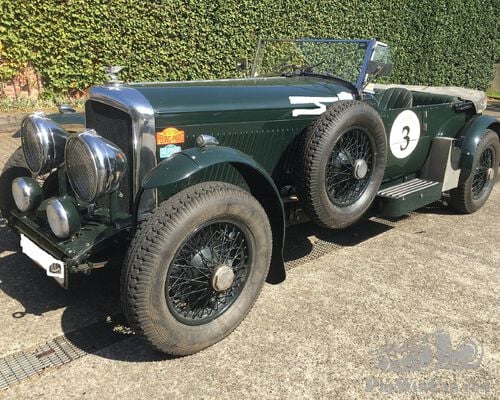
Bentley Derby Special Open Rally Car
This Bentley Derby, manufactured in 1935, has been rebuilt into a short and long-distance rally car. Full rebuilt engine in 2021, Since 2021 low mi..