The global magazine and marketplace for classic car enthusiasts, by enthusiasts.


Filter
Classic Bugatti, Hotchkiss for sale - Bugatti, Hotchkiss cars for sale
-

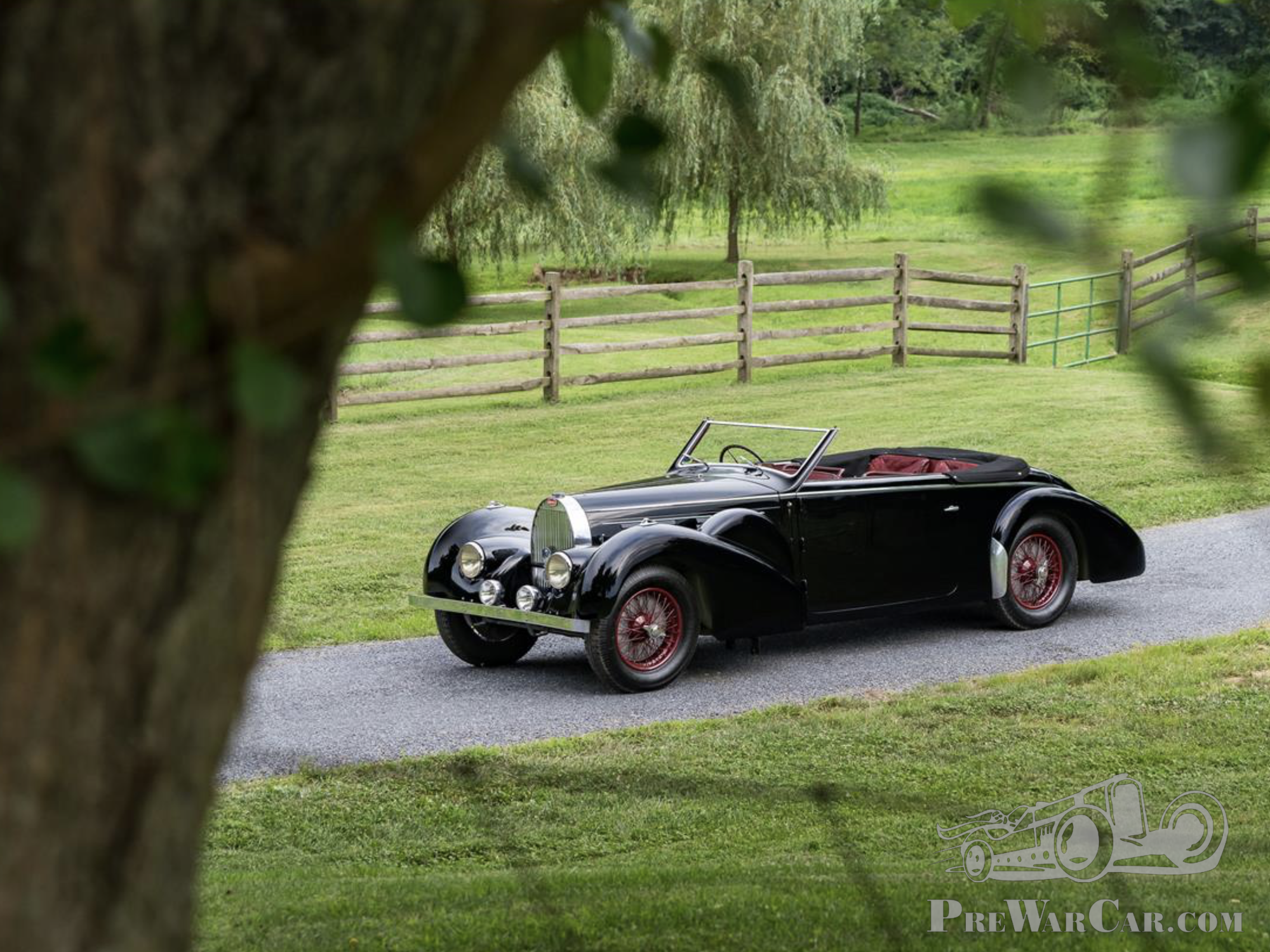
Deposit Taken - 1938 Bugatti Type 57 Stelvio Cabriolet Ex Lord Howe
1938 Bugatti Type 57 Stelvio Cabriolet A Matching numbers car with original engine number 496 in situ. - Chassis # 57679 USA Registered.- Engine # 496- Ordered New By Francis Curzon, The 5th Earl Howe- Featuring A Rich History & Unique .. -
1930 Bugatti Type 46 Coupé Superprofilée
1930 Bugatti Type 46 Coupé Superprofilée Registration: EEC Registered & EEC taxes paid. Chassis Number: 46208 The combination of Type 46 attributes, especially when its fine chassis and engine is clothed in sophisticated coachwork, makes it one of the most appreciated Bugatt.. -
1927 Bugatti Type 37A
1927 Bugatti Type 37A Chassis Number: 37280 Registration Number: B26406 A multiple Mille Miglia Participant; The long term owner tells us the following: He bought the car direct from the previous owner. It was far from being complete.. -
1934 BUGATTI TYPE 57 STELVIO Cabriolet
1934 BUGATTI TYPE 57 STELVIO Cabriolet Chassis Number: 57202 Registraton number: Swiss Registered. The old saying 'like father, like son' springs to mind when considering Ettore and Jean Bugatti. Ettore's name is always associated with innovative, race-winning sports cars and beautiful grand tourers constructe.. -
1934 Bugatti Type 55
1934 Bugatti Type 55 Roadster Please call Richard Biddulph 07967260673 for full details. This car is a reconstruction using mostly new components & is in brand new condition with just a few hundered miles put on it to date. It is in effect a tool room copy of an original with correct engine & supercharger etc... -
Bugatti T35B Grand Prix (2.3 Compressor) PS
Aktuell ist das hier vorgestellte Fahrzeug in der Museumsausstellung des GDC (Gentleman Drivers' Collection e.V.) zu sehen. Auf deren Website gd-collection.de gibt es eine ausführliche Beschreibung und über 50 Fotos nebst Detailabbildungen. Bitte zunächst dort alles durchlesen und dann TELFONISCH Kontakt aufnehmen – Telefonnummer befindet sich .. -
1930 BUGATTI BICYCLE (STADION)
1930 BUGATTI BICYCLE Replica – 1930 Stadion with Bugatti chainwheel(Stadion made Bugatti bicycles for a short time but they are no survivors)22.5″ Frame. 28″ Wheels. Frame No 227984Bugatti cars were very popular in Czechoslovakia as a result of Eliška Junková’s racing successes. So, after F.. -
Bugatti Type 35B
UK Registered with DVLA Chassis Number.Assembled from all original major components and crucially approved for historic status by DVLA. £POA -
1929 Bugatti Type 37
1929 Bugatti Type 37 Chassis Number: 40579 Registration Number: SL9982 A beautifully built up car with great attention to detail. This car was constructed in the 1970's by a Simon Clopper for european road rallies. It has three original of the 5 important components. This .. -
Bugatti Type 35B - Replica - French registered
Bugatti 35 supercharged version. 35B.Car is a built up Bugatti registered in France. The origin of the main parts are :French : Chassis Frame - Audoly radiator - Firewall and probably Front axle.English : Bodywork obtained from Ivan Dutton. Replica Bosch magneto converted to Electronic but can be revert to original sp..


Bugatti
D:F, 1909 – 1956, 1956 to date
Automobiles E. Bugatti, Molsheim, Bas-Rhin
Ettore Bugatti was perhaps the greatest maker of racing cars until his fellow Italian Ferrari began to dominate the scene in recent years. Born into an artistic family in Milan, Bugatti soon found that the graphic arts were not to his liking and turned to the mechanical. Drawn by speed and racing, at the age of 18 Ettore Bugatti attracted attention in early motorcycle and tricycle races in Northern Italy, enevitably applying his mechanical talent to the improvement and alteration of the machines.
In 1900, at the age of 19 he embarked on the design and production of his own Bugatti 4-cylinder, 90 x 120mm car with the help of Count Gulinelli, and won a medal for it at the Milan Exhibition in 1901. Baron de Dietrich who was attracted by the Bugatti machine and who was searching Europe for designs to produce at his Niederbronn works, signed an agreement with Bugatti to design for him. Bugatti moved to Niederbronn in 1902 to produce in the next two or three years a basic design of 4-cylinder, 114 x 130mm chain-driven chassis with variations, sold commercially as the De Dietrich-Bugatti, or in England as the Burlington, and occasionally raced by Bugatti himself. Engine dimensions varied, as was customary in those days, and larger engines were also listed.
De Dietrich was offering other designs at the same time, particulary the Turcat-Méry, and Bugatti’s car was not a commercial success; the arrangement came to an end around 1904, and Bugatti teamed up with Mathis, moving to Strasbourg, the district where Ettore was to remain for the rest of his active career.
The Mathis collaboration produced the Hermes car, which bore a strong resemblance to the earlier De Dietrich design, certainly in conception – 4 large cylinders, 4-speed gearbox, chain drive, semi-elliptic springs – but by now it had a modern type of radiator with a surrounding shell to replace the earlier exposed film type.
In 1906 Bugatti and Mathis fell out and separated, Bugatti going to the Deutz factory at Cologne to design and produce cars for them. Two chassis were produced, the first another typical 4-cylinder layout with an engine of 145 or 150 x 150mm and chain drive, and later a smaller 92x120mm car with, for the first time Bugatti’s design, a shaft drive.
During this period (about 1908) Bugatti produced at his own expense (and, it is said, in the cellar of his home at Cologne) the miniature Bugatti chassis, with a 4-cylinder, 60x100mm engine, and shaft drive which founded the thoroughbred line of his designs and enabled him later to produce his own car. This prototype (Type 10 in the Bugatti series) is still in existence.
There is at least some evidence that the creation of this Bugatti car owes something to the 1908 Coupe des Voiturettes Isotta Fraschini; it is more than likely that Bugatti saw and was inspired by these beautiful little cars. There is certainly no evidence that the Isotta Fraschini cars owe anything to Bugatti, and their designer Cattaneo has denied the suggestion. The overall conceptual similarity is, however, striking.
Whatever the origins of his thoroughbred, Ettore Bugatti found a backer who would help him to start up production of his own car at the end of 1909, in a disused dye work at Molsheim a few miles west of Strasbourg. Here production was started of the real Bugatti car, with 4-cylinder, 65x100mm, 1327cc and 2 valves per cylinder operated from an overhead camshaft with curved, sliding tappets and three chassis lengths; Bugatti Type 13 with a 6ft 6¾in wheelbase,the Bugatti Type 15, 7ft 10½in, and the Bugatti Type 17, 8ft 4½in and reinforced back springs for heavy bodywork.
Output was a few cars in 1910, but the Bugatti car caused a great deal of favourable comment at the 1910 Paris Salon, and in the early speed events it was entered in; commercial success, in spite of a high price, came immediately and several hundred Bugatti cars had been produced by 1914. During this period Bugatti also sold a licence to Peugeot for an 850cc Baby car(Peugeot Bebe), and kept his interest in large cars by producing a few chassis with a 4-cylinder 5-litre (100x160mm) ohc engine and reverting again to chain drive, for racing. The first chassis went to the aviator Roland Garros and survives as the famous Bugatti Black Bess. Other Bugatti cars competed unsuccessfully at Indianapolis in the 500 mile race in 1914 and 1915.
The early Bugatti 8-valve chassis had conventional semi-elliptic springs and radiators of squarish, 5-sided shape. At the end of 1913, Bugatti introduced his reversed quarter elliptic springs on the two long-length chassis, probably to simplify the fitting of the body: many of Bugatti’s design features show more originality than essential logic. This springs feature was to remain on all Bugatti’s chassis designs produced afterwards. At this time Ettore also introduced his design of oval Bugatti radiator, pearshaped, but later more like an inverted horse shoe.
Just before World War 1 Ettore produced a modified engine for voiturette racing, with 4 valves per cylinder (2 inlet, 2 exhaust), and an enlarged bore (66mm initially, later 68-69mm) giving more power, but the war prevented its use. Molsheim was soon occupied by the Germans and Bugatti found himself spending the next years in Paris working on aero engines.
In 1919 Ettore Bugatti reoccupied the factory himself, finding it happily undamaged, and resumed production of the 8-valve chassis and then the new 16-valve version. Wins at Le Mans in 1920 and at Brescia (1921) in voiturette races once more established his reputation and regular production of the car, now known as the Bugatti Brescia, followed steadily. The long-wheelbase chassis were now known as Bugatti Type 22 (7ft 10½in) and the Bugatti Type 23 (8ft 4½in) but the designation Bugatti Type 13 was retained for the short racing model. Improvements followed such as a crankshaft carried on ball bearings, better crank lubrication, a prettier radiator, and eventually 4-wheel brakes: in spite of these changes the similarity between the last chassis in 1926 and the first in 1910 is striking.
In 1922 Bugatti produced his first 8-cylinder production model, the Bugatti Type 30, with a 2-litre 60x88mm engine, an overhead camshaft and 2 inlet and 1 exhaust valve per cylinder. This 3-valve layout had been seen on the pre-war Bugatti Garros car(Black Bees) and the aero engines. Racing versions were entered in the 1922 French Grand Prix at Strasbourg, Friderich, Bugatti’s faithful mechanic, finishing 2nd. Production continued for the next few years of the 4-cylinder and 8-cylinder cars; an abortive attempt to produce a successful streamlined ‘Bugatti Tank’ with the 2-litre engine was made for the French GP at Tours in 1923 and then for 1924 Bugatti made the successful effort to produce a racing car which combined performance with aesthetic quality – the Bugatti Type 35 was the result.
The new 1924 car had the Bugatti Type 30 engine with its plain bearing crank replaced with a full ball and roller bearing, built-up unit, and a completely new chassis of fine lines carrying a handsome body, and first class brakes inside cast aluminium wheels. Tyre trouble prevented success in its first outing but soon success followed success, culminating in the world championship in 1926.
Although reluctant at first to fit a supercharger as his competitors had, Bugatti eventually in 1926 added one to the car to produce the Bugatti Type 35C (2-litre, 60x88mm), Bugatti Type 35B(2.3-litre, 60x100mm) and Bugatti Type 39 (1.5-litre, 60x66mm). A sports car version (Bugatti Type 35A) used the touring engine, and in 1926 a 4-cilinder (69x100mm, 1.5-litre) engine appeared, similar in layout to the 8-cylinder engine, but with a 5-(plain bearing crankshaft, which when fitted to the GP chassis became the main sports car version (Bugatti Type 37). Later this too had a blower fitted and became very potent (Bugatti Type 37A).
In the period 1926 -1929 a profusion of Bugatti models was listed for sale: racing types T35, T35B, T35C, T39; sports version Types 35A, T37, T37A; the touring model Type 30 replaced with a similar Type 38, later itself replaced by the 3-litre 8-cylinder Type 44 (69x100mm); Type 40 using the 4-cylinder engine from the Type 37; a splendid Bugatti Type 43GP sport four-seater using the Type 35B engine in a long-wheelbase chassis and catalogued as the fastest sports car in the world (110mph) which it was; and to crown all the Bugatti Royale.
The Bugatti Royale (Type 41) was to be Bugatti’s car of kings. It had a 12.7-litre (125x130mm) 8-cylinder engine of typical Bugatti layout producing over 250hp, fitted in an enormous chassis, intended to carry the works of the world’s finest coachbuilders. Although a batch of 25 was projected only six were built and indeed only three were sold (in 1932 – 1933), the financial crisis of 1929 intervening to spoil Bugatti’s plans.
Around 1930 Bugatti continued to produce fine cars mixed with oddities. The Bugatti Type 44 3-litre touring car became the Type 49 with the bore increased from 69 to 72mm, one of the best models. The Bugatti Type 46 5.3-litre with a 3-speed gearbox in the back axle was introduced as a small size Royale and several hundred were produced. A racing Bugatti 16-cylinder (Type 45, 47) was made, having some success in hillclimbs, and later an unsuccessful 4-wheel drive Type 53. The de luxe 5.3-litre had a new twin ohc engine fitted to become the Bugatti Type 50 of 4.9-litres, very exciting and exotic but rather too powerful to be safe, even in the racing version, the Type 54.
The GP Type 35 had a new engine with twin overhead camshafts fitted in 1931 to become the Type 51, a very successful and fine-looking car which was perhaps the most effective racing model Bugatti ever produced, but the search for power and the competition demanded a larger car. Thus in 1933 Bugatti produced the Type 59 3.3-litre racing car which was his last racing production except for specialized single-seaters. Meanwhile a sports version of the Type 51, the Bugatti Type 55, had appeared usually with a roadster body among the handsomest ever fitted to a car.
The touring equivalent of the Type 59, the Bugatti Type 57, was the last Molsheim model to go into production; about 800 T57’s were produced between 1934 and 1939. This had a twin-ohc 72x100mm, 3.3-litre engine, integral 4-speed gearbox, and a conventional Bugatti chassis with semi-elliptic springs at the front and reversed quarter-elliptic at the rear. Later supercharged versions (Type 57C) and sports versions (Type 57S, 57SC) were produced.
Production of Bugatti cars was interrupted by the war, and only sporadic and half-hearted attempts were made ( a few Bugatti Type 101 models were produced) to resume car manufacture after Ettore Bugatti’s death in 1947. In 1956 two Formula 1 GP cars were built. Known as the Bugatti Type 251, they had 2½-litre straight-8 engines mounted transversely behind the driver in a space frame. One was driven by Trintignant in the 1956 French GP at Reims, but retired, and the cars were never heard of again.
Bugatti is now part of the Volkswagen group and is still producing sport cars.
Source: Georgano, encyclopedia of motorcar; HGC
The information is written with the greatest of care. However, if you have any suggested amendments please contact us at office@prewarcar.com
Hotchkiss
France, 1903 – 1955
(1) Hotchkiss et Cie, St. Denis, Seine, 1903 – 1936
(2) Automobiles Hotchkiss, St. Denis, Seine, 1936 – 1955
The American Benjamin Berkeley Hotchkiss set up his ordnance Horchkiss car factory at St. Denis in 1867; the Hotchkiss cars were the result of an arm slump. The work of Terrasse, these first Hotchkiss cars were T-headed fours with pair-cast cylinders, 5-ball-bearing crankshafts, low-tension magneto ignition, round honeycomb radiators, 4-speed gearboxes, and the famous Hotchkiss drive by live axle and open propeller shaft. Initially cylinder capacities of Hotchkiss cars were 4.6-litres and 7.4-litres, but the Hotchkiss car company’s first racers of 1904 were 17.8-litre monsters notable for their aiv and chain drive. Though their 1905 successors conformed once more to touring-car practice, they were even bigger Hotchkiss cars, with 18.815cc and an alleged 130bhp. Hotchkiss’s last racing season was 1906 with their Grand Prix Hotchkiss cars had 16.3-litre L-head units and quick-detachable wire wheels. Though these Hotchkiss cars were unsuccessful, Hotchkiss sold 167 cars that year, with gate change standardized, and a choice of five Hotchkiss car models: a short-lived 4.2-litre petrol brougham, fours of 18, 30 and 42hp, and their first six. The last-mentioned Hotckiss car was the large V-type that evolved into a 9½-litre machine and was still being offered in 1912 as a Hotckiss car. Chassis price was £1.000 and it was capable of 60mph.
The slump following the Agadir crisis led to the abandonment of ball-bearing crankshafts on Hotchkiss cars; at the same time there was a move towards smaller Hotchkiss cars with the 3.1-litre T-type, with side valves in an L-head and high-tension magneto ignition. Two years later came something even smaller and more modern, the 12/16hp Hotchkiss X-type with 2-bearing crankshaft and three forward speeds at £390. Soon monobloc engines spread up the range to the 3.7-litre Hotckiss AB of 1912. From 1911 there were some smaller L-head sixes, the 4.678cc Hotchkiss X6 and the 5½-litre Hotchkiss AC6; 1912 sales were a record 598 Hotchkiss cars. Electric lighting was available from 1913, and all the 1914 Hotchkiss car models – the 2.6-litre Hotchkiss AG, the 4-litre Hotchkiss AF, the 5.7-litre Hotchkiss AC, and the 6-cylinder Hotchkiss AC6 – had semi-elliptic suspension all round.
The wartime demand for Hotchkiss machine guns led to the establishment of a branch factory under the Englishman Harry Ainsworth, this subsequently making engines for W.R. Morris until it was absorbed by him in 1923. At home Hotchkiss sold off their surplus works capacity at Lyons and concentrated on a revised Hotchkiss car again, the AF with full electrics and a horseshoe-shaped radiator in place of the traditional round one. Its successor, the Hotchkiss AH of 1921, had cantilever rear springs and torque tube drive, and a year later came the Hotchkiss AL with ohv, and a detachable head; front-wheel brakes were added for 1923. There was also a prototype luxury Hotchkiss car at the 1921 Paris Salon; this Hotchkiss AK had a 6.6-litre 6-cylinder ohc engine, dual ignition, 4-speed unit gearbox, servo-assisted 4-wheel brakes, and a cruciform-braced frame, but it never went into production.
The return of Ainsworth to St. Denis in 1923, coincided with the construction of a new Hotchkiss car factory and a more realistic type of car, the 2.4-litre 12CV Hotchkiss AM, with 4-cylinder sv engine, 4-speed unit box, four-wheel brakes, wire hwwls, and Hotchkiss drive once more. Between 1924 and 1928 it was the Hotchkiss car company’s staple product, selling at the rate of over a thousand a year and offering a 70mph performance at a modest outlay. It persisted until 1932, acquiring ohv in 1926 and rod-operated brakes in 1928, and its engine was used in some Morris-Léon Bollées. Even better was the Hotchkiss AM80 of 1929, largely the work of Bertarione. This was a short-stroke (80x100mm), 7-bearing ohv 3-litre six that owed a good deal to the AM2, though early cars featured torque tube drive; it was to be the basis from which all subsequent Hotchkisses were evolved. A silent 3rd gearbox featured on 1931 Hotchkiss car models, Hotchkiss drive reappeared in 1932, and 1933 improvements included Bendix brakes, cruciform-braked frames, down-draught carburetors and mechanical fuel pumps. Hotchkiss AM80 engines were also fitted to Sizaire Frères and Tracta cars.
The 1933 Hotchkiss car range was expanded both up and down, with new Hotchkiss 12CV (2-litre) and 13CV (1.3-litre) fours for the economy market, and an 85mph fast tourer, the 100bhp 3½-litre Hotckiss AM80S, for the enthusiast. This Hotchkiss car was based on the car with which Vasselle won the 1932 Monte Carlo Rally. Hotchkiss cars repeated this success in 1933 and 1934: in the latter year the Hotchkiss cars collected two Glazier Cups in the Alpine Trial. There were further wins in the Monte Carlo in 1938 and 1939; on the latter occasion a Grand Sport Hotchkiss car tied with a 3½-litre Delahaye. Radiators were moved forward on the 1934 Hotchkiss cars, and the 3-litre gave way to a 2.650cc 15CV that was not a success and lasted only one season. The 1935 Hotchkiss cars had synchromesh and integral boots, and at the top of the 3½-litre 20CV range was the twin-carburettor Hotckiss Paris-Nice, a 115bhp sports car capable of 95mph. Hydraulic brakes appeared in 1936 on Hotchkiss cars (to be quietly dropped halfway through 1937). The sports 20CV engine was now giving 125-130bhp and when allied to a short 9ft 2in wheelbase resulted in the Hotchkiss Grand Sport, a true 100mph saloon.
By 1938 the horseshoe radiator on the Hotchkiss car was now a wire-mesh grille, but despite the exigencies of French rearmament programmes the Hotchkiss car company managed to deliver 2.751 Hotchkiss cars that year, made up of the two fours, the reinstated 3-litre Hotchkiss 680, and the 3½-litre Hotchkiss 686 in various forms, including seven-seater limousines with the single-carburettor 100bhp engine. Hotchkiss also came to the rescue of the ailing Amilcar concern, helping to make the Grégoire-inspired 1.185cc Compound, a small fwd saloon with unitary construction in Alpax; this was sold in England, though not in France, as a Hotchkiss car. A 1.3-litre ohv development, the Hotchkiss B67, was ready for production when France collapsed in the summer of 1940.
Hotchkiss never really recovered from World War 2, though Peugeot were briefly interested in the Hotchkiss car company and Hotchkiss 686 cars won the first two post-war Monte Carlo Rallies of 1949 and 1950. The Hotchkiss 12CV and Hotchkiss 20CV were back in production, unchanged, by 1946, but the first year’s output was a miserable 117 Hotchkiss cars. Hydraulic brakes and independent front suspension did not appear until 1949 on Hotchkiss cars (though Hotchkiss had experimented with the latter in 1937), and a Cotal electric gearbox became a factory option. The 1951 Hotchkiss car models were ‘facelifted’ with V-screens, recessed headlamps and auxiliary coil rear suspension, but in the meantime there had been an expensive mistake: the acquisition by Hotchkiss of the rights to the Grégoire flat-4. This ingenious device was a development of the 1938 Amilcar theme featuring all-round independent suspension and a 4-speed overdrive gearbox, as well as front wheel drive. Production Hotchkiss car models with 2.2-litre engines were said to achieve 95mph and 30mpg, but the teething troubles were endless, and Hotchkiss only managed to make 250 Hotchkiss cars in the end. There was a shutdown in 1952 and the price of recovery was a merger with Delahaye that led inevitably to concentration on commercial vehicles. The old Hotchkiss cars 13CV and 20CV received another facelift in time for the 1954 Paris Salon, but his was their swansong, though medium-powered trucks continued to be made until 1970, along with a version of the American Jeep built under licence.
GB, 1920
Hotchkiss et Cie, Coventry, Warwickshire
Hotchkiss of Coventry, a British offshoot of the famous French Hotchkiss car firm, was set up during World War 1 to make engines in Britain. Their units became best known as the motive power for Morris and BSA light cars, but before they were taken over by William Morris, Hotchkiss experimented with a small car of their own. The Hotchkiss car consisted of their 1.080cc air-cooled V-twin ohv engine installed with a 3-speed gearbox in a pre-war Morris Oxford chassis. It never went into production.
Source: Georgano, encyclopedia of motorcar; MCS, TRN
The information is written with the greatest of care. However, if you have any suggested amendments please contact us at office@prewarcar.com


Featured
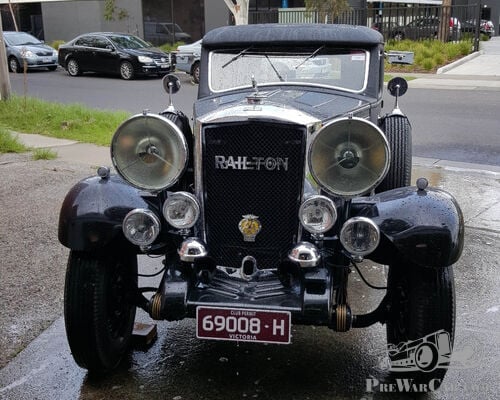
Railton straight 8 sports coupe for rallying REDUCED PRICE run with the bentleys at a fraction of the price
1934 Railton Sports CoupeBuilt for long distance rallyingRebuilt 2017built up at a cost of $160,000AUD, OFFERED FOR SALE AT A ..
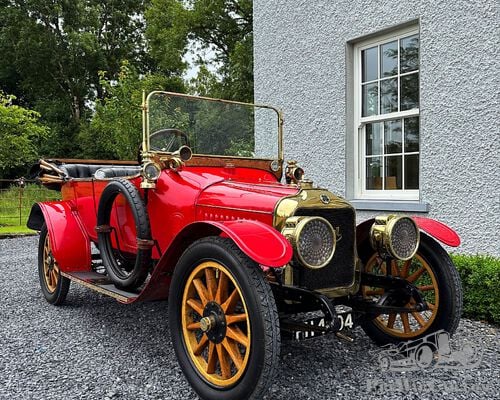
1914 Brasier
1914 Brasier Tourer 9ABrasier were a French manufacturer who were in business from 1901 until 1930, when the company became victim of the gr..
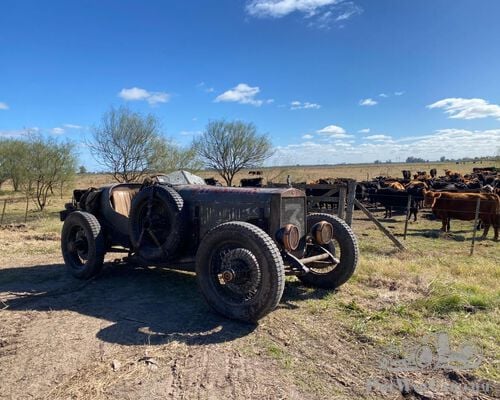
Studebaker 1927 for sale
Authentic race car of the time - Everything is working - All parts of its original mechanics - I have the history of the car - 6 cylinders - Ready ..