The global magazine and marketplace for classic car enthusiasts, by enthusiasts.


Filter
Classic Buick, Chalmers for sale - Buick, Chalmers cars for sale
-

Buick Racer 1931
This exceptional Buick Racer powered by a powerful 8 cylinder is definitely a head turning example when seeing and hearing the car! Being in top condition, this is the car you want to experience the thrill of 1930's racing! Exterior:The exterior of this 1931 Buick Racer is a stunning tribute to early motorsp.. -
Buick Chassis 1937 Engine is Sold
For Sale a very solid Buick chassis with a Straight Eight engine Frame number chassis : 3039138No documents -
2X BUICKS !! 1941 Buick Roadmaster 76s Coupe + 1948 Buick Roadmaster 2 doors serie 79, convertible
Car no 1.1941 Buick Roadmaster 76s Coupe ***one price two cars, both cars in Excellent conditions***Engine : 320 cu in (5.2 L) Fireball I8, 168hpTransmission : 3-speed sliding shift manualWheelbase : 126.0 in (3,200 mm)Length 1941 : 215.0 in (5,461 mm)Sold : 3.991 unitsThe Roadmaster Series 76s, f.. -
1917 Buick for sale
4 cylinder over head valve engine 35hp.3 speed conventional gear box.Electric start,electric lights and indicators fitted.Side screens and full length hood for weather protection.Older restoration,new radiator core fitted recently.An excellent reliable car with Veteran Car Club Certificate -
1940 Buick Super Convertible Coupe | RM Sotheby's | The Hershey Auction
To Be OFFERED AT AUCTION WITHOUT RESERVE at RM Sothebys' The Hershey Auction event, 7 - 8 October 2026. Offered Without Reserve | $50,000 - $60,000 USD Please check back soon as our dedicated cataloguing team is preparing the description for this lot. To view this car and others currently consigned to this auction, please visit the RM website a.. -
Buick 1911 Touring model 33
Older restored . Good condition. Can be used from day one .Newly restored engine : Sleves , new piston and rings. New valves and seats.Berings in good consition. Starts and runs good . Powerfull.No top ! Was extra at time when new. -
Buick 8/60 – Convertible with a Gläser body
For sale: a very rare Buick 8/60 with Gläser coachwork, built in 1931 in Berlin-Borsigwalde. The vehicle is in a highly original condition and has never been fully restored. Only the convertible top, the seats, and the paint on the rear fenders have been renewed. The car’s history is fully known and documented with many original documents. The B.. -
1910 Buick Model 10
Beautiful 1910 Buick Model 10 RunaboutThis was the first mass-produced Buick. It was marketed as a "light 4-cylinder roadster for gentlemen" and quickly became one of Buick’s bestsellers.Its respectable performance of 22.5 hp from the 4-cylinder “valve-in-head” engine with a 2.7-liter displacement earned it the nickname "The White .. -
1929 Buick 116 Baquet
1929 Buick 116 Baquet "Exquisite and FAST" In 1929, Buick offered this new series, the 116, They were named after their wheelbase measurements. The 1929 Buicks were slight raked, all models had fuel pumps, Marvel carburetors, and Delco-Remy ignition. The Series 116 was also available has a Sport Coupe Roadster. The engine was an overhead valve s.. -
1939 Buick Series 46c Straight Eight Convertible LHD
1939 Buick Series 46c Straight Eight Convertible. Vin Number: 13548839 Registration Number: OSU465 Under previous ownership for some 22 years from when it was imported to the UK. A massive nut & bolt restoration was immediately undertaken for which detailed bills & corre..


Buick
US, 1903 to date
(1) Buick Motor Car Co, Detroit, Mich., 1903
(2) Buick Motor Car Co, Flint, Mich., 1904 to date
David Buick’s first car followed conventional American design in having a flat-twin engine mounted amidships under the floor, a two-speed planetary transmission, and final drive by chain – but unusual were its mechanically-operated full overhead valves, a feature of all cars bearing the name of Buick to the present day, apart from Buick fours of the 1906 – 1909 period, which had side-valves in T-heads. Capacity was 2.6-litres, and it sold for $1.250. Developments of this original Buick model were selling in England for £294 in 1907, but there was already a companion 4.2-litre four with front-mounted engine, and 1908 saw a ‘square’ Buick four (95.2x95.2mm) with planetary transmission added to the range. In 1908 W.C. Durant formed General Motors, Buick being one of the original members of the group. In 1909 Bob Burman drove a Buick to victory in the first race ever held at Indianapolis Speedway. Sales had exceeded 30.000 Buick cars by 1910. For the next few years Buicks with English bodywork were sold in Britain first as ‘all British Bedfords’, and then as ‘Bedford-Buicks’. By 1912 planetary transmission had been dropped and 4-cylinder Buick cars were available in 2.7-litre, 3.3-litre and 5.2-litre sizes, still with rhd, but with the brake and gear levers faired into the driver’s door. Delco electric lighting and starting were standard on all Buick models by 1914, in which year Buick marketed their first six, the Buick B-55. Nearly 126.000 Buick cars were sold in 1916, and the company entered the post-World War 1 era with a 2.8-litre four and a 3.9-litre six, cars which brought Buick into fourth position in US sales, behind Ford, Dodge, and Chevrolet, all far cheaper vehicles; a Buick Six tourer cost $1795 in 1921.
Drastic change came in 1924. The Buick cars acquired front wheel brakes as standard equipment, while cylinder heads were now detachable, and the rounded radiator shell gave way to an angular, Packard-like outline that was to continue until 1928. Prices of Buick fours started at $935, and the cheapest Buick six was listed at $1565. The 6-cylinder cars became the staple in 1925 and the ‘back-to-front’ gear shift pattern shared with Dodge was discarded in 1927. The Buick cars were completely re-styled in 1929, when hydraulic shock absorbers were added, and the capacities of the two basic Buick models were increased to 3.8-litres and 5.1-litres respectively. Prices ran from $1.195 to $2.145, but for Buick customers with slenderer pockets there was the Buick Marquette. Buick went over to an all-straight-8 programme, still with overhead valves, in 1931. Expanding brakes were now standard at front and rear. Synchromesh was standardized on the more expensive Buick models and available as an extra on all, and was standardized throughout the range in 1932.
Buick’s evolution up to World War 2 followed General motors policy; cruciform-braced frame and no-draught ventilation in 1933, Dubonnet-type ifs in 1934, and turret-top styling, down-draught carburation and hydraulic brakes in 1936 with the Buick DA-series – one example of which became famous when it took Mrs Ernest Simpson into exile at the time of the British Abdication crisis. Despite Buick’s upper middle-class position in the GM sales picture, the 1937 range of 4.1-litre and 5.2-litre eights covered everything from a sedan on a 10ft 2in wheelbase at $855 up to a seven-seater Buick C090 limousine at $2095; prices in Britain, where the Buick cars were consistently well received between the Wars, were £500 and £865 respectively. 1938 Buicks had coil springing all round, and that year the Division produced GM’s first ‘dream car’, a two-seater convertible coupé styled by Harley Earl on a Roadmaster chassis. Buicks used the same engines up to 1952, though they came out with a 2-speed Dynaflow automatic transmission in 1948. In 1948 they pioneered the now popular hardtop convertible body with their Buick Riveira. The smaller engines were, however, enlarged to 4.3-litres in 1952, and the following year the Division’s first ohv V8 unit appeared; its capacity was 5.3-litres, and its output 188bhp. All 1954 Buicks used this type of engine.
Buick sales dropped in 1958, but the 1959 cars were style leaders with the delta tail and fins. Buick’s first effort at a compact car in 1961 was the Buick Special with an all-aluminium 155bhp, 3½-litres V8 engine, replaced the following year by a cast-iron V6, used also by Oldsmobile. The demand for cars with a sporting flavor resulted in the handsome Buick Riviera sports coupé of 1963, which by 1966 was giving 340bhp from 7 litres, and was capable of 120mph. Automatic transmission was, of course, standard. The 1966 Buick range had a more sporting atmosphere than in the past, and embraced the Buick Special with a 9ft 7in wheelbase and a choice of V6 or 4.9-litre V8 engines; the Buick Skylark with the same chassis dimensions and a 6.6-litre V8 engine; and the bigger Buicks in the shape of the 5½-litre Buick Le Sabre, the 6.6-litre Buick Wildcat, the Buick Electra, and the top-line Buick Riviera. These models continued without basic change until 1971, though concealed screenwipers (found on other GM cars of that year) and the option of front disc brakes came in 1967, and cylinder capacities were increased: the biggest V8 ran to 7046cc in that year, to 7456cc in 1970. The small 3½-litre V8 abandoned by Buick in 1963 was taken up by Rover of England in 1968 and was subsequently supplied by them to Morgan. The 1971 Buick station wagons featured glide-away tailgates. By 1972 all but the economy Buick Skylarks had front disc brakes as regular equipment. Engine outputs were reduced (from 370bhp to 250bhp in the case of the most potent V8), and the Buick Riviera was restyled in the Chevrolet Corvette hardtop idiom. Only V8s, of 5736cc and 7456cc, were offered in 1973; the Buick Skylark gave way to a new car with an old Buick name, the Century, that reverted to the single-headlamp layout.
Source: Georgano, encyclopedia of motorcar; MCS
The information is written with the greatest of care. However, if you have any suggested amendments please contact us at office@prewarcar.com
Chalmers / Chalmers-Detroit
US, 1908 – 1924
Chalmers Motor Car Co, Detroit, Mich.
The Chalmers was one of the most popular automobiles made in the United States for more than a decade. The Chalmers was the successor to the Thomas-Detroit which was built by a company which had been founded in 1906 by E.R. Thomas (builder of the Thomas car in Buffalo, N.Y.), Roy D. Chapin and Howard Earle Coffin; the two latter had previously served at Oldsmobile. The Thomas-Detroit of which some 500 were sold during the first year of production, was marketed through the parent firm in Buffalo which manufactured a larger line of cars under the Thomas emblem. The Thomas-Detroit was a medium priced four-cylinder car which had been designed by Coffin. In 1907, Hugh Chalmers, vice president of the National Cash Register Co and a noted salesman, entered the firm. Shortly after, he bought a half of E.R. Thomas’ stock and became president of the company which became the Chalmers-Detroit Motor Company. The Thomas-Detroit became the Chalmers-Detroit in 1908 and in 1910, the Chalmers. Open and closed Chalmers models in two lines comprised the Chalmers four-cylinder cars, with self-starters appearing in 1912. Chalmers (as Chalmers-Detroit) had distinguished itself in road races as early as 1908 when W.R. Burns won the Motor Parkway Sweekstakes at Jericho, N.Y., averaging 48.7mph in the six-lap 140.76 mile run.
In 1913, the Chalmers brought out its first 6-cylinder model, as well as the four and apart from small mechanical and design changes, continued both until 1914. The Chalmers four was dropped from the 1915 line, however, and sixes were to be used exclusively in Chalmers until the ending of manufacture. By 1915, some 20.000 Chalmers cars per year were coming off the Chalmers production line and would even exceed that figure before the advent of World War 1. In 1917, an L-head motor replaced the earlier overhead-valve type and on August 4th, Chalmers again headed racing news when Joe Dawson won the 24-hour stock Car Endurance Run at Sheepshead Bay, N.Y. Sales flagged following the end of the war and Hugh Chalmers, always the salesman, and with the realization that a competitor, Maxwell, wasn’t faring well either, arranged to lease his Chalmers plants to Maxwell, using his salesmanship to promote the two concerns and getting the benefit of Maxwell tooling and manufacturing equipment. By the early 1920s, however, many makes of cars were in financial difficulties due to over-expansion and recession, and Walter P. Chrysler was called in to try and reorganize Maxwell. Chrysler was at this time planning his own corporation and in 1922 Chalmers was taken over by Maxwell which had become a Chrysler subsidiary. The last Chalmer cars for sale were equipped with Lockheed hydraulic brakes but 1923 was the last year of Chalmers production with some 9000 units leaving the factories. The Maxwell survived until 1925 when it became the Chrysler Four.
Source: Georgano, encyclopedia of motorcar; KM
The information is written with the greatest of care. However, if you have any suggested amendments please contact us at office@prewarcar.com


Featured
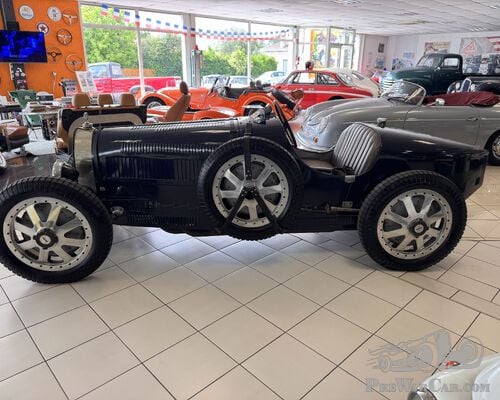
Bugatti 35 B Pur Sang
Bugatti 35 B Pur Sang,importée par un membre délégué de la FFVE il y’a une quinzaine d années.Participation à de nombreux Rallyes Bug..

HORCH 930 V
For SaleHorch 930 VManufacturer: HorchModel and Variant: 930 VBody Type: 4-door sedanChassis Number: ..
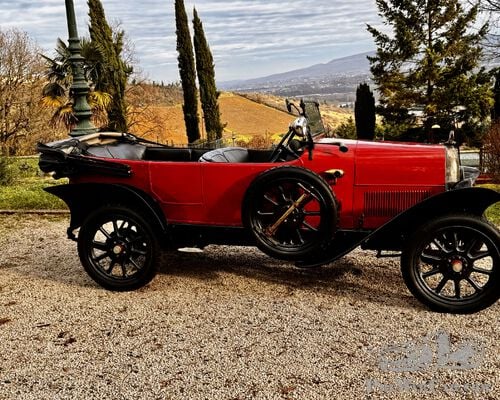
Torpedo sport de 1923 complete et fonctionnelle, conforme a sa sortie d'usine ,d'une authenticité totale, agréer à participer aux MILLE MIGLIA
Voiture référencée pour son authenticité au BOOK FIAT historique de ThurinBelle présentatio, peinture ancienne d'environ 20 ans ,Mot..