The global magazine and marketplace for classic car enthusiasts, by enthusiasts.


Filter
Classic Buick, Plymouth for sale - Buick, Plymouth cars for sale
-

1910 Buick Model 10
Beautiful 1910 Buick Model 10 RunaboutThis was the first mass-produced Buick. It was marketed as a "light 4-cylinder roadster for gentlemen" and quickly became one of Buick’s bestsellers.Its respectable performance of 22.5 hp from the 4-cylinder “valve-in-head” engine with a 2.7-liter displacement earned it the nickname "The White .. -
Buick sportscar
for sale.1928 Buick 6 cilinder This fully restored Buick with a special body was intended to drive the Route 66 in the US. due to circumstaces ,that could not go ahead.so it is now for sale for the true enthausiast to enjoy beautiful road trips. ask for more photo,s and info if you are seriousely interested -
1929 Buick 116 Baquet
1929 Buick 116 Baquet "Exquisite and FAST" In 1929, Buick offered this new series, the 116, They were named after their wheelbase measurements. The 1929 Buicks were slight raked, all models had fuel pumps, Marvel carburetors, and Delco-Remy ignition. The Series 116 was also available has a Sport Coupe Roadster. The engine was an overhead valve s.. -
Buick 8/60 – Convertible with a Gläser body
For sale: a very rare Buick 8/60 with Gläser coachwork, built in 1931 in Berlin-Borsigwalde. The vehicle is in a highly original condition and has never been fully restored. Only the convertible top, the seats, and the paint on the rear fenders have been renewed. The car’s history is fully known and documented with many original documents. The B.. -
1940 Plymouth P10 Deluxe Convertible Coupe | RM Sotheby's | The Hershey Auction
Sold | $43,680 USD One of 6,986 Deluxe Convertible Coupes produced for 1940Benefits from an excellent rotisserie restoration under previous ownershipL-head inline six-cylinder engine; three-speed manual with overdriveWonderfully presented in Boatswain Blue over red leather Richly appointed with a remark.. -
1939 Buick Series 46c Straight Eight Convertible LHD
1939 Buick Series 46c Straight Eight Convertible. Vin Number: 13548839 Registration Number: OSU465 Under previous ownership for some 22 years from when it was imported to the UK. A massive nut & bolt restoration was immediately undertaken for which detailed bills & corre.. -
Buick Racer 1931
This exceptional Buick Racer powered by a powerful 8 cylinder is definitely a head turning example when seeing and hearing the car! Being in top condition, this is the car you want to experience the thrill of 1930's racing! Exterior:The exterior of this 1931 Buick Racer is a stunning tribute to early motorsp.. -
Buick Chassis 1937 Engine is Sold
For Sale a very solid Buick chassis with a Straight Eight engine Frame number chassis : 3039138No documents -
1940 Buick Super Convertible Coupe | RM Sotheby's | The Hershey Auction
Sold | $44,800 USD Formerly owned by well-known enthusiast Alan EgelseerFinished in the classic Sequoia Cream over red leather interiorWell-optioned and accessorized; attractive older restorationA splendid example of the beautiful 1940 Buick Buick’s 1940 line was attractive, indeed, with more streaml.. -
2X BUICKS !! 1941 Buick Roadmaster 76s Coupe + 1948 Buick Roadmaster 2 doors serie 79, convertible
Car no 1.1941 Buick Roadmaster 76s Coupe ***one price two cars, both cars in Excellent conditions***Engine : 320 cu in (5.2 L) Fireball I8, 168hpTransmission : 3-speed sliding shift manualWheelbase : 126.0 in (3,200 mm)Length 1941 : 215.0 in (5,461 mm)Sold : 3.991 unitsThe Roadmaster Series 76s, f..


Buick
US, 1903 to date
(1) Buick Motor Car Co, Detroit, Mich., 1903
(2) Buick Motor Car Co, Flint, Mich., 1904 to date
David Buick’s first car followed conventional American design in having a flat-twin engine mounted amidships under the floor, a two-speed planetary transmission, and final drive by chain – but unusual were its mechanically-operated full overhead valves, a feature of all cars bearing the name of Buick to the present day, apart from Buick fours of the 1906 – 1909 period, which had side-valves in T-heads. Capacity was 2.6-litres, and it sold for $1.250. Developments of this original Buick model were selling in England for £294 in 1907, but there was already a companion 4.2-litre four with front-mounted engine, and 1908 saw a ‘square’ Buick four (95.2x95.2mm) with planetary transmission added to the range. In 1908 W.C. Durant formed General Motors, Buick being one of the original members of the group. In 1909 Bob Burman drove a Buick to victory in the first race ever held at Indianapolis Speedway. Sales had exceeded 30.000 Buick cars by 1910. For the next few years Buicks with English bodywork were sold in Britain first as ‘all British Bedfords’, and then as ‘Bedford-Buicks’. By 1912 planetary transmission had been dropped and 4-cylinder Buick cars were available in 2.7-litre, 3.3-litre and 5.2-litre sizes, still with rhd, but with the brake and gear levers faired into the driver’s door. Delco electric lighting and starting were standard on all Buick models by 1914, in which year Buick marketed their first six, the Buick B-55. Nearly 126.000 Buick cars were sold in 1916, and the company entered the post-World War 1 era with a 2.8-litre four and a 3.9-litre six, cars which brought Buick into fourth position in US sales, behind Ford, Dodge, and Chevrolet, all far cheaper vehicles; a Buick Six tourer cost $1795 in 1921.
Drastic change came in 1924. The Buick cars acquired front wheel brakes as standard equipment, while cylinder heads were now detachable, and the rounded radiator shell gave way to an angular, Packard-like outline that was to continue until 1928. Prices of Buick fours started at $935, and the cheapest Buick six was listed at $1565. The 6-cylinder cars became the staple in 1925 and the ‘back-to-front’ gear shift pattern shared with Dodge was discarded in 1927. The Buick cars were completely re-styled in 1929, when hydraulic shock absorbers were added, and the capacities of the two basic Buick models were increased to 3.8-litres and 5.1-litres respectively. Prices ran from $1.195 to $2.145, but for Buick customers with slenderer pockets there was the Buick Marquette. Buick went over to an all-straight-8 programme, still with overhead valves, in 1931. Expanding brakes were now standard at front and rear. Synchromesh was standardized on the more expensive Buick models and available as an extra on all, and was standardized throughout the range in 1932.
Buick’s evolution up to World War 2 followed General motors policy; cruciform-braced frame and no-draught ventilation in 1933, Dubonnet-type ifs in 1934, and turret-top styling, down-draught carburation and hydraulic brakes in 1936 with the Buick DA-series – one example of which became famous when it took Mrs Ernest Simpson into exile at the time of the British Abdication crisis. Despite Buick’s upper middle-class position in the GM sales picture, the 1937 range of 4.1-litre and 5.2-litre eights covered everything from a sedan on a 10ft 2in wheelbase at $855 up to a seven-seater Buick C090 limousine at $2095; prices in Britain, where the Buick cars were consistently well received between the Wars, were £500 and £865 respectively. 1938 Buicks had coil springing all round, and that year the Division produced GM’s first ‘dream car’, a two-seater convertible coupé styled by Harley Earl on a Roadmaster chassis. Buicks used the same engines up to 1952, though they came out with a 2-speed Dynaflow automatic transmission in 1948. In 1948 they pioneered the now popular hardtop convertible body with their Buick Riveira. The smaller engines were, however, enlarged to 4.3-litres in 1952, and the following year the Division’s first ohv V8 unit appeared; its capacity was 5.3-litres, and its output 188bhp. All 1954 Buicks used this type of engine.
Buick sales dropped in 1958, but the 1959 cars were style leaders with the delta tail and fins. Buick’s first effort at a compact car in 1961 was the Buick Special with an all-aluminium 155bhp, 3½-litres V8 engine, replaced the following year by a cast-iron V6, used also by Oldsmobile. The demand for cars with a sporting flavor resulted in the handsome Buick Riviera sports coupé of 1963, which by 1966 was giving 340bhp from 7 litres, and was capable of 120mph. Automatic transmission was, of course, standard. The 1966 Buick range had a more sporting atmosphere than in the past, and embraced the Buick Special with a 9ft 7in wheelbase and a choice of V6 or 4.9-litre V8 engines; the Buick Skylark with the same chassis dimensions and a 6.6-litre V8 engine; and the bigger Buicks in the shape of the 5½-litre Buick Le Sabre, the 6.6-litre Buick Wildcat, the Buick Electra, and the top-line Buick Riviera. These models continued without basic change until 1971, though concealed screenwipers (found on other GM cars of that year) and the option of front disc brakes came in 1967, and cylinder capacities were increased: the biggest V8 ran to 7046cc in that year, to 7456cc in 1970. The small 3½-litre V8 abandoned by Buick in 1963 was taken up by Rover of England in 1968 and was subsequently supplied by them to Morgan. The 1971 Buick station wagons featured glide-away tailgates. By 1972 all but the economy Buick Skylarks had front disc brakes as regular equipment. Engine outputs were reduced (from 370bhp to 250bhp in the case of the most potent V8), and the Buick Riviera was restyled in the Chevrolet Corvette hardtop idiom. Only V8s, of 5736cc and 7456cc, were offered in 1973; the Buick Skylark gave way to a new car with an old Buick name, the Century, that reverted to the single-headlamp layout.
Source: Georgano, encyclopedia of motorcar; MCS
The information is written with the greatest of care. However, if you have any suggested amendments please contact us at office@prewarcar.com
Plymouth
US, 1928 to date
Chrysler Corporation, Detroit, Mich.
The 4-cylinder 21hp Plymouth car appeared in 1928 at a list price of $725 for a sedan. This Plymouth car replaced the earlier 4-cylinder Chryslers and represented a serious challenge for Ford and Chevrolet in their lowest price class. The Plymouth car had side valves, internal-expanding hydraulic brakes and ribbon-type radiator and gave the Plymouth car a close resemblance to the 1928 Chryslers and De Sotos, and Plymouth cars sold over 100.000 in its first year, even improving its sales position in the bleak economic climate of 1932. Plymouth cars adhered to four cylinders until 1933, when the Plymouth PD-series 6-cylinder was listed at less than $600. 1934 de luxe models of Plymouth cars had independent front suspension, but this was dropped after a year and did not reappear for some time on Plymouth cars. The standard engine in the later 1930 Plymouth cars had a capacity of 3.3-litres, rather smaller than that used in comparable Chevrolets and Fords: a small-bore 2.8-litre version Plymouth car was made for export up to 1939, but the name Plymouth was not usually found on Plymouth cars sold in England, which were nominally Chrysler Kew and Wimbledon sixes. After World War 2 evolution followed that of other Chrysler Corporation cars closely, the old-fashioned styling losing the Plymouth car division its long-held third place in American sales to Buick. Further, Plymouth cars retained the L-head six as its staple power unit right up to 1955, when Flight Sweep versions were introduced with over-square ohv V8 engines on accepted American lines in a variety of powers from 157 to 177bhp. The capacity of these Plymouth cars had 4.3-litres, while the six, now of 3.8-litres, remained available. These 1955 Plymouth cars were lower and longer than their predecessors and could be obtained with synchromesh, overdrive or automatic gearboxes.
The Plymouth Fury models of the ensuing decade represented a breakaway from the traditional Plymouth stolid family car, while the Plymouth Car Division was also responsible for Chrysler’s contribution to the compacts, the Plymouth Valiant launched for 1960. This Plymouth car had rather more European styling than its competitors, with a dummy spare-wheel moulding on the tail; interesting items of specification were the unitary construction of the Plymouth car, alternator ignition, and inclined in-line 2.8-litre ohv 6-cylinder engine. The influence of the Plymouth GT car on America resulted in the Plymouth Barracuda of 1965, a fastback coupé using the Valiant’s 8ft 10in wheelbase and a 4½-litre V8 power unit. Plymouth cars, like Ford and Chevrolet, was aiming at comprehensive coverage of the low and medium price market in 1966, with the compact Plymouth Valiant, the sports-compact Plymouth Barracuda, the medium-sized Plymouth Belvedere, the full-size Plymouth Fury, and the luxurious ‘VIP’ 4-door hardtop Plymouth car, offered only with a 5.2-litre V8 engine and selling for $2.930. An increasing emphasis on sporting Plymouth cars was detectable by 1968, when in addition to the established Barracuda there were two other sports coupés Plymouth car, the Plymouth GTX and the Plymouth Road Runner. All three Plymouth cars were available with 4-speed manual gearboxes and the 6.981cc 425bhp hemi-head V8 also used by Dodge. In 1970, when Valiant prices started at a low $2.172, there was also a Valiant sports coupé, the Plymouth Duster.
In 1971 Plymouth car company added a sub-compact to their Plymouth car range when they offered the 1½-litre Hillman Avenger as the Plymouth Cricket. The 1972 range of Plymouth cars embraced the Valiant on a 9ft wheelbase, the Barracudas and Satellites, and the full-size Furys with V8 engines and automatic transmission as standard. Engines in the Plymouth cars ranged from the Valiant’s 3.2-litre and 3.7-litre sixes up to the largest Chrysler unit, a V8 of 7.210cc. Electronic ignition was offered on the costliest Barracuda model. Casualties of new Federal regulations were the hemi-head engine and convertibles, and the same range Plymouth cars with minor improvements, among them manually-operated sun roofs, was offerd in 1973.
Source: Georgano, encyclopedia of motorcar; MCS
The information is written with the greatest of care. However, if you have any suggested amendments please contact us at office@prewarcar.com



Featured
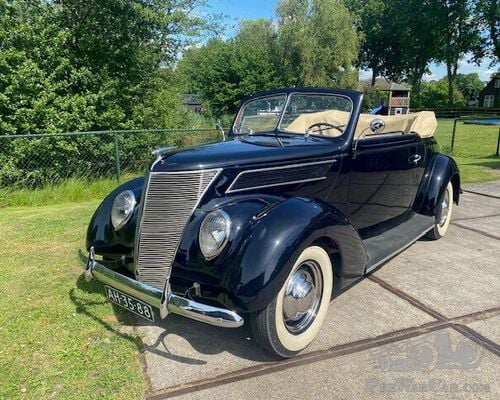
Ford v8 Club cabriolet 1937
Very nice Ford v8 Club cabriolet. In excellent condition. Runs and drives very well.Top condition.Shipping possible.
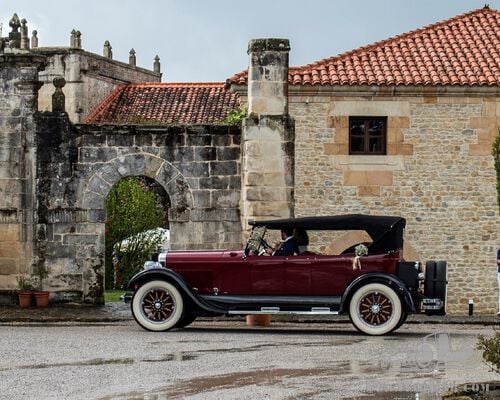
1925 Lincoln Model L Phaeton by Brunn - Excellent provenance
Retaining its original matching-numbers engine and chassis (both numbered 24576), the car benefits from an extensively documented history and..
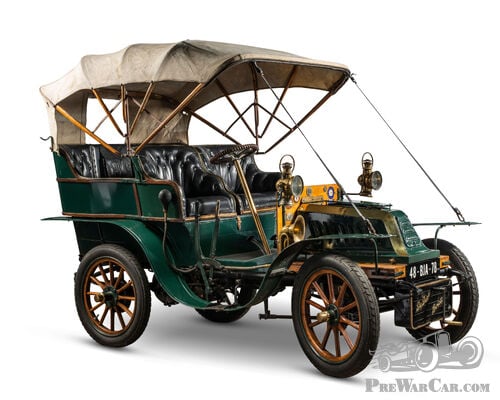
De Dion Bouton Type z in good running condition
De Dion Bouton Type Z from 1905. The car is in good condition, works and runs well. Serie number 36. Engine number 18190. French Carte grise.