The global magazine and marketplace for classic car enthusiasts, by enthusiasts.


Filter
Classic Buick, Vulcan for sale - Buick, Vulcan cars for sale
-

1940 Buick Super Convertible Coupe | RM Sotheby's | The Hershey Auction
To Be OFFERED AT AUCTION WITHOUT RESERVE at RM Sothebys' The Hershey Auction event, 7 - 8 October 2026. Offered Without Reserve | $50,000 - $60,000 USD Please check back soon as our dedicated cataloguing team is preparing the description for this lot. To view this car and others currently consigned to this auction, please visit the RM website a.. -
Buick 1911 Touring model 33
Older restored . Good condition. Can be used from day one .Newly restored engine : Sleves , new piston and rings. New valves and seats.Berings in good consition. Starts and runs good . Powerfull.No top ! Was extra at time when new. -
Buick 8/60 – Convertible with a Gläser body
For sale: a very rare Buick 8/60 with Gläser coachwork, built in 1931 in Berlin-Borsigwalde. The vehicle is in a highly original condition and has never been fully restored. Only the convertible top, the seats, and the paint on the rear fenders have been renewed. The car’s history is fully known and documented with many original documents. The B.. -
1910 Buick Model 10
Beautiful 1910 Buick Model 10 RunaboutThis was the first mass-produced Buick. It was marketed as a "light 4-cylinder roadster for gentlemen" and quickly became one of Buick’s bestsellers.Its respectable performance of 22.5 hp from the 4-cylinder “valve-in-head” engine with a 2.7-liter displacement earned it the nickname "The White .. -
1926 Buick Master Six Saloon | Brightwells | Auction Ends: Wed 24th Jun
Exceptionally rare right hand drive Buick Master Six sedan; originally delivered new to Argentina; appears to have been subject to a full restoration; desirable 4,500cc engine; fresh from dry storage; simply beautiful conditionThe imposing Buick Master Six formed part of Buick’s highly successful six-cylinder range during the mid-1.. -
1929 Buick 116 Baquet
1929 Buick 116 Baquet "Exquisite and FAST" In 1929, Buick offered this new series, the 116, They were named after their wheelbase measurements. The 1929 Buicks were slight raked, all models had fuel pumps, Marvel carburetors, and Delco-Remy ignition. The Series 116 was also available has a Sport Coupe Roadster. The engine was an overhead valve s.. -
BUICK speedster
te koop .Buick speedster 6 cilinder bouwjaar 1928 totaal gerestaureerd en met een nieuwe 2 zits cabrio boddy in goed rijdende staat. met nederlands kentekenmet veel reserve parts . Ask for more pict. -
1939 Buick Series 46c Straight Eight Convertible LHD
1939 Buick Series 46c Straight Eight Convertible. Vin Number: 13548839 Registration Number: OSU465 Under previous ownership for some 22 years from when it was imported to the UK. A massive nut & bolt restoration was immediately undertaken for which detailed bills & corre.. -
Buick Racer 1931
This exceptional Buick Racer powered by a powerful 8 cylinder is definitely a head turning example when seeing and hearing the car! Being in top condition, this is the car you want to experience the thrill of 1930's racing! Exterior:The exterior of this 1931 Buick Racer is a stunning tribute to early motorsp.. -
Buick Chassis 1937 Engine is Sold
For Sale a very solid Buick chassis with a Straight Eight engine Frame number chassis : 3039138No documents


Buick
US, 1903 to date
(1) Buick Motor Car Co, Detroit, Mich., 1903
(2) Buick Motor Car Co, Flint, Mich., 1904 to date
David Buick’s first car followed conventional American design in having a flat-twin engine mounted amidships under the floor, a two-speed planetary transmission, and final drive by chain – but unusual were its mechanically-operated full overhead valves, a feature of all cars bearing the name of Buick to the present day, apart from Buick fours of the 1906 – 1909 period, which had side-valves in T-heads. Capacity was 2.6-litres, and it sold for $1.250. Developments of this original Buick model were selling in England for £294 in 1907, but there was already a companion 4.2-litre four with front-mounted engine, and 1908 saw a ‘square’ Buick four (95.2x95.2mm) with planetary transmission added to the range. In 1908 W.C. Durant formed General Motors, Buick being one of the original members of the group. In 1909 Bob Burman drove a Buick to victory in the first race ever held at Indianapolis Speedway. Sales had exceeded 30.000 Buick cars by 1910. For the next few years Buicks with English bodywork were sold in Britain first as ‘all British Bedfords’, and then as ‘Bedford-Buicks’. By 1912 planetary transmission had been dropped and 4-cylinder Buick cars were available in 2.7-litre, 3.3-litre and 5.2-litre sizes, still with rhd, but with the brake and gear levers faired into the driver’s door. Delco electric lighting and starting were standard on all Buick models by 1914, in which year Buick marketed their first six, the Buick B-55. Nearly 126.000 Buick cars were sold in 1916, and the company entered the post-World War 1 era with a 2.8-litre four and a 3.9-litre six, cars which brought Buick into fourth position in US sales, behind Ford, Dodge, and Chevrolet, all far cheaper vehicles; a Buick Six tourer cost $1795 in 1921.
Drastic change came in 1924. The Buick cars acquired front wheel brakes as standard equipment, while cylinder heads were now detachable, and the rounded radiator shell gave way to an angular, Packard-like outline that was to continue until 1928. Prices of Buick fours started at $935, and the cheapest Buick six was listed at $1565. The 6-cylinder cars became the staple in 1925 and the ‘back-to-front’ gear shift pattern shared with Dodge was discarded in 1927. The Buick cars were completely re-styled in 1929, when hydraulic shock absorbers were added, and the capacities of the two basic Buick models were increased to 3.8-litres and 5.1-litres respectively. Prices ran from $1.195 to $2.145, but for Buick customers with slenderer pockets there was the Buick Marquette. Buick went over to an all-straight-8 programme, still with overhead valves, in 1931. Expanding brakes were now standard at front and rear. Synchromesh was standardized on the more expensive Buick models and available as an extra on all, and was standardized throughout the range in 1932.
Buick’s evolution up to World War 2 followed General motors policy; cruciform-braced frame and no-draught ventilation in 1933, Dubonnet-type ifs in 1934, and turret-top styling, down-draught carburation and hydraulic brakes in 1936 with the Buick DA-series – one example of which became famous when it took Mrs Ernest Simpson into exile at the time of the British Abdication crisis. Despite Buick’s upper middle-class position in the GM sales picture, the 1937 range of 4.1-litre and 5.2-litre eights covered everything from a sedan on a 10ft 2in wheelbase at $855 up to a seven-seater Buick C090 limousine at $2095; prices in Britain, where the Buick cars were consistently well received between the Wars, were £500 and £865 respectively. 1938 Buicks had coil springing all round, and that year the Division produced GM’s first ‘dream car’, a two-seater convertible coupé styled by Harley Earl on a Roadmaster chassis. Buicks used the same engines up to 1952, though they came out with a 2-speed Dynaflow automatic transmission in 1948. In 1948 they pioneered the now popular hardtop convertible body with their Buick Riveira. The smaller engines were, however, enlarged to 4.3-litres in 1952, and the following year the Division’s first ohv V8 unit appeared; its capacity was 5.3-litres, and its output 188bhp. All 1954 Buicks used this type of engine.
Buick sales dropped in 1958, but the 1959 cars were style leaders with the delta tail and fins. Buick’s first effort at a compact car in 1961 was the Buick Special with an all-aluminium 155bhp, 3½-litres V8 engine, replaced the following year by a cast-iron V6, used also by Oldsmobile. The demand for cars with a sporting flavor resulted in the handsome Buick Riviera sports coupé of 1963, which by 1966 was giving 340bhp from 7 litres, and was capable of 120mph. Automatic transmission was, of course, standard. The 1966 Buick range had a more sporting atmosphere than in the past, and embraced the Buick Special with a 9ft 7in wheelbase and a choice of V6 or 4.9-litre V8 engines; the Buick Skylark with the same chassis dimensions and a 6.6-litre V8 engine; and the bigger Buicks in the shape of the 5½-litre Buick Le Sabre, the 6.6-litre Buick Wildcat, the Buick Electra, and the top-line Buick Riviera. These models continued without basic change until 1971, though concealed screenwipers (found on other GM cars of that year) and the option of front disc brakes came in 1967, and cylinder capacities were increased: the biggest V8 ran to 7046cc in that year, to 7456cc in 1970. The small 3½-litre V8 abandoned by Buick in 1963 was taken up by Rover of England in 1968 and was subsequently supplied by them to Morgan. The 1971 Buick station wagons featured glide-away tailgates. By 1972 all but the economy Buick Skylarks had front disc brakes as regular equipment. Engine outputs were reduced (from 370bhp to 250bhp in the case of the most potent V8), and the Buick Riviera was restyled in the Chevrolet Corvette hardtop idiom. Only V8s, of 5736cc and 7456cc, were offered in 1973; the Buick Skylark gave way to a new car with an old Buick name, the Century, that reverted to the single-headlamp layout.
Source: Georgano, encyclopedia of motorcar; MCS
The information is written with the greatest of care. However, if you have any suggested amendments please contact us at office@prewarcar.com
Vulcan
GB, 1902 – 1928
(1) Vulcan Motor Manufacturing and Engineering Co Ltd, Southport, Lancs., 1902 – 1906
(2) Vulcan Motor and Engineering Co Ltd, Southport, Lancs., 1906 – 1928
The Vulcan car firm was better known for commercial vehicles. Private Vulcan cars stemmed from experiments conducted in the 1897-1899 period by the brothers Thomas and Joseph Hampson. A belt-driven single-cylinder voiturette Vulcan car with lateral radiators was shown in 1902, being replaced a year later by a 6hp Vulcan car with armoured wood frame, mechanically-operated inlet valves, and shaft drive. This Vulcan car was listed at only £105, and this Vulcan car was soon followed by a 10hp twin, also T-headed but with a steel frame, selling for £200. 4-cylinder Vulcan cars of 12 and 16hp, still modestly priced, were available in 1905, while the biggest 1906 Vulcan cars, with capacities of 3.1- and 5.2-litres, had gate change. No 2-cylinder Vulcan cars were catalogued after 1908, but a year previously Vulcan cars had joined the ranks of 6-cylinder manufacturers with a 4.8-litre T-headed machine featuring dual ignition and cone clutch, at £600 for a Vulcan car chassis. Unlike other makers, Vulcan cars retained their interest in this type, which Vulcan car had acquired a 4-speed box and had grown to 6-litres by 1908, and the 1909 Vulcan car range consisted of four 4-cylinder cars and the six, all shaft-driven and still with T-heads; the smallest Vulcan car, rated at 12hp, had a 3-speed gearbox and worm drive. A new 3.6-litre six Vulcan car with unit gearbox and worm drive followed in 1911, along with an L-head 2.4-litre fifteen. Worm drive was standardized on the 1912 Vulcan cars, when the bigger Vulcan cars had T-heads, and a 1.8-litre, 2-cylinder with an Aster engine was offered. All but the smallest Vulcan car had detachable wheels as standard in 1913, and by the outbreak of World War 1 the Vulcan car company was well established with a range of solidly-built Vulcan cars: a 2.4-litre 10/15, a 2.6-litre 15.9, and a 3-litre monobloc 15/20 Vulcan car at £375. All these Vulcan cars had L-heads and bull-nose radiators, though the similarly styled six retained the older Vulcan car configuration. A 1½-litre Vulcanette with a 3-speed rear-axle gearbox and full electrical equipment was announced for 1915 but the war intervened.
After 1918 the Vulcan car company concentrated increasingly on trucks, and a brief association with the Harper Bean Group (1919-1920) did no good to finances. Some odd experiments by Vulcan cars included a worm-drive 3½-litre V8 tourer Vulcan car intended to sell for £625 (1919), and two Vulcan cars in 1922 with Howard sleeve-valve engines, a big 3.6-litre sports-touring four Vulcan car and a 10hp 1.4-litre flat-twin listed at £315. However, none of these Vulcan cars reached the public, the regular Vulcan car lines being a 1.8-litre ohv 12 and a 2.6-litre sv 16/20, both with Dorman engines. There was also a conservative 20hp Vulcan carmodel with the Vulcan car company’s own 3.3-litre sv fixed-head engine and 4-speed separate gearbox, this Vulcan car was selling for £850 in 1921; by this time flat radiators were again being used on Vulcan cars. The Vulcan 20 was available to military order with full wireless equipment in 1923, in which year C.B. Wardman effected a liaison of Vulcan cars and Lea-Francis. The two companies pooled their dealer network, Vulcan cars became responsible for certain Lea-Francis power units and bodies, and Lea-Francis made gear and steering boxes for Vulcan cars. A 1½-litre sv Dorman-engined Vulcan 12 was listed at £295 in 1925, followed a year later by an ohv worm-driven derivative, also with Dorman engine, and looking very like a Lea-Francis. 4-wheel brakes were available on Vulcan cars in 1925 and standardized in 1926. Last of the line Vulcan cars were the 14/40 and 16/60, with the disastrous twin ohc 6-cylinder engines of their own make. Short-chassis Vulcan cars were worm-driven, but bevel drive was adopted for long-chassis versions. Vulcan cars wore artillery wheels, but were otherwise identical to their Lea-Francis counterparts which Vulcan cars were made alongside them at Southport. Not many of these Vulcan cars were made, and after 1928 only commercial vehicles were produced. The Vulcan car firm subsequently amalgamated with Tilling-Stevens and thus were abrorbed into the Rootes Group after World War 2. Truck production ceased in 1953.
US, 1913 – 1914
(1) Vulcan Motor Car Co, Painesville, Ohio, 1913
(2) Vulcan Manufacturing Co, Painesville, Ohio, 1913 – 1914
This Vulcan car was a cleanly-designed light car with a 27hp 4-cylinder engine. A two-seater speedster Vulcan car on an 8ft 9in wheelbase with electric lights sold for $750. A five-seater version of this Vulcan car with the same engine, but on a longer wheelbase, cost $850.
Source: Georgano, encyclopedia of motorcar; MCS, GMN
The information is written with the greatest of care. However, if you have any suggested amendments please contact us at office@prewarcar.com


Featured
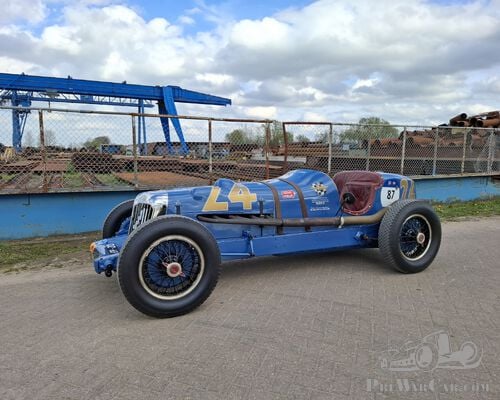
1932 - Graham " Lucenti " Indianapolis
Original participant of the 1932, 1934 and 1935 Indy 500. Best result: finishing 10th overall in the 1934 Indy 500 with driver “Herb” Ardinger...
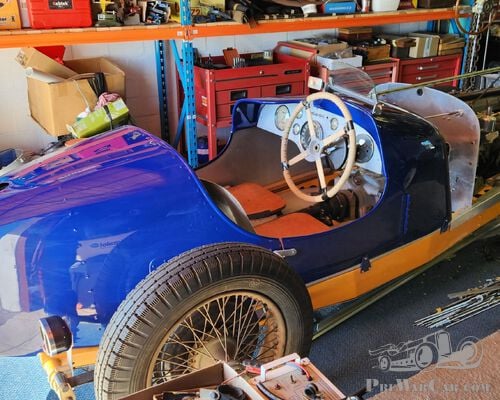
Riley TT Sprite
1935 6-cylinder TT Sprite replica. Chassis # 46A2722. Engine # 6A2722. Original Ulster Imp body. Restoration nearing completion. Engine, G..
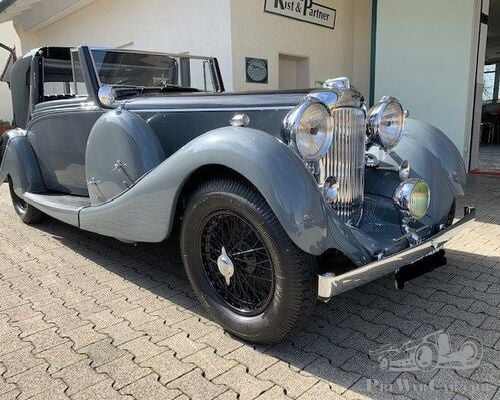
Lagonda LG 45 Coupe de Ville Sedanca by Mayfair
The successor to the M45, the LG45 was built around the same highly capable, competition-proven 4.5-litre Meadows inline-six engine, but featured r..