The global magazine and marketplace for classic car enthusiasts, by enthusiasts.


Filter
Classic Bentley, Cadillac for sale - Bentley, Cadillac cars for sale
-

1941 Cadillac Coupe
Cadillac really hit it with there design for 1941 , here a serie 62 coupe in a classic and eye-catching color combination. Designed by Harley Earl and Bill Mitchell and built at the Fleetwood plant, this serie 62 coupe is a full Classic (according to CCCA). The V8 engine with 150 hk make it a very powerful pre war car very usable on any ki.. -
1929 Bentley 4.5 litre Blower
1929 Bentley 4.5 litre Blower. Chassis number: PL3481 Registration Number: SV4904 (To be reinstated.) Chassis PL3481 was originally fitted with a saloon body and registered in 1929. The car suffered an accident in the 1940's at which time it went off the road prior to being rebu.. -
Bentley 4½ Litre Blower Continuation 1 of 12 (Chassis No.8)
A final opportunity to acquire a 100% original Blower Bentley, newly crafted by the manufacturer itself.Ninety years after the original Birkin Blowers defined an era, Bentley Mulliner undertook one of the most ambitious heritage projects in the marque’s history: the Blower Continuation Series. Built using original 1920s drawings, period t.. -
Bentley 4½ Litre Blower 1930 - Birkin Spec
Some cars are admired. Others are experienced. This Bentley Blower belongs firmly in the latter category. Shaped in period by the respected H.J.K. Townshend, a craftsman trusted by original Team Bentley owners, this example reflects a deep understanding of what defines a true Blower. Authentic in spirit and purposeful in execution,.. -
1924 Bentley 3 4 ½ Litre
•Sold new to Major EG Thomson of Edinburgh, of Ecuire Ecosse fame •Owned for more than 50 years by the Martin family•Upgraded to 4.5 Litre spec using original crankcase•Extensive history file includes factory records and buff logbooks•Fully restored by Paul Grist to his ‘ultimate’ period look and specification .. -
4 ½ Litre Vanden Plas Tourer
Chassis AD3652 was delivered 90 years ago from Mayfair by Jack Olring & Co to a Mr Grout. A sports four seater with fully valanced wings in green. This heavy chassis 4 ½ model was built to the latest specification including self-wrapping brakes, electron engine etc. and was unusually delivered with an aluminium sump and long bonnet. Dr William .. -
Speed Six Close Couple Coupe
This matching numbers Speed Six Bentley was supplied new to Viscount Mandeville the 10th Duke of Manchester. Termed a ‘Folkestone’ close-coupled saloon by the coachbuilder Martin Walter it was the second of only two built. The 1930 Vintage Bentley Speed Six, registration GJ755, has been in the Medcalf family ownership for over 40 years. Campaigned .. -
1938 Bentley Petersen 4 ½-Litre Blower Lemans Replica
1938 Bentley Petersen 4 ½-Litre Blower Lemans Replica Chassis Number: GGR64 Registration Number: FGO523 This stunning Bentley 4 ½-Litre Blower recreation was hand-crafted by the marque specialists at Bob Petersen Engineering in the UK, and according to recent correspondence with.. -
1934 Derby Bentley 3 ½ Litre All Weather Tourer by Barker
1934 Derby Bentley 3 ½ Litre All Weather Tourer by Barker Chassis Number: B-169-AE Registration Number: AXM20 A unique and handsome rare all-weather tourer bodied by Barker of London in 1934. The coachwork on this car is particularly distinguised & quite rare with lovely sca.. -
Cadillac 1934 Town Sedan serie 370D V12 Fleetwood Body
Cadillac 370D Town Sedan from Fleetwood with the V12 150HP engine and a wheelbase from 146" only 683 V12 where produced in 1934 by Cadillac This Impressive car has a weight from over 2500KG The Cadillac runs and drives well. Frank Kennis Phone: 00.31.622.420.766 or mail me: info@KennisCars.NL www.KennisCars.NL Classic Car Dealer for Europe Cad..


Bentley
GB, 1920 to date
(1) Bentley Motors Ltd, Cricklewood, London N.W.2., 1920 – 1931
(2) Bentley Motors (1931) Ltd, Derby, 1933 – 1945
(3) Bentley Motors (1931 Ltd, Crewe, Cheshire, 1946 to date
W.O. Bentley was already well-known as the importer of the D.F.P. car, a pioneer of aluminium pistons and a designer of successful rotary aircraft engines when his first Bentley 3-litre car for sale appeared at the 1919 London Show. This Bentley model, indelibly imprinted in the layman’s mind as the archetype of the Vintage sports car, had a long-stroke (80x149mm) single ohc engine with fixed head and dual magneto ignition developing about 70bhp in its early form. The Bentley 3-litre was at its best in long-distance events; a team of Bentley 3-litres with flat radiators (the only instance of this apart from the same year’s Indianapolis car) finished 2nd, 3rd, and 5th in the 1922 T.T., and the model accounted for the first two of the marque’s Le Mans wins, those of Duff/ Clement in 1924 and Davis/ Benjafield in 1927 on the badly damaged ‘Bentley Old No. 7’ – one of the legends of motor-racin history. Up to 1929 1.630 3-litres Bentley motorcars were made. 1924 saw the introduction of front wheel brakes and also the famous sports four-seater ‘Bentley Speed Model’ by Vanden Plas. Bentley cars are popularly known by the colours of the enamel on their radiator badges – ‘Bentley Red Label’ signifying a Speed Model short-chassis 3-litre, ‘Bentley Blue Label’ the early short, and long chassis which could and sometimes did carry limousine coachwork, and ‘Bentley Green Label’, a special 100mph Bentley type made in very small numbers.
In 1926 the Bentley company made a bid for the carriage trade with a big Bentley 6½-ltre six for sale on similar lines. A chassis cost £1.450, but the Bentley image made no impression in this market. However, the model was developed into the 180bhp ‘Bentley Speed 6’ of 1929, considered by many to be the best of the old-school Bentleys for sale, and responsible for the firm’s last two Le Mans wins – Barnato/ Clement in 1929, and Barnato/Kidston in 1930. In 1927 the Bentley 3-litre was developed into the Bentley 4½-litre, still with four cylinder, but with a 100bhp engine which was giving 130bhp by the time production ended. This admirable car could exceed 90mph in standard form, and was used by Barnato and Rubin to win LeMans in 1928. A supercharged version was listed in 1930; it had 182bhp, and did not have the approval of Bentley himself, but it was an excellent if thirsty road car, and won Sir Henry Birkin an unexpected 2nd place in the formule libre French G.P. of 1930. Bentley finances were always shaky, and even Woolf Barnato’s aid of 1927 did not last long; the Bentley company went down in the early summer of 1931 to the accompaniment of a splendid gesture – a 220bhp ohc Bentley 8-litre six, made in two wheelbase lengths, 12ft and 13ft. Only 100 of these eight-litres Bentleys were made, plus 50 examples of a rather uninspired inlet over exhaust valve 4-litre car.
Napier made an unsuccessful bid for the assets of the Bentley company, but were beaten by Rolls-Royce, who introduced their version of the Bentley at Olympia in 1933. This was an entirely different type, based on Derby’s contemporary 3.7-litre ohv push-rod ’20-25’. It had a 4-speed synchromesh gearbox, Rolls-Royce servo brakes, and sold for £1.460 with saloon bodywork. In this form, it could reach 90mph and merited its slogan ‘The Silent Sports Car’. It was not raced, of course, apart from E.R. Hall’s three consecutive second places in the T.T. (1934, 1935 and 1936). By 1936 it had grown into a Bentley 4¼-litre, the increase of capacity being necessitated by the rising weight of bespoke coachwork. An overdrive gearbox was standardized in 1939, and the 1940 Bentley Mk V had independent front suspension, though only a handful were made because of the war. The Derby Bentley car’s swansong was a creditable 6th place by H.S.F. Hay at Le Mans in 1949, on a ten-year-old machine with 60.000 road miles behind it. Cylinder capacity was unchanged at 4.257cc in 1946, but independent front suspension, was standard, and Bentely, like Rolls-Royce, had gone over to inlet over exhaust valves. Prices for the Bentley motorcars for sale rose from £2.997 to £4.474 in 1951 for the standard steel saloon, the first Rolls-Royce product to have a regular series-produced factory body.
Thereafter the Rolls-Royce and Bentley identities merges, though in 1952 there was a special ‘Bentley Continental’ version of the latter with fastback 2-door saloon body by H.J. Mulliner which gave 120mph on a 3.077:1 top gear. Capacity went up to 4.6 litres in 1952 and 4.9 litres in 1955. Automatic transmissions, already optional, became standard that year; power-assisted steering and air conditioning followed In 1957, and for 1960 the old six at long last gave way to a 6.2-litre V8 with full overhead valves, by which time only the radiator style distinguished one make from the other. The ‘Bentley Continental’ with separate chassis was discontinued at the end of 1966; 1972 Bentleys were the 6.745cc Bentley T saloon and the Bentley Corniche 2-door saloon and convertible. Even the price differential between the two sister makes was now a thing of the past, the Bentley T-series selling for the same £10.455 as the Rolls-Royce Silver Shadow.
Source: Georgano, encyclopedia of motorcar; MCS
The information is written with the greatest of care. However, if you have any suggested amendments please contact us at office@prewarcar.com
Cadillac
US, 1903 to date
(1) Cadillac Automobile Co, Detroit, Mich., 1903 – 1905
(2) Cadillac Motor Car Co, Detroit, Mich., 1905 to date
The ‘Standard of the World’ started humbly as a single-cylinder car selling for $750. Henry M. Leland, its creator, had been associated with Henry Ford and has also built engines for Oldsmobile. The Model-A Cadillac was markedly similar to the early Fords in having a horizontal underfloor engine, 2-speed planetary transmission and central chain drive via a spur-type differential, but Cadillac’s 1½-litre inlet over exhaust power unit had one cylinder where Ford used two. There was no bonnet on the early Cadillac models. This very successful design remained in production until 1908, later improvements including rack-and-pinion steering, transverse front suspension and a dummy bonnet. The Cadillac marque was introduced to Britain by F.S. Bennett, who in 1908 conducted a ‘standardization test’ at Brooklands. Three single-cylinder Cadillac cars were dismantled and the parts mixed up – they were then reassembled and the vehicles run on the track. The R.A.C. awarded Cadillac the Dewar Trophy for this achievement.
A 30hp 4-cylinder Cadillac car with separate cylinders and copper jackets was announced for 1906 and 75.000 of this type Cadillac were sold before it was discontinued in 1914. The original planetary transmission gave way first to a conventional 3-speed box, and finally in 1914 to a 3-speed box with 2-speed back axle. Cadillac was one of the firms organized into the General Motors group in 1909 by W.C. Durant, and in 1910, when a 4-cylinder Cadillac tourer could be bought for $1600, the company was claiming that tolerance on 112 parts of the car were accurate to one-thousandth of an inch. 1912 saw a most important Cadillac innovation: the standardization of the Delco system of electric lighting and starting on the Cadillac, now of 5½-litres capacity and capable of 60mph. The first left-hand drive Cadillac of 1915 was also the first of the company’s V8s, to become as much a hallmark of the breed as were Buick’s overhead valves. Inspired by the De Dion Bouton of 1910 it had 5.1-litre engine and sold for $2700. 13.000 V8 Cadillac cars were sold in the first year of production and the model was widely used by the U.S. Army in World War 1. Cylinder heads were detachable from 1917 on, and 1924 Cadillac versions had Duco cellulose finish and front wheel brakes.
In 1927, when 47.000 Cadillac cars were sold, a less expensive companion make, La Salle appeared, and the cars were restyled in 1928. The synchromesh gearbox made its world debut with the 1929 Cadillac models, which also featured chromium plating and safety glass, with a price range from $3.295 to $5.995. 1930 saw the advent of the ohv Cadillac V16 of 7.4-litres, which gave 185bhp and had a wheelbase of 12ft 4in. This sold at an average rate of 500 Cadillac cars a year for eight seasons in the $6.000-$9.000 price backet. It was joined in 1931 by an equally impressive ohv 6-litre V12 Cadillac for sale. Improvements over the next few years included power brakes (1931), ride control (1932), no-draught ventilation (1933), Dubonnet type independent front suspension (1934) and ‘turret-top’ all-steel bodies (for sale in 1935). 1938 Cadillac models had column change as standard, a year ahead of other GM products, while the V12 and V16 were dropped in favour of a side-valve short-stroke Cadillac 16-cylinder model which was made until 1940. Another new model for Cadillac in 1938, the 8-cylinder Cadillac Sixty Special, anticipated GM’s 1940 styling with its absence of running boards and 4-light sedan bodywork. 5.7-litre side-valve V8s in three wheelbase lengths made up the 1941 Cadillac range, on which Hydramatic transmission was optional for the first time.
The post-war era was to see Cadillac outstrip all its competitors in the top-price class and become an international symbol of wealth. Sales climbed from 66.000 cars in 1941 to 103.857 Cadillac cars in 1950, and to a new record of 165.959 Cadillac cars in 1964. Tail fins made their first appearance on Cadillac’s 1948 fastback coupé, and in 1949 Cadillac, along with Oldsmobile, adopted overhead valves and oversquare cylinder dimensions, their new 5.4-litre engine developing 160bhp. Cadillacs were raced at Le Mans in 1950 by Briggs Cunningham and the Cadillac engine was also used in export editions of Britain’s J2. Allard. Power output increased steadily: 190bhp in 1952 (by which time manual transmission was no longer offered), 210bhp in 1953 (when a 12-volt electric system was standardized), and 230bhp in 1954, the year when panoramic wrap-around windscreens and power-assisted steering became standard on the Cadillac for sale.
The expensive Cadillac Eldorado Brougham of 1957 (it cost over $13.000) was the first car to have air suspension (dropped after a few seasons) as standard equipment, while Cadillac, along with Lincoln, started the fashion for four headlamps, that later became universal in the USA. 1966 Cadillac cars featured GM’s perimeter-type chassis frame, a 340bhp 7-litre engine, variable-rate power steering, full air conditioning, electric door locks and seat controls, a time switch for the headlamps and a six-position steering wheel. Prices started at $4.650. In 1967 Cadillac set a new sales record of 213.161 cars, bettered in 1969 with 266.798/ They introduced a fwd car on Oldsmobile Toronado lines, the Fleetwood Cadillac Eldorado with torsion-bar ifs, self-levelling suspension, and front disc brakes, these last being applied to the more expensive Cadillac Fleetwoods with conventional drive, and to all the 1969 Cadillac range. Capacity of the Cadillac V8 engine was increased – to 7.735cc in 1968 and to 8.2 litres in 1970, but otherwise there were no major changes. In 1973 Cadillac were one of the few firms offering a nine-seater limousine: the Cadillac 75 with a wheelbase of 12ft 7½in and an overall length of 20ft 8in.
Source: Georgano, encyclopedia of motorcar; MCS
The information is written with the greatest of care. However, if you have any suggested amendments please contact us at office@prewarcar.com


Featured
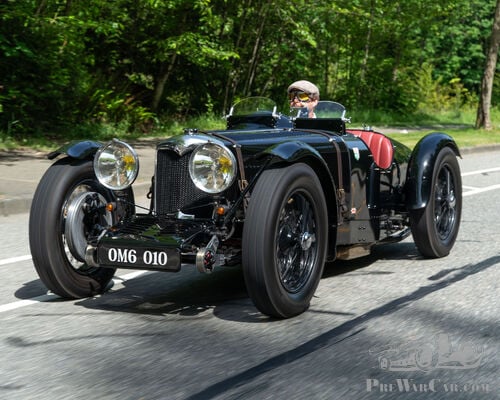
Riley 14/6 Special 1933
The ExperienceStep into the golden age of British motoring. This 1933 Riley 14/6 Special is a masterclass in pre-w..
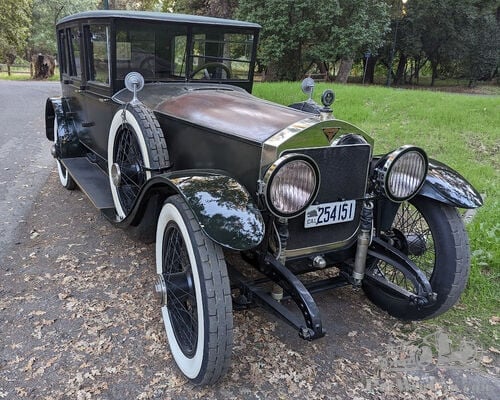
1916 Simplex, Crane model 5
1916 Simplex, Crane MODEL 5CUSTOM MADE HISTORIC PRESERVATION VEHICLE – READY TO TOUR!This Simplex recently completed th..
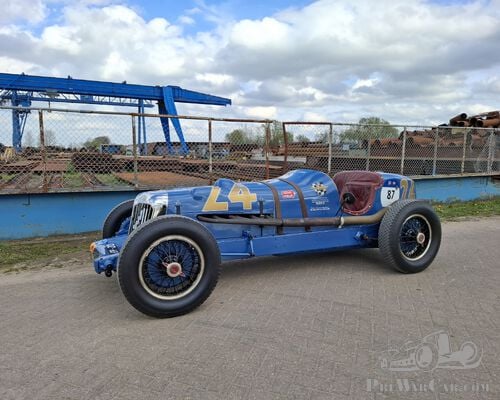
1932 - Graham " Lucenti " Indianapolis
Original participant of the 1932, 1934 and 1935 Indy 500. Best result: finishing 10th overall in the 1934 Indy 500 with driver “Herb” Ardinger...