The global magazine and marketplace for classic car enthusiasts, by enthusiasts.


Filter
Classic Cadillac, Daimler for sale - Cadillac, Daimler cars for sale
-

1941 Cadillac Coupe
Cadillac really hit it with there design for 1941 , here a serie 62 coupe in a classic and eye-catching color combination. Designed by Harley Earl and Bill Mitchell and built at the Fleetwood plant, this serie 62 coupe is a full Classic (according to CCCA). The V8 engine with 150 hk make it a very powerful pre war car very usable on any ki.. -
Cadillac 1934 Town Sedan serie 370D V12 Fleetwood Body
Cadillac 370D Town Sedan from Fleetwood with the V12 150HP engine and a wheelbase from 146" only 683 V12 where produced in 1934 by Cadillac This Impressive car has a weight from over 2500KG The Cadillac runs and drives well. Frank Kennis Phone: 00.31.622.420.766 or mail me: info@KennisCars.NL www.KennisCars.NL Classic Car Dealer for Europe Cad.. -
1932 Cadillac Series 452B V-16 All-Weather Phaeton by Fisher | The Quail Auction 2026
Engine No. 1400211 (See Text) Body No. 16 At a time when fours and sixes dominated the market and V8s were considered a luxury, Cadillac's decision to introduce a sixteen-cylinder engine in 1930 was as audacious as it was revolutionary. Designed as the halo example of the brand's "Standard of the World" reputation, the V-16 left compet.. -
1936 Cadillac Series 90 V-16 Five-Passenger Town Sedan | The Quail Auction 2026
Engine No. 5110221 Body No. 24 Fleetwood Style No. 5833-S 1936 marked the penultimate model year for Cadillac's celebrated overhead valve V-16, an engine that had redefined standards of power, smoothness, and underhood presentation since its 1930 debut. Whisper-quiet in operation, the 452-cubic-inch sixteen was perfectly suited t.. -
Cadillac V16 - Series 452 - 1930 - Imperial Sedan 4330
Offers invited a round € 200.000 - This ONE of 4 Survivors of Serie 4330 body style - book C.W. Cummings - 2014) ***excellent driving car, the V16 gives you a special experience, no other car has***https://www.prewarcar.com/a-stately-cadillac-v16-in-the-netherlandsBuilt; no 9 of 50 - Engine no. 700163Lengt.. -
1935 Daimler 15 Sports Coupe by Mulliner
Technical Specification:Mark & Model: Daimler 15 Sports Coupe by MullinerYear: 1935Registration plate: Jersey registeredChassis Number: 39538Engine Number: SG7L039Engine Capacity: 2003 ccTransmissions: 4-speed pre-selectorMileage:Body style: 2-door CoupeInterior col.. -
1939 Daimler E4 Labourdette
1939 Daimler E4 "Light Eight" , body "Labourdette"Not restored, complete.Aluminum body made by "Labourdette"The chassis was commenced in 1938 and completed in March 1939 before being fitted with the body by Labourdette, which was known as a 'Vutotal' design. Very interesting, unique car, ideal for a project "Concourse d'Ele.. -
1928 Cadillac Model 7980 convertible coupe
Cadillac is one of the pristine cars in American history, here we have a 1928 model 7980 convertible coupewith all options as twin wooden spare wheels, trunk rack, pilot ray lights (who follow the direction of the front wheels) etc.The engine is a V8 with 5588cc on a 3560 wheelbase. At 2200kg it is not a lightweight.We parti.. -
1927 Cadillac V8 complete and restored rolling chassis
1927 Cadillac V8 complete and restored rolling chassis. With good radiator, beautiful original headlights, bonnet, cowling and dashboard. On restored wooden spoked wheels with the original hubcaps. Ideal car for racing and build your own body on ! We also have most of the dismantled original tourer body and the original fenders (guards) in good con.. -
1923 Daimler D16 Landaulette. Electric vehicle.
1923 Daimler D16 Landaulette. Electric Conversion. Chassis number: 21825Registration number: XP8310 Utterly Charming with very period upright coachwork: This Sleeve valve (Now fully Electric) Daimler was purchased by the Duke of Hamilton From London Dealers Stratton Instone of Pall Mall for the use of a Miss Lo..


Cadillac
US, 1903 to date
(1) Cadillac Automobile Co, Detroit, Mich., 1903 – 1905
(2) Cadillac Motor Car Co, Detroit, Mich., 1905 to date
The ‘Standard of the World’ started humbly as a single-cylinder car selling for $750. Henry M. Leland, its creator, had been associated with Henry Ford and has also built engines for Oldsmobile. The Model-A Cadillac was markedly similar to the early Fords in having a horizontal underfloor engine, 2-speed planetary transmission and central chain drive via a spur-type differential, but Cadillac’s 1½-litre inlet over exhaust power unit had one cylinder where Ford used two. There was no bonnet on the early Cadillac models. This very successful design remained in production until 1908, later improvements including rack-and-pinion steering, transverse front suspension and a dummy bonnet. The Cadillac marque was introduced to Britain by F.S. Bennett, who in 1908 conducted a ‘standardization test’ at Brooklands. Three single-cylinder Cadillac cars were dismantled and the parts mixed up – they were then reassembled and the vehicles run on the track. The R.A.C. awarded Cadillac the Dewar Trophy for this achievement.
A 30hp 4-cylinder Cadillac car with separate cylinders and copper jackets was announced for 1906 and 75.000 of this type Cadillac were sold before it was discontinued in 1914. The original planetary transmission gave way first to a conventional 3-speed box, and finally in 1914 to a 3-speed box with 2-speed back axle. Cadillac was one of the firms organized into the General Motors group in 1909 by W.C. Durant, and in 1910, when a 4-cylinder Cadillac tourer could be bought for $1600, the company was claiming that tolerance on 112 parts of the car were accurate to one-thousandth of an inch. 1912 saw a most important Cadillac innovation: the standardization of the Delco system of electric lighting and starting on the Cadillac, now of 5½-litres capacity and capable of 60mph. The first left-hand drive Cadillac of 1915 was also the first of the company’s V8s, to become as much a hallmark of the breed as were Buick’s overhead valves. Inspired by the De Dion Bouton of 1910 it had 5.1-litre engine and sold for $2700. 13.000 V8 Cadillac cars were sold in the first year of production and the model was widely used by the U.S. Army in World War 1. Cylinder heads were detachable from 1917 on, and 1924 Cadillac versions had Duco cellulose finish and front wheel brakes.
In 1927, when 47.000 Cadillac cars were sold, a less expensive companion make, La Salle appeared, and the cars were restyled in 1928. The synchromesh gearbox made its world debut with the 1929 Cadillac models, which also featured chromium plating and safety glass, with a price range from $3.295 to $5.995. 1930 saw the advent of the ohv Cadillac V16 of 7.4-litres, which gave 185bhp and had a wheelbase of 12ft 4in. This sold at an average rate of 500 Cadillac cars a year for eight seasons in the $6.000-$9.000 price backet. It was joined in 1931 by an equally impressive ohv 6-litre V12 Cadillac for sale. Improvements over the next few years included power brakes (1931), ride control (1932), no-draught ventilation (1933), Dubonnet type independent front suspension (1934) and ‘turret-top’ all-steel bodies (for sale in 1935). 1938 Cadillac models had column change as standard, a year ahead of other GM products, while the V12 and V16 were dropped in favour of a side-valve short-stroke Cadillac 16-cylinder model which was made until 1940. Another new model for Cadillac in 1938, the 8-cylinder Cadillac Sixty Special, anticipated GM’s 1940 styling with its absence of running boards and 4-light sedan bodywork. 5.7-litre side-valve V8s in three wheelbase lengths made up the 1941 Cadillac range, on which Hydramatic transmission was optional for the first time.
The post-war era was to see Cadillac outstrip all its competitors in the top-price class and become an international symbol of wealth. Sales climbed from 66.000 cars in 1941 to 103.857 Cadillac cars in 1950, and to a new record of 165.959 Cadillac cars in 1964. Tail fins made their first appearance on Cadillac’s 1948 fastback coupé, and in 1949 Cadillac, along with Oldsmobile, adopted overhead valves and oversquare cylinder dimensions, their new 5.4-litre engine developing 160bhp. Cadillacs were raced at Le Mans in 1950 by Briggs Cunningham and the Cadillac engine was also used in export editions of Britain’s J2. Allard. Power output increased steadily: 190bhp in 1952 (by which time manual transmission was no longer offered), 210bhp in 1953 (when a 12-volt electric system was standardized), and 230bhp in 1954, the year when panoramic wrap-around windscreens and power-assisted steering became standard on the Cadillac for sale.
The expensive Cadillac Eldorado Brougham of 1957 (it cost over $13.000) was the first car to have air suspension (dropped after a few seasons) as standard equipment, while Cadillac, along with Lincoln, started the fashion for four headlamps, that later became universal in the USA. 1966 Cadillac cars featured GM’s perimeter-type chassis frame, a 340bhp 7-litre engine, variable-rate power steering, full air conditioning, electric door locks and seat controls, a time switch for the headlamps and a six-position steering wheel. Prices started at $4.650. In 1967 Cadillac set a new sales record of 213.161 cars, bettered in 1969 with 266.798/ They introduced a fwd car on Oldsmobile Toronado lines, the Fleetwood Cadillac Eldorado with torsion-bar ifs, self-levelling suspension, and front disc brakes, these last being applied to the more expensive Cadillac Fleetwoods with conventional drive, and to all the 1969 Cadillac range. Capacity of the Cadillac V8 engine was increased – to 7.735cc in 1968 and to 8.2 litres in 1970, but otherwise there were no major changes. In 1973 Cadillac were one of the few firms offering a nine-seater limousine: the Cadillac 75 with a wheelbase of 12ft 7½in and an overall length of 20ft 8in.
Source: Georgano, encyclopedia of motorcar; MCS
The information is written with the greatest of care. However, if you have any suggested amendments please contact us at office@prewarcar.com
Daimler
D, 1886 – 1902
(1) Gottlieb Daimler, Bad Cannstatt, 1886 – 1890
(2) Daimler Motoren-Gesellschaft, Bad Cannstatt, 1890 – 1902
Gottlieb Daimler was employed until 1882 as technical director at the Gasmotorenfabrik Deutz, where he worked on internal combustion engines. Wilhelm Maybach was also engaged by Daimler at the Deutz works. Daimler held shares in the Deutz company and the income form these gave Daimler some financial support when Daimler left Deutz. He moved to Bad Cannstatt near Stuttgart, where Daimler started a small workshop for research and experimentation and brought in Maybach to work for him. Daimler’s plans were to develop a high-speed internal combustion engine which could be fitted into road and rail vehicles as well as into boats. In 1883 a high-speed Daimler prototype petrol engines with hot-tube ignition were built. This was the first time that petrol was used for an internal combustion engine. The next step for Daimler was the construction in 1885 of the world’s first Daimler motor cycle, which was also the last one ever built by Daimler or later companies bearing the Daimler name. Next, trials were made with a motorized boat and sleigh before Daimler and Maybach fitted an engine to an ordinary horse-drawn carriage, modified for the purpose . The Daimler car was ready in 1886 and made its first trial runs around Cannstatt. The engine was an air-cooled vertical single-cylinder or 1.5hp with tube ignition. Further trials with Daimler engines in boats, trams and fire-engines followed.
For some time Maybach had tried to convince Daimler that they should build a vehicle designed from the start as a motor car. Daimler opposed the idea for a long time but he at last agreed to build a Daimler prototype. It was a two-seater 4-wheeled vehicle with a rear-mounted V-twin engine. The chassis was a tubular steel frame and the steel wire wheels gave the cars its name of ‘Stahlradwagen’. The Daimler car was sent to the Paris World Fair of 1889. Panhard-Levassor and Peugeot took a great interest in this car, and both firms started car production with Daimler engines and laid the foundation of the French motor car industry.
In 1890 the Daimler Motoren-Gesellschaft was founded by soon differences arose between Daimler and his new partners. This led to Daimler’s separation from the company in 1893. He and Maybach started an experimental workshop in the Hotel Hermann; this can be regarded as an independent Daimler enterprise which also built cars. Daimler successfully continued his efforts to develop a high-speed engine for motor cars. The very important invention of the atomizing carburetor by Daimler was also made in the Hotel Hermann. In 1895 an agreement was reached and Daimler and Maybach returned to the Daimler company. The Daimler cars produced were the belt-driven 2-cylinder type, the first Daimler car manufactured in any numbers. It was succeeded in 1897 by the Daimler Phönix, the first type with front engine. 1899 saw the first 4-cylinder engines. A car with a 28hp engine was entered by its owner, Emile Jellinek for the Nice Week, 1899; this Daimler car was called the Mercedes after his eldest daughter.
Jellinek was a successful business man and Consul-General of the Austro-Hungarian empire in Nice, taking a great interest in motoring and especially Daimler cars. He acted as an unofficial agent selling Daimler cars to his wealthy friends. But he was not satisfied with their performance and suggested that the Daimler company should build a high-performance car of an entirely new conception. The result was the 35hp 4-cylinder Daimler model which became known as the first Mercedes car. It was designed by Maybach, incorporating some of the principles of the P.D. Car designed by Paul Daimler, a son of Gottlieb Daimler. It made a very successful debut at the Nice Week, 1901. Jellinek had a seat on the Daimler car company’s board of directors since 1900. He now obtained the sole agency for Daimler in France, Belgium, Austro-Hungary and the United States of America. He sold the cars under the name of Mercedes – which formerly had been only his pseudonym – to counter possible legal proceedings by Panhard-Levassor, who owned licences for Daimler cars under an earlier agreement with Gottlieb Daimler himself. As a result of the great successes of Mercedes cars Daimler decided in 1902 to accept this as a new brand name for all subsequent private Daimler cars. Commercial vehicles continued to be marketed under the name Daimler, and this name was also applied to the cars built in 1901 by the breakaway M.M.B. company in Berlin.
GB, 1896 to date
(1) Daimler Motor Syndicate Ltd, Coventry, Warwickshire, 1896 – 1904
(2) Daimler Motor Co (1904) Ltd, Coventry, Warwickshire, 1904 – 1910
(3) Daimler Co Ltd, Coventry, Warwickshire, 1910 to date
The Daimler Motor Syndicate was formed in England in 1893 by F.R. Simms to exploit Gottlieb Daimler motor patents, but it was not until 1896 that the Coventry factory became active as part of H.J. Lawson’s empire. Though Daimler himself was a director until 1898, the English and German Daimler concerns pursued their separate ways. In the first two years cars were mostly imported, and early English Daimlers were 2-cylinder machines, largely on Panhard lines, with automatic inlet valves, tiller steering, tube ignition, 4-speed and reverse gearboxes, chain drive and solid tyres. Prices ranged from £368 for a pheaeton up to £418 for a ‘Daimler private omnibus’. 1899 saw the first 4-cylinder car, a 3-litre machine rated at 12hp; this Daimler had wheel steering, and the Hon. John Scott-Montagu became the first British driver to compete in a continental race on a vehicle of British construction when he drove one Daimler in the Paris-Ostend that year. King Edward VII, while still Prince of Wales, took delivery of his first Daimler in 1900, thus forging a connection between the Daimler company and the reigning house which lasted until the 1950s. Design policy was very uncertain for the next few seasons, but in 1902 there was a chain-driven 1.8-litre twin Daimler, as well as fours of 2.4 and 4½-litres’ capacity with tubular, Panhard-like radiators. These Daimler cars retained stand-by tube ignition. The fluted radiator and 3-piece bonnet, both to become Daimler hallmarks, were introduced in 1904, the year in which the Daimler company went over to large and powerful chain-driven fours with mechanically-operated side valves and coil ignition, which ran in such events as the herkomer Trophy Trials. The 9¼ litre ‘Daimler 35’ was typical, but there were even bigger versions of over 10½-litres, and Daimler advertising made much of sprint wins on the Continent and in the USA as well as at home. Some of these Daimler cars were made under licence in Italy as the De Luca.
1909 saw a complete volte face with the adoption of Charles Yale Knight’s double-sleeve valve engine and underslung worm drive, and the Daimler cars of the next 23 years were smooth, and silent, but not capable of high performance. They also changed little in appearance, since Daimler, unlike most luxury-car makers, built their own bodywork. Poppet valves were dropped altogether after 1909. By 1914 the Daimler company’s range extended from a 4-cylinder 3.3-litre ‘Daimler 20’ with rear-axle gearbox at £430 for a chassis up to a very large 7.4-litre 6-cylinder ‘Daimler 45’. Electric lighting and starting were standard on the bigger cars. The purchase of Daimler by BSA in 1910 made no difference to the cars, though the BSA itself became merely a cheap Daimler.
After World war 1, 4-cylinder cars were dropped (apart from a short-lived ‘Daimler 20’ in 1922) and the same solid conservative machines were offered in a range of fearsome complexity. There was a 1½-litre six in 1923 and front wheel brakes arrived with the 35hp model in 1924, becoming universal late in 1925, when light steel sleeves were adopted and outputs went up. The immense and stately 12-cylinder 7.1-litre Daimler Double Six was introduced in 1927; 12-cylinder Daimler cars were used by the Royal Family and persisted in a variety of capacities from 3.7 litres until 1938, the last ones using poppet valves. In 1927 the company offered 23 separate Daimler car models (exclusive of body styles), using five engines from 1.9-litres to 7.1-litres, and twelve wheelbase lengths from the 9ft 9in of the owner-driver ’Daimler 16-55’ up to the 13ft 7in of the Royal model of the Double-Six, which cost £1950 for a chassis alone. In 1930 Daimler pioneered the fluid-flywheel transmission with column selector which was used on all Daimler models from 1932 to 1956. The Lanchester company was acquired in 1931 and the make downgraded into another species of inexpensive Daimler cars for sale. In 1933 the influence of Launce Pomeroy Sr was reflected in a 1.8-litre 6-cylinder ‘Daimler 15’ with overhead valves for the owner-driver at £450, and this was followed by a series of ohv sixes and straight-8s, some of them with fixed cylinder heads. Independent front suspension appeared on 1938 versions of the ‘Daimler 15’. In 1939 there were three sixes and two eights, the top of the range being the 4½-litre 32hp limousine.
After World War 2 the 2½-litre Daimler DB.18 (descended from the ‘15’) was revived and there were two limousine models with hypoid final drive, a 4-litre six and a 5½-litre eight. A certain lack of direction punctuated the early 1950s, which saw the short-stroke 2½-litre ‘Daimler Conquest’ saloon and its 100mph variant, the ‘Daimler Conquest Century’, and also a sports two-seater. The company was reorganized in 1956, in which year automatic transmission was available as an alternative to the fluid-flywheel gearbox. The 3.8-litre 6-cylinder ‘Daimler Majestic’ of 1958 had automatic transmission and disc brakes as standard equipment and a year later came the Turner-designed V8 2½-litre Daimler SP250 sports car, a 120mph machine which broke away form traditional Daimler appearance and sold for £1.395. A synchromesh gearbox was standard. A pair of 4.6-litre V8s with traditional bodywork joined it in 1960, in which year the company was bought by Jaguar. A 2½-litre saloon using the small V8 Daimler engine in a Mk II jaguar body was introduced for 1963, and gradually Jaguar influences took over. The 8-cylinder Majestic Major saloon was replaced in 1967 by the Daimler Sovereign, a Jaguar 420 down to its dohc 6-cylinder engine, and a year later there was a new Jaguar-based limousine using the 4235cc power unit and a Vanden Plas body. The last V8 Daimlers were made in 1996, and inevitably the 1973 season brought a Daimler version of the 5.3-litre V12 XJ6 Jaguar, designated the Double Six; a long-chassis version had trim by Vanden Plas.
Source: Georgano, encyclopedia of motorcar; HON, MCS
The information is written with the greatest of care. However, if you have any suggested amendments please contact us at office@prewarcar.com


Featured
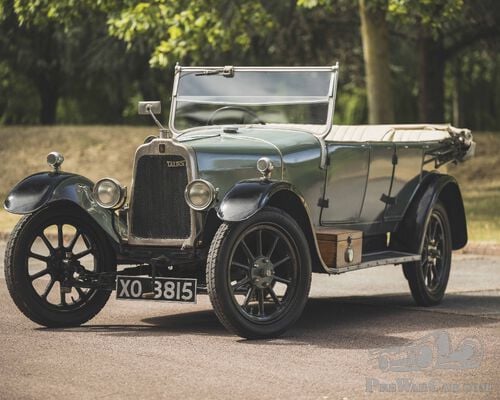
Rare RHD, low miles & great history file
This is an ONLINE-ONLY AUCTION at THE MARKET. The price shown here is the lower estimate. To see all the details, description, 250+ high-res photog..
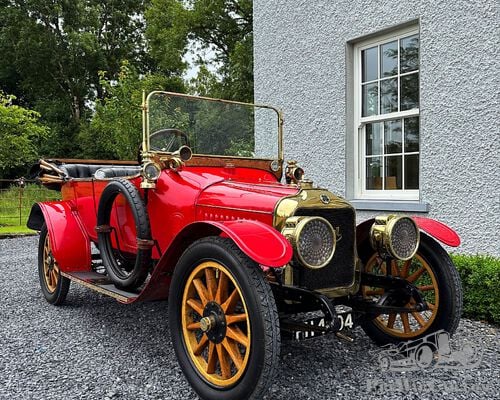
1914 Brasier
1914 Brasier Tourer 9ABrasier were a French manufacturer who were in business from 1901 until 1930, when the company became victim of the gr..
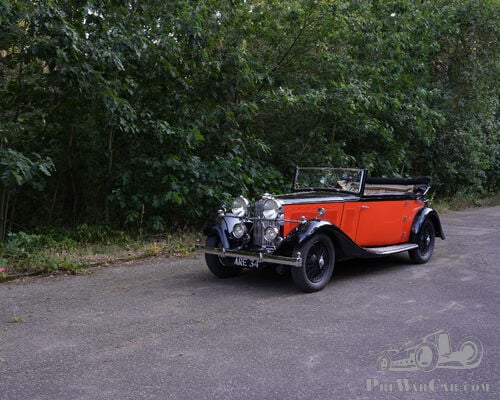
1934 Talbot AV105 Three Position Drophead Coupé
Registration no. ARE 34Chassis no. 35488 Much supporting paperworkRestored exampleVery usa..