The global magazine and marketplace for classic car enthusiasts, by enthusiasts.


Filter
Classic Cadillac, Franklin for sale - Cadillac, Franklin cars for sale
-

1941 Cadillac Coupe
Cadillac really hit it with there design for 1941 , here a serie 62 coupe in a classic and eye-catching color combination. Designed by Harley Earl and Bill Mitchell and built at the Fleetwood plant, this serie 62 coupe is a full Classic (according to CCCA). The V8 engine with 150 hk make it a very powerful pre war car very usable on any ki.. -
Cadillac 1934 Town Sedan serie 370D V12 Fleetwood Body
Cadillac 370D Town Sedan from Fleetwood with the V12 150HP engine and a wheelbase from 146" only 683 V12 where produced in 1934 by Cadillac This Impressive car has a weight from over 2500KG The Cadillac runs and drives well. Frank Kennis Phone: 00.31.622.420.766 or mail me: info@KennisCars.NL www.KennisCars.NL Classic Car Dealer for Europe Cad.. -
1932 Cadillac Series 452B V-16 All-Weather Phaeton by Fisher | The Quail Auction 2026
Engine No. 1400211 (See Text) Body No. 16 At a time when fours and sixes dominated the market and V8s were considered a luxury, Cadillac's decision to introduce a sixteen-cylinder engine in 1930 was as audacious as it was revolutionary. Designed as the halo example of the brand's "Standard of the World" reputation, the V-16 left compet.. -
1936 Cadillac Series 90 V-16 Five-Passenger Town Sedan | The Quail Auction 2026
Engine No. 5110221 Body No. 24 Fleetwood Style No. 5833-S 1936 marked the penultimate model year for Cadillac's celebrated overhead valve V-16, an engine that had redefined standards of power, smoothness, and underhood presentation since its 1930 debut. Whisper-quiet in operation, the 452-cubic-inch sixteen was perfectly suited t.. -
Cadillac V16 - Series 452 - 1930 - Imperial Sedan 4330
Offers invited a round € 200.000 - This ONE of 4 Survivors of Serie 4330 body style - book C.W. Cummings - 2014) ***excellent driving car, the V16 gives you a special experience, no other car has***https://www.prewarcar.com/a-stately-cadillac-v16-in-the-netherlandsBuilt; no 9 of 50 - Engine no. 700163Lengt.. -
1927 Franklin 11-B Tandem Sport
1927 Franklin 11-B Tandem Sport Chassis Number: 164935-17 Registration Number: OFL27H (Germany.) Body Number: 58 A rare & unusual air cooled Franklin as used in a similar model by Charles Lindburgh in peiod. Air cooled 3.3l, 6 cyli.. -
1928 Cadillac Model 7980 convertible coupe
Cadillac is one of the pristine cars in American history, here we have a 1928 model 7980 convertible coupewith all options as twin wooden spare wheels, trunk rack, pilot ray lights (who follow the direction of the front wheels) etc.The engine is a V8 with 5588cc on a 3560 wheelbase. At 2200kg it is not a lightweight.We parti.. -
1927 Cadillac V8 complete and restored rolling chassis
1927 Cadillac V8 complete and restored rolling chassis. With good radiator, beautiful original headlights, bonnet, cowling and dashboard. On restored wooden spoked wheels with the original hubcaps. Ideal car for racing and build your own body on ! We also have most of the dismantled original tourer body and the original fenders (guards) in good con.. -
Cadillac 1930 La Salle 340 Coupe
Beautifull Impresive Cadillac 1930 La Salle 340 Coupe with buffalo wire wheels, 2 spare wheels in the front wings, V8 engine 340 CID 5.600 cc with 90 HP. With a mother in law extra 2 seats in the trunk and a golf bag door for easy loading some stuff. This Cadillac / La Salle is in good original condition and great running. Frank Kennis Phone:.. -
1938 Cadillac V16 Coupe Series 90 Coupe by Fleetwood
1938 Cadillac V16 Coupe Series 90 Chassis number: 702748 Registration Number: H1087BBB (Spain Historic) On January 4, 1930, Cadillac introduced a new top of the line automobile at the New York Auto Show with the introduction of its breathtaking new V-16. With this first V16 pro..


Cadillac
US, 1903 to date
(1) Cadillac Automobile Co, Detroit, Mich., 1903 – 1905
(2) Cadillac Motor Car Co, Detroit, Mich., 1905 to date
The ‘Standard of the World’ started humbly as a single-cylinder car selling for $750. Henry M. Leland, its creator, had been associated with Henry Ford and has also built engines for Oldsmobile. The Model-A Cadillac was markedly similar to the early Fords in having a horizontal underfloor engine, 2-speed planetary transmission and central chain drive via a spur-type differential, but Cadillac’s 1½-litre inlet over exhaust power unit had one cylinder where Ford used two. There was no bonnet on the early Cadillac models. This very successful design remained in production until 1908, later improvements including rack-and-pinion steering, transverse front suspension and a dummy bonnet. The Cadillac marque was introduced to Britain by F.S. Bennett, who in 1908 conducted a ‘standardization test’ at Brooklands. Three single-cylinder Cadillac cars were dismantled and the parts mixed up – they were then reassembled and the vehicles run on the track. The R.A.C. awarded Cadillac the Dewar Trophy for this achievement.
A 30hp 4-cylinder Cadillac car with separate cylinders and copper jackets was announced for 1906 and 75.000 of this type Cadillac were sold before it was discontinued in 1914. The original planetary transmission gave way first to a conventional 3-speed box, and finally in 1914 to a 3-speed box with 2-speed back axle. Cadillac was one of the firms organized into the General Motors group in 1909 by W.C. Durant, and in 1910, when a 4-cylinder Cadillac tourer could be bought for $1600, the company was claiming that tolerance on 112 parts of the car were accurate to one-thousandth of an inch. 1912 saw a most important Cadillac innovation: the standardization of the Delco system of electric lighting and starting on the Cadillac, now of 5½-litres capacity and capable of 60mph. The first left-hand drive Cadillac of 1915 was also the first of the company’s V8s, to become as much a hallmark of the breed as were Buick’s overhead valves. Inspired by the De Dion Bouton of 1910 it had 5.1-litre engine and sold for $2700. 13.000 V8 Cadillac cars were sold in the first year of production and the model was widely used by the U.S. Army in World War 1. Cylinder heads were detachable from 1917 on, and 1924 Cadillac versions had Duco cellulose finish and front wheel brakes.
In 1927, when 47.000 Cadillac cars were sold, a less expensive companion make, La Salle appeared, and the cars were restyled in 1928. The synchromesh gearbox made its world debut with the 1929 Cadillac models, which also featured chromium plating and safety glass, with a price range from $3.295 to $5.995. 1930 saw the advent of the ohv Cadillac V16 of 7.4-litres, which gave 185bhp and had a wheelbase of 12ft 4in. This sold at an average rate of 500 Cadillac cars a year for eight seasons in the $6.000-$9.000 price backet. It was joined in 1931 by an equally impressive ohv 6-litre V12 Cadillac for sale. Improvements over the next few years included power brakes (1931), ride control (1932), no-draught ventilation (1933), Dubonnet type independent front suspension (1934) and ‘turret-top’ all-steel bodies (for sale in 1935). 1938 Cadillac models had column change as standard, a year ahead of other GM products, while the V12 and V16 were dropped in favour of a side-valve short-stroke Cadillac 16-cylinder model which was made until 1940. Another new model for Cadillac in 1938, the 8-cylinder Cadillac Sixty Special, anticipated GM’s 1940 styling with its absence of running boards and 4-light sedan bodywork. 5.7-litre side-valve V8s in three wheelbase lengths made up the 1941 Cadillac range, on which Hydramatic transmission was optional for the first time.
The post-war era was to see Cadillac outstrip all its competitors in the top-price class and become an international symbol of wealth. Sales climbed from 66.000 cars in 1941 to 103.857 Cadillac cars in 1950, and to a new record of 165.959 Cadillac cars in 1964. Tail fins made their first appearance on Cadillac’s 1948 fastback coupé, and in 1949 Cadillac, along with Oldsmobile, adopted overhead valves and oversquare cylinder dimensions, their new 5.4-litre engine developing 160bhp. Cadillacs were raced at Le Mans in 1950 by Briggs Cunningham and the Cadillac engine was also used in export editions of Britain’s J2. Allard. Power output increased steadily: 190bhp in 1952 (by which time manual transmission was no longer offered), 210bhp in 1953 (when a 12-volt electric system was standardized), and 230bhp in 1954, the year when panoramic wrap-around windscreens and power-assisted steering became standard on the Cadillac for sale.
The expensive Cadillac Eldorado Brougham of 1957 (it cost over $13.000) was the first car to have air suspension (dropped after a few seasons) as standard equipment, while Cadillac, along with Lincoln, started the fashion for four headlamps, that later became universal in the USA. 1966 Cadillac cars featured GM’s perimeter-type chassis frame, a 340bhp 7-litre engine, variable-rate power steering, full air conditioning, electric door locks and seat controls, a time switch for the headlamps and a six-position steering wheel. Prices started at $4.650. In 1967 Cadillac set a new sales record of 213.161 cars, bettered in 1969 with 266.798/ They introduced a fwd car on Oldsmobile Toronado lines, the Fleetwood Cadillac Eldorado with torsion-bar ifs, self-levelling suspension, and front disc brakes, these last being applied to the more expensive Cadillac Fleetwoods with conventional drive, and to all the 1969 Cadillac range. Capacity of the Cadillac V8 engine was increased – to 7.735cc in 1968 and to 8.2 litres in 1970, but otherwise there were no major changes. In 1973 Cadillac were one of the few firms offering a nine-seater limousine: the Cadillac 75 with a wheelbase of 12ft 7½in and an overall length of 20ft 8in.
Source: Georgano, encyclopedia of motorcar; MCS
The information is written with the greatest of care. However, if you have any suggested amendments please contact us at office@prewarcar.com
Franklin
US, 1901 – 1934
(1) H.H. Franklin Mfg Co, Syracuse, N.Y., 1901 – 1917
(2) Franklin Automobile Co, Syracuse, N.Y., 1917 – 1934
Probably the world’s most successful air-cooled car before the advent of the Volkswagen, the Franklin inspired an intense make-loyalty. H.H. Franklin had founded a factory for the manufacture of die castings in 1895, and in 1901 he was introduced to John Wilkinson’s air-cooled designs by Messsrs Brown and lipe, later well known as manufacturers of proprietary transmissions. The New York Motor Co had already made three prototypes before the first Franklin car went on sale in 1902. These Franklin featured transversely-mounted 1.7-litre 4-cylinder air-cooled engines – the valves were overhead, with mechanically operated inlet valves from 1905 – float-feed carburetors, 2-speed planetary gearboxes, central change, full-elliptic suspension and the wooden frames which were to be standard on all Franklin cars up to the end of 1927. A push-on handbrake was used until 1906. Although a Franklin version with water-jacketed engine was projected, the Franklin company remained faithful to air-cooling until they closed down. Sales rose from 13 in 1902 to 184 in 1903, when wire wheels gave way to the wood artillery type, and in 1904 a Franklin broke the San Francisco-New York record. The transverse-engined Franklin cars were catalogued until the end of 1906, but from 1905 onwards new Franklin models with conventionally-located engines made their appearance. These had auxiliary exhaust valves, shaft drive, 3-speed sliding-type gearboxes and round bonnets modelled on the Delaunay-Belleville. A 4-cylinder Franklin sold for $1800, but there was also a 6-cylinder Franklin Model H with a 7-bearing crankshaft and a 9ft 6in wheelbase for $4.000: all subsequent 6-cylinder Franklin cars had seven main bearings. A straight-8 appeared without success in the 1905 Vanderbilt Cup Eliminating Trials. Franklin’s full-elliptic suspension was continued. This gave an excellent ride and resulted in tyre mileages in the region of 20.000: this is why the Franklin company was refusing to fit detachable rims as standard equipment as late as 1922. In 1907 an automatic advance-and-retard was fitted on the Franklin and in 1908 a gear-driven fan. The 1910 Franklin cars used a suction-driven sirocco fan incorporated in the flywheel. Smallest of the 1909 range was the 18hp Franklin Model G, a 2.3-litre 4-cylinder car with quadrant change sold at $1850. Selective change was used on the bigger Franklin fours and sixes which had oversquare cylinder dimensions and cost $2800 and $3750 respectively. With the 1912 Franklin models came a Renault-type bonnet and full pressure lubrication, and a 4-cylinder was still available at $2.000, or $1.500 less than the big 38.4hp 6-cylinder.
In 1914 only a 6-cylinder car, the ‘Franklin 6/30’, was offered, and Franklin fell into line with the rest of the American industry by going over to left-hand drive, central change and full electrical equipment. A year later aluminium pistons were adopted. A stunt drive by Franklin from Walla Walla, Washington, to San Francisco in bottom gear demonstrated the car’s ability to keep cool. The 1917 models had electric chokes, while imitators arose in the industry to try and cash in on Franklin’s success with air-cooling. One of these firms, Holmes, was headed by former vice-president of the Franklin Automobile Co. By the end of World War 1 a 6-cylinder Franklin could be bought for $2.050, reduced two years later to $2.000. 8.648 Franklin cars were sold in 1920. Late in 1922, came a redesigned Franklin car with a ‘horse-collar’ bonnet allegedly modelled on the Fiat, pressure air-cooling with frontal blower, unit gearbox, single dry-plate clutch, 6-volt instead of 12-volt electrics and detachable rims. Sales rose to 11.000 and the Franklin company which had pioneered series-production closed cars as early as 1913 was offering a Franklin sedan at $2.850. During 1925 the design was face-lifted once again and the De Causse-styled Franklin Series 11 introduced. Cylinder capacity remained a modest 3.3-litres, but appearance was entirely changed with a 9ft 11in wheelbase and a vertical-barred ‘radiator’. This revolutionary step so appalled John Wilkinson that he resigned from the Franklin company forthwith. Some of the semi-custom body styles – especially the boat-taled sports coupé at $3.150 – were remarkably attractive. Subsequently some excellent and expensive custom bodywork was designed for Franklin by such firms as Derham, Willoughby, Holbrook, and (especially) Dietrich. Over 13.000 Franklin Series 11s were sold between mid-1925 and the end of 1926, among those who favoured Franklins being Colonel Charles Lindbergh. Yet even the ‘Franklin 11B’ of 1927 retained the wooden frame, full-elliptic suspension and foot transmission brake. Front-wheel brakes did not arrive until the introduction of the 1928 3.9-litre Franklin Airman, which boasted internal-expanding Lockheed hydraulics at a time when the contracting type was generally favoured in America. In 1928 long-chassis models were given steel frames, standardized in 1929, and a standard sedan sold for £885 in England. All but the cheapest Franklin cars now had silent 2nd gearboxes. This was the period in which Dietrich introduced their delightful speedster (actually a 4-door convertible sedan) and a 4½-litre 6-cylinder Franklin engine actually took to the air in a Waco biplane. Prices were generally in the $2.200 - $3.500 range, with custom Franklin models running up to $7.200.
The 1930 Franklin Series 14 introduced a new radiator and side-blast cooling, an the elegant Pirate models had concealed running-boards as well. The unconventional, however, could no longer sell in America, and only 2.851 Franklin cars were delivered in 1931. In 1932 came synchromesh, free wheels and ‘Startix’ devices, as well as a magnificent Dietrich-styled 6.8-litre supercharged V12 (Franklin Series 17) on a 12ft wheelbase. Unfortunately this was re-engineered to incorporate proprietary axles and semi-elliptic suspension, and in production form it weighed nearer three tons than the two tons of the prototype. It combined elegance, 95mph, and 150bhp for $4.400, but few were sold, though a dratic price cut to $2.885 was made for 1933. The last new Franklin was the Franklin Olympic, an inexpensive 6-cylinder using a Franklin engine wedded to a REO chassis and body. The Franklin factory closed down in 1934. The patents were, however, taken over by the Air-Cooled Motors Corporation (now Franklin Engine Co.), whose Syracuse factory has specialized in light horizontally-opposed aircraft engines: a 6-cylinder Franklin helicopter engine, converted to water-cooling, powered the Tucker of 1947. 2-, 4-, and 6-cylinder untis up to 5.7 litres’ capacity were being produced in 1972.
Source: Georgano, encyclopedia of motorcar; MCS
The information is written with the greatest of care. However, if you have any suggested amendments please contact us at office@prewarcar.com


Featured
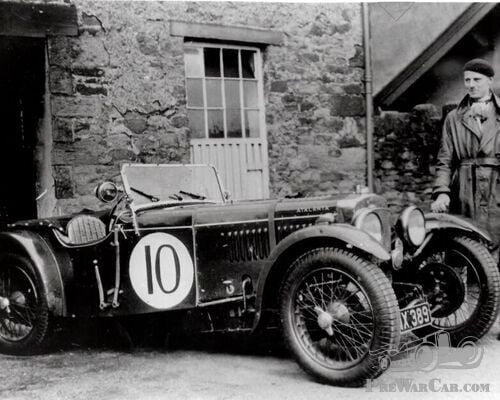
Fraser Nash TT Replica
AHX 389 ( chassis no. 2073, engine no. 10367).An important and correct short-chassis TT Replica with known history from new. Ex. H. P..
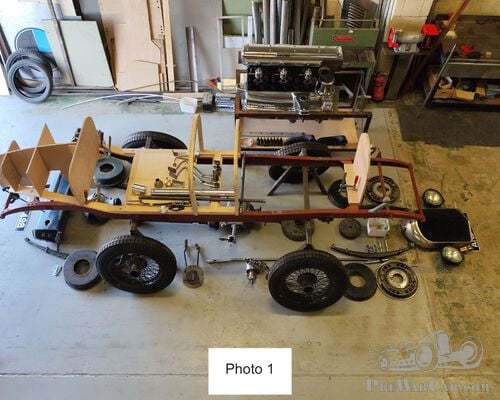
Bentley 3/6 litre sports racing car kit with V5C
I am a specialist vintage and classic car restorer with decades of hands-on experience. For some time I have been collecting parts for a special pr..
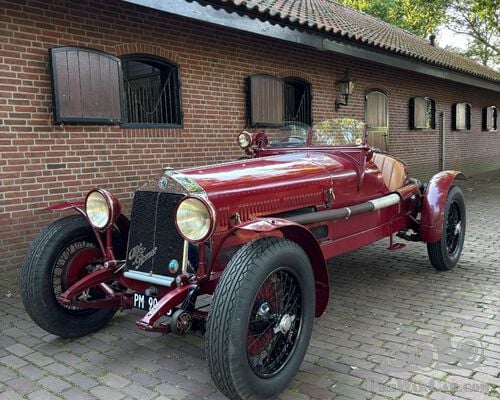
1930 Alfa Romeo 6C 1750 Spider
1930 Alfa Romeo 6C 1750 Spider with complete history from delivery to first owner in 1930 in Firenze till today with copy Libretto/license plate.