The global magazine and marketplace for classic car enthusiasts, by enthusiasts.


Filter
Classic Cameron, Saxon for sale - Cameron, Saxon cars for sale
-

1923 Rolls Royce Silver Ghost Alpine Eagle
1923 Rolls Royce Silver Ghost Alpine Eagle. Chassis Number: 44SG Registration Number: Spanish Registered. An extraordinary car with an extraordinary story: This Silver Ghost was bricked up in a Spanish nobleman's mansion in 1936. It slumbered there .. -
Packard single six convertible
Rare 1925 Packard Six Sedan – Unique 7-Seater Project with Belgian PapersA solid, rust-free base for the true vintage enthusiast.We are proud to offer this rare and stately 1925 Packard Six. In the 1920s, Packard was the ultimate symbol of American luxury and engineering. This specific model is a grand 7-seater, complete with the.. -
1930 Standard Avon Alvis 12/50 Supercharged Special
1930 Standard Avon Alvis 12/50 Supercharged Special Chassis Number: 29035 Registration Number: BF9202 The present owner began building the A-A in 1965. He had enjoyed driving his first real car, a 1929 12/50 Alvis Betleback and when he acquired a 1930 Standard Avon, he found tha.. -
1928 Cadillac Model 7980 convertible coupe
Cadillac is one of the pristine cars in American history, here we have a 1928 model 7980 convertible coupewith all options as twin wooden spare wheels, trunk rack, pilot ray lights (who follow the direction of the front wheels) etc.The engine is a V8 with 5588cc on a 3560 wheelbase. At 2200kg it is not a lightweight.We parti.. -
MG NA Magnette (Ex Beryl Markham)
MODEL OVERVIEW: By the early 1930s, MG had joined the fashionable trend of six cylinder sports and racing cars with the K and N Magnette models. MG’s road going overhead camshaft six cylinder cars we’re directly related to the works racing cars used to achieve phenomenal international competition success in period.The N Magnette series of.. -
1924 Bentley 3 4 ½ Litre
•Sold new to Major EG Thomson of Edinburgh, of Ecuire Ecosse fame •Owned for more than 50 years by the Martin family•Upgraded to 4.5 Litre spec using original crankcase•Extensive history file includes factory records and buff logbooks•Fully restored by Paul Grist to his ‘ultimate’ period look and specification .. -
HORCH 930 V
For SaleHorch 930 VManufacturer: HorchModel and Variant: 930 VBody Type: 4-door sedanChassis Number: 931906Color: Dark bluePower: 93 kWEngine Capacity: 3,796 ccFirst Registration: 01/07/1939Engine Type: Petrol, 8-cylinderMileage: 12,125 km -
1921 Rolls Royce 20hp Experimental tourer
1921 Rolls Royce 20hp Experimental tourer. Chassis number: 4G2 Registration Number: CH2892 Sir Henry Royces' personal car used for development of the 20HP chassis. He is pictured in it both at his French house; La Villa Mimosa in Le Canadel & also near his UK home "Elmsted" .. -
Oldsmobile Curved Dash Model 6C 7hp 1904
We have available for sale this exceptionally original 7hp Curved Dash Oldsmobile. Manufactured in 1904. Continuous ownership/history for many years. This is the larger engined motor car with rear brakes & larger hp. These are exceptionally good strong motor cars and can certainly cover some miles without any issues, well built & very go.. -
BMW 326 Cabriolet
DISPONIBLE PRES DE PARISRare version cabriolet 2 portes douanes EU acquittées, title américainNécessite une restauration totale, Voiture complète vendue avec un moteur complet en plus


Cameron
US, 1902 – 1921
(1) United Motor Co, Pawtucket, R.I., 1902 – 1903
(2) James Brown Machine Corp, Pawtucket, R.I., 1903 – 1904
(3) Cameron Car Co, Brockton, Mass.; New London, Conn., 1905 – 1908
(4) Cameron Car Co, Beverly, Mass.; New London, Conn., 1908 – 1912
(5) Cameron Motor Co, West Haven, Conn., 1912 – 1913
(6) Cameron Motor Co, New Haven, Conn., 1914 – 1916
(7) Cameron Motors Coorp, Norwalk, Conn., 1917 – 1918
(8) Cameron Motors Corp, Stamford, Conn., 1917 – 1921
Few cars have had so many changes of address and company organization as the Cameron. It began life as a light two-seater powered by a 6hp single-cylinder air-cooled engine, and using shaft drive. This lasted during the Pawtucket period, but with the formation of the Cameron Car Co. at Brockton larger cars with 2- or 3-cylinder engines of up to 12hp were made by Cameron. They had the gearbox mounted on the rear axle, a feature that was retained until the end of Cameron production. In 1908 a Cameron 20hp 4-cylinder car was introduced, still with air-cooling and a round bonnet rather like that of the contemporary Franklin. A Cameron six was made for a short time in the New London factory, and in 1913 came the first Cameron cars with water-cooled engines. Apart from the position of the gearbox the later Cameron cars were conventional cars, though the 1917 Cameron models had adjustable cantilever suspension. The Stamford factory was bought in 1917, and a 6-cylinder car was built in small numbers until 1921.
Source: Georgano, encyclopedia of motorcar; GNG
The information is written with the greatest of care. However, if you have any suggested amendments please contact us at office@prewarcar.com
Saxon
US, 1913 – 1923
Saxon Motor Car Co, Detroit, Mich.; Ypsilanti, Mich.
The Saxon car appeared in the winter of 1913-1914 as a small two-seater roadster with a 1.4-litre 4-cylinder engine, and 2-speed rear-axle gearbox, soon this engine on the Saxon car was replaced by a 3-speed unit. Electric lights were available on the Saxon car at extra cost. At $395 (£105 in England), these wire-wheeled Saxon cars caught the public fancy and although the Saxon car looked more like cyclecars than conventional small automobiles, sales were high from the first. Peak year was 1916, with 27.800 Saxon cars delivred. Continental and Ferro engines were used and several thousand Saxon cars had been sold, wooden artillery spoke wheels were available as an option. Various improvements on Saxon cars were noted through 1915 and a small number of delivery vans were produced to augment the roadster in the Saxon car range. By 1915, electric lighting was standard equipment on every Saxon car. A 2.9-litre 6-cylinder touring Saxib car still with rear-axle gearbox appeared in 1915 as a companion to the 4-cylinder roadsters which were retained until 1917, when Saxon cars reached tenth place in sales among American manufacturers. In 1920, a 4-cylinder ohv Saxon car reappeared and by 1921, sixes were discontinued. In the years following this reappearance the Saxon carmodels were known as Saxon-Duplex. Production of Saxon cars dropped rapidly, the last Saxon cars being sold early in 1923.
Source: Georgano, encyclopedia of motorcar; KM
The information is written with the greatest of care. However, if you have any suggested amendments please contact us at office@prewarcar.com


Featured
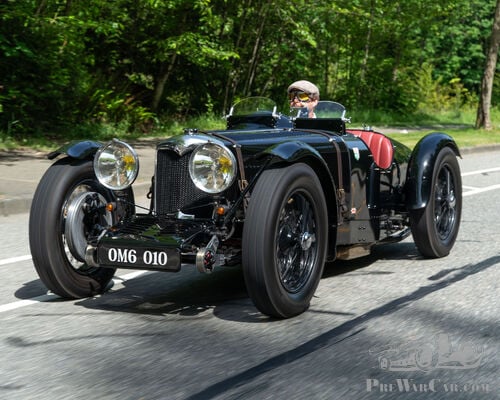
Riley 14/6 Special 1933
The ExperienceStep into the golden age of British motoring. This 1933 Riley 14/6 Special is a masterclass in pre-w..

1915 Rolls-Royce Silver Ghost Barker Tourer
⁃ An exceptionally rare original bodied pre-war Silver Ghost⁃ Desirable Barker tourer in exciting barn find condition⁃ ..