The global magazine and marketplace for classic car enthusiasts, by enthusiasts.


Filter
Classic Austro Daimler, Chalmers for sale - Austro Daimler, Chalmers cars for sale
-

Austro Daimler AD6 Restoration project
Austro Daimler AD6 open tourer restoration project. More details on application...Looking also for all spare parts of AD six cylinder 6-17 or ADV.

Austro-Daimler
Austria, 1899 – 1936
(1) Österreichische Daimler Motoren AG, Wiener-Neustadt, 1899 – 1934
(2) Steyr—Daimler-Puch AG, Wiener-Neustadt, 1934 – 1936
Austria’s most famous motor car, the Austro-Daimler, was born when Daimler of Cannstatt established a factory in Vienna for the manufacture of about 100 of its Daimler cars annually. The Austro-Daimler was a copy of its German parent. In 1906 the Austro-Daimler concern became a separate financial entity, and a year earlier, Ferdinand Porsche had replaced Paul Daimler at Wiener-Neustadt as director. A new era began, for Porsche was a designer with original ideas. He did not exercise them at once; the two 1909 Austro-Daimler models for sale were large well-made fours with side valves in a T-head and a choice of chain or live-axle drive. World-wide fame came to the Austro-Daimler company with their 1910 models, especially the Austro-Daimler 22/80ps model originally designed to win the Prince Henry Tour of that year. It accomplished this very convincingly. The five large valves per cylinder – one inlet, four exhaust – were actuated by a single overhead camshaft. A combination of well-shaped combustion chambers and light reciprocating parts made for an engine of an efficiency never before seen in a catalogued, non-racing car. Its 5.7-litres produced 95bhp. Even Porsche, however, felt that so much power could not be safely transmitted by a live axle, and chain drive was used initially. The Austro-Daimler 22/80’s small brother, the Austro-Daimler 16/18ps, had a side-valve L-head engine. After it had swept the board in the Austrian Alpine Tour of 1911, the Austro-Daimler 16/25ps Alpine variant was also for sale. In 1914 the range consisted of these three cars, the sv Austro-Daimler 20/30ps, and the luxurious Austro-Daimler 35/60ps also with side valves. Both Austro-Daimler and Daimler sold the Lohner-Porsche, the name given to the electric and petrol-electric cars designed by Porsche before he went to Wiener-Neustadt. The Vienna Austro-Daimler firm was Austria’s largest manufacturer of motorcars.
Immediately after World War 1 a few cars were assembled in Liège from pre-war Austro-Daimler parts by M. Klinkenhammers, and sold under the Alfa-Legia. On their home ground the company returned to high-grade fast tourers. As well as the old ‘Austro-Daimler 16/18’ and ‘Austro-Daimler 20/30’, they made the new Austro-Daimler AD617 for sale, a 6-cylinder car of 4.4-litres with a single overhead camshaft, that was succeeded in 1923 by its development, the Austro-Daimler ADV17/60ps for sale, which was the same but for its front wheel brakes. Four years earlier, Porsche had maintained his reputation for really exciting design by producing the Sascha-type Austro-Daimler, a 1100cc – later 1½-litre – racing voiturette. Its four cylinders, like the six of the Austro-Daimler AD617, were of aluminium, with detachable steel liners. There were two overhead camshafts, however, and dry sump lubrication. The power output was 50bhp. Four-wheel brakes were, of course, fitted.
Although Porsche left Vienna in 1923 to return to Daimler, he was mainly responsible for the new ADM type, which was offered alongside the Austro-Daimler ADV17/60 from that year. The Austro-Daimler ADM1 was basically similar, but had a smaller engine of 2½-litres, and its rounded radiator was a departure for the hitherto traditional Austro-Daimler V-shape. It was sold in sports from in 1925 as the Austro-Daimler ADMII. After 1926, the old Austro-Daimler ADV17/60 was dropped and the ADM engine was enlarged to three litres by increasing the bore. This Austro-Daimler ADMIII in sports form developed 100bhp at 400rpm, and could do more than 100mph. Porsche’s successor, Karl Rabe, designed the even more advanced ADR type. Its tubular backbone chassis and swing-axle independent rear suspension so resembled that of the Tatra that legal action was taken against Austro-Daimler. The Austro-Daimler ADR was available in sports or normal form. At first, the Austro-Daimler ADR used the old ADMIII engine, but the Austro-Daimler ADR6 Bergmeister of 1929, one of the most glamorous Austro-Daimler built, had a new 3.6-litre power unit providing 120bhp. This car was made until production ceased shortly after the Steyr-Daimler-Puch amalgamation in 1934. The Austro-Daimler ADR8, the firm’s first and last 8-cylinder car, designed for more formal bodies, had disappeared in 1933 after a life of three years.
Source: Georgano, encyclopedia of motorcar; TRN
The information is written with the greatest of care. However, if you have any suggested amendments please contact us at office@prewarcar.com
Chalmers / Chalmers-Detroit
US, 1908 – 1924
Chalmers Motor Car Co, Detroit, Mich.
The Chalmers was one of the most popular automobiles made in the United States for more than a decade. The Chalmers was the successor to the Thomas-Detroit which was built by a company which had been founded in 1906 by E.R. Thomas (builder of the Thomas car in Buffalo, N.Y.), Roy D. Chapin and Howard Earle Coffin; the two latter had previously served at Oldsmobile. The Thomas-Detroit of which some 500 were sold during the first year of production, was marketed through the parent firm in Buffalo which manufactured a larger line of cars under the Thomas emblem. The Thomas-Detroit was a medium priced four-cylinder car which had been designed by Coffin. In 1907, Hugh Chalmers, vice president of the National Cash Register Co and a noted salesman, entered the firm. Shortly after, he bought a half of E.R. Thomas’ stock and became president of the company which became the Chalmers-Detroit Motor Company. The Thomas-Detroit became the Chalmers-Detroit in 1908 and in 1910, the Chalmers. Open and closed Chalmers models in two lines comprised the Chalmers four-cylinder cars, with self-starters appearing in 1912. Chalmers (as Chalmers-Detroit) had distinguished itself in road races as early as 1908 when W.R. Burns won the Motor Parkway Sweekstakes at Jericho, N.Y., averaging 48.7mph in the six-lap 140.76 mile run.
In 1913, the Chalmers brought out its first 6-cylinder model, as well as the four and apart from small mechanical and design changes, continued both until 1914. The Chalmers four was dropped from the 1915 line, however, and sixes were to be used exclusively in Chalmers until the ending of manufacture. By 1915, some 20.000 Chalmers cars per year were coming off the Chalmers production line and would even exceed that figure before the advent of World War 1. In 1917, an L-head motor replaced the earlier overhead-valve type and on August 4th, Chalmers again headed racing news when Joe Dawson won the 24-hour stock Car Endurance Run at Sheepshead Bay, N.Y. Sales flagged following the end of the war and Hugh Chalmers, always the salesman, and with the realization that a competitor, Maxwell, wasn’t faring well either, arranged to lease his Chalmers plants to Maxwell, using his salesmanship to promote the two concerns and getting the benefit of Maxwell tooling and manufacturing equipment. By the early 1920s, however, many makes of cars were in financial difficulties due to over-expansion and recession, and Walter P. Chrysler was called in to try and reorganize Maxwell. Chrysler was at this time planning his own corporation and in 1922 Chalmers was taken over by Maxwell which had become a Chrysler subsidiary. The last Chalmer cars for sale were equipped with Lockheed hydraulic brakes but 1923 was the last year of Chalmers production with some 9000 units leaving the factories. The Maxwell survived until 1925 when it became the Chrysler Four.
Source: Georgano, encyclopedia of motorcar; KM
The information is written with the greatest of care. However, if you have any suggested amendments please contact us at office@prewarcar.com


Featured

HORCH 930 V
For SaleHorch 930 VManufacturer: HorchModel and Variant: 930 VBody Type: 4-door sedanChassis Number: ..
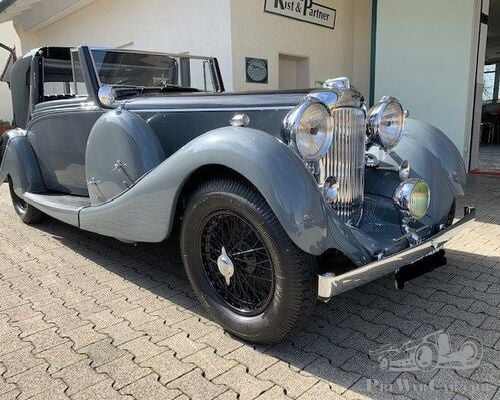
Lagonda LG 45 Coupe de Ville Sedanca by Mayfair
The successor to the M45, the LG45 was built around the same highly capable, competition-proven 4.5-litre Meadows inline-six engine, but featured r..

1915 Rolls-Royce Silver Ghost Barker Tourer
⁃ An exceptionally rare original bodied pre-war Silver Ghost⁃ Desirable Barker tourer in exciting barn find condition⁃ ..