The global magazine and marketplace for classic car enthusiasts, by enthusiasts.


Filter
Classic Bean, Chalmers for sale - Bean, Chalmers cars for sale
-

Circa 1928 Bean 14 hp rolling chassis
Circa 1928 Bean 14 hp rolling chassis for sale. This would be an ideal project to build a special sporty body on . Look at the large frontwheel brakes a la Delage and more powerful engine. Not many of these 14hp Beans are around . The price includes all shipping costs to Europe and the import vat . £ 8500.

Bean
GB, 1919 – 1929
(1) A. Harper, Sons & Bean Ltd, Tipton, Dudley, Worcs., 1919 – 1926
(2) Bean Cars Ltd, Tipton, Dudley, Staffs., 1926 – 1929
The Bean was a remodeling of the Perry light car, whose manufacturers were taken over by Harper Sons & Bean, motor components makers, after World War 1. The Bean was to be mass-produced, in one 11.9hp model only. Its makers were members of a consortium of firms, including the famous, old-established names of Swift and Vulcan, Hadfields, the engineers of Sheffield, Gallay Radiators and Marles Steering, that was intended to achieve efficient quantity production by rationalization of parts. In fact, Bean carried cost cutting too far with this car. Its 4-cylinder, side-valve 1794cc engine was rough, the gear change difficult and the suspension harsh. The Bean four-seater open body cost only £80. However, 1922 customers were car-starved and undiscriminating, and 80 Bean cars a week were made that year, even if the first target of 50.000 Beam cars per annum remained a dream. The bigger, 2.3-litre Bean Fourteen introduced for 1924 was more modern machine, with its unit construction of engine and gearbox.
Hadfields took over Bean early in 1926. For 1927, the Bean company followed fashion by introducing a six, the ‘Bean 18/50’. Its 2.7-litre, overhead-valve engine was made by Meadows, and a rather square radiator replaced the well-known rounded Bean shape. Also new in 1927 was the Bean Imperial Six, the first Bean designed specifically for export. Unlike the Bean 18/50 for sale this had a Bean-built engine of 3.8-litres with a Ricardo cylinder head. The Australian explorer Francis Birtles drove a disintegrating Bean prototype from England to India, and in fact the Bean Imperial Six was never put into production. From 1927 all cars were called Hadfield-Beans. The 2.3-litre 14/40 Hadfield-Bean, which joined the range in 1928, was no better, with its unreliable engine and overhead-worm drive rear axle, bad brakes and difficult clutch- and gear-change. It was also old-fashioned in that it used a fairly large, long-stroke, side-valve 4-cylinder engine. The latter was economical, and the 14/40 Hadfield-Bean for sale was cheap, but cost cutting presumably dictated the fitting of quarter-elliptic rear springs, which cannot have improved comfort. There was a Bean 14/70hp sports version, which had better brakes, with Dewandre vacuum servo assistance, but the only good car in the range, the old Hadfield-Bean Fourteen for sale, was desperately out-dated and no Hadfield-Beans at all were made after 1929.
Source: Georgano, encyclopedia of motorcar; TRN
The information is written with the greatest of care. However, if you have any suggested amendments please contact us at office@prewarcar.com
Chalmers / Chalmers-Detroit
US, 1908 – 1924
Chalmers Motor Car Co, Detroit, Mich.
The Chalmers was one of the most popular automobiles made in the United States for more than a decade. The Chalmers was the successor to the Thomas-Detroit which was built by a company which had been founded in 1906 by E.R. Thomas (builder of the Thomas car in Buffalo, N.Y.), Roy D. Chapin and Howard Earle Coffin; the two latter had previously served at Oldsmobile. The Thomas-Detroit of which some 500 were sold during the first year of production, was marketed through the parent firm in Buffalo which manufactured a larger line of cars under the Thomas emblem. The Thomas-Detroit was a medium priced four-cylinder car which had been designed by Coffin. In 1907, Hugh Chalmers, vice president of the National Cash Register Co and a noted salesman, entered the firm. Shortly after, he bought a half of E.R. Thomas’ stock and became president of the company which became the Chalmers-Detroit Motor Company. The Thomas-Detroit became the Chalmers-Detroit in 1908 and in 1910, the Chalmers. Open and closed Chalmers models in two lines comprised the Chalmers four-cylinder cars, with self-starters appearing in 1912. Chalmers (as Chalmers-Detroit) had distinguished itself in road races as early as 1908 when W.R. Burns won the Motor Parkway Sweekstakes at Jericho, N.Y., averaging 48.7mph in the six-lap 140.76 mile run.
In 1913, the Chalmers brought out its first 6-cylinder model, as well as the four and apart from small mechanical and design changes, continued both until 1914. The Chalmers four was dropped from the 1915 line, however, and sixes were to be used exclusively in Chalmers until the ending of manufacture. By 1915, some 20.000 Chalmers cars per year were coming off the Chalmers production line and would even exceed that figure before the advent of World War 1. In 1917, an L-head motor replaced the earlier overhead-valve type and on August 4th, Chalmers again headed racing news when Joe Dawson won the 24-hour stock Car Endurance Run at Sheepshead Bay, N.Y. Sales flagged following the end of the war and Hugh Chalmers, always the salesman, and with the realization that a competitor, Maxwell, wasn’t faring well either, arranged to lease his Chalmers plants to Maxwell, using his salesmanship to promote the two concerns and getting the benefit of Maxwell tooling and manufacturing equipment. By the early 1920s, however, many makes of cars were in financial difficulties due to over-expansion and recession, and Walter P. Chrysler was called in to try and reorganize Maxwell. Chrysler was at this time planning his own corporation and in 1922 Chalmers was taken over by Maxwell which had become a Chrysler subsidiary. The last Chalmer cars for sale were equipped with Lockheed hydraulic brakes but 1923 was the last year of Chalmers production with some 9000 units leaving the factories. The Maxwell survived until 1925 when it became the Chrysler Four.
Source: Georgano, encyclopedia of motorcar; KM
The information is written with the greatest of care. However, if you have any suggested amendments please contact us at office@prewarcar.com


Featured

Alfa 6C1750 Spider
Alfa 6C1750 Spider with complete history from delivery in 1930 to first owner in Firenze till today with copy Libretto/license plate all the years
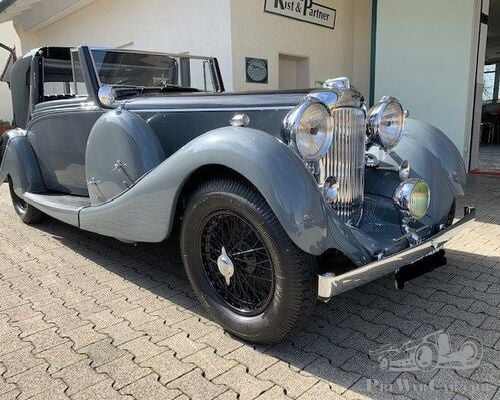
Lagonda LG 45 Coupe de Ville Sedanca by Mayfair
The successor to the M45, the LG45 was built around the same highly capable, competition-proven 4.5-litre Meadows inline-six engine, but featured r..
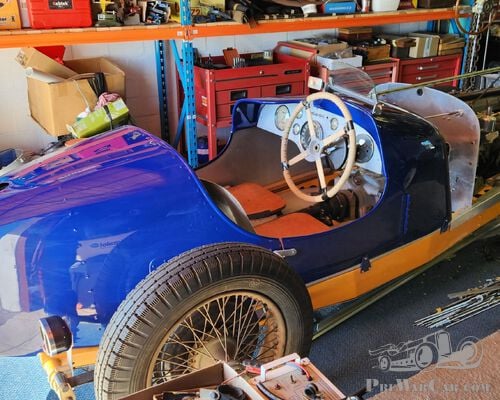
Riley TT Sprite
1935 6-cylinder TT Sprite replica. Chassis # 46A2722. Engine # 6A2722. Original Ulster Imp body. Restoration nearing completion. Engine, Ge..