The global magazine and marketplace for classic car enthusiasts, by enthusiasts.


Filter
Classic Chalmers, Imperia for sale - Chalmers, Imperia cars for sale
-

Imperia 8/25 racing/sport car
Imperia 8/25 racing/sport car with Couchard patent slide-valve engine. Fully restored car, the radiator cooling design is very special and unique. Hallot cable braking system. (make an offer or proposal for an exchange) -
Imperia 8/25 1923
Imperia 8/25 1923,Couchard patent slide-valve engine,fully restored rolling chassis,interior still needs finishing.(make an offer or proposal for an exchange)


Chalmers / Chalmers-Detroit
US, 1908 – 1924
Chalmers Motor Car Co, Detroit, Mich.
The Chalmers was one of the most popular automobiles made in the United States for more than a decade. The Chalmers was the successor to the Thomas-Detroit which was built by a company which had been founded in 1906 by E.R. Thomas (builder of the Thomas car in Buffalo, N.Y.), Roy D. Chapin and Howard Earle Coffin; the two latter had previously served at Oldsmobile. The Thomas-Detroit of which some 500 were sold during the first year of production, was marketed through the parent firm in Buffalo which manufactured a larger line of cars under the Thomas emblem. The Thomas-Detroit was a medium priced four-cylinder car which had been designed by Coffin. In 1907, Hugh Chalmers, vice president of the National Cash Register Co and a noted salesman, entered the firm. Shortly after, he bought a half of E.R. Thomas’ stock and became president of the company which became the Chalmers-Detroit Motor Company. The Thomas-Detroit became the Chalmers-Detroit in 1908 and in 1910, the Chalmers. Open and closed Chalmers models in two lines comprised the Chalmers four-cylinder cars, with self-starters appearing in 1912. Chalmers (as Chalmers-Detroit) had distinguished itself in road races as early as 1908 when W.R. Burns won the Motor Parkway Sweekstakes at Jericho, N.Y., averaging 48.7mph in the six-lap 140.76 mile run.
In 1913, the Chalmers brought out its first 6-cylinder model, as well as the four and apart from small mechanical and design changes, continued both until 1914. The Chalmers four was dropped from the 1915 line, however, and sixes were to be used exclusively in Chalmers until the ending of manufacture. By 1915, some 20.000 Chalmers cars per year were coming off the Chalmers production line and would even exceed that figure before the advent of World War 1. In 1917, an L-head motor replaced the earlier overhead-valve type and on August 4th, Chalmers again headed racing news when Joe Dawson won the 24-hour stock Car Endurance Run at Sheepshead Bay, N.Y. Sales flagged following the end of the war and Hugh Chalmers, always the salesman, and with the realization that a competitor, Maxwell, wasn’t faring well either, arranged to lease his Chalmers plants to Maxwell, using his salesmanship to promote the two concerns and getting the benefit of Maxwell tooling and manufacturing equipment. By the early 1920s, however, many makes of cars were in financial difficulties due to over-expansion and recession, and Walter P. Chrysler was called in to try and reorganize Maxwell. Chrysler was at this time planning his own corporation and in 1922 Chalmers was taken over by Maxwell which had become a Chrysler subsidiary. The last Chalmer cars for sale were equipped with Lockheed hydraulic brakes but 1923 was the last year of Chalmers production with some 9000 units leaving the factories. The Maxwell survived until 1925 when it became the Chrysler Four.
Source: Georgano, encyclopedia of motorcar; KM
The information is written with the greatest of care. However, if you have any suggested amendments please contact us at office@prewarcar.com
Imperia
B, 1906 – 1949
(1) Automobiles Imperia, Liège, Nessonvaux, 1906 – 1929
(2) SA des Automobiles Imperia-Excelsior, Nessonvaux, 1929 – 1949
The first Imperia cars were the work of the German Paul Henze, who himself handled an 8-litre car in the 1907 Kaiserpreis. At first only a Imperia 24/30hp four of 4.9-litres was marketed with low tension magneto and coil-ignition, 4-speed gearbox, and shaft or side-chain drive. The smaller 3-litre Imperia car that followed was shaft-driven, and a 1.767cc monobloc four arrived during 1909. As late as 1911 an immense, Kaiserpreis-inspired chain-driven 9.9-litre 50/60 Imperia car was still offered. In 1912 Imperia cars merged with Springuel, but though the latter name soon vanished, Jules Springuel took over the management, and some Springuel designs were sold under the Imperia car companies name. In 1914 Imperia cars in a range of conventional, well-made small volume fours, of 1.8-litres, 2.6-litres, 3.6-litres and 5-litres was offered.
In 1919 the Imperia car company took over the manufacture of the Spanish Abadal (this had always had a substantial Belgium content), offering both a 3-litre Imperia Type E, and the Hispano-Suiza-like 80x180mm 3.6-litre Imperia Type T, complete with handsome V-radiator as found on subsequent Imperias. These Imperia cars were made in small numbers until 1922, though a 6-litre twin-carburettor sohc Imperia-Abadal straight-9 with Perrot fwb on a 12ft wheelbase never progressed beyond the prototype stage. Equally short-lived Imperia car, was a promosing sports car, the long-stroke 16-valve ohc 4-cylinder 3-litre with which de Tornaco won the 1922 Belgium GP. In 1923 M.A. van Roggen, now in charge at Nessonvaux, came up with his side-valve 1.100cc 6CV Imperia car, a small tourer of Panhard-like appearance, but with an unusual servo-assisted foot transmission brake – brakes on the front wheels were standardized in 1925 on Imperia cars. This Imperia car was quite successful, winning the small-car class of the 1926 Monte Carlo Rally and selling 504 Imperia cars in 1927, but Van Roggen’s ‘empire-building’ did not prosper: plans to produce 6CVs in France (at the Voisin works) and at the British GWL factory proved abortive. The 1928 Imperia car season brought a companion 1.642cc six, later enlarged to 1.8-litres and available in 3-carburettor sporting form, and in this period Imperia cars acquired Excelsior, Nagant (who were converted to making 6-cylinder engines), and the Matthys et Osy coachbuilding works. The slide-valve Imperia car models survived until 1934, acquiring hydraulic brakes at the end, but in 1934 Imperia took out a licence to build fwd Adlers, and until 1940 these were their staple; the 995cc Trumpf-Junior, the 1.645cc Trumpf, and the later Zweiliter were all made. In 1935 the Imperia car company fused with the only other surviving Belgian private-car maker, Minerva, and the big sleeve-valve models from Antwerp disappeared for good.
In 1947 there was a brief revival by Imperia cars with the Imperia TA8, a synthesis of pre-World War 2 fwd models by Adler and Amilcar, powered by the 1.340cc ohv 4-cylinder engine used in 1940 Amilcars. Features of this Imperia car were fravity feed, hydraulic brakes, a 3-speed gearbox with dashboard change, and composite wood and metal coachwork.
D, 1935
Imperia-Werk AG, Bad Godesberg
The German Imperia factory, well-known for its motorcycles, had already experimented with Imperia cars in 1924/ 1925, but production on a limited scale of Imperia cars was not started until 1935. A 3-cylinder 2-stroke 750cc radial engine mounted in the rear of the Imperia car was used for a streamlined two-seater coupé and for a small monoposto racing Imperia car, both with independent wheel suspension. Financial difficulties stopped production of Imperia cars at an early stage.
Source: Georgano, encyclopedia of motorcar; MCS, HON
The information is written with the greatest of care. However, if you have any suggested amendments please contact us at office@prewarcar.com


Featured

HORCH 930 V
For SaleHorch 930 VManufacturer: HorchModel and Variant: 930 VBody Type: 4-door sedanChassis Number: ..
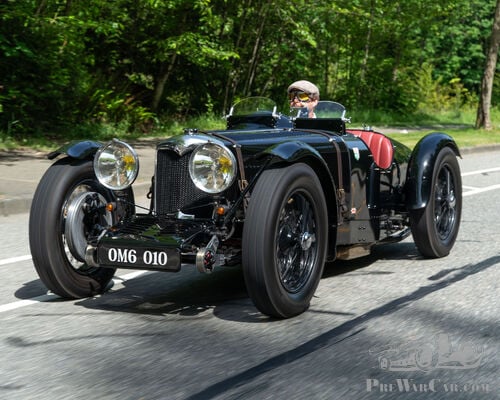
Riley 14/6 Special 1933
The ExperienceStep into the golden age of British motoring. This 1933 Riley 14/6 Special is a masterclass in pre-w..

Alfa 6C1750 Spider
Alfa 6C1750 Spider with complete history from delivery in 1930 to first owner in Firenze till today with copy Libretto/license plate all the years