The global magazine and marketplace for classic car enthusiasts, by enthusiasts.


Filter
Classic Chalmers, Rosengart for sale - Chalmers, Rosengart cars for sale
-

Rosengart LR 4 2 1939
An exceptionally beautiful 1939 Rosengart.Restored to the finest detail.Beautiful genuine leather interior.The paintwork, interior, and mechanical overhaul have represented a substantial investment. An appraisal report is available, valuing the car at €22,500.Part of a private collection since 2019.Only require.. -
Rosengart LR4N2 1938 – Rare Pre-War French Saloon – Restoration Project
Na sprzedaż: Rosengart LR4N2 z 1938 roku Rzadki francuski samochód przedwojenny, projekt do renowacji. Sprzedaję projekt..


Chalmers / Chalmers-Detroit
US, 1908 – 1924
Chalmers Motor Car Co, Detroit, Mich.
The Chalmers was one of the most popular automobiles made in the United States for more than a decade. The Chalmers was the successor to the Thomas-Detroit which was built by a company which had been founded in 1906 by E.R. Thomas (builder of the Thomas car in Buffalo, N.Y.), Roy D. Chapin and Howard Earle Coffin; the two latter had previously served at Oldsmobile. The Thomas-Detroit of which some 500 were sold during the first year of production, was marketed through the parent firm in Buffalo which manufactured a larger line of cars under the Thomas emblem. The Thomas-Detroit was a medium priced four-cylinder car which had been designed by Coffin. In 1907, Hugh Chalmers, vice president of the National Cash Register Co and a noted salesman, entered the firm. Shortly after, he bought a half of E.R. Thomas’ stock and became president of the company which became the Chalmers-Detroit Motor Company. The Thomas-Detroit became the Chalmers-Detroit in 1908 and in 1910, the Chalmers. Open and closed Chalmers models in two lines comprised the Chalmers four-cylinder cars, with self-starters appearing in 1912. Chalmers (as Chalmers-Detroit) had distinguished itself in road races as early as 1908 when W.R. Burns won the Motor Parkway Sweekstakes at Jericho, N.Y., averaging 48.7mph in the six-lap 140.76 mile run.
In 1913, the Chalmers brought out its first 6-cylinder model, as well as the four and apart from small mechanical and design changes, continued both until 1914. The Chalmers four was dropped from the 1915 line, however, and sixes were to be used exclusively in Chalmers until the ending of manufacture. By 1915, some 20.000 Chalmers cars per year were coming off the Chalmers production line and would even exceed that figure before the advent of World War 1. In 1917, an L-head motor replaced the earlier overhead-valve type and on August 4th, Chalmers again headed racing news when Joe Dawson won the 24-hour stock Car Endurance Run at Sheepshead Bay, N.Y. Sales flagged following the end of the war and Hugh Chalmers, always the salesman, and with the realization that a competitor, Maxwell, wasn’t faring well either, arranged to lease his Chalmers plants to Maxwell, using his salesmanship to promote the two concerns and getting the benefit of Maxwell tooling and manufacturing equipment. By the early 1920s, however, many makes of cars were in financial difficulties due to over-expansion and recession, and Walter P. Chrysler was called in to try and reorganize Maxwell. Chrysler was at this time planning his own corporation and in 1922 Chalmers was taken over by Maxwell which had become a Chrysler subsidiary. The last Chalmer cars for sale were equipped with Lockheed hydraulic brakes but 1923 was the last year of Chalmers production with some 9000 units leaving the factories. The Maxwell survived until 1925 when it became the Chrysler Four.
Source: Georgano, encyclopedia of motorcar; KM
The information is written with the greatest of care. However, if you have any suggested amendments please contact us at office@prewarcar.com
Rosengart
France, 1928 – 1955
(1) Automobiles L. Rosengart, Neuilly-sur-Seine, 1928 – 1937
(2) Société Industrielle de l’Ouest Parisienne, Paris, 1937 – 1955
The first Rosengart cars were made in the old Bellanger factory under the direction of Lucien Rosengart and Jules Salomon (the designer of the original Citroëns). The Rosengart cars were Austin Sevens built under licence, and differed from their British prototypes mainly in matters of styling: for example the ribbon radiator shells, not adopted by Birmingham until late 1930. Production had reached 28 Rosengart cars a day by the summer of 1930, and the Austin theme was continued by Rosengart cars until the end of pre-World War 2 production, though 1932 and subsequent Rosengart cars had a longer wheelbase and semi-elliptic rear suspension. By 1939, when a roadster Rosengart car could be bought for the equivalent of £78, the chassis had channel-section side members. In the 1932 range of Rosengart cars there was also a 1.100cc 20bhp 6-cylinder, which Rosengart car was virtually an elongated 5CV with 3-speed gearbox and vacuum-servo brakes. A line of fwd 4-cylinder sv Rosengart cars began in 1933, with transverse independent front suspensions, built under Adler licence and based on the German company’s 1.6-litre Trumpf. A more conventional rear-driven Rosengart car was sold ast he ‘8/40’.
Fwd Rosengart cars were still marketed in 1939, but by this time the Rosengart cars were based on the 11CV Citroën, from which they derived their 1.9-litre ohv engines, 3-speed synchromesh gearboxes, and hydraulic brakes. Sporting 2-door saloon Rosengart car and cabriolet bodies were mounted on a platform-type chassis. Similar bodies were used on the 1947 Super-Trahuit, but the Super-Traction fwd structure now housed a 95bhp 3.9-litre sv Mercury engine. Such a car was an unrealistic proposition in the prevailing economic climate, and 1952 brought Rosengart cars a return to the Austin Seven theme – the sv 747cc engine now gave 21bhp, and the Rosengart Ariette and Rosengart Artisane saloons had modern styling, transverse independent front suspension and hydraulic brakes. Speeds of 60mph were claimed on these Rosengart cars.
The last of the line of Rosengart cars, the Rosengart Sagaie of 1954, abandoned the old sv four in favour of a 40bhp, 750cc, ohv air-cooled flat-twin engine. Saloon and convertible models Rosengart cars were made, and it was said to do 70mph, but failed to compete with Renault and Panhard.
Source: Georgano, encyclopedia of motorcar; MCS
The information is written with the greatest of care. However, if you have any suggested amendments please contact us at office@prewarcar.com


Featured

HORCH 930 V
For SaleHorch 930 VManufacturer: HorchModel and Variant: 930 VBody Type: 4-door sedanChassis Number: ..
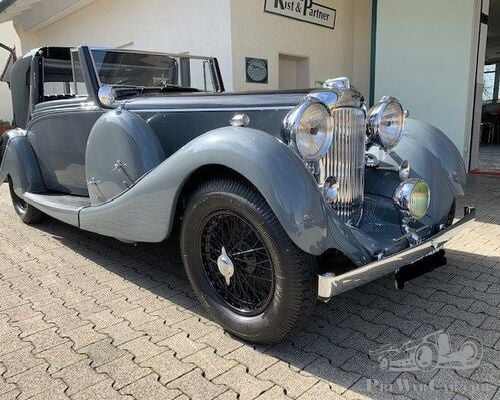
Lagonda LG 45 Coupe de Ville Sedanca by Mayfair
The successor to the M45, the LG45 was built around the same highly capable, competition-proven 4.5-litre Meadows inline-six engine, but featured r..
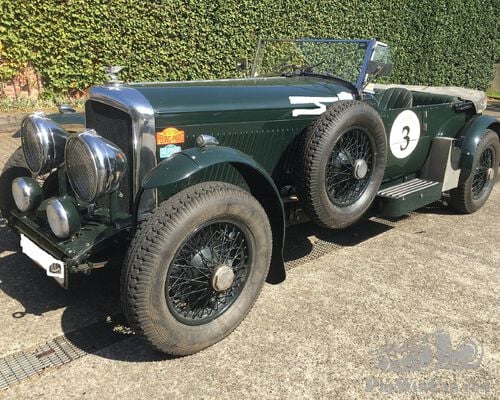
Bentley Derby Special Open Rally Car
This Bentley Derby, manufactured in 1935, has been rebuilt into a short and long-distance rally car. Full rebuilt engine in 2021, Since 2021 low mi..