The global magazine and marketplace for classic car enthusiasts, by enthusiasts.


Filter
Classic Chenard Walcker, Crossley for sale - Chenard Walcker, Crossley cars for sale
-

1917 Buick for sale
4 cylinder over head valve engine 35hp.3 speed conventional gear box.Electric start,electric lights and indicators fitted.Side screens and full length hood for weather protection.Older restoration,new radiator core fitted recently.An excellent reliable car with Veteran Car Club Certificate -
Riley TT Sprite
1935 6-cylinder TT Sprite replica. Chassis # 46A2722. Engine # 6A2722. Original Ulster Imp body. Restoration nearing completion. Engine, Gearbox and Diff have been rebuilt.Requires aluminium bonnet (material supplied), wiring, seat upholstery and fettling to finish.Comes with many spares including complete pre-select and ma.. -
Rosengart LR4N2 1938 – Rare Pre-War French Saloon – Restoration Project
For sale: 1938 Rosengart LR4N2, an exceptionally rare French pre-war automobile and an increasingly hard-to-find restoration project. The car is registered in Poland and comes with valid registration documents. The original Rosengart identification plate is present. The vehicle retains a high level of originality and appears largely complete, i.. -
rare Peerless for sale
The Peerless Motor Corporation of Cleveland, Ohio, manufactured high-quality cars between 1900 and 1931. Peerless, along with Packard and Pierce-Arrow, became known as the ‘Three P’s of Motordom’ (top-of-the-range cars) in the United States. The car offered for sale is one of the very few vehicles still in existence today. The new car was import.. -
Lancia Lambda 3rd Series Torpedo
With a monocoque body, four-wheel brakes, independent front suspension and V4 overhead camshaft engine, many enthusiasts view the Lancia Lambda as one of the great and innovative automobiles of all time. The Lambda was also successful in competition with privately entered cars finishing fourth and fifth behind the works OMs in the first Mille Migli.. -
Highly Awarded 1936 Delahaye 135 Competition Streamlined Disappearing Top Convertible, Figoni-Falaschi Masterpiece
This is the 1936 "Talk of Paris" car, the beginning of the famed Figoni Streamlined Teardrop Period, an objet d'artFigoni et Falaschi Centennial One of one; pièce unique Figoni streamlined Design #581One of the most highly awarded cars in the world....Best of.. -
1932 Rolls-Royce Phantom II Continental Drophead Coupe by Carlton
Vintage and Prestige are proud to offer this 1932 Rolls-Royce Phantom II Continental Drophead Coupe by Carlton For Sale. Previous UK Registration: 544 YUS Chassis no: 32MS Engine no: HD 55 Mileage shown: 22,480 32MS was first ordered by the Duke of Sutherland; Sir G.. -
1928 Packard 533 Golfers Coupe
1928 Packard 533 Golfers Coupe Chassis number 144148RRegistration number: UC1064 Vintage and Prestige Fine Motor Cars are proud to be offering this 1928 Packard 533 Golfers Coupe for sale. A spectacular Packard in mint order throughout. This right hand drive example was sold new to the UK in 1928 and has remained here since... -
1925 Triumph Model P Mk1
1925 Triumph Model P Frame Number: 903083 Well presented and restored to a high standard Mk1 Model P Triumph, correct numbers and complete with a dating letter from the Triumph Owners Club. A Landmark model produced by Triumph from 1924 onwards at their Priory Street factoryFitt..


Chenard-Walcker
France, 1901 – 1946
(1) Chenard, Walcker et Cie, Asnières, Seine, 1901 – 1907
(2) SA des Anciens Établissements Chenard et Walcker, Gennevilliers, Seine, 1907 – 1946
The Chenard-Walcker company was founded in 1899 and made tricycles before exhibiting the first Chenard-Walcker car at the 1901 Paris Salon. It was a 1.160cc twin with mechanically operated side valves in a T-head, coil ignition, four forward speeds, and a flitchplate frame. The most interesting feature was, however, the ‘double’ back axle with the drive taken by two cardan shafts independently of a second, dead axle beam. This was to be a feature of the Chenard-Walcker make until the middle 1920s, though at first a cheaper Chenard-Walcker 10hp car was for sale with conventional drive, and there as also a short-lived Chenard-Walcker 12hp twin with side-chain transmission in 1904. A 4.1-litre 4-cylinder with Iow-tension magneto ignition followed in 1903, and by 1905 only Chenard-Walcker fours were made, the smallest short-stroke 2.6-litre was made exclusively for export to Britain. By 1906 the Chenard-Walcker cars for sale had the classic radiator with round core. In 1907 Chenard-Walcker cars had pressed-steel chassis, twin transmission brakes, and no hand throttle. New during 1908 was a 9/10hp single that had a 4-speed gearbox, though neither this nor its companion twin was quoted after 1910, by which time L-head engines had arrived on the 2.1-litre P-type. From 1912 to 1914 the Chenard-Walcker cars had monobloc power units with full-pressure lubcrication. Friction dampers were standard, and capacities of the fours were 1.6-litres and 3-litres. A big six joined the Chenard-Walcker range in 1913.
The staple 1919 Chenard-Walcker was the usual uprated 1914 design, the 3-litre Chenard-Walcker UU, still with separate 4-speed gearbox and foot transmission brake; it was joined by a 2651cc Chenard-Walcker 12CV in 1920, and by a 2-litre, the Chenard-Walcker TT, in 1921, and a 3-speed 1½-litre Chenard-Walcker Type Y, appeared in 1923, these old-fashioned machines persisiting for several years. New in 1922, however, was the Touté-designed 3-litre, an ohc four with dry-sump lubcrication that gave close on 90bhp, and had the usual Hallot servo brakes on front wheels and transmission only. These Chenard-Walcker cars finished 1st and 2nd in the first Le Mans 24-Hour Race of 1923, as well as winning the 1924 Circuit des Routes Pavées. A 2-litre edition followed soon afterwards, these sports Chenard-Walcker cars being made until 1927. From 1925 there were also parallel sv touring editions of Chenard-Walcker with similar chassis and plug covers giving the appearance of ohv units.
In 1924 and 1925 the Chenard-Walcker company raced a bi-block straight-8 which in its final form had brakes on all four wheels, and achieved nearly 110mph on 130bhp. But it was never reliable though it was catalogued, at 84.525 francs for a Chenard-Walcker tourer. Much more successful were the 1100cc ‘Chenard-Walcker tanks’ for sale with 55bhp 2-bearing pushrod engines and differential-less back axles that had two successful racing seasons (1925 and 1926) and even staged a comeback in 1937, when two Chenard-Walcker examples finished 1st and 2nd in the Bol d’Or. For 1927 the company introduced the 8CV Chenard-Walcker Z2, a tough little family car with 1300cc sv short-stroke engine, magneto ignition, 4-speed gearbox, conventional rear axle, and fabric bodywork; it sold for 24.000 francs. That year, however, an association with Delahaye, which lasted until 1932, led to the rationalization of both companies’ ranges, and it became difficult to tell the two makes apart. A production edition of the ‘Chenard-Walcker tank’ came out in 1928 with a 1½-litre ioe engine, but this was the last Chenard-Walcker with any sporting potential; the range now consisted of pedestrian sv fours, plus a couple of Delahaye-like ioe sixes with capacities of 2½-litres and 2.9-litres. The smaller of these, the Chenard-Walcker 14CV, was still being made in 1934. In 1932 the Chenard-Walcker T11 appeared, a new 12CV four on the usual lines with a free-wheel as standard equipment. Then in 1934 Chenard-Walcker cars, now free of Delahaye influence, adopted transverse ifs. They also offered a 3560cc sv V8, the Chenard-Walcker Aigle 8, which used their own engine, in effect a double T11 unit. In 1935 the Chenard-Walcker cars had torsion-bar front suspension and the option of a Cotal gearbox, and ohv engines became available; the range consisted of two fours and the eight. A 4-cylinder fwd car did not go into production.
From 1937 onwards Chenard-Walcker cars slowly lost their individuality. Their bodies were replaced by Chausson coachwork identical to that of the Matford, and only one Chenard-Walcker model retained the 2.180cc ohv Chenard-Walcker engine. The other Chenard-Walcker cars had 1911cc 4-cylinder Citroën and 3622cc Matford units. Finally Citroën and Matford chassis were adopted as well and the Chenard engine dropped, the only ‘native’ components of the cars being their back axles – though the cabriolets were quite handsome, being of Vutotal type with no screen pillars. A few Chenard-Walcker 11CV and 21CV cars were made after World War 2, but from 1947 the staple Chenard-Walcker product was a forward-control light van, the development of which was continued by Peugeot after that company took over in 1951.
Source: Georgano, encyclopedia of motorcar; MCS
The information is written with the greatest of care. However, if you have any suggested amendments please contact us at office@prewarcar.com
Crossley
GB, 1904 – 1937
(1) Crossley Brothers Ltd, Gorton, Manchester, 1904 – 1910
(2) Crossley Motors Ltd, Gorton, Manchester, 1910 – 1937
The name of Crossley was famous on engines before it was famous on cars; in fact the Crossley company was the first in Britain to make 4-stroke internal combustion engines on the Otto principle. Later, Daimler engines were made under licence. The first Crossley car for sale, a chain-driven 22hp 4-cylinder, appeared for the 1904 season. A Crossley 28hp and Crossley 40hp followed, all three cars being of normal design and foreign inspiration. Their designer was J.S. Critchley, formerly of Daimler. Shaft drive appeared in 1906, and late in 1909, some were fitted with Allen-Liveredge front-wheel brakes, but Crossley cars, though excellent machines, made little impression until after 1910. The 4-litre 20hp Crossley which then made its bow was a well-constructed, durable and very popular car. Designed by A.W. Reeves, it lived on in modified form until 1925. Crossley’s finest hour came in World War 1, when, as the Crossley 20/25hp it achieved fame as a staff car in the Royal Flying Corps, and as an ambulance and light truck. The Crossley model was extremely popular with the British Royal Family after the war in its 25/30hp version. In its early years, however, it was rivalled by the 15hp. The efficiency of the latter’s otherwise conventional engine, a side-valve four like the rest, gave this Crossley a better performance than most cars in its class and encouraged the makers to offer a special sporting variant, the Crossley Shelsley.
The Crossley Fifteen was discontinued after 1914, but a new Crossley arrived for 1921. This Crossley 19.6hp was a rather more modern design, having a detachable cylinder head, and it was cheaper and lighter on fuel than its 25/30hp companion. The performance was about the same. It was also made in sporting form as the Crossley 20/70hp, but this model was heavy, like the ’Crossley 19.6’ itself, and the brakes were not good enough for the 75mph that was available. Crossley did not make a serious attempt to invade the middle-class market until 1923, when the Crossley 12/14hp, later called the Crossley Fourteen, was introduced. Like its brothers, this was a simple side-valve four, in this case of 2.4 litres, but was more modern, with its unit construction of engine and gearbox and central gear-change. The Crossley Fourteen was a very successful model, being flexile and, thanks to its light weight, both roomy and economical. It survived until 1927. By this time the two bigger Crossley cars were giving way to a much more up-to-date car; the Crossley company’s first six and its first overhead-valve machine. This Crossley 18/50hp model was a spacious, heavy 2.6-litre car with good brakes but somewhat lacking in power. Its engine was enlarged to 3.2-litres and 20.9hp for 1928. At the same time a new small Crossley of similar design, the 2-litre Crossley 15.7hp was introduced, to which a sporting alternative reviving the Shelsley name was added in 1929. Lagonda’s 16/80 model used this engine later. The 6-cylinder Crossley 15.7hp continued until 1934 and the Crossley 20.9hp until 1937. Wilson pre-selector gearboxes were fitted from 1934.
In 1932, the Crossley company had introduced a light car, the Crossley Ten. This was an assembled vehicle powered by an 1100cc Coventry-Climax engine with overhead inlet valves. It was too heavy (a drawback compounded by the pre-selector gearbox), it was very low-geared and its brakes were mediocre. Another mistake was Crossley’s attempt to market the Burney rear-engined car with all-independent suspension. It was given a 15.7hp Crossley engine and a Wilson box, but it was too unconventional in appearance and handling. Very few were made. In 1935, Crossley introduced its new Regis range of small cars with handsome bodies styled by C.F. Beauvais. They consisted of the Crossley Ten and a new Crossley 1½-litre six of the same design also powered by Coventry-Climax, both with a new lowered frame. Both cars, together with the last Crossley 20.9s, disappeared after 1937.
Crossley assembled other people’s cars as well as making their own, beginning with the Willys-Overland Model 4 in 1920. The Gorton-produced Willys came to include more and more British-made parts, such as a Morris Oxford engine. A less likely diversion was an attempt of Crossley in 1921 to make the Type 22 Bugatti in England, but only a handful of these Crossley-Bugattis appeared. In 1922-1933 the Crossley factory made the AJS as well.
Source: Georgano, encyclopedia of motorcar; TRN
The information is written with the greatest of care. However, if you have any suggested amendments please contact us at office@prewarcar.com


Featured
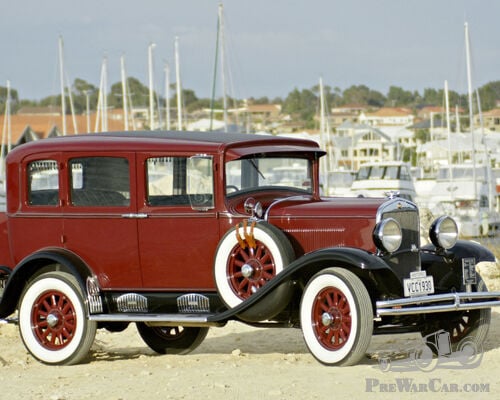
1930 Chrysler 66 Six-Wheel Equipped Royal Sedan
An exceptionally well restored and highly awarded Chrysler 66 Royal Sedan, with only two owners in nearly 97 years.The present owner ..

Lagonda LC Tourer 1934
The Lagonda story began in 1901 in Staines, a small town in the UK. The company enjoyed its greatest successes around 1935. During this period, the..