The global magazine and marketplace for classic car enthusiasts, by enthusiasts.


Filter
Classic Chevrolet, Plymouth for sale - Chevrolet, Plymouth cars for sale
-

Chevrolet Master Sedan 1934
A super cool Chevrolet Master from 1934.In very original condition, drives well.With many original accessories such as the covers on the rear fenders, sun visor, and spare wheel protection.Car originally from California, imported to the Netherlands about 10 years ago. Dutch registration. -
1940 Chevolet Master Business Coupe
5-Fenster_Coupe.Sammler-Zustand.Zweifarbige Lackierung in Burgund und Schwarz.einwandfreie Chromteile.Neuer Kabelbaum.Innenraum mit neuer Polsterung.Überholter 235-cui-Reihen-6_Zylinder (3,9 Liter) mit 140 SAE-PS.3-Gang-Schaltgetriebe.Firestone-Weißwandreifen.Teardrop-Fenderskirts. -
Chevrolet Sport Roadster 1929
Chevrolet Sport Roadster 1929. Technically, body and chassis in perfect condition. Ready for the road!A six cilinder beast. Complete restored. This car separates men from boys!https://youtube.com/shorts/xl1ap2l7pHQ?is=MFFXs9-S7zLRMTJA -
Chevrolet Superior B Roadster 1923
Unrestored but very solid and honest car. Engine: 4 cylinder, 2200cc, 22hp. Three speed manual transmission. -
Chevrolet Special
This masterpiece is a truly fun to ride prewar car. The makers of this car were inspired by the Vauxhall going back to 1939. It means that this car is a reproduction of the Vauxhalle Villiard Supercharger. This Chevrolet Special based on a 1939 chassis was built in Argentina in the ‘60. It consists of a full aluminum body and has participated at.. -
Chevrolet Indepence AE Landau Phaeton 1931
Very rare Chevrolet , only 5634 were produced in 1931.4 seater cabriolet with two doors and a trunk.Original delivered in the Netherlands, a lot of history is with the car.Been in a 40 year family ownership.Restored in the 1980’s and still very nice.Recent new white wall tires and engine overhaul.Nice ch.. -
1940 Plymouth P10 Deluxe Convertible Coupe | RM Sotheby's | The Hershey Auction
Sold | $43,680 USD One of 6,986 Deluxe Convertible Coupes produced for 1940Benefits from an excellent rotisserie restoration under previous ownershipL-head inline six-cylinder engine; three-speed manual with overdriveWonderfully presented in Boatswain Blue over red leather Richly appointed with a remark.. -
1936 Chevrolet - 2D Business Coupe
1936 Chevrolet - 2D Business Coupe*** in Excellent condition ***Engine: Inline 6 cil SixDisplacement: 206.8 cu. in.Horsepower: 79 @ 3200 RPMWheelbase: 109 inches - 276.86 cmThe 1936 Business Coupe was a more practical approach as 2 passengers could cram in behind the front riders. Primarily a salesman's car wit.. -
1932 Plymouth Model PB Sport Roadster | RM Sotheby's | The Hershey Auction
Sold | $22,400 USD One of just 2,163 Sport Roadsters produced for 1932Final year for Plymouth's original Silver Dome four-cylinder engineEquipped with dual side-mounted spares, rumble seat, and folding rear luggage rackOne of Plymouth's most attractive and desirable pre-war open body styles By 1932, .. -
Chevrolet Fleetmaster 'Woodie' Station Wagon
Chevrolet Fleetmaster 'Woodie' Station Wagon ***in absolute new state***European Car Registration in EU-Netherlands reg.no. DZ-87-00Chassis no. CL8434• The most expensive Chevrolet of its day• Imported from South Africa• Original right-hand drive model• Partially renovated in 2013 Footnote..


Chevrolet
US, 1911 to date
Chevrolet Motor Co, Detroit, Mich.
Chevrolet, General Motors’ least expensive American car and the world’s best-seller, was actually started by W.C. Durant at a time when he did not control GM. In association with racing driver Louis Chevrolet he brought out a 4.9-litre six with side valves in a T-head, selling for $2150. This was followed by a smaller 6-cylinder model, but the Chevrolet marque’s first big impact came with the 4-cylinder overhead-valve Chevrolet Baby Grand touring car at $875, and its companion roadster model, the Chevrolet Royal Mail. Electrics were an optional extra on Chevrolet cars for sale until 1917, but in the meantime the Chevrolet company had come right to the fore with the 2.7-litre 4-cylinder Chevrolet 490, also an ohv, in 1916. The type designation indicated its original list price in dollars, and sales went up from 13.600 to 70.701.
General Motors acquired Chevrolet in 1917, and by 1920 the Chevrolet marque was ousted in the United States only by Ford and Dodge. A one-model policy was pursued in 1923, but before this there had been other types of Chevrolet including the FA and FB fours, and a short-lived Chevrolet V8 with a Mason engine at $1100. There was also anabortive air-cooled Chevrolet car using the regular chassis and body styles in 1923. The 1925 Chevrolet Superior coach with disc wheels and Duco cellulose finish sold for $650, and two years later Chevrolet outsold Ford for the first time, though this was hardly a fair comparison, since Ford was shut down for a good part of the year during the change-over from the Model T to the Model A. Chevrolet did not have front-wheel brakes until 1928, the last year of the 4-cylinder cars. In 1929 came the ‘Cast Iron Wonder’, the 3.2-litre ohv Chevrolet International 6 with an 8ft 11in wheelbase and detachable disc wheels. More than a million Chevrolet cars were sold during its first season at $595, and the engine was progressively developed up to 1953.
In 1931 Chevrolet finally went ahead of Ford and stayed there apart from three seasons. 1932 Chevrolet cars resembled scaled-down Buicks or Oldsmobiles and featured rubber engine mountings, synchromesh and a free wheel, all for $495. In 1933 a V-grille was adopted to the Chevrolet cars, and capacity went up to 3.4-litres. GM’s Dubonnet-type ifs was fitted on the 1934 Chevrolet cars – in that year the ten millionth Chevrolet was delivered. Turret top styling followed in 1935 and hydraulic brakes in 1936. Engine capacity was increased slightly again in 1937. 1939 was the year of the fifteen millionth Chevrolet car; station wagons were catalogued, column-shift was optional, and prices ranged from $625 upwards. In 1940 Chevrolet was offering a power-top convertible in the low-price field, and Juan Manuel Fangio scored his first big victory in a long-distance race in Argentina at the wheel of one of that year’s coupés. Fastback Chevrolet coupés were listed in 1942, but along with most other American makes, the Chevrolet cars were little altered when they reappeared on the market after World War 2.
Extensive restyling and lowering took place in 1949, when a Chevrolet sedan cost $1460, but in 1950 Chevrolet offered the option of a 2-speed Powerglide fully-automatic transmission, as well as a now-fashionable hardtop coupé style. A new sports car, the Chevrolet Corvette, with fiberglass bodywork, featured in the 1953 programme with a 160bhp version of the regular 6-cylinder Chevrolet engine.
Chevrolet’s lead over Ford was down to a narrow 20.000 margin by 1954. In 1955 they came out with a 4.3-litre ohv V8 on conventional lines, giving 162bhp with an 180bhp ‘power pack’ available at extra cost. The capacity of the companion six was now 3.9-litres. By 1957 the Chevrolet Corvette had acquired the 8-cylinder engine, and special Chevrolet Corvette SS versions were being tried with 360bhp power units and 4-speed all-synchromesh boxes listed as a factory option. 1958 V8 Chevrolets had 5.7-litre engines and air suspension was available, though the idea was soon discarded.
A new departure was the Chevrolet Division’s 1960 compact car, the Chevrolet Corvair, a 2.3-litre air-cooled flat-6 with engine at the rear, unitry construction of chassis and body and all wheels independently sprung. It proved a little too advanced for the market at which it was aimed, but by 1966 Chevrolet had entered upon a new lease of life as a specialist semi-sporting machine available with such options as a 4-speed box and 180bhp turbosupercharged engine.
The evolution of subsequent Chevrolets reveals the need of the modern American mass-producer to offer a diversity of products, rather than to concentrate on a single basic model and ring the changes on body styles. In 1963 the Chevrolet company started to bridge the gap between the Chevrolet Corvair and the inexpensive, but by no means small Chevrolet Impala, Chevrolet Bel Air and Chevrolet Biscayne series(that year’s version were 17ft 6in long) with a ‘semi-compact’, thee Chevy II. This had integral construction, a 9ft 2in wheelbase and the choice of two engines of modest dimensions, a 2½-litre four and a 3.2-litre six. The slightly bigger Chevrolet Chevelle of 1964 was the first Chevrolet to use GM’s perimeter-type chassis frame (standardized on the big cars in 1965) and was available either with the Chevy II six or a 4.6-litre V8. Another new model in 1964 was the Chevrolet Corvette Stingray sports car with retractable headlamps, giving 145mph from 360bhp; the following season it had disc brakes as standard equipment. 1966 coverage of the market was comprehensive. Besides the specialized Chevrolet Corvair and Chevrolet Corvette there was the Chevy II in three series, the Chevrolet Chevelle with a wide choice of power units and five different types of full-sized Chevrolet from the inexpensive Chevrolet Biscayne up tot the luxurious Chevrolet Caprice. Prices ranged from $2028 for the simplest Chevy II with 90bhp 4-cylinder engine up to the Chevrolet Caprice custom station wagon at $3347. Chevrolet engines were used by Checker, Avanti, the revived 8/10 Cord, Excalibur, the last Canadian-built Studebakers, the Anglo-American Gordon-Keeble and the Italo-American Iso and Bizzarini. They were also used in the smallest Oldsmobiles in 6-cylinder form and in Candian-built Pontiacs and the Acadian, an all-Canadian GM product. They are also found in the biggest 8-cylinder Opels. For 1967 the Chevrolet company added to its range a sports coupé model, the V8 5.7-litre Chevrolet Camaro with 295bhp and front disc brakes, a belated answer to Ford’s Mustang.
Meanwhile Chevrolet Corvette-powered cars were dominating Can-Am racing, continuing to do so until 1971. Chevrolet’s sixth two-million year came in 1968 (the others had been 1962 – 1966 inclusive), the tenth successive season in which they had outsold Ford. Chevrolet Camaros were now available with 6½-litre engines, and the Chevrolet Corvette was completely restyled. Then 1969 brought the demise of the Chevrolet Corvair, the final season’s sales being a low 2359 as against its 1961 peak of 316.000. A further gap in the range was filled by the Chevrolet Blazer, a 4x4 jeep-type vehicle offered with 6-cylinder or V8 engine. Sporting and prestige images were combined in the Monte Carlo of 1970, a coupé on the Chevrolet Chevelle chassis with front disc brakes and a choice of five V8 units, the biggest having 7.3-litres and 360bhp. This was the last year of 4-cylinder engines in the Chevy II line, and Chevrolet Camaro sales came within 20.000 of the Ford Mustang’s. The major news of 1971 was a sub-compact, the unitary-construction Chevrolet Vega with coil rear suspension, offered in hatchback coupé, 2-door sedan and station wagon styles, and powered by a new 2.3-litre 4-cylinder engine with alloy block and cogged belt drive for its overhead camshaft. Transmission options included a 3-speed semi-automatic and front disc brakes were standard. The 1973 line was one of the biggest in the USA, embracing the Vega, Chevy II Nova and Chevelle in the compact and intermediate markets, the Chevrolet Bel Air, Chevrolet Impala and Chevrolet Caprice with 10ft 1½in wheelbase in the full-size group; the Chevrolet Camaro and Chevrolet Monte Carlo coupés; the Chevrolet Corvette sports car; and such specialist semi-utility types as the Chevrolet Blazer, the Chevrolet Suburban station wagon on a light-truck chassis, the forward-control twelve-seater Chevrolet Sportsvan station wagon, and the Chevrolet El Camino, a car-based coupé-utility in the Australian idiom. All passenger-car types with the exception of the Chevrolet Nova had front disc brakes as standard equipment, while innovations were a Nova hartchback coupé and a restyled and lowered Monte Carlo available with V8s of 5736cc or 7440cc. Power-assisted steering was standard on Camaros, big Chevrolets were now offered only with automatic transmissions, and energy-absorbing front bumpers were found on all types.
In the summer of 1972 Chevrolet announced plans for a Wankel-powered Vega to be available by 1975.
Source: Georgano, encyclopedia of motorcar; MCS
The information is written with the greatest of care. However, if you have any suggested amendments please contact us at office@prewarcar.com
Plymouth
US, 1928 to date
Chrysler Corporation, Detroit, Mich.
The 4-cylinder 21hp Plymouth car appeared in 1928 at a list price of $725 for a sedan. This Plymouth car replaced the earlier 4-cylinder Chryslers and represented a serious challenge for Ford and Chevrolet in their lowest price class. The Plymouth car had side valves, internal-expanding hydraulic brakes and ribbon-type radiator and gave the Plymouth car a close resemblance to the 1928 Chryslers and De Sotos, and Plymouth cars sold over 100.000 in its first year, even improving its sales position in the bleak economic climate of 1932. Plymouth cars adhered to four cylinders until 1933, when the Plymouth PD-series 6-cylinder was listed at less than $600. 1934 de luxe models of Plymouth cars had independent front suspension, but this was dropped after a year and did not reappear for some time on Plymouth cars. The standard engine in the later 1930 Plymouth cars had a capacity of 3.3-litres, rather smaller than that used in comparable Chevrolets and Fords: a small-bore 2.8-litre version Plymouth car was made for export up to 1939, but the name Plymouth was not usually found on Plymouth cars sold in England, which were nominally Chrysler Kew and Wimbledon sixes. After World War 2 evolution followed that of other Chrysler Corporation cars closely, the old-fashioned styling losing the Plymouth car division its long-held third place in American sales to Buick. Further, Plymouth cars retained the L-head six as its staple power unit right up to 1955, when Flight Sweep versions were introduced with over-square ohv V8 engines on accepted American lines in a variety of powers from 157 to 177bhp. The capacity of these Plymouth cars had 4.3-litres, while the six, now of 3.8-litres, remained available. These 1955 Plymouth cars were lower and longer than their predecessors and could be obtained with synchromesh, overdrive or automatic gearboxes.
The Plymouth Fury models of the ensuing decade represented a breakaway from the traditional Plymouth stolid family car, while the Plymouth Car Division was also responsible for Chrysler’s contribution to the compacts, the Plymouth Valiant launched for 1960. This Plymouth car had rather more European styling than its competitors, with a dummy spare-wheel moulding on the tail; interesting items of specification were the unitary construction of the Plymouth car, alternator ignition, and inclined in-line 2.8-litre ohv 6-cylinder engine. The influence of the Plymouth GT car on America resulted in the Plymouth Barracuda of 1965, a fastback coupé using the Valiant’s 8ft 10in wheelbase and a 4½-litre V8 power unit. Plymouth cars, like Ford and Chevrolet, was aiming at comprehensive coverage of the low and medium price market in 1966, with the compact Plymouth Valiant, the sports-compact Plymouth Barracuda, the medium-sized Plymouth Belvedere, the full-size Plymouth Fury, and the luxurious ‘VIP’ 4-door hardtop Plymouth car, offered only with a 5.2-litre V8 engine and selling for $2.930. An increasing emphasis on sporting Plymouth cars was detectable by 1968, when in addition to the established Barracuda there were two other sports coupés Plymouth car, the Plymouth GTX and the Plymouth Road Runner. All three Plymouth cars were available with 4-speed manual gearboxes and the 6.981cc 425bhp hemi-head V8 also used by Dodge. In 1970, when Valiant prices started at a low $2.172, there was also a Valiant sports coupé, the Plymouth Duster.
In 1971 Plymouth car company added a sub-compact to their Plymouth car range when they offered the 1½-litre Hillman Avenger as the Plymouth Cricket. The 1972 range of Plymouth cars embraced the Valiant on a 9ft wheelbase, the Barracudas and Satellites, and the full-size Furys with V8 engines and automatic transmission as standard. Engines in the Plymouth cars ranged from the Valiant’s 3.2-litre and 3.7-litre sixes up to the largest Chrysler unit, a V8 of 7.210cc. Electronic ignition was offered on the costliest Barracuda model. Casualties of new Federal regulations were the hemi-head engine and convertibles, and the same range Plymouth cars with minor improvements, among them manually-operated sun roofs, was offerd in 1973.
Source: Georgano, encyclopedia of motorcar; MCS
The information is written with the greatest of care. However, if you have any suggested amendments please contact us at office@prewarcar.com



Featured
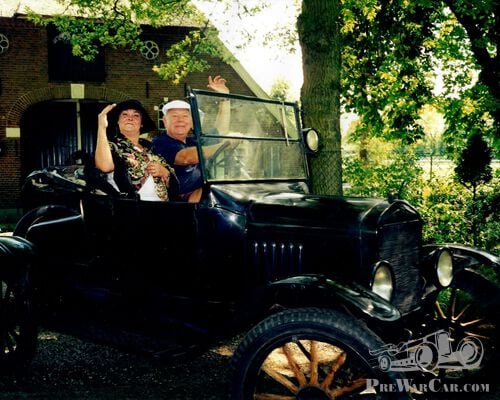
Zeer originele Ford Model T runabout
2 zits cabrio, motor is los, niet gerestaureerd, volledig orgineel, ingevoerd uit california in 1998, van de 2e eigenaar (m'n Oom) die hem van zn b..
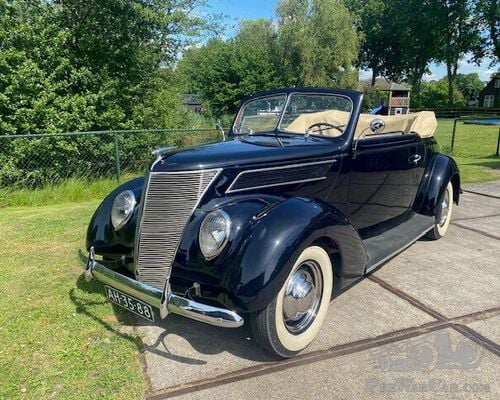
Ford v8 Club cabriolet 1937
Very nice Ford v8 Club cabriolet. In excellent condition. Runs and drives very well.Top condition.Shipping possible.
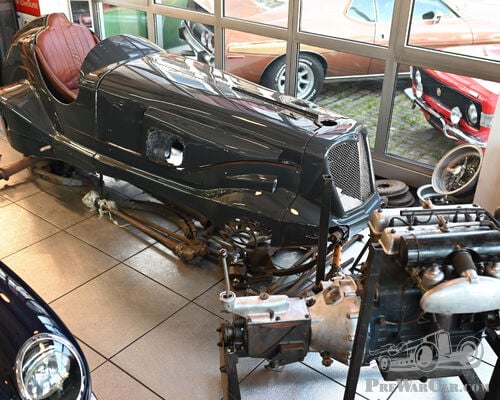
Riley special - 1937 Big Four Monoposto project with aluminium hand built body in Switzerland
An interesting Riley Special project offered for completion, based on a bare 1937 chassis and supplied with various associated parts, together with..