The global magazine and marketplace for classic car enthusiasts, by enthusiasts.


Filter
Classic Chrysler, DeSoto for sale - Chrysler, DeSoto cars for sale
-

1930 Chrysler 66 Six-Wheel Equipped Royal Sedan
An exceptionally well restored and highly awarded Chrysler 66 Royal Sedan, with only two owners in nearly 97 years.The present owner acquired the car as a complete and remarkably original example and subsequently carried out a no-expense-spared restoration over many years. The restoration was a total body-off, nut-and-bolt rebuild .. -
Chrysler 75 Roadster 1929 , mille miglia eligible
Nice older restoration.USA TitleNice chromeLeather interior.With extra accesoires lights -
1926 Chrysler Racer
1926 Chrysler Biposto Racer, 4 cylinders, 3100ccm, 40HP, hydraulic brakes, frictions shock absorber, aluminium body, rolling chassis, engine, transmission, all Chrysler components, leather seats... The car will be delivered with new German technical inspection (TÜV) and historical plates (H-Zulassung)91077 Neunkirchen am Brand - G.. -
1940 Chrysler New Yorker Highlander Convertible | RM Sotheby's | The Hershey Auction
Sold | $56,000 USD One of 87 New Yorker Convertibles built with the Highlander interior, according to the consignorA long-term part of The Michael Leith Collection, with fascinating historyAttractive and well-preserved older restoration with numerous accessoriesPast AACA Senior and Grand National First Prize win.. -
1931 Chrysler CG Imperial Roadster in the style of LeBaron | RM Sotheby's | The Hershey Auction
Sold | $156,800 USD Formerly owned by noted collectors Lloyd Harriman, Ronald Benach, and Henry PetronisAttractive older restoration completed by Brian Joseph's Classic and Exotic ServiceFeatured in Dennis Adler's Chrysler and The Art of the AutomobileA CCCA Full Classic The 1931 CG Imp.. -
1938 Chrysler convertible sedan
Model: series C-18, 4-door convertible sedanColour: red body with red wingsInterior: red leatherEngine: 6 cylinder line, 241.5 cubic inch, 3.9 litre, 95 hpTransmission: manual, 3-speed synchronised, with overdriveCondition: body off restoredPrice on request Description:Beautiful and .. -
Chrysler Roadster Special
Chrysler Roadster Special, 1930, 3200cc, 6 cylinders, full aluminum, recently fully restored, FIA regularity passport present, cycle wings present, very powerful car. Contact us for more information.


Chrysler
US, 1923 to date
Chrysler Corporation, Detroit, Mich.
Walter P. Chrysler, formerly of Buick and Willys, acquired Maxwell-Chalmers in 1923, and the first car to bear his name, the 6-cylinder ‘Chrysler 70’ of 1924, was something of a sensation with its 4-wheel contracting hydraulic brakes and 70mph performance. At $1645 for a Chrysler sedan, 43.000 were sold in 1925. The 1926 Chrysler range was widened to include a 3-litre 4-cylinder ‘Chrysler 58’ to replace the Maxwell and the expensive 4.7-litre 6-cylinder Chrysler Imperial, selling for $3095. The 6-cylinder roadsters offered an excellent road performance for a modest price, as was shown by their 3rd and 4th places at Le Mans in 1928, behind a Bentley and a Stutz. The 1929 Chrysler models had internal-expanding brakes and their body styling and ribbon-type radiator shells were widely imitated in Europe over the next few years.
Meanwhile Chrysler had laid the foundations for a motor empire to rival General Motors and Ford by taking over Dodge and launchin two new makes, the Plymouth Four in the lowest price sector, and the De Soto Six in a slightly higher bracket – all this in 1928. Chrysler sold 98.000 cars in 1929. The 1931 Chrysler cars featured the long, low look inspired by the Cord of 1929; 4-speed gearboxes were offered for a short while and for the first time a brace of straight-8s featured in the Chrysler range – the medium-priced Chrysler CD, and the 6.3-litre Chrysler CG-type Imperial for the carriage trade, often with bodies by Le Baron. 1932 saw fully flexible rubber engine mountings (‘Floating Power’), automatic clutches and free wheels. Synchromesh followed a year later. Automatic overdrive was available in 1934 on Chrysler, and regular equipment by 1936. The Chrysler line for 1934 was spearheaded by the revolutionary CD-type 8-cylinder Chrysler Airflow, with welded unitary construction of chassis and body, all seats within the wheelbase, headlamps mounted flush in the wings, a full aerodynamic shape and concealed luggage accommodation. At $1345 it was a commercial failure, though it was continued till 1937. Chrysler hurriedly brought out the more conventionally styled Chrysler Airstream line in 1935, and for the next twenty years the Chrysler company’s styling policy was cautious, though technical progress is represented by the adoption of independent front suspension and hypoid rear axles (for sale in 1937), steering-column gear-change (for sale in 1939) and optional fluid drive from 1939 onward.
The 1942 Chrysler cars for sale, generally competitive with GM’s Buick, embraced two 4.1-litre sixes and three 5.3-litre eights, all side-valve, with prices from $1295 for the Chrysler Windsor to $3965 for the Chrysler Crown Imperial limousine on the 12ft 1½in wheelbase.
Early post-war design followed the 1942 Chrysler models closely, apart from some interesting ‘Town and Country’ bodies, basically standard sedans and convertibles with wooden exterior trim in station-wagon style. In 1951, however, Chrysler broke new ground with a 5.4-litre overhead valve oversquare V8 with hemispherical heads, a fully automatic transmission and the option of hydraulic power-assisted steering. This was at the time America’s most powerful car and Chrysler engines were fitted and raced by Allard and Cunningham. Caliper disc brakes were optional, but were dropped after a few years, while another individual feature of Chrysler Corporation products was the push-button layout of controls for the automatic transmission, found on Chrysler cars made between 1956 and 1965. Chrysler’s lag in styling was painfully apparent in 1954, when the Chrysler group lay a bad third behind GM and Ford, and 1955 not only saw the retirement of the old side-valve six in favour of a 4.9-litre 188bhp V8, but also new, lower ‘Flight Sweep’ lines which put the Chrysler cars well back in the running. A new range of ‘Chrysler 300’ coupés and convertibles gave Chrysler a ‘personal car’ competitive with Ford’s Thunderbird and the 6¼-litre V8s used in the 1957 Chrysler cars developed more bhp than any of their rivals. Alternator ignition and unitary construction of chassis and body were adopted in 1960, while Chrysler, who had had a gas-turbine car running experimentally in 1954, built a series of fifty vehicles using Plymouth running gear in 1964 which were supplied to selected customers for evaluation.
The 1960s also saw the corporation extend its motor-car interests into Europe by the acquisition of majority interests in Simca of France and the Rootes Group of Great Britain. Another overseas venture was Chrysler Australia Ltd of Adelaide. Chrysler’s V8 engine was also used by Facel Vega in France, and by Bristol and Jensen in Britain. Chyrsler’s 1968 cars were all V8s in the $3300 - $4600 price class, with 6.3-litre or 7.2-litre engines. Automatic transmission was standard on the more expensive Chrysler New Yorkers and the 350bhp Chrysler 300 coupé. There were no major changes in subsequent years, though the general derating of American power units was reflected by the standardization of 5.9-litre, 6.6-litre and 7.2-litre V8 in 1972 and 1973, with outputs ranging from 175bhp to 245bhp. Between 1955 and 1967 a handful of special-bodied Chryslers, Dodges and Plymouths with Ghia coachwork were sold under the Dual-Ghia name.
Source: Georgano, encyclopedia of motorcar; MCS
The information is written with the greatest of care. However, if you have any suggested amendments please contact us at office@prewarcar.com
DeSoto
US, 1913 – 1916
DeSoto Motro Car Co, Auburn, Ind.
The DeSoto appears to have succeeded the Zimmerman. This was a large car with a 55hp, 6-cylinder engine, which was furnished with a compressed-air starter. The DeSoto model Six-55 five-seater touring car sold for $2185.
US, 1928 – 1960
Chrysler Motors Corp, Detroit, Mich.
The DeSoto was launched in 1928 as a 3.2-litre side valve six to compete with Oldsmobile, Pontiac and the cheaper Nashes. Styling and general design of the DeSoto were in line with the 1929 Chryslers, and at $885 for a DeSoto sedan 90.000 were sold in the first twelve months. A 3.4-litre straight-8 DeSoto on a 9ft 6in wheelbase was announced for 1930 as the world’s cheapest 8-cylinder car. However, DeSoto suffered badly in the Depression, and in 1932, when flexible rubber engine mountings and free wheels were made available, sales dropped to 26.000 DeSoto cars.
The DeSoto disappeared from the British market about this time, though certain ‘Chrysler’ models listed in England (the Mortlake, Croydon, and some of the Richmonds) were in fact DeSoto cars in all but name. A 6-cylinder version of Chrysler’s advanced unitary-construction Airflow, the SE-type with a 4-litre engine, was brought out in 1934, but was an unsuccessful as its bigger sister. Later DeSotos followed regular Chrysler lines closely though in later years there was a tendency for DeSoto to move into a higher price class than Dodge; by 1952 DeSotos started $300 higher than the companion make.
By 1939 the DeSoto cars for sale were being made with independent front suspension, hypoid back axles and column change. There was a choice at DeSoto of two 6-cylinder engines and three wheelbase lengths, the longest of these being reserved for seven-seater bodywork – DeSoto continued to offer a really roomy family car right up to 1954. A 4-speed semi-automatic Vacumatic transmission became an option in 1941, but DeSoto’s big post-war change of models did not take place until 1952, when the division followed Chrysler’s lead in adopting the oversquare ohv V8; the DeSoto version was of 4½-litre capcity and developed 16-bhp. With the advent of Chrysler’s ‘flight sweep’ styling in 1955, the side-valve sixes were dropped and the standard engine in a DeSoto was now a 4.8-litre eight, giving 185bhp in Firedome guise, and 200bhp in Fireflite form. Though this redesigning saved Chrysler sales generally, the slump in the medium-price class had an adverse effect on DeSoto and in 1959 the DeSoto division was merged with Plymouth. Last of the DeSotos were the 1961 models, unitary-construction cars with a choice of three engines: Plymouth’s 145bhp ohv ‘slant six’ as used in the Valiant, and V8s of 230 and 265bhp, the two former only in Canadian DeSotos. Production of DeSoto cars ceased in November 1960 after only a few had been delivered.
Source: Georgano, encyclopedia of motorcar; MCS
The information is written with the greatest of care. However, if you have any suggested amendments please contact us at office@prewarcar.com



Featured
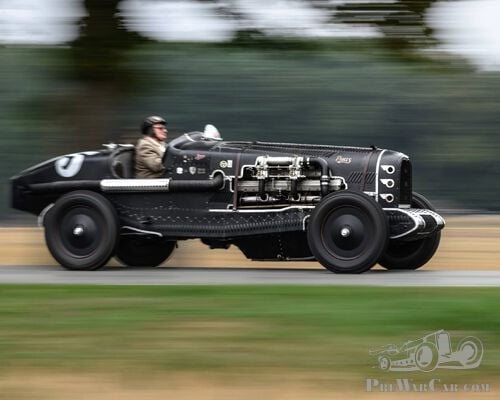
Delage DI, 1924, IL DRAGO RUGGENTE, one of few cars with an Aircraft engine and with war history.
A COLLECTOR'S OPPORTUNITY ONE-OFF. HAND-BUILT. UNREPEATABLE.A MACHINE WITH NO COMPARISONThere are special cars, there are racing cars..
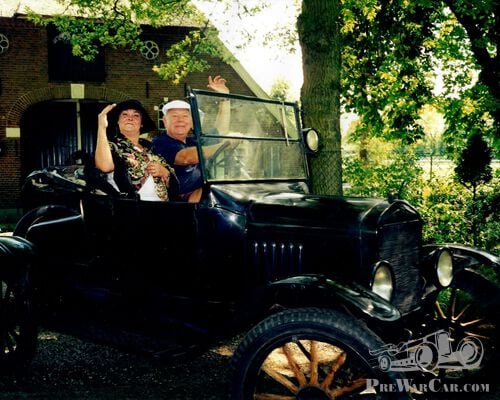
Zeer originele Ford Model T runabout
2 zits cabrio, motor is los, niet gerestaureerd, volledig orgineel, ingevoerd uit california in 1998, van de 2e eigenaar (m'n Oom) die hem van zn b..
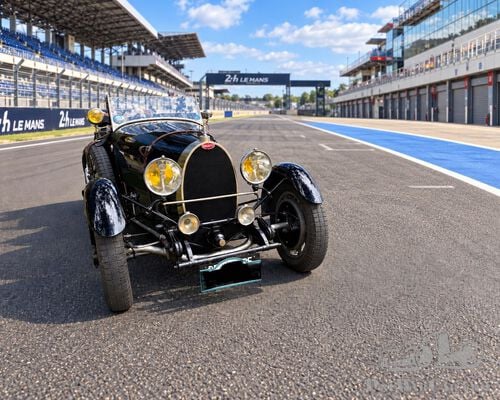
BUGATTI 43 GRAND SPORT
Bugatti Type 43 Grand Sport — Une histoire à poursuivre au volant Certaines automobiles se contemplent avec admiration. D’autres susc..