The global magazine and marketplace for classic car enthusiasts, by enthusiasts.


Filter
Classic Chrysler, Stoewer for sale - Chrysler, Stoewer cars for sale
-

Chrysler B70 Phaeton 1925
Very nice Chrysler, in good running order.Older Quality restoration.Powerfull engine.Hydraulic BrakesBeautiful color combination ,Leather interior. -
1931 Chrysler CG Imperial Convertible Coupe by LeBaron | RM Sotheby's | Sealed June
To Be OFFERED AT AUCTION at RM Sothebys' Sealed June event, Bidding Closes 24-26 June 2026. $225,000 - $275,000 USD Offered from 38 years in a prominent collectionOne of only ten examples produced in this body styleFormerly owned by noted West Coast enthusiast Irving DavisAttractive older restoration in very go.. -
Chrysler 75 Roadster 1929 , mille miglia eligible
Nice older restoration.USA TitleNice chromeLeather interior.With extra accesoires lights -
1932 Chrysler CH Imperial Speedster | RM Sotheby's | The Monterey Auction
To Be OFFERED AT AUCTION at RM Sothebys' The Monterey Auction event, 13 - 15 August 2026. $2,500,000 - $3,000,000 USD Best of Show at the 1991 Pebble Beach Concours d’EleganceA one-off Chrysler in-house design and engineering study for Walter P. ChryslerBuilt using almost entirely custom hardware and numerous prototype .. -
1924 Stoewer type D3 roadster
Rare opportunity to buy a vintage 1924 Stoewer type D3 roadster in fully restored condition. More than € 50K were spent in 2018 and 2019 on its restoration . Detailed work invoices come with the car. A video can be sent on request . Price € 64000 ex Eibergen Netherlands imported EEC. -
1938 Chrysler convertible sedan
Model: series C-18, 4-door convertible sedanColour: red body with red wingsInterior: red leatherEngine: 6 cylinder line, 241.5 cubic inch, 3.9 litre, 95 hpTransmission: manual, 3-speed synchronised, with overdriveCondition: body off restoredPrice on request Description:Beautiful and .. -
Chrysler Roadster Special
Chrysler Roadster Special, 1930, 3200cc, 6 cylinders, full aluminum, recently fully restored, FIA regularity passport present, cycle wings present, very powerful car. Contact us for more information.


Chrysler
US, 1923 to date
Chrysler Corporation, Detroit, Mich.
Walter P. Chrysler, formerly of Buick and Willys, acquired Maxwell-Chalmers in 1923, and the first car to bear his name, the 6-cylinder ‘Chrysler 70’ of 1924, was something of a sensation with its 4-wheel contracting hydraulic brakes and 70mph performance. At $1645 for a Chrysler sedan, 43.000 were sold in 1925. The 1926 Chrysler range was widened to include a 3-litre 4-cylinder ‘Chrysler 58’ to replace the Maxwell and the expensive 4.7-litre 6-cylinder Chrysler Imperial, selling for $3095. The 6-cylinder roadsters offered an excellent road performance for a modest price, as was shown by their 3rd and 4th places at Le Mans in 1928, behind a Bentley and a Stutz. The 1929 Chrysler models had internal-expanding brakes and their body styling and ribbon-type radiator shells were widely imitated in Europe over the next few years.
Meanwhile Chrysler had laid the foundations for a motor empire to rival General Motors and Ford by taking over Dodge and launchin two new makes, the Plymouth Four in the lowest price sector, and the De Soto Six in a slightly higher bracket – all this in 1928. Chrysler sold 98.000 cars in 1929. The 1931 Chrysler cars featured the long, low look inspired by the Cord of 1929; 4-speed gearboxes were offered for a short while and for the first time a brace of straight-8s featured in the Chrysler range – the medium-priced Chrysler CD, and the 6.3-litre Chrysler CG-type Imperial for the carriage trade, often with bodies by Le Baron. 1932 saw fully flexible rubber engine mountings (‘Floating Power’), automatic clutches and free wheels. Synchromesh followed a year later. Automatic overdrive was available in 1934 on Chrysler, and regular equipment by 1936. The Chrysler line for 1934 was spearheaded by the revolutionary CD-type 8-cylinder Chrysler Airflow, with welded unitary construction of chassis and body, all seats within the wheelbase, headlamps mounted flush in the wings, a full aerodynamic shape and concealed luggage accommodation. At $1345 it was a commercial failure, though it was continued till 1937. Chrysler hurriedly brought out the more conventionally styled Chrysler Airstream line in 1935, and for the next twenty years the Chrysler company’s styling policy was cautious, though technical progress is represented by the adoption of independent front suspension and hypoid rear axles (for sale in 1937), steering-column gear-change (for sale in 1939) and optional fluid drive from 1939 onward.
The 1942 Chrysler cars for sale, generally competitive with GM’s Buick, embraced two 4.1-litre sixes and three 5.3-litre eights, all side-valve, with prices from $1295 for the Chrysler Windsor to $3965 for the Chrysler Crown Imperial limousine on the 12ft 1½in wheelbase.
Early post-war design followed the 1942 Chrysler models closely, apart from some interesting ‘Town and Country’ bodies, basically standard sedans and convertibles with wooden exterior trim in station-wagon style. In 1951, however, Chrysler broke new ground with a 5.4-litre overhead valve oversquare V8 with hemispherical heads, a fully automatic transmission and the option of hydraulic power-assisted steering. This was at the time America’s most powerful car and Chrysler engines were fitted and raced by Allard and Cunningham. Caliper disc brakes were optional, but were dropped after a few years, while another individual feature of Chrysler Corporation products was the push-button layout of controls for the automatic transmission, found on Chrysler cars made between 1956 and 1965. Chrysler’s lag in styling was painfully apparent in 1954, when the Chrysler group lay a bad third behind GM and Ford, and 1955 not only saw the retirement of the old side-valve six in favour of a 4.9-litre 188bhp V8, but also new, lower ‘Flight Sweep’ lines which put the Chrysler cars well back in the running. A new range of ‘Chrysler 300’ coupés and convertibles gave Chrysler a ‘personal car’ competitive with Ford’s Thunderbird and the 6¼-litre V8s used in the 1957 Chrysler cars developed more bhp than any of their rivals. Alternator ignition and unitary construction of chassis and body were adopted in 1960, while Chrysler, who had had a gas-turbine car running experimentally in 1954, built a series of fifty vehicles using Plymouth running gear in 1964 which were supplied to selected customers for evaluation.
The 1960s also saw the corporation extend its motor-car interests into Europe by the acquisition of majority interests in Simca of France and the Rootes Group of Great Britain. Another overseas venture was Chrysler Australia Ltd of Adelaide. Chrysler’s V8 engine was also used by Facel Vega in France, and by Bristol and Jensen in Britain. Chyrsler’s 1968 cars were all V8s in the $3300 - $4600 price class, with 6.3-litre or 7.2-litre engines. Automatic transmission was standard on the more expensive Chrysler New Yorkers and the 350bhp Chrysler 300 coupé. There were no major changes in subsequent years, though the general derating of American power units was reflected by the standardization of 5.9-litre, 6.6-litre and 7.2-litre V8 in 1972 and 1973, with outputs ranging from 175bhp to 245bhp. Between 1955 and 1967 a handful of special-bodied Chryslers, Dodges and Plymouths with Ghia coachwork were sold under the Dual-Ghia name.
Source: Georgano, encyclopedia of motorcar; MCS
The information is written with the greatest of care. However, if you have any suggested amendments please contact us at office@prewarcar.com
Stoewer
D, 1899 – 1939
(1) Gebrüder Stoewer, Fabrik für Motorfahrzeuge, Stettin, 1899 – 1916
(2) Stoewer-Werke AG vorm. Gebr. Stoewer, Stettin, 1916 – 1939
The Stoewer car factory developed out of the Stoewer ironworks and was among the pioneers of the German car industry. After manufacturing motor cycles, tricycles and quadricycles for two years, Stoewer turned to cars in 1899. The first Stoewer car had a rear-mounted 2-cylinder engine. 4-cylinder Stoewer cars followed in 1901, and electric Stoewer cars were also produced. Best known were the 2-cylinder Type T Stoewer car (2.280cc and 3/12PS), the 4-cylinder Stoewer P4 (3.052cc and 11/22PS), the Stoewer G4 (1.500cc and 6/12PS) and the 6-cylinder Stoewer P6 (8.820cc and 34/60PS), evolved in the 1905-1907 period all Stoewer cars with shaft-drive. The Stoewer B1 of 6/16PS and the Stoewer B6 of 9/22PS which appeared in 1910 were also built by Mathis under licence. The G4 Stoewer car was the basis for the Stoewer B5, which Stoewer car in 1912 became famous by setting up a record at Brooklands with 67.7mph. The new range of Stoewer cars which appeared in 1913 was also based on successful earlier cars. They were the Stoewer C1 (6/18PS), Stoewer C2 (10/28PS) and C3 Stoewer car (6-cylinder and 19/45PS). Shortly before the outbreak of World War 1 the Stoewer car range was headed by the F4 Stoewer car with a 4-cylinder, 8.8-litre 33/100PS ohc engine. After the war an enormous Stoewer car appeared, the Stoewer D7, using a 6-cylinder 11.2-litre 42/120PS aero engine, as well as some conservative sv 4- and 6-cylinder Stoewer cars with rear wheel and transmission brakes. Front wheel brakes appeared on Stoewer cars in 1925. Stoewer introduced 8-cylinder Stoewer cars in 1928. These were the Stoewer Superior, Stoewer Marschall, Stoewer Gigant and Stoewer Repräsentant with engines ranging from 2-litres and 45bhp to 4.9-litres and 100bhp. The Stoewer car firm re-entered the economy class in 1931 with the V5, a front-driven Stoewer car with a V4 1.188cc engine, followed by the front-drive models R140 (1.369cc), R150 (1.488cc) and R180 (1.769cc). Another 8-cylinder was the front wheel drive Greif V8 with a 2.488cc engine, which was replaced by the conventional 6-cylinder 3.609cc Arcona Stoewer car in 1938. In 1934 the 1½-litre 4-cylinder Stoewer car and 2½-litre V8 Stoewer car were shown at the Brussels Salon by Monsieur Dewaet under the name D.S. (Dewaet-Stoewer). The Greif Junior was built under Tatra licence with an opposed 4-cylinder 1.474cc engine. It succeeded the Röhr Junior. In the middle of the range was the Stoewer Sedina with a 4-cylinder engine of 2.4-litres.
Production of private Stoewer cars was given up at the outbreak of World War 2 in 1939. The Stoewer car factory was destroyed during the war and production of Stoewer cars was not resumed.
Source: Georgano, encyclopedia of motorcar; HON
The information is written with the greatest of care. However, if you have any suggested amendments please contact us at office@prewarcar.com


Featured
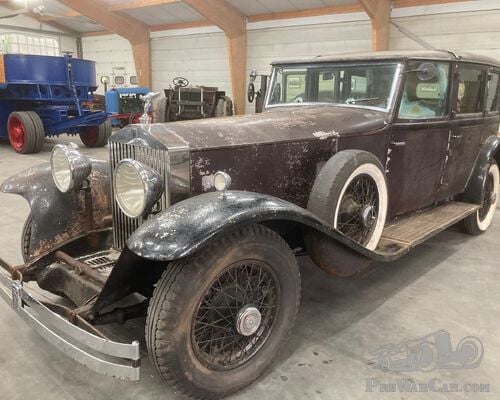
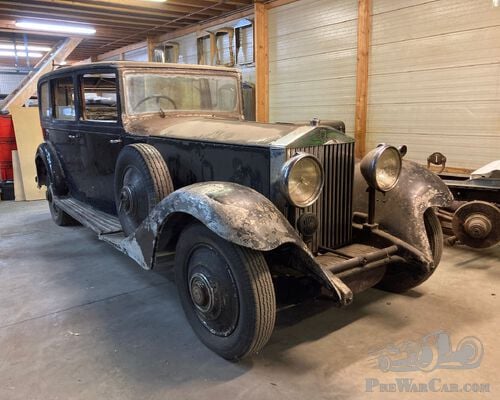
Rolls-Royce
Rolls-Royce Phantom ll chassisnummer 287 AJS. bouwjaar 1932, Links gestuurd, Brewster Keswick Sedance Towncar
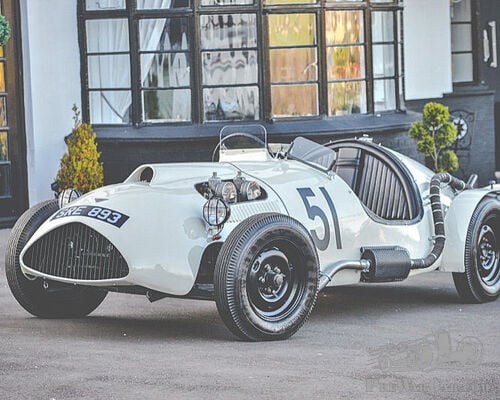
1933 Alvis 3.0 Special - One-Off Alloy Body | Period Competition Car | Featured in “Alvis – A Century of Drivers”
1933 Alvis 3. 0 Special - One-Off Alloy-Body | Period Competition Car | Featured in “Alvis – A Century of Drivers”