The global magazine and marketplace for classic car enthusiasts, by enthusiasts.


Filter
Classic Citroën, Duesenberg for sale - Citroën, Duesenberg cars for sale
-

Open to Offers! Duesenberg Model J Dual Cowl Phaeton coachwork built in the style of LaGrande with Engine J-241
Open to Offers! Duesenberg Model J Dual Cowl Phaeton coachwork built in the style of LaGrande with Engine J-241 Not complete - Great Restoration project -
Citroen 7C Traction Avant
Seltener Citroen 7C Traction Avant aus der Vorkriegszeit Das Erste was dem Betrachter bei diesem Exemplar auffällt ist der bemerkenswert gute Zustand des Fahrzeugs. Der vorherige Eigentümer hat bei der Restauration detailverliebt gearbeitet und ein unbezahlbares Maß an Herzblut und Zeit in die Arbeiten einfließen lassen, wie es nur ein wahrer En.. -
1923 Citroen 5CV Cabriolet Boulogne - LHD
Technical Specifications Mark & Model: Citroen 5CV Cabriolet Boulogne - LHDYear: 1923Registration plate: Guernsey registeredChassis Number: 49518Engine Number: 2131794Engine Capacity: 856 ccTransmission: 3-speed manualMileage: Body style: 1-door convertibleInterior color: .. -
Citroën Type C Delivery Van 1924
Citroën Type C Delivery Van 1924 Company / History In 1905, André Citroën founded a gear factory. He was the son of Levie Citroën, a diamond merchant of Dutch origin who moved to Paris in 1873. In 1919, Citroën introduced Europe’s first mass-produced car: the Type A. By the end of the First World.. -
1931 Duesenberg Model J convertible sedan
Vehicle Highlights Chassis No. 2479Engine No. J 464ACD Category One Certified Original CarOne-Off CoachworkCCCA National First, Senior And Premier Award WinnerKnown Ownership History from New Vehicle DescriptionThis legendary Model J, with Chassis No. 2479.. -
1931 Duesenberg Model J Tourster by Derham | RM Sotheby's | The Monterey Auction
To Be OFFERED AT AUCTION at RM Sothebys' The Monterey Auction event, 13 - 15 August 2026. $2,250,000 - $3,250,000 USD One of the eight original, authentic Derham TourstersOriginal chassis, firewall, engine, and coachworkFormerly owned by Dr. Irwin Ginsberg, Andy Granatelli, and Joseph and Margie CassiniMeticulo.. -
1922 Duesenberg Model A Phaeton by Millspaugh & Irish For Sale
1922 Duesenberg Model A Phaeton by Millspaugh & Irish Chassis number: 798 Registration Number: Not currently registered. Engine Number 1111 Concours condition. This car when launched was a true standout. It was the very first seria.. -
1935 Duesenberg Model J "Sweep Panel" Dual-Cowl Phaeton by LaGrande | RM Sotheby's | Private Sales
Asking | $3,300,000 USD The final “Sweep Panel” Dual-Cowl Phaeton built by LaGrandeOriginally the New York Duesenberg factory branch demonstratorMultiple award-winning restoration by the noted Steve Babinsky, with further recent servicingA respected example with original frame, firewall, engine, and coachwork -
1935 Duesenberg Model JN Convertible Coupe by Rollston and Bohman & Schwartz | RM Sotheby's | The Monterey Auction
To Be OFFERED AT AUCTION at RM Sothebys' The Monterey Auction event, 13 - 15 August 2026. $5,750,000 - $8,000,000 USD Built for legendary actor Clark Gable, “The King of Hollywood”Restyled to Gable’s wishes by Bohman & Schwartz; a truly bespoke commissionUsed extensively by Gable with his beloved wife, Carole Lombar..


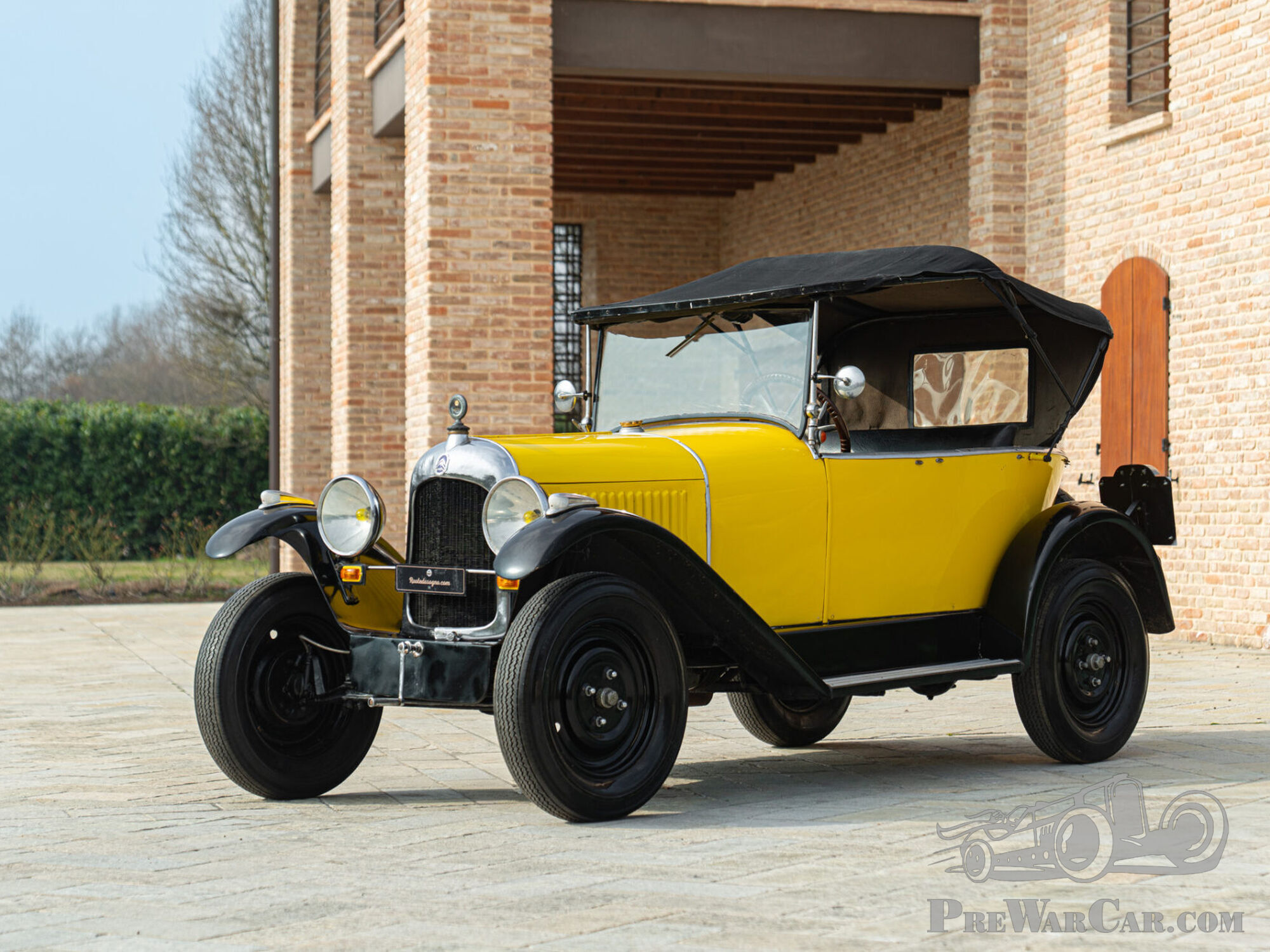


Citroën
France, 1919 to date
(1) SA André Citroën, Paris, 1919 – 1968
(2) Citroën A, Paris, 1968 to date
André Citroën, a former chief engineer of Mors, started his own gear-making firm in 1913, a fact commemorated by the ‘herring-bone bevel’ emblem used on all Citroën cars. He put his knowledge of American mass-production methods to good effect in 1919, when, in association with Jules Salomon (already responsible for Le Zèbre and later to be behind the Rosengart), he evolved two Citroën designs. The bigger of these, a sleeve-valve 4-litre, was taken over by Gabriel Voisin, but the 1.3-litre 4-cylinder Citroën Type-A was put into production in a factory previously used by Mors. This was a straightforward sv machine with disc wheels, cone clutch, fully electrical equipment, left hand drive and central change for the 3-speed gearbox. By the end of 1919 it was selling for 7950fr in France and £500 in England. 10.000 Citroën cars were made in 1921.
The need for expansion was soon to lead to the acquisition of Clément-Bayard. At this time, Citroën was developing the half-track system evolved by M. Kégresse, former manager of Tsar Nicholas II’s garage. This was mainly applied to commercial and military vehicles, but the smaller Kégresse versions were adaptations of Citroën’s private-car chassis, and among their exploits was the first successful crossing of the Sahara by Citroën motor car in 1922 – 1923. The 1922 Citroën range included an improved Citroën Type-B of 1½-litres, and the 856cc Citroën 5CV with cloverleaf bodywork, detachable head, quarter-elliptic springing all round, a foot transmission brake and coil ignition. Though neither a brisk goer nor a brisk stopper, it was indestructible and remained in production until 1925, in which year Noel Westwood used on to drive all round Australia in a Citroën. 15.000 Citroëns had been sold by 1924, when 250 cars a day were being turned out and Opel were marketing what amounted to a copy of the Citroën 5CV under the name of Laubfrosch. 1925 saw the advent of cheap all-steel saloon bodies made under Budd patents; this angular tout acier model sold in England for £325, or only £100 more than the standard tourer. Though a modernized derivative of the Citroën 5CV was to reappear in 1929 as the Sima-Standard, Citroën themselves concentrated in 1926 on the Citroën 12hp type, now enlarged to over 1½-litres, and given a flat radiator, 4-wheel brakes, and semi-elliptic springs. Cars were lso being assembled outside France. The British factory at Slough was opened in 1926, and was followed by others in Italy and Germany. In 1934 Gräf u. Stift of Vienna also built cars under Citroën licence. Of these only Slough survived the 1930s, British built Citroëns continuing to appear until 1965.
The Citroën company was now firmly established with Peugeot and Renault as one of France’s ‘big three’. In 1928 the saloons became more streamlined – they were also cheaper, the Citroën 12/24hp costing £220. Production in 1929 was 100.000 vehicles; new for that season was the 2.4-litre 6 cylinder Citroën C6, a conventional sv machine with 3-speed box, coil ignition, servo brakes and gravity feed. The 4-cylinder Citroën C4 cars were enlarged to 1.6 litres and had a similar specification. These two basic Citroën types were continued to 1932, when the company offered a new 1½-litre Citroën Ten among with the bigger Citroën Four and Citroën Six. These cars had low-pressure tyres, box-section frames, ‘Floating Power’ engine mountings under Chrysler licence and synchromesh gearboxes. The Citroën Ten cost £198 and the bigger cars were available in long-wheelbase form with seven-seater coachwork. Under the sponsorship of the Yacco Oil company the 10hp Citroën ‘Petite Rosalie’ successfully undertook a herculean programme of long-distance record work, in the course of which 187.500 miles were covered at 58mph and 128 International Class and 43 World Records were acquired. These Citroën models formed part of the range until 1936, acquiring four forward speeds in 1934, but they were overshadowed by yet another Citroën revolution, the first Citroën 7CV traction avant which appeared in that year. This had front-wheel drive, an ohv wet-liner engine, unitary construction of chassis and body, and all-round torsionbar independent suspension. The 3-speed synchromesh gearbox had dashboard change and production engines had a capacity of 1.6-litres. This design formed the backbone of Citroën’s range until 1955, and was not withdrawn until July 1957, by which time 708.339 4-cylinder Citroën traction-avant cars had been built and the car’s appeal was largely founded on its now ‘traditional’ styling.
A 3.8-litre fwd V8 was shown at the 1934 Paris Salon, but early the following year André Citroën found himself in serious financial difficulties and was forced to sell out to the Michelin interests. Meanwhile an alternative 1.9-litre engine had been applied to the Citroën traction avant and by mid-1935 three additional types were available: the Citroën 11 légère (Sports 12 or light 15) which shared a hull with the 7CV, and the Citroën 11 normale (Big 15), made in two wheelbase lengths, 10ft 1½in and 10ft 9in, the latter for seven-seaters. In 1936 Francois Lecot drove a Citroën 7CV 400.000 kilometers in 12 months. The 1937 fwd Citroëns had rack-and-pinion steering, rear-wheel drive cars were still made with the 11CV engine and (for a short while) the option of a diesel power unit. The 1939 range ws rounded out with a 2.9-litre 15CV 6-cylinder fwd car on regular lines, which sold in England for £328 and just before World War 2 downdraught carburetors were standardized. 1939 models of Georges Irat, Rosengart, and smaller Chenard-Walckers used 11CV mechanical components as a basis for their cars, to be followed in 1947 by D.B.
After the war the Citroën 7CV was dropped, but production of the other fwd models was resumed, cars for the French market being supplied only in matt black. In 1949, however, the fruits of ten years of experimentation were seen in another evolutionary Citroën, the Boulanger-designed Citroën 2CV. Like its bigger sisters, it had fwd and unitary construction, but it also had interlinked coil suspension, a 4-speed all-synchromesh and all-indirect gearbox with geared-up top and quick detachable bonnet, doors and front wings for easy maintenance. Power came from a 375cc 9bhp ohv flat-twin and the corrugated grey finish attracted unkind comparisons with garden sheds. Supply, however, never caught up with demand: Citroën production jumped from 48.177 in 1950 to 78.199 in 1951 as the Citroën 2CV got into its stride. 1955 cars had 425cc, 12bhp, and centrifugal clutches, and in 1958 came tous terrains model with twin engines and 4-wheel drive. The Slough factory offered the Bijou variants in 1960 with a fiberglass coupé body, but at £695 it was hardly competitive. By July, 1966, 2.574.642 2CVs had been sold.
The full-sized Citroën cars of 1953 came with built-out boots and heaters as standard equipment, and a year later the Citroën Six was available with self-levelling hydropneumatic suspension. This led to the Citroën DS19 introduced at the 1955 shows, on which the only old features were the fwd and the long-stroke 4-cylinder engine, now up-rated to 65bhp. The self-levelling suspension was joined by power assistance for the brakes (disc front and rum rear), steering and gear-change. There were 4 forward speeds, the roof section was of reinforced plastic, and the single-spoke steering wheel found on Humbers of half a century before was revived. It was expensive (£1726 in England) and complicated, and a year later a simplified Citroën ID19 version retained the advanced springing but eliminated the power assistance. It was £140 less than the DS in France and Citroën sales rose to 206.138 cars. 1954 had seen the first association between the company and Panhard, which was to lead to a full integration within the next decade, while Cooper in England used Citroën gearboxes on their racing cars from 1956 onward. A Citroën won the 1959 Monte Carlo Rally.
A development of the 2CV was the Citroën Ami-6 flat-twin of 1961, a curious-looking little 4-door saloon which took some time to find acceptance. In 1965 short-stroke engines were at long last adopted for the more expensive 4-cylinder cars, though it was not until 1967 that the basic 1934-1935 unit was dropped from the ID. The most expensive 1967 Citroën model was the 2.2-litre 108bhp Citroën DS21; it acquired a swiveling 4-headlamp installation in 1968 and could be had wih fuel injection in 1971. The Citroën Dyane of 1968 filled a gap in the range: it was a more refined 2CV available either with the latter’s uprated 435cc unit or with the 602cc Ami motor. An open jeep-type version, the Citroën Méhari, arrived a year later. But meanwhile during 1968 Citroën had acquired Italian affiliations, first entering into an agreement with Maserati and then negotiating (against General de Gaulle’s wishes) with Fiat. As a result the Italian giant acquired a 15 per cent stake in the Citroën company and their new French ally undertook the distribution of Autobianchi products in France. In 1969 there was an experimental batch of 500 M35 coupés using 49bhp Wankel engines in Ami-type structures, but a year later came the result of the Maserati alliance, in the shape of the Citroën SM sports coupé, powered by a 2.7-litre 4ohc V6 engine developing 170bhp. This, of course, drove the front wheels via a 5-speed all-synchromesh gearbox; other features were power steering and disc brakes, and a 6-headlamp layout. With a price of 51.800 francs and a top speed of 137mph it was the fastest and most expensive Citroën ever, and it helped boost the marque’s flagging reputation in rallies. Their only major performance (a near miss in the 1968 London-Sydney Marathon apart) had been a 1-2-3 victory in the 1969 Moroccan event, but the Citroën SM won again in Morocco in 1971.
For 1971 another gap was bridged with an answer to Peugeot and Renault: the 1015cc Citroën GS. This had an air-cooled ohv light-alloy flat-4 engine, and all-disc brakes, those at the front being inboard. A station wagon followed in 1972, when fully automatic gearboxes and fuel injection were available on the big 4-cylinder saloons, and the twins continued in Citroën 2CV Dyane, Méhari and Ami forms. Even more powerful DS Citroëns were offered in 1973, outputs of the new 2.3-litre engines being 115bhp in carburetor form, or 130bhp with fuel injection: the latter was standardized on the SM. At the same time the Citroën GS was made available with automatic transmission, and the option of a 1200cc engine. The 2-cylinder Citroën cars were ssembled or manufacturerd in eight countries, and Citroën D-series models produced in South-Africa and Yugoslavia. In the latter country Citroën cars are marketed under the Tomos name.
Source: Georgano, encyclopedia of motorcar; MCS
The information is written with the greatest of care. However, if you have any suggested amendments please contact us at office@prewarcar.com
Duesenberg
US, 1920 – 1937, 1966
(1) Duesenberg Motor Co, Indianapolis, Ind., 1920 – 1937
(2) Duesenberg Corporation, Indianapolis, Ind., 1966
Fred Duesenberg began by making bicycles and designed his first Duesenberg car, the Mason, in 1904. He and his brother August made engines with horizontal overhead valves for the 1912 Mason racing cars, and founded Duesenberg Motors in the following year in order to produce marine engines and complete racing cars bearing the Duesenberg name. The most famous of the latter appeared in 1920: a 3-litre Bugatti-inspired Duesenberg straight-8 with single overhead camshaft and three (vertical) valves per cylinder. This Duesenberg won the 1921 French Grand Grand Prix. In the 1920s the Duesenberg racing cars were the great rivals of the Millers at Indianapolis, and victory was assured in 1924 by the adoption of a centrifugal blower on Duesenberg cars. Though a two-stroke 1½-litre 8-cylinder racing engine capable of 7.000rpm was made in 1926, this was not proceeded with. The horizontal-valve Duesenberg engine was taken over in 1920 by the Rochester Motor Manufacturing Co Inc and was used in various sporting and luxury cars.
Meanwhile, at the end of 1920, the first Duesenberg production car made its debut. This Duesenberg Model A was an extremely expensive, if very advanced, luxury car, embodying an 8-cylinder in-line engine – the first to be seen in an American production car – of 4.2 litres, basically similar to the Duesenberg racing unit, but with only two valves per cylinder and developing about 100bhp. There were also hydraulically-operated front wheel brakes – another ‘first’ as far as America was concerned. The Model A was current until 1926. A handful of its little-altered successor, the Duesenberg Model X, was made in 1926-1927, but in the former year E.L. Cord of Auburn acquired control of the Duesenberg company. He stipulated that Fred Duesenberg’s next car should be completely new, and a quite exceptional machine. In fact, the Duesenberg Model J, which made its bow at the end of 1928, was the most remarkable automobile in America: bigger, faster, more elaborate and more expensive than any other, yet also superior to them in refinement and good looks. Its 6.9-litre, 8-cylinder engine, made by Lycoming (a firm which Cord had also bought), had two chain-driven overhead camshafts operating four valves per cylinder; a layout of racing type unique among American cars at the time and said to develop 265bhp at 4250rpm – more than double the output of any rival. Although the complete Duesenberg car weighed more than 4980lb, it was claimed to be capable of 116mph in top gear and 89mph in second. Only Duesenberg Model J chassis were made for which $8500 was asked in 1929. Immensely long and strong and lowbuilt, Duesenberg cars were very popular with all the leading coachbuilders. The Duesenberg company preferred to sell cars complete with bodies designed by them but made by approved builders, such as Murphy, Bohman & Schwarts, Judkins, Derham and Le Baron. In this form, catalogued Duesenberg models cost up to $17.950. The transmission – apart form the double dry-plate clutch – was conventional, as was the suspension by half-elliptic springs and hydraulic shock absorbers. The brakes, of course, were hydraulic, with vacuum servo assistance from late 1929.
In 1932 a supercharged version of the Model J, the Duesenberg SJ, was added. To cope with the 320bhp now alleged to be available, bearings, reciprocating parts and valve springs were strengthened. Usually, the shortest Duesenberg J chassis was used, with the highest axle ratio and stronger front springs. A maximum speed of 129mph was attributed to the Duesenberg SJ, with an acceleration figure of 0-100mph in 17 seconds.
Duesenberg survived the Depression, but died in the collapse of the Cord Corporation in 1937. Attempts to revive the Duesenberg name were made in 1947 and in 1966. The first Duesenberg was unsuccessful, and in 1966 only one Duesenberg car was actually made, powered by a 7-litre V8 Chrysler engine with push-rod overhead valves, developing 431bhp at 5.000rpm. Transmission was automatic, front suspension was independent, and there were disc brakes. Body styling was by Ghia. This Duesenberg venture, too, collapsed.
Source: Georgano, encyclopedia of motorcar; TRN
The information is written with the greatest of care. However, if you have any suggested amendments please contact us at office@prewarcar.com


Featured
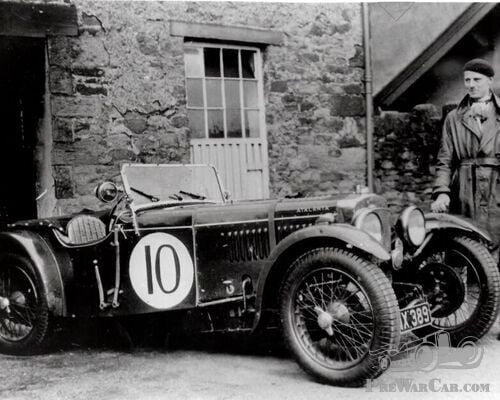
Fraser Nash TT Replica
AHX 389 ( chassis no. 2073, engine no. 10367).An important and correct short-chassis TT Replica with known history from new. Ex. H. P..
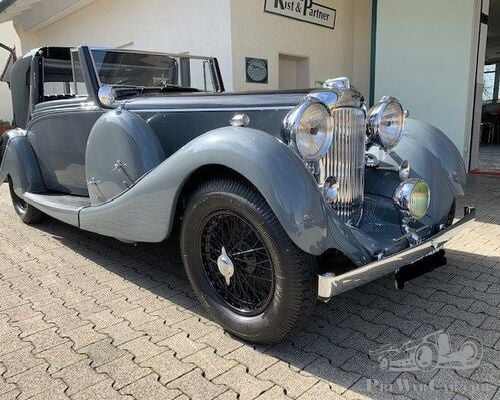
Lagonda LG 45 Coupe de Ville Sedanca by Mayfair
The successor to the M45, the LG45 was built around the same highly capable, competition-proven 4.5-litre Meadows inline-six engine, but featured r..
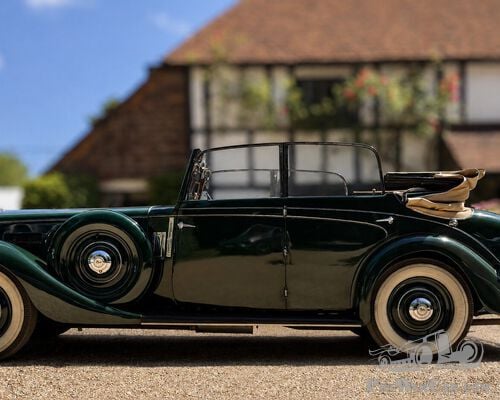
1936 Armstrong Siddeley 20/25 Cabriolet with Tickford coachwork by Salmons & Sons, Newport Pagnell
This exceptionally rare Armstrong Siddeley 20/25 Cabriolet with original Tickford coachwork by Salmons & Sons of Newport Pagnell was first reg..