The global magazine and marketplace for classic car enthusiasts, by enthusiasts.


Filter
Classic Citroën, Plymouth for sale - Citroën, Plymouth cars for sale
-

1923 Citroen 5CV Cabriolet Boulogne - LHD
Technical Specifications Mark & Model: Citroen 5CV Cabriolet Boulogne - LHDYear: 1923Registration plate: Guernsey registeredChassis Number: 49518Engine Number: 2131794Engine Capacity: 856 ccTransmission: 3-speed manualMileage: Body style: 1-door convertibleInterior color: .. -
c.1923 – Citroën 5 HP Plateau
Chassis No. 1JCCF87AXFT004443Vehicle sold without a registration certificate Vehicle sold without a roadworthiness test“Museum condition, an incredible patina of age…” The second car produced by automotive pioneer André Citroën, the Type C 5 HP was one of the first European cars to be mass.. -
1935 Citroën Traction Avant
Early-production Traction AvantExceptionally original, unrestored conditionRecently part of a major museum collectionDrives and brakes well The Citroën Traction Avant is rightly regarded as one of the most important cars of the twentieth century. With its front-wheel drive, monocoque constructi.. -
1940 Plymouth P10 Deluxe Convertible Coupe | RM Sotheby's | The Hershey Auction
Sold | $43,680 USD One of 6,986 Deluxe Convertible Coupes produced for 1940Benefits from an excellent rotisserie restoration under previous ownershipL-head inline six-cylinder engine; three-speed manual with overdriveWonderfully presented in Boatswain Blue over red leather Richly appointed with a remark.. -
1932 Plymouth Model PB Sport Roadster | RM Sotheby's | The Hershey Auction
Sold | $22,400 USD One of just 2,163 Sport Roadsters produced for 1932Final year for Plymouth's original Silver Dome four-cylinder engineEquipped with dual side-mounted spares, rumble seat, and folding rear luggage rackOne of Plymouth's most attractive and desirable pre-war open body styles By 1932, ..


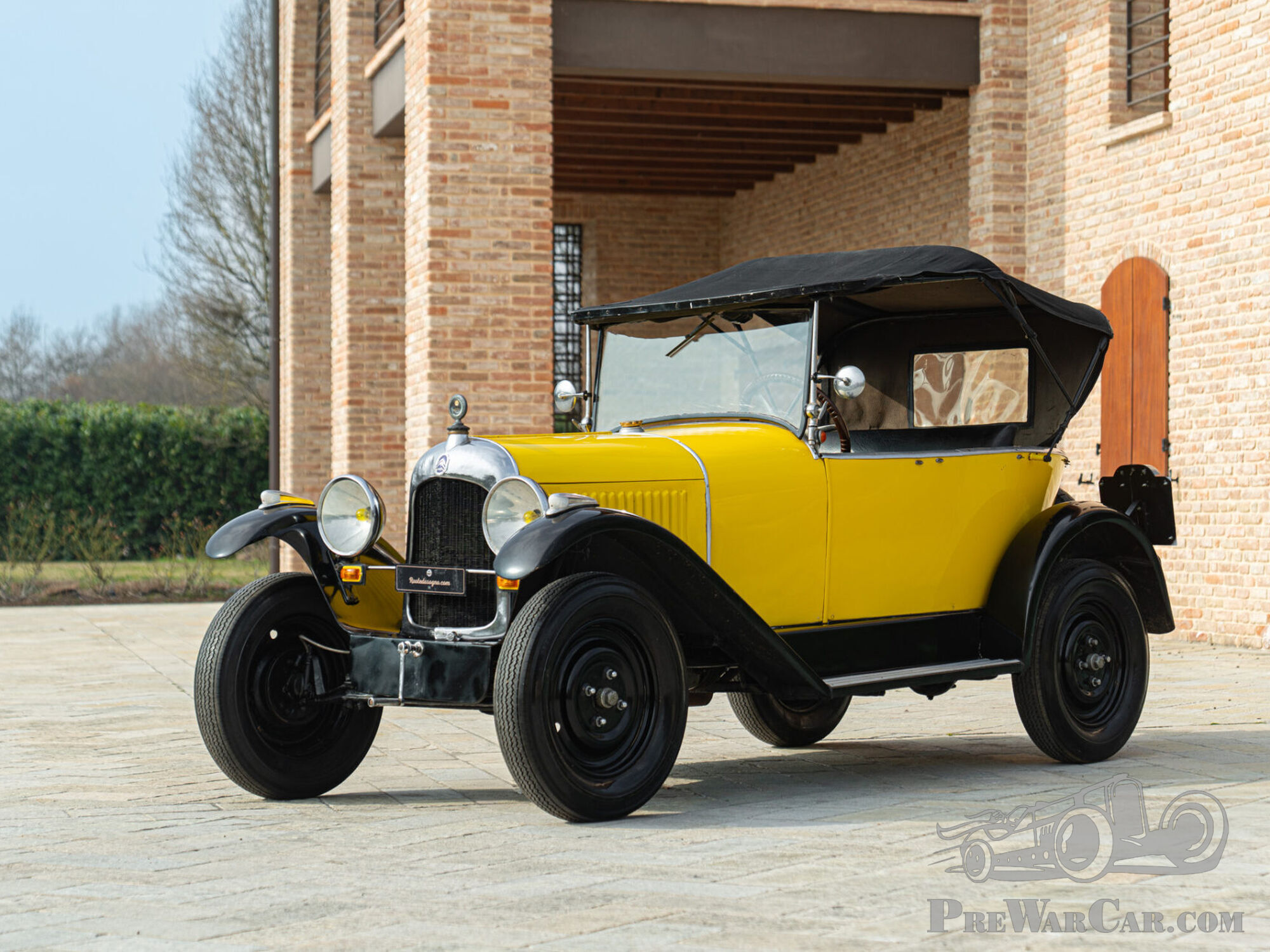


Citroën
France, 1919 to date
(1) SA André Citroën, Paris, 1919 – 1968
(2) Citroën A, Paris, 1968 to date
André Citroën, a former chief engineer of Mors, started his own gear-making firm in 1913, a fact commemorated by the ‘herring-bone bevel’ emblem used on all Citroën cars. He put his knowledge of American mass-production methods to good effect in 1919, when, in association with Jules Salomon (already responsible for Le Zèbre and later to be behind the Rosengart), he evolved two Citroën designs. The bigger of these, a sleeve-valve 4-litre, was taken over by Gabriel Voisin, but the 1.3-litre 4-cylinder Citroën Type-A was put into production in a factory previously used by Mors. This was a straightforward sv machine with disc wheels, cone clutch, fully electrical equipment, left hand drive and central change for the 3-speed gearbox. By the end of 1919 it was selling for 7950fr in France and £500 in England. 10.000 Citroën cars were made in 1921.
The need for expansion was soon to lead to the acquisition of Clément-Bayard. At this time, Citroën was developing the half-track system evolved by M. Kégresse, former manager of Tsar Nicholas II’s garage. This was mainly applied to commercial and military vehicles, but the smaller Kégresse versions were adaptations of Citroën’s private-car chassis, and among their exploits was the first successful crossing of the Sahara by Citroën motor car in 1922 – 1923. The 1922 Citroën range included an improved Citroën Type-B of 1½-litres, and the 856cc Citroën 5CV with cloverleaf bodywork, detachable head, quarter-elliptic springing all round, a foot transmission brake and coil ignition. Though neither a brisk goer nor a brisk stopper, it was indestructible and remained in production until 1925, in which year Noel Westwood used on to drive all round Australia in a Citroën. 15.000 Citroëns had been sold by 1924, when 250 cars a day were being turned out and Opel were marketing what amounted to a copy of the Citroën 5CV under the name of Laubfrosch. 1925 saw the advent of cheap all-steel saloon bodies made under Budd patents; this angular tout acier model sold in England for £325, or only £100 more than the standard tourer. Though a modernized derivative of the Citroën 5CV was to reappear in 1929 as the Sima-Standard, Citroën themselves concentrated in 1926 on the Citroën 12hp type, now enlarged to over 1½-litres, and given a flat radiator, 4-wheel brakes, and semi-elliptic springs. Cars were lso being assembled outside France. The British factory at Slough was opened in 1926, and was followed by others in Italy and Germany. In 1934 Gräf u. Stift of Vienna also built cars under Citroën licence. Of these only Slough survived the 1930s, British built Citroëns continuing to appear until 1965.
The Citroën company was now firmly established with Peugeot and Renault as one of France’s ‘big three’. In 1928 the saloons became more streamlined – they were also cheaper, the Citroën 12/24hp costing £220. Production in 1929 was 100.000 vehicles; new for that season was the 2.4-litre 6 cylinder Citroën C6, a conventional sv machine with 3-speed box, coil ignition, servo brakes and gravity feed. The 4-cylinder Citroën C4 cars were enlarged to 1.6 litres and had a similar specification. These two basic Citroën types were continued to 1932, when the company offered a new 1½-litre Citroën Ten among with the bigger Citroën Four and Citroën Six. These cars had low-pressure tyres, box-section frames, ‘Floating Power’ engine mountings under Chrysler licence and synchromesh gearboxes. The Citroën Ten cost £198 and the bigger cars were available in long-wheelbase form with seven-seater coachwork. Under the sponsorship of the Yacco Oil company the 10hp Citroën ‘Petite Rosalie’ successfully undertook a herculean programme of long-distance record work, in the course of which 187.500 miles were covered at 58mph and 128 International Class and 43 World Records were acquired. These Citroën models formed part of the range until 1936, acquiring four forward speeds in 1934, but they were overshadowed by yet another Citroën revolution, the first Citroën 7CV traction avant which appeared in that year. This had front-wheel drive, an ohv wet-liner engine, unitary construction of chassis and body, and all-round torsionbar independent suspension. The 3-speed synchromesh gearbox had dashboard change and production engines had a capacity of 1.6-litres. This design formed the backbone of Citroën’s range until 1955, and was not withdrawn until July 1957, by which time 708.339 4-cylinder Citroën traction-avant cars had been built and the car’s appeal was largely founded on its now ‘traditional’ styling.
A 3.8-litre fwd V8 was shown at the 1934 Paris Salon, but early the following year André Citroën found himself in serious financial difficulties and was forced to sell out to the Michelin interests. Meanwhile an alternative 1.9-litre engine had been applied to the Citroën traction avant and by mid-1935 three additional types were available: the Citroën 11 légère (Sports 12 or light 15) which shared a hull with the 7CV, and the Citroën 11 normale (Big 15), made in two wheelbase lengths, 10ft 1½in and 10ft 9in, the latter for seven-seaters. In 1936 Francois Lecot drove a Citroën 7CV 400.000 kilometers in 12 months. The 1937 fwd Citroëns had rack-and-pinion steering, rear-wheel drive cars were still made with the 11CV engine and (for a short while) the option of a diesel power unit. The 1939 range ws rounded out with a 2.9-litre 15CV 6-cylinder fwd car on regular lines, which sold in England for £328 and just before World War 2 downdraught carburetors were standardized. 1939 models of Georges Irat, Rosengart, and smaller Chenard-Walckers used 11CV mechanical components as a basis for their cars, to be followed in 1947 by D.B.
After the war the Citroën 7CV was dropped, but production of the other fwd models was resumed, cars for the French market being supplied only in matt black. In 1949, however, the fruits of ten years of experimentation were seen in another evolutionary Citroën, the Boulanger-designed Citroën 2CV. Like its bigger sisters, it had fwd and unitary construction, but it also had interlinked coil suspension, a 4-speed all-synchromesh and all-indirect gearbox with geared-up top and quick detachable bonnet, doors and front wings for easy maintenance. Power came from a 375cc 9bhp ohv flat-twin and the corrugated grey finish attracted unkind comparisons with garden sheds. Supply, however, never caught up with demand: Citroën production jumped from 48.177 in 1950 to 78.199 in 1951 as the Citroën 2CV got into its stride. 1955 cars had 425cc, 12bhp, and centrifugal clutches, and in 1958 came tous terrains model with twin engines and 4-wheel drive. The Slough factory offered the Bijou variants in 1960 with a fiberglass coupé body, but at £695 it was hardly competitive. By July, 1966, 2.574.642 2CVs had been sold.
The full-sized Citroën cars of 1953 came with built-out boots and heaters as standard equipment, and a year later the Citroën Six was available with self-levelling hydropneumatic suspension. This led to the Citroën DS19 introduced at the 1955 shows, on which the only old features were the fwd and the long-stroke 4-cylinder engine, now up-rated to 65bhp. The self-levelling suspension was joined by power assistance for the brakes (disc front and rum rear), steering and gear-change. There were 4 forward speeds, the roof section was of reinforced plastic, and the single-spoke steering wheel found on Humbers of half a century before was revived. It was expensive (£1726 in England) and complicated, and a year later a simplified Citroën ID19 version retained the advanced springing but eliminated the power assistance. It was £140 less than the DS in France and Citroën sales rose to 206.138 cars. 1954 had seen the first association between the company and Panhard, which was to lead to a full integration within the next decade, while Cooper in England used Citroën gearboxes on their racing cars from 1956 onward. A Citroën won the 1959 Monte Carlo Rally.
A development of the 2CV was the Citroën Ami-6 flat-twin of 1961, a curious-looking little 4-door saloon which took some time to find acceptance. In 1965 short-stroke engines were at long last adopted for the more expensive 4-cylinder cars, though it was not until 1967 that the basic 1934-1935 unit was dropped from the ID. The most expensive 1967 Citroën model was the 2.2-litre 108bhp Citroën DS21; it acquired a swiveling 4-headlamp installation in 1968 and could be had wih fuel injection in 1971. The Citroën Dyane of 1968 filled a gap in the range: it was a more refined 2CV available either with the latter’s uprated 435cc unit or with the 602cc Ami motor. An open jeep-type version, the Citroën Méhari, arrived a year later. But meanwhile during 1968 Citroën had acquired Italian affiliations, first entering into an agreement with Maserati and then negotiating (against General de Gaulle’s wishes) with Fiat. As a result the Italian giant acquired a 15 per cent stake in the Citroën company and their new French ally undertook the distribution of Autobianchi products in France. In 1969 there was an experimental batch of 500 M35 coupés using 49bhp Wankel engines in Ami-type structures, but a year later came the result of the Maserati alliance, in the shape of the Citroën SM sports coupé, powered by a 2.7-litre 4ohc V6 engine developing 170bhp. This, of course, drove the front wheels via a 5-speed all-synchromesh gearbox; other features were power steering and disc brakes, and a 6-headlamp layout. With a price of 51.800 francs and a top speed of 137mph it was the fastest and most expensive Citroën ever, and it helped boost the marque’s flagging reputation in rallies. Their only major performance (a near miss in the 1968 London-Sydney Marathon apart) had been a 1-2-3 victory in the 1969 Moroccan event, but the Citroën SM won again in Morocco in 1971.
For 1971 another gap was bridged with an answer to Peugeot and Renault: the 1015cc Citroën GS. This had an air-cooled ohv light-alloy flat-4 engine, and all-disc brakes, those at the front being inboard. A station wagon followed in 1972, when fully automatic gearboxes and fuel injection were available on the big 4-cylinder saloons, and the twins continued in Citroën 2CV Dyane, Méhari and Ami forms. Even more powerful DS Citroëns were offered in 1973, outputs of the new 2.3-litre engines being 115bhp in carburetor form, or 130bhp with fuel injection: the latter was standardized on the SM. At the same time the Citroën GS was made available with automatic transmission, and the option of a 1200cc engine. The 2-cylinder Citroën cars were ssembled or manufacturerd in eight countries, and Citroën D-series models produced in South-Africa and Yugoslavia. In the latter country Citroën cars are marketed under the Tomos name.
Source: Georgano, encyclopedia of motorcar; MCS
The information is written with the greatest of care. However, if you have any suggested amendments please contact us at office@prewarcar.com
Plymouth
US, 1928 to date
Chrysler Corporation, Detroit, Mich.
The 4-cylinder 21hp Plymouth car appeared in 1928 at a list price of $725 for a sedan. This Plymouth car replaced the earlier 4-cylinder Chryslers and represented a serious challenge for Ford and Chevrolet in their lowest price class. The Plymouth car had side valves, internal-expanding hydraulic brakes and ribbon-type radiator and gave the Plymouth car a close resemblance to the 1928 Chryslers and De Sotos, and Plymouth cars sold over 100.000 in its first year, even improving its sales position in the bleak economic climate of 1932. Plymouth cars adhered to four cylinders until 1933, when the Plymouth PD-series 6-cylinder was listed at less than $600. 1934 de luxe models of Plymouth cars had independent front suspension, but this was dropped after a year and did not reappear for some time on Plymouth cars. The standard engine in the later 1930 Plymouth cars had a capacity of 3.3-litres, rather smaller than that used in comparable Chevrolets and Fords: a small-bore 2.8-litre version Plymouth car was made for export up to 1939, but the name Plymouth was not usually found on Plymouth cars sold in England, which were nominally Chrysler Kew and Wimbledon sixes. After World War 2 evolution followed that of other Chrysler Corporation cars closely, the old-fashioned styling losing the Plymouth car division its long-held third place in American sales to Buick. Further, Plymouth cars retained the L-head six as its staple power unit right up to 1955, when Flight Sweep versions were introduced with over-square ohv V8 engines on accepted American lines in a variety of powers from 157 to 177bhp. The capacity of these Plymouth cars had 4.3-litres, while the six, now of 3.8-litres, remained available. These 1955 Plymouth cars were lower and longer than their predecessors and could be obtained with synchromesh, overdrive or automatic gearboxes.
The Plymouth Fury models of the ensuing decade represented a breakaway from the traditional Plymouth stolid family car, while the Plymouth Car Division was also responsible for Chrysler’s contribution to the compacts, the Plymouth Valiant launched for 1960. This Plymouth car had rather more European styling than its competitors, with a dummy spare-wheel moulding on the tail; interesting items of specification were the unitary construction of the Plymouth car, alternator ignition, and inclined in-line 2.8-litre ohv 6-cylinder engine. The influence of the Plymouth GT car on America resulted in the Plymouth Barracuda of 1965, a fastback coupé using the Valiant’s 8ft 10in wheelbase and a 4½-litre V8 power unit. Plymouth cars, like Ford and Chevrolet, was aiming at comprehensive coverage of the low and medium price market in 1966, with the compact Plymouth Valiant, the sports-compact Plymouth Barracuda, the medium-sized Plymouth Belvedere, the full-size Plymouth Fury, and the luxurious ‘VIP’ 4-door hardtop Plymouth car, offered only with a 5.2-litre V8 engine and selling for $2.930. An increasing emphasis on sporting Plymouth cars was detectable by 1968, when in addition to the established Barracuda there were two other sports coupés Plymouth car, the Plymouth GTX and the Plymouth Road Runner. All three Plymouth cars were available with 4-speed manual gearboxes and the 6.981cc 425bhp hemi-head V8 also used by Dodge. In 1970, when Valiant prices started at a low $2.172, there was also a Valiant sports coupé, the Plymouth Duster.
In 1971 Plymouth car company added a sub-compact to their Plymouth car range when they offered the 1½-litre Hillman Avenger as the Plymouth Cricket. The 1972 range of Plymouth cars embraced the Valiant on a 9ft wheelbase, the Barracudas and Satellites, and the full-size Furys with V8 engines and automatic transmission as standard. Engines in the Plymouth cars ranged from the Valiant’s 3.2-litre and 3.7-litre sixes up to the largest Chrysler unit, a V8 of 7.210cc. Electronic ignition was offered on the costliest Barracuda model. Casualties of new Federal regulations were the hemi-head engine and convertibles, and the same range Plymouth cars with minor improvements, among them manually-operated sun roofs, was offerd in 1973.
Source: Georgano, encyclopedia of motorcar; MCS
The information is written with the greatest of care. However, if you have any suggested amendments please contact us at office@prewarcar.com



Featured
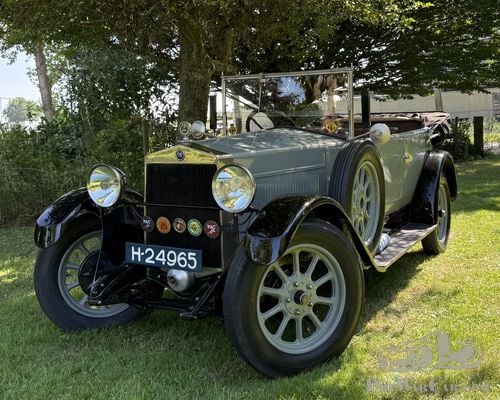
Fiat 509 Torpedo / Spider – Exceptionally Original and Complete
A Rare and Highly Original Example with Long-Term Dutch HistoryOffered for sale is an exceptionally original and remarkably complete Fiat 50..
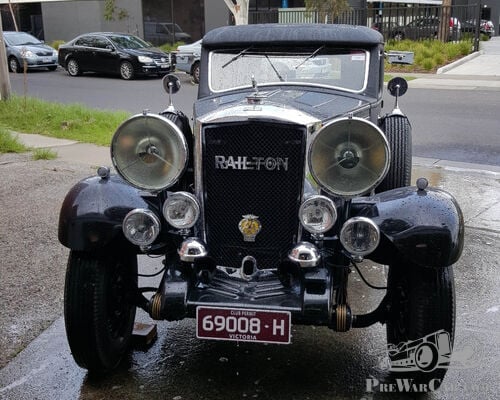
Railton straight 8 sports coupe for rallying REDUCED PRICE run with the bentleys at a fraction of the price
1934 Railton Sports CoupeBuilt for long distance rallyingRebuilt 2017built up at a cost of $160,000AUD, OFFERED FOR SALE AT A ..
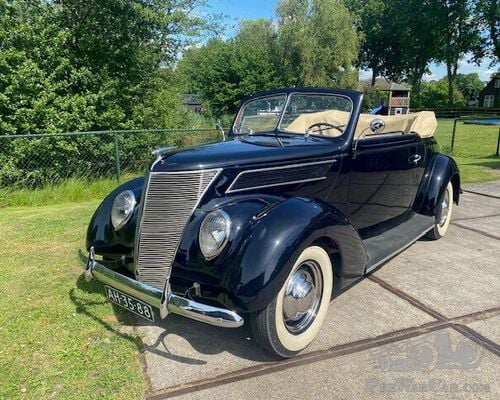
Ford v8 Club cabriolet 1937
Very nice Ford v8 Club cabriolet. In excellent condition. Runs and drives very well.Top condition.Shipping possible.