The global magazine and marketplace for classic car enthusiasts, by enthusiasts.


Filter
Classic Clément-Talbot, DeSoto for sale - Clément-Talbot, DeSoto cars for sale
-

1904 Clement-Talbot
This French-English car was the fruit of a collaboration between Adolphe Clement and Lord Chetwynd-Talbot, 20th Earl of Shrewsbury and talbotA 2 cylindre engine which brings good performance for this car and a 3 speed gearbox is all you need for a enjoyable rallyWe used it in rallies in Belgium, France, Germany, Italy, Netherlands .. -
1903 Clément AC4R 12/16 HP Rear-Entrance Tonneau | RM Sotheby's | The London Auction
To Be OFFERED AT AUCTION at RM Sothebys' The London Auction event, 31 October 2026. £350,000 - £450,000 GBP An exceptional, powerful four-cylinder Veteran automobileWell-known enthusiast history since the 1930s, including A W F Smith and Barry HonRestored from an excellent and well-preserved original exampleA s..


Clement-Talbot
1903 – 1938
Clement-Talbot Ltd, North Kensington, London W.10
From 1903, Clement-Talbot Ltd, a company backed by the Earl of Shrewsbury and Talbot, began importing the French Clément car into Britain; in spite of its name and an interest held by Adolphe Clément, the concern was British, and by the end of the year its cars were called Talbots. The 1904 Clement-Talbot models were a 6hp single, and 11hp twin, and two big fours. All of them had shaft drive and side valves in T-heads, except for the biggest, the Clement-Talbot 27hp voiture de luxe, which used overhead inlet valves and a single camshaft. Trucks, buses and boats were also advertised. Promotion, which was at first in the hands of the managing director, D.M. Weigel, was energetic and successful.
By the end of 1904, an impressive Clement-Talbot factory had been built, complete with test track, and in the following year British-assembled, and partly British-made Clement-Talbots emerged from it. A wide variety of tupes was listed, from an 11hp twin to a great 50hp 4-cylinder model. One model that was to be famous, the Clement-Talbot 12/16hp, had already been designed. French cars were still being imported by the company. However, the 20hp of 1906 was the first British-made Talbot. It was designed by C.R. Garrard, and while still conventional, had an unusually efficient engine of 3.8 litres’ capacity. Both this and the 2.7-litre ‘12/16’ were fast cars that quickly made a name for themselves in competitions; their slogan became ‘The Invincible Talbot’. For 1907 a 3-litre 15hp, a car in the same mould, superseded the ‘12/16’. By 1908 it was the only British chassis offered, into which could be installed 15hp, 25hp or 35hp engines. Their popularity was due to a combination of smoothness, reliability, speed and reasonable price. The French range was still listed. A six was introduced for 1910, and the 4½-litre 25hp was revised by G.W.A. Brown with an L-head valve arrangement. This Clement-Talbot model, highly tuned and lightened, and fitted with a racing body, became the first car to cover 100 miles in an hour, at Brooklands in 1913 in the hands of Percy Lambert. In the same year a new model, the 2.6-litre 15/20hp, was introduced. This and the 25hp, now called the ‘Clement-Talbot 25/50’, were the famous cars that kept the name before the public eye in competitions. A sports model of the latter was also listed. By this time, the French range had been dropped.
In 1919 Clement-Talbot was taken over by another French-sounding, but in fact British-owned firm, the Société Alexandre Darracq of Paris.
Source: Georgano, encyclopedia of motorcar; TRN
The information is written with the greatest of care. However, if you have any suggested amendments please contact us at office@prewarcar.com
DeSoto
US, 1913 – 1916
DeSoto Motro Car Co, Auburn, Ind.
The DeSoto appears to have succeeded the Zimmerman. This was a large car with a 55hp, 6-cylinder engine, which was furnished with a compressed-air starter. The DeSoto model Six-55 five-seater touring car sold for $2185.
US, 1928 – 1960
Chrysler Motors Corp, Detroit, Mich.
The DeSoto was launched in 1928 as a 3.2-litre side valve six to compete with Oldsmobile, Pontiac and the cheaper Nashes. Styling and general design of the DeSoto were in line with the 1929 Chryslers, and at $885 for a DeSoto sedan 90.000 were sold in the first twelve months. A 3.4-litre straight-8 DeSoto on a 9ft 6in wheelbase was announced for 1930 as the world’s cheapest 8-cylinder car. However, DeSoto suffered badly in the Depression, and in 1932, when flexible rubber engine mountings and free wheels were made available, sales dropped to 26.000 DeSoto cars.
The DeSoto disappeared from the British market about this time, though certain ‘Chrysler’ models listed in England (the Mortlake, Croydon, and some of the Richmonds) were in fact DeSoto cars in all but name. A 6-cylinder version of Chrysler’s advanced unitary-construction Airflow, the SE-type with a 4-litre engine, was brought out in 1934, but was an unsuccessful as its bigger sister. Later DeSotos followed regular Chrysler lines closely though in later years there was a tendency for DeSoto to move into a higher price class than Dodge; by 1952 DeSotos started $300 higher than the companion make.
By 1939 the DeSoto cars for sale were being made with independent front suspension, hypoid back axles and column change. There was a choice at DeSoto of two 6-cylinder engines and three wheelbase lengths, the longest of these being reserved for seven-seater bodywork – DeSoto continued to offer a really roomy family car right up to 1954. A 4-speed semi-automatic Vacumatic transmission became an option in 1941, but DeSoto’s big post-war change of models did not take place until 1952, when the division followed Chrysler’s lead in adopting the oversquare ohv V8; the DeSoto version was of 4½-litre capcity and developed 16-bhp. With the advent of Chrysler’s ‘flight sweep’ styling in 1955, the side-valve sixes were dropped and the standard engine in a DeSoto was now a 4.8-litre eight, giving 185bhp in Firedome guise, and 200bhp in Fireflite form. Though this redesigning saved Chrysler sales generally, the slump in the medium-price class had an adverse effect on DeSoto and in 1959 the DeSoto division was merged with Plymouth. Last of the DeSotos were the 1961 models, unitary-construction cars with a choice of three engines: Plymouth’s 145bhp ohv ‘slant six’ as used in the Valiant, and V8s of 230 and 265bhp, the two former only in Canadian DeSotos. Production of DeSoto cars ceased in November 1960 after only a few had been delivered.
Source: Georgano, encyclopedia of motorcar; MCS
The information is written with the greatest of care. However, if you have any suggested amendments please contact us at office@prewarcar.com


Featured
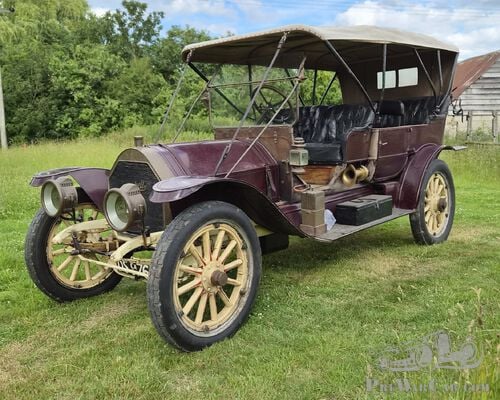
1910 Mitchell Model S - 50HP Six Cylinder
Based in Racine, Wisconsin and being the largest wagon manufacturer in the USA, Mitchell-Lewis produced their first motor car in 1903. Sales grew ..
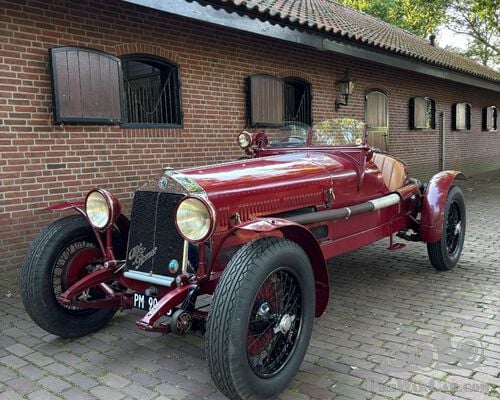
1930 Alfa Romeo 6C 1750 Spider
1930 Alfa Romeo 6C 1750 Spider with complete history from delivery to first owner in 1930 in Firenze till today with copy Libretto/license plate.
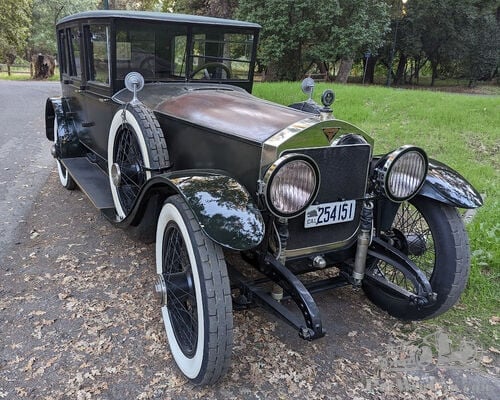
1916 Simplex, Crane model 5
1916 Simplex, Crane MODEL 5CUSTOM MADE HISTORIC PRESERVATION VEHICLE – READY TO TOUR!This Simplex recently completed th..