The global magazine and marketplace for classic car enthusiasts, by enthusiasts.


Filter
Classic Cole for sale - Cole cars for sale
-

Speed Six Close Couple Coupe
This matching numbers Speed Six Bentley was supplied new to Viscount Mandeville the 10th Duke of Manchester. Termed a ‘Folkestone’ close-coupled saloon by the coachbuilder Martin Walter it was the second of only two built. The 1930 Vintage Bentley Speed Six, registration GJ755, has been in the Medcalf family ownership for over 40 years. Campaigned .. -
1935 Duesenberg 'Sweep Panel' Model J Dual-Cowl Phaeton LaGrande | RM Sotheby's | Private Sales
Asking | $3,300,000 USD The final “Sweep Panel” Dual-Cowl Phaeton built by LaGrandeOriginally the New York Duesenberg factory branch demonstratorMultiple award-winning restoration by the noted Steve Babinsky, with further recent servicingA respected example with original frame, firewall, engine, and coachwork -
Marquette 1930 – 4 door sedan. Only year made .
Previous owner bought it in the seventies . Took it apart and newer came ahead with the restoration . Fairly complete . very sound body . original upholstery. New radiator core . Danish registration document. Original literature and many copies. Original photos , from when he drowe it home by its own power . EUR 3.900.. -
Ford Model A Tudor 1931
Ford Model A Tudor 1931 Company / HistoryHenry Ford had a remarkable talent for engineering. In 1893, he managed to build his own cylinder engine, which he demonstrated to his wife Clara on Christmas Eve on the kitchen counter. In 1896, he built his first car: the Quadricycle. Many years later, he developed the Model T. -
Lagonda M45 T7 ready for new adventures
The Lagonda car company was founded in 1906 in Staines, Middlesex by the American Wilbur Gunn (1859-1920) who named it after a river near his home town of Springfield, Ohio. Having established its reputation, Lagonda concentrated mainly on the production of light cars before reverting to sporting and luxury models in the mid-1920s with the introduc.. -
1917 Buick for sale
4 cylinder over head valve engine 35hp.3 speed conventional gear box.Electric start,electric lights and indicators fitted.Side screens and full length hood for weather protection.Older restoration,new radiator core fitted recently.An excellent reliable car with Veteran Car Club Certificate -
Riley TT Sprite
1935 6-cylinder TT Sprite replica. Chassis # 46A2722. Engine # 6A2722. Original Ulster Imp body. Restoration nearing completion. Engine, Gearbox and Diff have been rebuilt.Requires aluminium bonnet (material supplied), wiring, seat upholstery and fettling to finish.Comes with many spares including complete pre-select and ma.. -
Rosengart LR4N2 1938 – Rare Pre-War French Saloon – Restoration Project
Na sprzedaż: Rosengart LR4N2 z 1938 roku Rzadki francuski samochód przedwojenny, projekt do renowacji. Sprzedaję projekt.. -
rare Peerless for sale
The Peerless Motor Corporation of Cleveland, Ohio, manufactured high-quality cars between 1900 and 1931. Peerless, along with Packard and Pierce-Arrow, became known as the ‘Three P’s of Motordom’ (top-of-the-range cars) in the United States. The car offered for sale is one of the very few vehicles still in existence today. The new car was import.. -
Lancia Lambda 3rd Series Torpedo
With a monocoque body, four-wheel brakes, independent front suspension and V4 overhead camshaft engine, many enthusiasts view the Lancia Lambda as one of the great and innovative automobiles of all time. The Lambda was also successful in competition with privately entered cars finishing fourth and fifth behind the works OMs in the first Mille Migli..


Cole
US, 1909 – 1925
(1) Cole Carriage Co, Indianapolis, Ind.
(2) Cole Motor Car Co, Indianapolis, Ind.
The first Coles were typical high-wheelers powered by oversquare 14hp air-cooled flat-twin engines, but in 1910 the Cole car company turned to a straightforward in-line four of 30hp, with pair-cast cylinders, dual ignition, a cone clutch, a 3-speed gearbox, and a shaft drive, retailing at $1.500. Electric lights and a starter were standardized in 1913 on Cole cars, when a big 7.3-litre six was added to the range. Cole-built engines were still used in 1914, coil ignition and left-hand steering now featured, and the four ran to 4.8-litres. Both this and the Cole 6-60 survived into 1916, although for the last two years Northway were responsible for the 6-cylinder engine. They also provided engines for the 1915 new Cole car model, a 5.4-litre V8 destined to be the staple type from 1917 onwards. This unit had detachable heads and semi-pressure lubcriaction, and wheelbase was 10ft 7in. Price rose from $1.595 in 1916 to $2.395 in 1918, in spite of which Cole managed to sell 5.000 cars in 1919, their best performance. Cole cars of the early 1920s were noted for their unusual closed bodies (octagonal rear quarter windows were a feature), and nomenclature was also peculiar (‘tourosine’, ‘brouette’). The Cole car company claimed to be pioneers of balloon tyres, which they adopted in 1924, but though the cars also wore Westinghouse air springs, 4-wheel brakes were never factory equipment. To the end the Cole Aero Eight retained a cone clutch.
Source: Georgano, encyclopedia of motorcar; MCS
The information is written with the greatest of care. However, if you have any suggested amendments please contact us at office@prewarcar.com


Featured
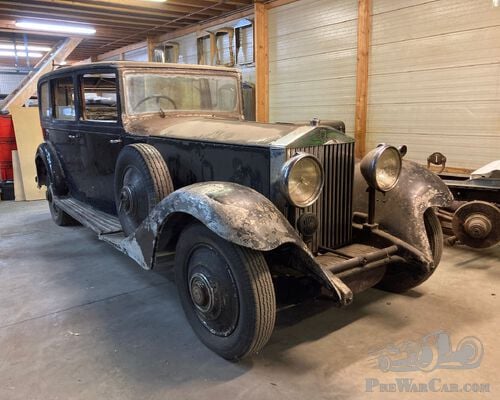
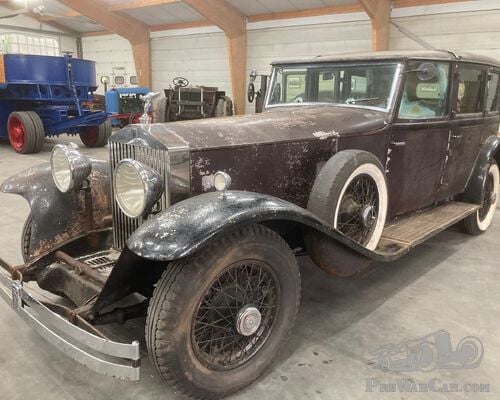
Rolls-Royce
Rolls-Royce Phantom ll chassisnummer 287 AJS. bouwjaar 1932, Links gestuurd, Brewster Keswick Sedance Towncar

1915 Rolls-Royce Silver Ghost Barker Tourer
⁃ An exceptionally rare original bodied pre-war Silver Ghost⁃ Desirable Barker tourer in exciting barn find condition⁃ ..