The global magazine and marketplace for classic car enthusiasts, by enthusiasts.


Filter
Classic Cord, DFP - Doriot-Flandrin-Parant for sale - Cord, DFP - Doriot-Flandrin-Parant cars for sale
-

1937 Cord 812 "Sportsman" Cabriolet
Vehicle Highlights Chassis No. 1268FEngine No. FB1707Auburn Cord Duesenberg (ACD) Club Certified Category 1 (C-277)Ideal for Auburn Cord Duesenberg Club and CCCA events Vehicle DescriptionThis is a 1937 Model 812 Cord Cabriolet “Sportsman”. A beautifully restored exa.. -
C1926 DFP open
Rare DFP from c1926Mechanical complet, Missing interior and hood topno documents,can see in LisbonCan help with transportchassis # 40 273 -
1937 Cord 812 Supercharged Cabriolet | RM Sotheby's | The Hershey Auction
Sold | $218,400 USD Offered from 27 years of loving enthusiast ownershipFormerly owned by Harrah’s Automobile Collection and William Cord HummelKnown history since 1952; never fully restored, just refinished as necessaryOne of the best known and most respected surviving 812 Supercharged cabrioletsACD Cl.. -
1937 Cord 812 Supercharged Phaeton | RM Sotheby's | The Hershey Auction
Sold | $78,400 USD Attractive older restoration in superb colorsDesirably equipped with supercharged engine and side exhaustACD Club Certified Category 1 (C-408)A CCCA Full Classic The many early, industry-first design achievements of the Cord 810 and 812 are legion and famed: hidden door hinges, a s.. -
1936 Cord 810 Supercharged Phaeton | RM Sotheby's | The Hershey Auction
Sold | $123,200 USD Owned for over 60 years by legendary ACD Club member Ric SimpsonRestored in Mr. Simpson’s distinctive colors, with a supercharged engineDriven extensively, including a cross-country trip to the 2008 Pebble Beach Concours d’Elegance Recently fitted with new top, interior, and other cosmetic im..


Cord
US, 1929 – 1937
Auburn Automobile Co, Auburn, Ind., 1929 -1937
The first American front-wheel-drive car to win popular approval, the Cord was one of a trio of distinctive cars (the others being the Auburn and the Duesenburg) that made up Erret Lobban Cord’s empire. The first Cord for sale was the Cord Model L-29, powered by a 4.934cc straight 8 engine made by Lycoming, another Cord subsidiary. The Cord L-29 was much lower than most contemporary American cars and was made in open and closed models, as well as being given special coachwork by such firms as Murphy, Hayes, and in England, Freestone & Webb. However, the price of over $3.300 was against the car in the Depression years, and production ended in 1932 after some 4400 Cord cars had been sold.
The Cord name re-emerged later in 1935 with the strikingly modernistic Cord Model 810. Designed by Gordon Buehrig, this car had originally been intended as a small model of Duesenberg. Like the Cord L-29 the new car was front-driven and Lycoming-powered, although by a slightly smaller V8 engine of 4.730cc. The body was of a very advanced design, and featured retractable headlamps and a wrap-around grille. Body styles were the Westchester and Beverly sedans (identical except for upholstery pattern), two-seater Sportsman and four-seater Phaeton convertibles. In 1937 the Cord Model 812 series was introduced, featuring a long-wheelbase Custom berline with chauffeur division, while an optional supercharger boosted power to 195bhp. Prices ranged from $1.995 for the early models to $3.575 for the 1937 Cord Supercharged Custom berline, and this drastically restricted sales. Only 2320 examples of the Cord 810 and Cord 812 were made.
Source: Georgano, encyclopedia of motorcar; KM
The information is written with the greatest of care. However, if you have any suggested amendments please contact us at office@prewarcar.com
D.F.P.
France, 1906 – 1926
Doriot, Flandrin et Parant, Courbevoie, Seine
Doriot and Flandrin had worked for Clément-Bayard and Peugeot, and their first products were straightforward shaft-driven single-cylinder voiturettes with transverse rear suspension, sold as Doriot-Flandrins until Parant arrived to complete the triumvirate. The singles DFP cars were still being marketed with 1100cc engines as late as 1910, but the 1908 DFP car range already included two 4-cylinder cars with sv Chapuis-Dornier engines of 2.4-litres and 2.8-litres capacity. By 1910 there was a small DFP four, the very successful DFP 10/12hp of 1.6-litres, with L-head Monobloc engine, magneto ignition, thermos-syphon cooling, cone clutch and 3-speed gearbox. There was also a DFP 25/30hp 6-cylinder car in 1911. In 1912 DFP started to make their own engines the ‘DFP 10/12’ being joined by an excellent 2-litre ‘DFP 12/15’ with pressure lubcrication, 3-bearing crankshaft and 4-speed gearbox, capable of 2500rpm and 55mph. Further, the British concession was acquired by the brothers W.O. and H.M. Bentley, who ran the ‘12/15’ in competitions; by the end of 1913 a specially prepared example of the DFP car had been timed of the half-mile at 89.70mph. Nothing, however, could be done with the DFP 16/22hp, a 2.8-litre (later 3-litre) machine with pair-cast cylinders and poor performance. In 1914 came the sporting DFP 12/40hp with V-radiator and electrics: for this model the Bentleys persuaded D.F.P. to fit aluminium pistons, as a consequence of which a 65mph performance was available for only £320. W.O. Bentley finished 6th in that year’s T.T., an excellent effort for a 2-litre car competing against specialized 3.3-litre machines.
DFP never recovered fully from World War 1 and Bentley’s decision to set up as a manufacturer in his own right meant that the DFP car company lost its best export market. A DFP 12/15hp chassis now cost £675 as against £290 in 1914. Failing finances forced the DFP company to use proprietary engines, Altos for the 2-litre models, and a Sergant in the ‘10/12’, which went American in 1922 with central change and coil ignition, but reverted to a magneto in 1923. 1922 ‘DFP 12/40s’ had 4-wheel brakes, and a year later this model was supplanted by an ohv 4-speed ‘13/50’, once again with a DFP-built engine. At the same time the DFP company marketed the little D.F.Petite, a sporting machine in the Amilcar idiom, with an ohv 1100cc engine, 3-speed gearbox, quarter-elliptic springing all round and a back axle without differential. This DFP car had front-wheel brakes by 1925, but a year later production had ceased, the DFP car factory being acquired by the Lafitte concern.
Source: Georgano, encyclopedia of motorcar; MCS
The information is written with the greatest of care. However, if you have any suggested amendments please contact us at office@prewarcar.com



Featured
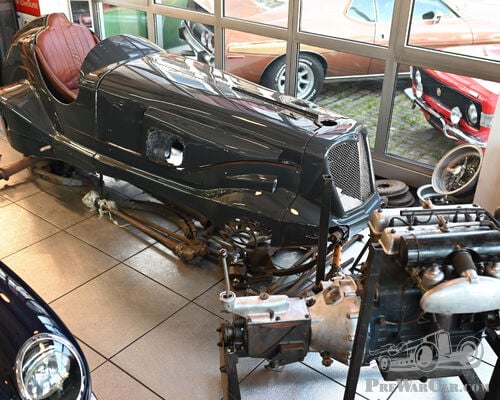
Riley special - 1937 Big Four Monoposto project with aluminium hand built body in Switzerland
An interesting Riley Special project offered for completion, based on a bare 1937 chassis and supplied with various associated parts, together with..
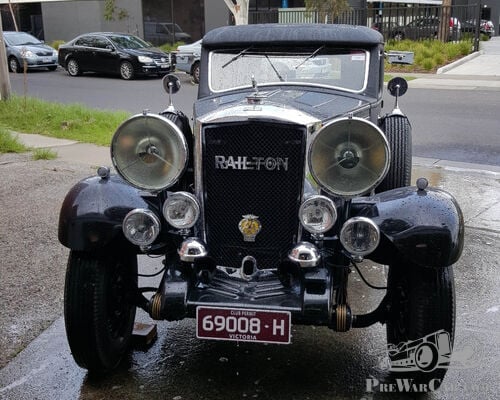
Railton straight 8 sports coupe for rallying REDUCED PRICE run with the bentleys at a fraction of the price
1934 Railton Sports CoupeBuilt for long distance rallyingRebuilt 2017built up at a cost of $160,000AUD, OFFERED FOR SALE AT A ..
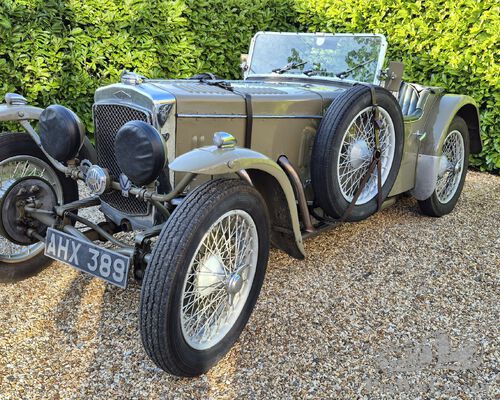
Fraser Nash TT Replica
AHX 389 ( chassis no. 2073, engine no. 10367).An important and correct short-chassis TT Replica with known history from new. Ex. H. P..