The global magazine and marketplace for classic car enthusiasts, by enthusiasts.


Filter
Classic Cord, Du Pont for sale - Cord, Du Pont cars for sale
-

1937 Cord 812 Supercharged Cabriolet | RM Sotheby's | The Monterey Auction
To Be OFFERED AT AUCTION at RM Sothebys' The Monterey Auction event, 13 - 15 August 2026. $175,000 - $250,000 USD The iconic Cord in its most desirable and sought-after formA much-enjoyed part of the Mann Collection for 33 yearsAttractive older restoration, mellowed through years of touring pleasureIdeal for CC.. -
1929 Du Pont Model G Two-Passenger Speedster by Merrimac | RM Sotheby's | The Monterey Auction
To Be OFFERED AT AUCTION at RM Sothebys' The Monterey Auction event, 13 - 15 August 2026. $800,000 - $1,200,000 USD One of the most beautiful American automobiles of its generationThe 1929 New York International Automobile Show display carOne of three two-passenger “taper tail” models with an external spareOne .. -
1937 Cord 812 "Sportsman" Cabriolet
Vehicle Highlights Chassis No. 1268FEngine No. FB1707Auburn Cord Duesenberg (ACD) Club Certified Category 1 (C-277)Ideal for Auburn Cord Duesenberg Club and CCCA events Vehicle DescriptionThis is a 1937 Model 812 Cord Cabriolet “Sportsman”. A beautifully restored exa..


Cord
US, 1929 – 1937
Auburn Automobile Co, Auburn, Ind., 1929 -1937
The first American front-wheel-drive car to win popular approval, the Cord was one of a trio of distinctive cars (the others being the Auburn and the Duesenburg) that made up Erret Lobban Cord’s empire. The first Cord for sale was the Cord Model L-29, powered by a 4.934cc straight 8 engine made by Lycoming, another Cord subsidiary. The Cord L-29 was much lower than most contemporary American cars and was made in open and closed models, as well as being given special coachwork by such firms as Murphy, Hayes, and in England, Freestone & Webb. However, the price of over $3.300 was against the car in the Depression years, and production ended in 1932 after some 4400 Cord cars had been sold.
The Cord name re-emerged later in 1935 with the strikingly modernistic Cord Model 810. Designed by Gordon Buehrig, this car had originally been intended as a small model of Duesenberg. Like the Cord L-29 the new car was front-driven and Lycoming-powered, although by a slightly smaller V8 engine of 4.730cc. The body was of a very advanced design, and featured retractable headlamps and a wrap-around grille. Body styles were the Westchester and Beverly sedans (identical except for upholstery pattern), two-seater Sportsman and four-seater Phaeton convertibles. In 1937 the Cord Model 812 series was introduced, featuring a long-wheelbase Custom berline with chauffeur division, while an optional supercharger boosted power to 195bhp. Prices ranged from $1.995 for the early models to $3.575 for the 1937 Cord Supercharged Custom berline, and this drastically restricted sales. Only 2320 examples of the Cord 810 and Cord 812 were made.
Source: Georgano, encyclopedia of motorcar; KM
The information is written with the greatest of care. However, if you have any suggested amendments please contact us at office@prewarcar.com
Du Pont
US, 1920 – 1932
(1) Du Pont Motors Inc, Wilmington, Del., 1920 – 1923
(2) Du Pont Motors Inc, Moore, Pa., 1923 – 1932
E. Paul du Pont’s company built quality cars in limited numbers, total production being 537 vehicles of all Du Pont types. First of the line was a Du Pont 4.1-litre sv four with their own engine, selling for $2.600, but this gave way to proprietary-engined sixes, initially powered by Herschell-Spillman. The 1925 Du Pont Model D had a 6-cylinder 5-litre Wisconsin engine with overhead valves that developed 75bhp, a constant-mesh gearbox, and Lockheed hydraulic brakes to all four wheels. Its successor, the Du Pont Model E, could be had with a supercharger, but the best-known, and best, Du Pont was the Du Pont Model G speedster introduced in 1928. With its narrow straight wings copied from the Amilcar, Woodlite headlamps and grille concealing the radiator, the last a pioneering feature, the Du Pont Model G was not a good-looking car, but it was a very effective one. Like all the DuPont speedsters it had four forward speeds. The 5.3-litre, sv straight-8 engine, by Continental, gave 114bhp at 3600rpm with catalogued modifications. With the latter, 100mph was guaranteed. In the 1929 Le Mans 24 Hours race the Du Pont Model G proved itself faster than the other American entries, Stutz and Chrysler. Touring bodywork was, of course, available on the Du Pont car, and in 1931 came the long wheelbase (12ft 2 in) Du Pont Model H, built in a Stearns Knight frame. The later Du Pont cars were assembled in the Indian motorcycle factory at Springfield, after E. Paul du Pont had acquired this concern.
Source: Georgano, encyclopedia of motorcar; TRN
The information is written with the greatest of care. However, if you have any suggested amendments please contact us at office@prewarcar.com


Featured
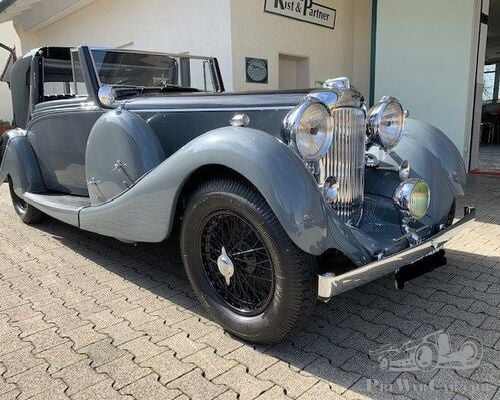
Lagonda LG 45 Coupe de Ville Sedanca by Mayfair
The successor to the M45, the LG45 was built around the same highly capable, competition-proven 4.5-litre Meadows inline-six engine, but featured r..
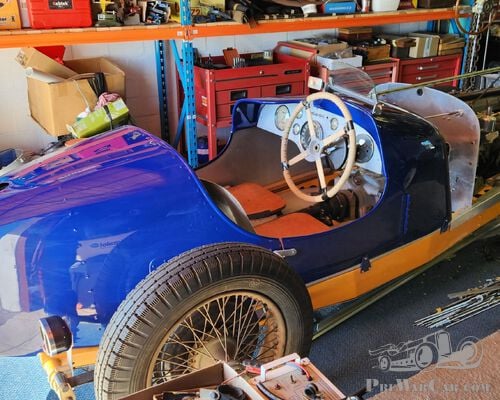
Riley TT Sprite
1935 6-cylinder TT Sprite replica. Chassis # 46A2722. Engine # 6A2722. Original Ulster Imp body. Restoration nearing completion. Engine, G..

Lagonda LC Tourer 1934
The Lagonda story began in 1901 in Staines, a small town in the UK. The company enjoyed its greatest successes around 1935. During this period, the..