The global magazine and marketplace for classic car enthusiasts, by enthusiasts.


Filter
Classic Cord, Orient for sale - Cord, Orient cars for sale
-

1936 Cord 810 Supercharged Phaeton | RM Sotheby's | The Hershey Auction
To Be OFFERED AT AUCTION at RM Sothebys' The Hershey Auction event, 7 - 8 October 2026. $125,000 - $175,000 USD Owned for over 60 years by legendary ACD Club member Ric SimpsonRestored in Mr. Simpson’s distinctive colors, with a supercharged engineDriven extensively, including a cross-country trip to the 2008 Pebble Bea.. -
1937 Cord 812 "Sportsman" Cabriolet
Vehicle Highlights Chassis No. 1268FEngine No. FB1707Auburn Cord Duesenberg (ACD) Club Certified Category 1 (C-277)Ideal for Auburn Cord Duesenberg Club and CCCA events Vehicle DescriptionThis is a 1937 Model 812 Cord Cabriolet “Sportsman”. A beautifully restored exa.. -
1905/6 Orient Buckboard
Build by Waltham , mass. Usa . very original and unrestored , except the engine which is restored and running .Known history back to before ww2 . Last ovner found it in 1950.Eur 25.800 -
1937 Cord 812 Supercharged Cabriolet | RM Sotheby's | The Monterey Auction
To Be OFFERED AT AUCTION at RM Sothebys' The Monterey Auction event, 13 - 15 August 2026. Sold | $168,000 USD The iconic Cord in its most desirable and sought-after formA much-enjoyed part of the Mann collection for 33 yearsAttractive older restoration, mellowed through years of touring pleasureIdeal for CCCA C..


Cord
US, 1929 – 1937
Auburn Automobile Co, Auburn, Ind., 1929 -1937
The first American front-wheel-drive car to win popular approval, the Cord was one of a trio of distinctive cars (the others being the Auburn and the Duesenburg) that made up Erret Lobban Cord’s empire. The first Cord for sale was the Cord Model L-29, powered by a 4.934cc straight 8 engine made by Lycoming, another Cord subsidiary. The Cord L-29 was much lower than most contemporary American cars and was made in open and closed models, as well as being given special coachwork by such firms as Murphy, Hayes, and in England, Freestone & Webb. However, the price of over $3.300 was against the car in the Depression years, and production ended in 1932 after some 4400 Cord cars had been sold.
The Cord name re-emerged later in 1935 with the strikingly modernistic Cord Model 810. Designed by Gordon Buehrig, this car had originally been intended as a small model of Duesenberg. Like the Cord L-29 the new car was front-driven and Lycoming-powered, although by a slightly smaller V8 engine of 4.730cc. The body was of a very advanced design, and featured retractable headlamps and a wrap-around grille. Body styles were the Westchester and Beverly sedans (identical except for upholstery pattern), two-seater Sportsman and four-seater Phaeton convertibles. In 1937 the Cord Model 812 series was introduced, featuring a long-wheelbase Custom berline with chauffeur division, while an optional supercharger boosted power to 195bhp. Prices ranged from $1.995 for the early models to $3.575 for the 1937 Cord Supercharged Custom berline, and this drastically restricted sales. Only 2320 examples of the Cord 810 and Cord 812 were made.
Source: Georgano, encyclopedia of motorcar; KM
The information is written with the greatest of care. However, if you have any suggested amendments please contact us at office@prewarcar.com
Orient
US, 1898 – 1908
Waltham Mfg Co, Waltham, Mass.
The Orient car company made an experimental electric runabout in 1898, but did not put this Orient car into production. Their first petrol-engined Orient cars were motor cycles, tricycles and light runabouts powered by De Dion engines. In 1902 they introduced the Orient Buckboard, a very simple Orient car consisting of two seats on a wooden platform, with a 4hp air-cooled engine geared to the rear axle, and, originally, only one speed. There were no springs on this Orient car, as the wooden platform was said to have enough resilience. The weight was 350lb and the price $375.
Although the simple Buckboard was continued, more sophisticated Orient cars were gradually introduced, including a four-seater version Orient car which in turn became a side-entrance tonneau. Wheel steering and small bonnets to cover the driver’s feet appeared in 1904, although the engine of the Orient car was still at the back, and the Buckboard ancestry remained obvious.
In 1905 a completely new Orient car appeared, known as the Waltham Orient. This Orient car had a 4-cylinder air-cooled 18/20hp engine mounted in front in the conventional manner, friction transmission and shaft drive. A slightly smaller 16hp Orient car model was also made. In 1908 Waltham merged with the C.H. Metz Company, and for the following year the cars were known as Metz.
Source: Georgano, encyclopedia of motorcar; GNG
The information is written with the greatest of care. However, if you have any suggested amendments please contact us at office@prewarcar.com


Featured
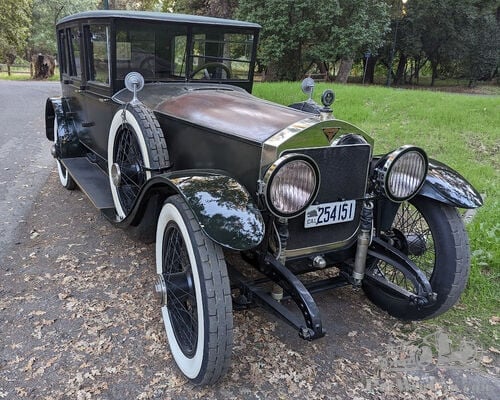
1916 Simplex, Crane model 5
1916 Simplex, Crane MODEL 5CUSTOM MADE HISTORIC PRESERVATION VEHICLE – READY TO TOUR!This Simplex recently completed th..
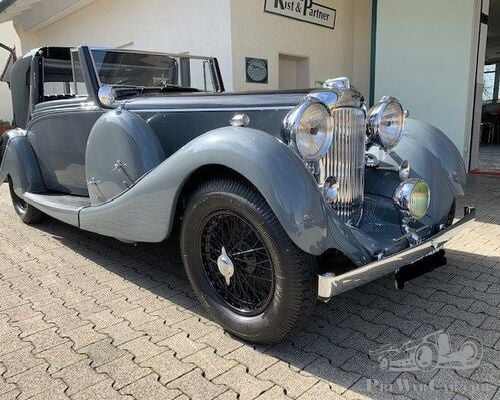
Lagonda LG 45 Coupe de Ville Sedanca by Mayfair
The successor to the M45, the LG45 was built around the same highly capable, competition-proven 4.5-litre Meadows inline-six engine, but featured r..
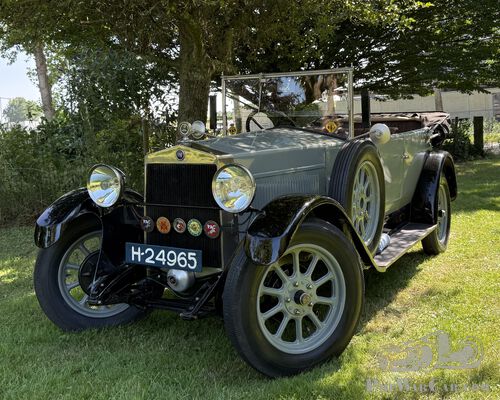
Fiat 509 Torpedo / Spider – Exceptionally Original and Complete
A Rare and Highly Original Example with Long-Term Dutch HistoryOffered for sale is an exceptionally original and remarkably complete Fiat 50..