The global magazine and marketplace for classic car enthusiasts, by enthusiasts.


Filter
Classic Cord, Stoewer for sale - Cord, Stoewer cars for sale
-

1937 Cord 812 Supercharged Cabriolet | RM Sotheby's | The Monterey Auction
To Be OFFERED AT AUCTION at RM Sothebys' The Monterey Auction event, 13 - 15 August 2026. $175,000 - $250,000 USD The iconic Cord in its most desirable and sought-after formA much-enjoyed part of the Mann Collection for 33 yearsAttractive older restoration, mellowed through years of touring pleasureIdeal for CC.. -
1937 Cord 812 "Sportsman" Cabriolet
Vehicle Highlights Chassis No. 1268FEngine No. FB1707Auburn Cord Duesenberg (ACD) Club Certified Category 1 (C-277)Ideal for Auburn Cord Duesenberg Club and CCCA events Vehicle DescriptionThis is a 1937 Model 812 Cord Cabriolet “Sportsman”. A beautifully restored exa.. -
1924 Stoewer type D3 roadster
Rare opportunity to buy a vintage 1924 Stoewer type D3 roadster in fully restored condition. More than € 50K were spent in 2018 and 2019 on its restoration . Detailed work invoices come with the car. A video can be sent on request . Price € 64000 ex Eibergen Netherlands imported EEC.


Cord
US, 1929 – 1937
Auburn Automobile Co, Auburn, Ind., 1929 -1937
The first American front-wheel-drive car to win popular approval, the Cord was one of a trio of distinctive cars (the others being the Auburn and the Duesenburg) that made up Erret Lobban Cord’s empire. The first Cord for sale was the Cord Model L-29, powered by a 4.934cc straight 8 engine made by Lycoming, another Cord subsidiary. The Cord L-29 was much lower than most contemporary American cars and was made in open and closed models, as well as being given special coachwork by such firms as Murphy, Hayes, and in England, Freestone & Webb. However, the price of over $3.300 was against the car in the Depression years, and production ended in 1932 after some 4400 Cord cars had been sold.
The Cord name re-emerged later in 1935 with the strikingly modernistic Cord Model 810. Designed by Gordon Buehrig, this car had originally been intended as a small model of Duesenberg. Like the Cord L-29 the new car was front-driven and Lycoming-powered, although by a slightly smaller V8 engine of 4.730cc. The body was of a very advanced design, and featured retractable headlamps and a wrap-around grille. Body styles were the Westchester and Beverly sedans (identical except for upholstery pattern), two-seater Sportsman and four-seater Phaeton convertibles. In 1937 the Cord Model 812 series was introduced, featuring a long-wheelbase Custom berline with chauffeur division, while an optional supercharger boosted power to 195bhp. Prices ranged from $1.995 for the early models to $3.575 for the 1937 Cord Supercharged Custom berline, and this drastically restricted sales. Only 2320 examples of the Cord 810 and Cord 812 were made.
Source: Georgano, encyclopedia of motorcar; KM
The information is written with the greatest of care. However, if you have any suggested amendments please contact us at office@prewarcar.com
Stoewer
D, 1899 – 1939
(1) Gebrüder Stoewer, Fabrik für Motorfahrzeuge, Stettin, 1899 – 1916
(2) Stoewer-Werke AG vorm. Gebr. Stoewer, Stettin, 1916 – 1939
The Stoewer car factory developed out of the Stoewer ironworks and was among the pioneers of the German car industry. After manufacturing motor cycles, tricycles and quadricycles for two years, Stoewer turned to cars in 1899. The first Stoewer car had a rear-mounted 2-cylinder engine. 4-cylinder Stoewer cars followed in 1901, and electric Stoewer cars were also produced. Best known were the 2-cylinder Type T Stoewer car (2.280cc and 3/12PS), the 4-cylinder Stoewer P4 (3.052cc and 11/22PS), the Stoewer G4 (1.500cc and 6/12PS) and the 6-cylinder Stoewer P6 (8.820cc and 34/60PS), evolved in the 1905-1907 period all Stoewer cars with shaft-drive. The Stoewer B1 of 6/16PS and the Stoewer B6 of 9/22PS which appeared in 1910 were also built by Mathis under licence. The G4 Stoewer car was the basis for the Stoewer B5, which Stoewer car in 1912 became famous by setting up a record at Brooklands with 67.7mph. The new range of Stoewer cars which appeared in 1913 was also based on successful earlier cars. They were the Stoewer C1 (6/18PS), Stoewer C2 (10/28PS) and C3 Stoewer car (6-cylinder and 19/45PS). Shortly before the outbreak of World War 1 the Stoewer car range was headed by the F4 Stoewer car with a 4-cylinder, 8.8-litre 33/100PS ohc engine. After the war an enormous Stoewer car appeared, the Stoewer D7, using a 6-cylinder 11.2-litre 42/120PS aero engine, as well as some conservative sv 4- and 6-cylinder Stoewer cars with rear wheel and transmission brakes. Front wheel brakes appeared on Stoewer cars in 1925. Stoewer introduced 8-cylinder Stoewer cars in 1928. These were the Stoewer Superior, Stoewer Marschall, Stoewer Gigant and Stoewer Repräsentant with engines ranging from 2-litres and 45bhp to 4.9-litres and 100bhp. The Stoewer car firm re-entered the economy class in 1931 with the V5, a front-driven Stoewer car with a V4 1.188cc engine, followed by the front-drive models R140 (1.369cc), R150 (1.488cc) and R180 (1.769cc). Another 8-cylinder was the front wheel drive Greif V8 with a 2.488cc engine, which was replaced by the conventional 6-cylinder 3.609cc Arcona Stoewer car in 1938. In 1934 the 1½-litre 4-cylinder Stoewer car and 2½-litre V8 Stoewer car were shown at the Brussels Salon by Monsieur Dewaet under the name D.S. (Dewaet-Stoewer). The Greif Junior was built under Tatra licence with an opposed 4-cylinder 1.474cc engine. It succeeded the Röhr Junior. In the middle of the range was the Stoewer Sedina with a 4-cylinder engine of 2.4-litres.
Production of private Stoewer cars was given up at the outbreak of World War 2 in 1939. The Stoewer car factory was destroyed during the war and production of Stoewer cars was not resumed.
Source: Georgano, encyclopedia of motorcar; HON
The information is written with the greatest of care. However, if you have any suggested amendments please contact us at office@prewarcar.com


Featured
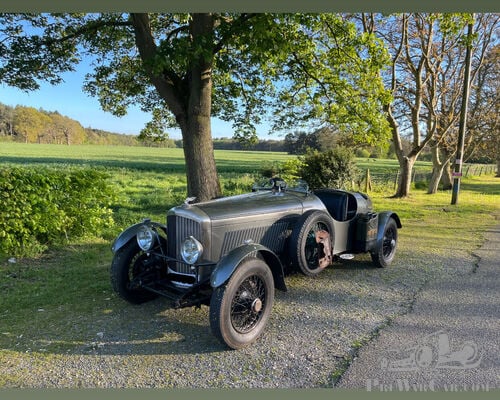
Derby Bentley Special 4-1/4
Sadly i am having to sell on my Bentley special ( Icarus). It is currently a work in progress and still needs finalising/ refining. A great o..

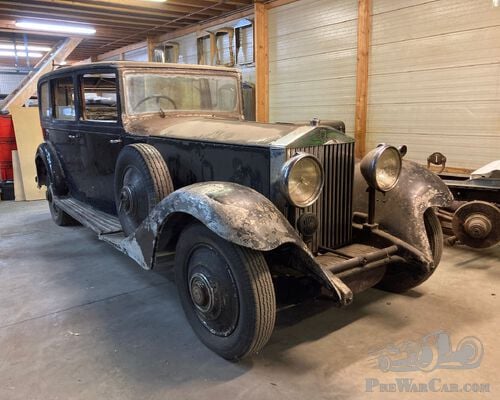
1915 Rolls-Royce Silver Ghost Barker Tourer
⁃ An exceptionally rare original bodied pre-war Silver Ghost⁃ Desirable Barker tourer in exciting barn find condition⁃ ..