The global magazine and marketplace for classic car enthusiasts, by enthusiasts.


Filter
Classic Delage, DeSoto for sale - Delage, DeSoto cars for sale
-

Delage DE
In meinem Besitz seit 1994. 1996 am Klausen Memorial gefahren. Restauration des Getriebe 1995, 2025 Motor in Stand gesetzt mit neuen Laufbüchsen, Kolben, Kurbelwelle geschliffen und Ausbalanciert, neue Kurbelwellen- und Pleuellager, Dynostarter neu gelagert. -
1923 Grand Prix Delage - Bequet Delage
This exceptional car is the first of the iconic Grand Prix Delages, renowned for their dominance in the late 1920s. As the world’s first V12-engined Grand Prix car, it was entered in the 1923 French Grand Prix, driven by legendary René Thomas, starting from pole before retiring with engine issues. In 1925, the car was sold to flyin.. -
Delage DE Torpedo 1923
This Delage is a special sight; you don't often see them with the original Torpedo bodywork and the 820 x 120 beaded edge wheels.This rare Delage DE has been in the Netherlands for more than 50 years.In the 1970s and 1980s, it was restored by the well-known collector Mr. Smits, who had a passion for special French cars.The c.. -
DELAGE D.I. 14/40 1924 BOAT TAIL TWO SEATER
This Delage D.I. was one of the finest tourers of the vintage period and has been mine for over thirty years. Rakish and comfortable boat tail two seater with interesting history having spent time in the South of France, Morocco, Ireland and the U.K.Alloy body, steel wings, teak and beech deck, leather interior.Engine o.h.v 2.2 l.. -
1930 Delage D8
This is a car with history that is ready to be passed onto a new owner.Originally bought into New Zealand in 1939 and since passed through owners who have all looked after and respected the heritage of such a car. As with many cars of this vintage, it has had a couple of different bodies fitted with the latest prior to it participating in..


Delage
France, 1905 – 1954
(1) Automobiles Delage, Courbevoie, Seine, 1905 – 1935
(2) Automobiles Delage, Paris, 1935 – 1954
Louis Delage, a former employee of Turgan-Foy and Peugeot, started modestly with a conventional shaft-driven single-cylinder 6½hp runabout with a De Dion Bouton engine which was marketed in England as the Baby Friswell. As early as 1906 Delage showed an interest in racing, and the Delage make’s second place in that year’s Coupe des Voiturettes was followed in 1908 with an outright win on a Delage single powered by a Causan-Designed engine. Meanwhile touring Delage cars continued to use De Dion power units, and later 4-cylinder engines of modest capacity built by Ballot, though single-cylinder cars rated at 6, 8 and 9hp were still catalogued by Delage for sale as late as 1910. The 1.4-litre ’Delage 12’ of 1909 was a neat little machine with monobloc cylinders, 3-speed gearbox and fuel tank streamlined into the dashboard, which sold for £230 and was progressively developed up to 1914. This Delage car had a pressure-fed crankshaft in 1910 and was joined in 1911 by a 2.5-litre 30bhp six on similar lines: the footbrake, unusually, worked on the rear wheels. This Delage model had acquired a 4-speed gearbox and electrics by 1914, a version with 11ft wheelbase being listed for town-carriage work.
Delage also pursued his racing career to good purpose, winning the 1911 Coupe de l’Auto with a horizontal-valve 3-litre 4-cylinder Delage which had a 5-speed gearbox with overdrive top. These features were also found on the 6.3-litre Delage cars which won both the 1913 GP du Mans and the 1914 Indianapolis 500-Mile Race, while for the 1914 Grand Prix his 4½-litre Delage cars had twin ohc, desmodromic valves and 4-wheel brakes (but no handbrake). While producing munitions in World War 1, Delage found time to develop a new long-stroke 4½-litre sv 6-cylinder (Delage Type CO), which went into production in 1919 with 4-wheel brakes, but still with a fixed cylinder head. There was also a companion 3-litre 4-cylinder, and by 1921 the Delage CO had developed into the Delage CO2 with ohv, twin-plug head, dual magneto ignition and 88bhp. The 1920s saw a line of excellent fast Delage tourers, while from 1922 to 1927 a costly but very successful Delage racing programme was pursued. Starting with the 6-cylinder Delage I and Delage II sprint cars, the Delage company progressed to an ohv V12 of 10.7 litres’ capacity in 1923, with which René Thomas annexed the World’s Land Speed Record at Arpajon in the following year with a speed of 143,31mph. The Delage car subsequently had a long and distinguished racing career in England. For the 2-litre GP Formula in 1924 Planchon designed a four ohc V12 Delage of great complexity – in twin-supercharged 1925 form it gave 190bhp and won the French and Spanish Grand Prix. Equally costly were the Lory-designed 1½-litre twin-cam Delage straight-8s of 1926 – 1927, with 5-speed overdrive gearboxes and various types of supercharging. In their early days these Delage cars had a bad name for overheating but they were unbeatable in 1927, with five major Grands Prix to their credit. There was also R.J.B. Seaman’s triumphal 1936 voiturette season, when the nine-year-old Delage trounced the ERA and Maseati opposition.
Mainstay of the Delage touring-car programme from 1924 onwards was the classic 2.1-litre 4-cylinder Delage DI for sale, with ohv, 4-wheel brakes, magneto ignition (coil on later cars), 4-speed gearbox and single-plate clutch. For sale at £475 in England it was excellent value and sports versions with aluminium pistons were quite fast. At the same time the Delage company offered the vast 6-litre Delage Type-GL as competition for the Hispano-Suiza: unusual features of this ohc 6-cylinder were the clutched fan, twin oil pumps, X-braced frame and hydraulic servo brakes – it could be bought in England for £1650 in 1925. It was only produced up to 1927. The Delage DI had gone a year later, Delage turning to 6-cylinder cars of more modest capacity: the 3.2-litre ohv Delage DM followed by a less successful sv Delage DR, made in 2.2-litre and 2.5-litre forms. The 1929 Paris Salon saw the first of the big ohv long-stroke straight-8s Delage cars for sale, all with coil ignition, pump and fan cooling, and 4-speed gearboxes. Valve bounce was countered by making the springs operate separate rocker arms. It came in several wheelbase lengths from 10ft 10in to 11ft 11in, and carried superbly elegant if not always practical bodywork. In 1931 it was joined by a 3-litre Delage D6 which was the same car with two less cylinders.
A super-sports Delage D8 was available in 1932: though often overbodied it took its International class 12-hour record at 112mph. The Delage range was further complicated in 1932 by the advent of a new series of short-stroke models, the first of which, the Delage D6-11, had an almost square 2.1-litre 6-cylinder unit, with the Delage D8’s valve gear, independent transverse front suspension and a silent-third gearbox. Inexpensive pressed-steel saloon bodywork was used and the Delage car sold for £595. By 1934 there was not only a companion straight-8 (the Delage D8-15) of 2.7-litres, but also a 1½-litre 4-cylinder version. The big Delage D8s were still listed. 1935 Delages featured synchromesh and hydraulic brakes and slightly undersquare 6- and 8-cylinder engines were used: all Delage cars now had ifs. Louis Delage was, however, forced to sell out to Delahaye and thereafter the Delage cars slowly evolved into more florid versions of that make, built in the same factory. The 4-cylinder cars died out with the obscure 2.2-litre mechanically-braked Delage DI-12 of 1936, a badge-engineered Delahaye. There was an abortive plan to make Delage cars in England in 1937. Up to World War 2 the Delage company’s offerings were the 2.7-litre Delage D6-70 and the 4.3-litre 8-cylinder Delage D8-100 and Delage D8-120. All had hydraulic brakes, Cotal gearboxes and ifs, and the Delage D6-70 could be bought in England for £695. This Delage was raced to some purpose, winning the 1938 TT and taking second place at Le Mans in 1939, in which year capacities of both engines were increased. The 3-litre 6-cylinder car appeared after the war, but only a few were made, and Louveau’s and Jover’s second place at Le Mans in 1949 was almost the last that was heard of Delage. Along with Delahaye, Delage was aborbed by Hotchkiss in 1954.
Source: Georgano, encyclopedia of motorcar; MCS
The information is written with the greatest of care. However, if you have any suggested amendments please contact us at office@prewarcar.com
DeSoto
US, 1913 – 1916
DeSoto Motro Car Co, Auburn, Ind.
The DeSoto appears to have succeeded the Zimmerman. This was a large car with a 55hp, 6-cylinder engine, which was furnished with a compressed-air starter. The DeSoto model Six-55 five-seater touring car sold for $2185.
US, 1928 – 1960
Chrysler Motors Corp, Detroit, Mich.
The DeSoto was launched in 1928 as a 3.2-litre side valve six to compete with Oldsmobile, Pontiac and the cheaper Nashes. Styling and general design of the DeSoto were in line with the 1929 Chryslers, and at $885 for a DeSoto sedan 90.000 were sold in the first twelve months. A 3.4-litre straight-8 DeSoto on a 9ft 6in wheelbase was announced for 1930 as the world’s cheapest 8-cylinder car. However, DeSoto suffered badly in the Depression, and in 1932, when flexible rubber engine mountings and free wheels were made available, sales dropped to 26.000 DeSoto cars.
The DeSoto disappeared from the British market about this time, though certain ‘Chrysler’ models listed in England (the Mortlake, Croydon, and some of the Richmonds) were in fact DeSoto cars in all but name. A 6-cylinder version of Chrysler’s advanced unitary-construction Airflow, the SE-type with a 4-litre engine, was brought out in 1934, but was an unsuccessful as its bigger sister. Later DeSotos followed regular Chrysler lines closely though in later years there was a tendency for DeSoto to move into a higher price class than Dodge; by 1952 DeSotos started $300 higher than the companion make.
By 1939 the DeSoto cars for sale were being made with independent front suspension, hypoid back axles and column change. There was a choice at DeSoto of two 6-cylinder engines and three wheelbase lengths, the longest of these being reserved for seven-seater bodywork – DeSoto continued to offer a really roomy family car right up to 1954. A 4-speed semi-automatic Vacumatic transmission became an option in 1941, but DeSoto’s big post-war change of models did not take place until 1952, when the division followed Chrysler’s lead in adopting the oversquare ohv V8; the DeSoto version was of 4½-litre capcity and developed 16-bhp. With the advent of Chrysler’s ‘flight sweep’ styling in 1955, the side-valve sixes were dropped and the standard engine in a DeSoto was now a 4.8-litre eight, giving 185bhp in Firedome guise, and 200bhp in Fireflite form. Though this redesigning saved Chrysler sales generally, the slump in the medium-price class had an adverse effect on DeSoto and in 1959 the DeSoto division was merged with Plymouth. Last of the DeSotos were the 1961 models, unitary-construction cars with a choice of three engines: Plymouth’s 145bhp ohv ‘slant six’ as used in the Valiant, and V8s of 230 and 265bhp, the two former only in Canadian DeSotos. Production of DeSoto cars ceased in November 1960 after only a few had been delivered.
Source: Georgano, encyclopedia of motorcar; MCS
The information is written with the greatest of care. However, if you have any suggested amendments please contact us at office@prewarcar.com


Featured
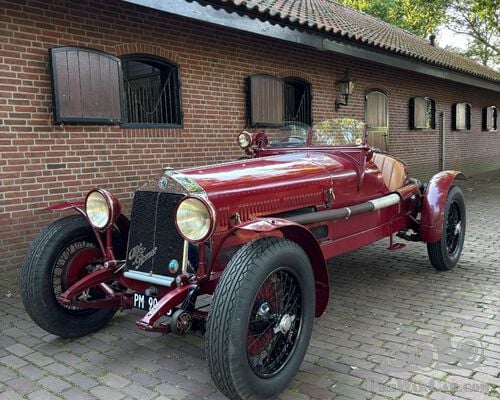
1930 Alfa Romeo 6C 1750 Spider
1930 Alfa Romeo 6C 1750 Spider with complete history from delivery to first owner in 1930 in Firenze till today with copy Libretto/license plate.
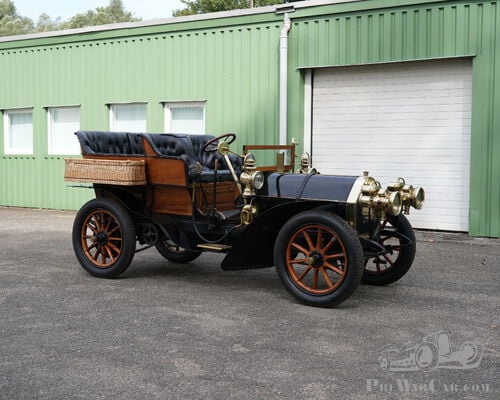
1904 Aster 16/20 HP Four-Cylinder Five-Seat Rear-Entrance Tonneau
Powerful four-cylinder engineFour-speed gearboxChain driveFive seatsMore than €100,000 recently invested
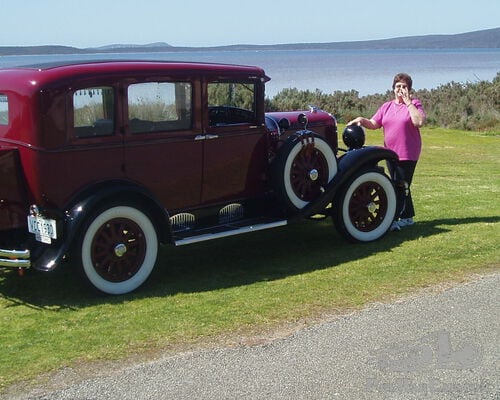
1930 Chrysler 66 Six-Wheel Equipped Royal Sedan
An exceptionally well restored and highly awarded Chrysler 66 Royal Sedan, with only two owners in nearly 97 years.The present owner ..