The global magazine and marketplace for classic car enthusiasts, by enthusiasts.


Filter
Classic Delahaye, Morgan for sale - Delahaye, Morgan cars for sale
-

Te koop Morgan Aero 1927
De Morgan Aero is geproduceerd van 1920 tot rond 1933. Dit voertuig met chassisnummer B718 is van 1927. De driewieler is in goed rijdbare en in originele staat, video’s hierover zijn het bewijs. De aandrijving (koppeling & bak) en dynamo zijn op kwalitatief gezien technisch verantwoorde wijze enigszins aangepast, waarmee de technische betrou.. -
1937 Delahaye 145 Cabriolet by Franay | RM Sotheby's | The Monterey Auction
To Be OFFERED AT AUCTION at RM Sothebys' The Monterey Auction event, 13 - 15 August 2026. $4,500,000 - $6,000,000 USD One of five competition 12-cylinder 145 chassis producedBelieved to be the car that famously beat Germany’s finest for the Prix du MillionFitted with astonishing custom roadgoing coachwork by Fran.. -
1937 Delahaye 135 Grand Prix | RM Sotheby's | The Monterey Auction
To Be OFFERED AT AUCTION at RM Sothebys' The Monterey Auction event, 13 - 15 August 2026. $250,000 - $400,000 USD Mr. Mann’s proven and very successful longtime vintage racing entrantBuilt by Pascal Morel to period Le Mans specificationRecipient of much sorting over the years by Competition Motors and Marcovicci-Wenz -
1938 Delahaye 135M Figoni & Falaschi Cabriolet
A wolf in sheep’s clothing: this 1938 Delahaye 135M with coachwork by Figoni & Falaschi has got more grunt and power underneath the beautiful skin than one can imagine. The model 135 with a lower chassis and a more powerful engine was first introduced at the Paris Auto Show in 1935 and completed the top of the range for Delahay.. -
1939 Delahaye 135MS 3 position drophead by Pennock
1939 Delahaye 135MS 3 position drophead by Pennock Chassis number: 800874Registration number: 126JLB Owned by Prince Birabongse of Siam, the famed Racing driver. This Delahaye 135 comes to us with two large box files of history & photographs detailing the extensive works undertaken to it. In addition to a..


Delahaye
France, 1894 – 1954
(1) Emile Delahaye, Tours, Paris, 1894 – 1898
(2) L. Desmarais et Morane, Tours, Paris, 1899 – 1906
(3) Automobiles Delahaye, Paris, 1906 – 1954
The Delahaye firm was established in 1845 and initially produced brick-making machinery, later launching out into stationary engines. The first Delahaye cars were very much on Benz lines with slow-running, rear-mounted horizontal engines and belt transmission. Radiators and frames were tubular; Archdeacon and Delahaye himself took 4th and 6th places respectively in the Paris-Marseilles-Paris Race of 1896, though the Delahaye firm took little interest in competition and their last appearance was in the Paris-Vienna (1902). By contrast, Delahaye were very interested in commercial vehicles, which made their debut in 1898 and bulked larger and larger in later years. In 1898 a 1.4-litre single and twins of 4½hp and 6hp were being made, the Paris Delahaye works were opened, and Charles Weiffenbach joined the Delahaye firm as Chief Engineer, a post he was to retain until after World War 2. By 1899, 600 Delahaye cars had been delivered, and production was running at 20 Delahaye’s a month. Emile Delahaye himself retired in 1901, when wheel steering was standardized, though the old belt-driven designs were still catalogued as late as 1904, and there was even a short-lived 1902 Delahaye model with front vertical engine and belt drive. More advanced was Delahaye Type 10B, a 2.2-litre 4-cylinder, still with aiv, but with Panhard styling, final drive by side chains, and detachable cylinder heads; this was followed by a bigger 4.4-litre Delahaye car said to develop 28bhp.
In 1904 detachable heads were found on both the 2.7-litre Delahaye Type 15B twin at £420, and on a big 4.9-litre 4-cylinder Delahaye car which also had a water-cooled exhaust system. T-head engines, gate change, and ht magneto ignition made their appearance in 1905, when the range included two twins and three 4-cylinder cars, the largest an 8-litre. The King of Spain bought one of these big Delahaye cars, with two hand and two foot brakes, and a foot-operated decompressor, in 1906. In 1907 licence-production of the Delahaye make was undertaken in Germany by Presto, transverse rear suspension was featured, and the small 2-cylinder model acquired shaft drive. In the usual French tradition L-head Monobloc engines appeared in 1908 on the 1.9-litre 12/16hp (Delahaye Type 32), but the chain-driven cars were listed as late as 1911. An even smaller 1.2-litre 4-cylinder Delahaye sold for £240 in 1909, and the new monobloc engines were used by White in America as the basis for their first petrol car, the 20/30. 1911 brought an interesting departure in the shape of the 3.2-litre Delahaye Type 44, a blockcast V6 with 4-speed gearbox. It sold for £470 in England, and this Delahaye was still being made in 1914. A 4-cylinder car was used for tests with the Parry Thomas electric transmission. Apart from such ingenious features as pressure lubcrication to the spring shackles, the other 1914 Delahaye models were conventional monobloc 4-cylinder machines, available with detachable wheels and electric lighting. They came in 1.6-litre, 2.3-litre, 2.6-litre, 3-litre, 4-litre and 5.7-litre sizes, all but the smallest with 4-speed gearboxes.
After World War 1 the Delahaye company settled down to 14 years of stodgy, dependable, and uninteresting cars, now with full electrical equipment and V-radiators, though at first the foot-operated transmission brake was retained. 4-cylinder Delahaye models were sold with 2.6-litre and 3-litre sv engines, but there was also a 4.1-litre six (Delahaye Type 82), with the unusual combination of detachable head and valve caps, which acquired front wheel brakes in 1921. All other Delahaye models were so equipped by 1925, but in the meanwhile the firm was ringing the changes on a complicated and dull range which included a 1.8-litre in sv and ohv versions, and two bigger inlet over exhaust fours, the 2.4-litre Delahaye 15/35hp and the 2.9-litre Delahaye 18/40hp. 4-speed gearboxes, pump cooling, and wooden wheels were regular features. In 1927 Delahaye formed a consortium with Chenard-Walcker, Donnet and (for a short while only) Unic, which was supposed to rationalize production, and did to the extent that it was hard to distinguish the 6-cylinder Delahaye for sale from its Chenard-Walcker counterpart, though the former had full overhead valves and the latter inlet over exhaust. These sixes appeared in 1928, the Delahaye cars coming in 2.5-litre and 2.9-litre sixes, with magneto ignition up to 1929, and coil thereafter. 1929 was also the last year for the V-radiatored Delahaye for sale, which gave way to an American-style ribbon-type. In 1930 there were also two 4-cylinder models, the smaller a straight-forward sv 1½-litre (Delahaye Type 109), which was still listed in 1932. A bigger 6-cylinder for sale (Delahaye Type 126) pointed the way to better things, and in 1934 independent front suspension was offered on the 2150cc Delahaye Super 12 4-cylinder and on the Delahaye 18CV Superlux, an ohv 6-cylinder which was also available with a Wilson gearbox.
In 1935 Delahaye bought the ailing Delage company, and in 1936 Delahaye were supplying 2.2-litre ohv 4-cylinder engines to Amilcar for installation in that firm’s Pégase model. More important, they had come out with two exciting 6-cylinder sports Delahaye models, both with ohv push-rod engines, independent front suspension, Bendix brakes, and synchromesh or Cotal gearboxes; the 3.2-litre Delahaye Coupe des Alpes had 110bhp, and the 3.5-litre Delahaye Type 135 120bhp. Both were capable of over 100mph in standard form, and the Delahaye 135s proceeded to take 2nd, 3rd, 4th and 5th places in the 1936 French Sports Car Grand Prix, following this up by wins in 1937 and 1939 Monte Carlo Rallies, and at Le Mans in 1938. A Delahaye type 135 also won the controversial ‘Fastest Sports Car Race’ at Brooklands in 1939, where the opposition included a 2.9-litre Alfa Romeo. There was a long-chassis version of Type 135, the Delahaye Type 148, and in 1937 came the Jean Francois-designed Delahaye Type 145, a short stroke 4½-litre ohv V12 with Cotal gearbox and De Dion rar axle; its output was 238bhp, and the two-seater was capable of 165mph. Delahaye tried very hard with this car during the 1938 GP season, even beating Mercedes-Benz at Pau, as well as finishing 4th in the Mille Miglia – a remarkable double. The Delahaye was outclassed, however, and even more so in 1939, despite the introduction of a single-seater version. A very few ‘cooking’ V12s with conventional rear axles, hydraulic brakes, and exotic roadster coachwork were sold by Delahaye in 1939 at £1485; though the 135 continued to do well.
During World War 2 Delahaye joined Baron Petiet’s G.F.A. (Groupe Francaise Automobile) selling organization, these initials appearing on the radiator badges of all post-war Delahaye cars, though the group ceased production in 1952. Production of the 4-cylinder Delahaye 134 as well as the Delahaye 135 was resumed in 1946, though the former did not last long. Output of the sports cars was now 130bhp, and narrower, more ornate radiator grilles were used. In 1948 came the 4½-litre Delahaye Type 175 series with hydraulic brakes; output was quoted as 185bhp, but they were not a success and were dropped from the range in 1951. Penal taxation was in any case making life difficult for France’s quality-car makers, and combined Delahaye and Delage sales dropped from 483 in 1950 to only 77 in 1951. In which year Delahaye won the Monte Carlo Rally for the second and last time. It also marked the introduction of the Delahaye company’s last new designs – a Delahaye jeep-type 4x4 with all-round independent suspension, and an improved 3½-litre, the Delahaye Type 235 with aerodynamic bodywork, its output increased to 152bhp, and still with mechanical brakes. The marque was still exhibiting at the Salon in 1953, but the following year Delahaye merged with Hotchkiss, and under the new management only trucks were made. After 1956 these too only bore the name of Hotchkiss.
Source: Georgano, encyclopedia of motorcar; MCS
The information is written with the greatest of care. However, if you have any suggested amendments please contact us at office@prewarcar.com
Morgan
GB, 1905 – 1906
Morgan and Co Ltd, Leighton Buzzard, Beds.
Made by a well-known firm of coachbuilders, the Morgan car was a conventional shaft-driven car with 5.8-litre T-head 4-cylinder Mutel engine, distinguished only by the Sparks-Boothby hydraulic clutch on the Morgan car, soon abandoned in favour of an ordinary leather cone. Only about five Morgan cars were made and their lack of success resulted in Morgan cars becoming Adler concessionaires in 1907, and abandoning motor manufacture.
GB, 1910 to date
Morgan Motor Co Ltd, Malvern Link, Worcs.
This Morgan car was the best-known, and best, of the British 3-wheelers that were popular while the horsepower tax gave the Morgan cars an advantage. H.F.S. Morgan’s tricycle was also the first of its type, this Morgan car going into production in 1910. At the front of a tubular chassis frame was an sv, air-cooled V-twin motor-cycle engine of 1.100cc by JAP, transversely mounted. Transmission of the Morgan car was by dog clutches and chains, providing two forward speeds. The steering was direct. The front wheels of the Morgan car, had independent front suspension, by sliding pillars and coil springs. There were two seats. A reasonable amount of power plus light weight meant an excellent performance of the Morgan cars. The Morgan car was safer than most 3-wheelers because its road-holding was above average. This recipe made the Morgan car popular with sportsmen, for whom the Morgan Grand Prix model was produced in 1914: the first catalogued competition Morgan car. Soon afterwards, an exiguous four-seater Morgan car, the forerunner of the Morgan Family model of the 1920s, was listed.
After World War 1, Morgan carscontinued to cater for all markets. Names changed, but the Morgan Sports or Morgan Standard model was the normal two-seater, also available in De Luxe form; the Morgan Family model was the more capacious type Morgan car, and the long-tailed Morgan Aero, later the Morgan Super Sports, was the Morgan car intended for serious speed work. Engines of Morgan cars were water- or air-cooled to choice, most being supplied by JAP, or by Blackburne in the case of the competition Morgan cars. From 1925 all the latter’s power units had overhead valves. By 1927 the Super Sports Morgan car could attain 80mph in standard trim, while the less sporting Morgan cars now had internal expanding front wheel brakes and electric starting. Geared-down steering and (if required) three forward speeds followed on Morgan cars in 1929. Even so, Morgan cars were losing customers to new, cheap sports cars such as the M-type MG. Three speeds and reverse in a normal gearbox (though still with chain final drive) were available from 1931 and standard on the Morgan car after 1932, and a modified 8hp Ford 4-cylinder engine could later be had in the Morgan car instead of the twin. Four years later the first 4-wheeled Morgan car was introduced, the excellent little Morgan 4/4. This Morgan car used an 1.122cc 4-cylinder Coventry-Climax engine with overhead inlet valves, developing 34bhp. The Morgan car was still light in weight, and retained the Morgan independent front suspension, so the performance and handling qualities of Morgan cars were well up to form. The Morgan car could attain 75mph. The twins were last catalogued in 1939.
Just before World War 2, a 1.267cc Standard 10hp engine with ohv head was substituted in the Morgan 4/4. When this was no longer available, from 1950, Morgan fitted a tuned Standard Vanguard unit in the Morgan car giving 70bhp. In this Morgan Plus Four, as the Morgan car was renamed, performance became still more lively, and when the 90bhp Triumph TR2 engine became available in 1954, maximum speed of the Morgan car rose to 100mph for the first time. With the advent of the Morgan Plus Four, there was no longer a small Morgan car, but this gap was made good in 1955, when the Morgan Series 2 4/4 arrived. This Morgan car used the very hard-wearing 1.172cc sv Ford Ten engine which had powered F4 Morgan. (The latter was the last 3-wheeler Morgan car, which had been made until 1950.) The result was a cheap, pleasant and reliable sports Morgan car of the old school. Later, the ohv Ford 105E engine was substituted. The latest version Morgan car had a 1.599cc 98bhp engine, a 4-speed all-synchromesh gearbox, front disc brakes, and the traditional Morgan suspension. The Morgan Plus Four kept pace with Triumph’s TR engine development, also acquiring disc brakes and, eventually, the 2.138cc 105bhp TR4 unit. A streamlined coupé, the Morgan Plus Four Plus of 1964, was a brief deviation from the classical Morgan car line which met with little approval and was discontinued after only 50 of these Morgan cars had been sold. When Triumph changed to a six during 1968, Morgan cars adopted a new engine for their bigger Morgan cars, and the Morgan Plus Four became the Morgan Plus Eight, powered by Rover’s 3 ½-litre 160bhp V8 and capable of 125mph. The 1973 versions of the Morgan car use the 4-speed all-synchromesh Rover gearbox in place of the Moss box previously fitted.
Source: Georgano, encyclopedia of motorcar; MCS, TRN
The information is written with the greatest of care. However, if you have any suggested amendments please contact us at office@prewarcar.com


Featured
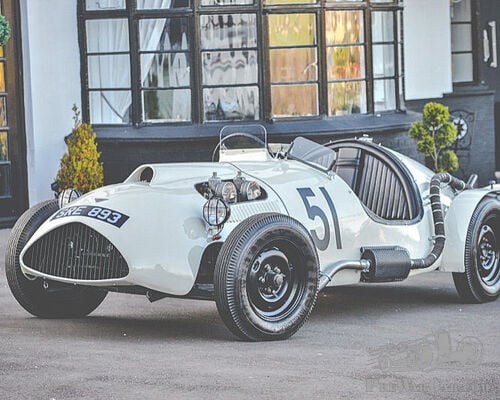
1933 Alvis 3.0 Special - One-Off Alloy Body | Period Competition Car | Featured in “Alvis – A Century of Drivers”
1933 Alvis 3. 0 Special - One-Off Alloy-Body | Period Competition Car | Featured in “Alvis – A Century of Drivers”
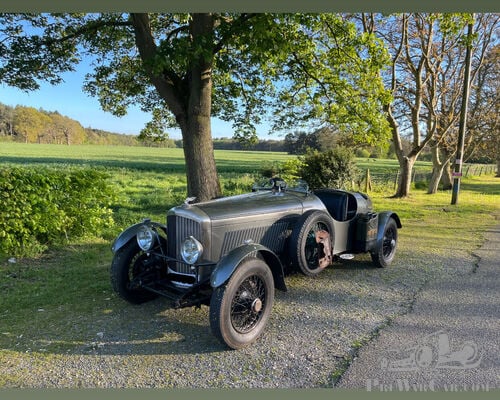
Derby Bentley Special 4-1/4
Sadly i am having to sell on my Bentley special ( Icarus). It is currently a work in progress and still needs finalising/ refining. A great o..

K3 Replica on KN Chassis
"The K3 Magnette must rank in the history books as the most famous and successful of all the record breaking MGs. With only 33 examples produced durin..