The global magazine and marketplace for classic car enthusiasts, by enthusiasts.


Filter
Classic Brasier, Delaunay-Belleville for sale - Brasier, Delaunay-Belleville cars for sale
-

Packard single six convertible
Rare 1925 Packard Six Sedan – Unique 7-Seater Project with Belgian PapersA solid, rust-free base for the true vintage enthusiast.We are proud to offer this rare and stately 1925 Packard Six. In the 1920s, Packard was the ultimate symbol of American luxury and engineering. This specific model is a grand 7-seater, complete with the.. -
1930 Standard Avon Alvis 12/50 Supercharged Special
1930 Standard Avon Alvis 12/50 Supercharged Special Chassis Number: 29035 Registration Number: BF9202 The present owner began building the A-A in 1965. He had enjoyed driving his first real car, a 1929 12/50 Alvis Betleback and when he acquired a 1930 Standard Avon, he found tha.. -
1928 Cadillac Model 7980 convertible coupe
Cadillac is one of the pristine cars in American history, here we have a 1928 model 7980 convertible coupewith all options as twin wooden spare wheels, trunk rack, pilot ray lights (who follow the direction of the front wheels) etc.The engine is a V8 with 5588cc on a 3560 wheelbase. At 2200kg it is not a lightweight.We parti.. -
MG NA Magnette (Ex Beryl Markham)
MODEL OVERVIEW: By the early 1930s, MG had joined the fashionable trend of six cylinder sports and racing cars with the K and N Magnette models. MG’s road going overhead camshaft six cylinder cars we’re directly related to the works racing cars used to achieve phenomenal international competition success in period.The N Magnette series of.. -
1924 Bentley 3 4 ½ Litre
•Sold new to Major EG Thomson of Edinburgh, of Ecuire Ecosse fame •Owned for more than 50 years by the Martin family•Upgraded to 4.5 Litre spec using original crankcase•Extensive history file includes factory records and buff logbooks•Fully restored by Paul Grist to his ‘ultimate’ period look and specification .. -
HORCH 930 V
For SaleHorch 930 VManufacturer: HorchModel and Variant: 930 VBody Type: 4-door sedanChassis Number: 931906Color: Dark bluePower: 93 kWEngine Capacity: 3,796 ccFirst Registration: 01/07/1939Engine Type: Petrol, 8-cylinderMileage: 12,125 km -
1921 Rolls Royce 20hp Experimental tourer
1921 Rolls Royce 20hp Experimental tourer. Chassis number: 4G2 Registration Number: CH2892 Sir Henry Royces' personal car used for development of the 20HP chassis. He is pictured in it both at his French house; La Villa Mimosa in Le Canadel & also near his UK home "Elmsted" .. -
Oldsmobile Curved Dash Model 6C 7hp 1904
We have available for sale this exceptionally original 7hp Curved Dash Oldsmobile. Manufactured in 1904. Continuous ownership/history for many years. This is the larger engined motor car with rear brakes & larger hp. These are exceptionally good strong motor cars and can certainly cover some miles without any issues, well built & very go.. -
BMW 326 Cabriolet
DISPONIBLE PRES DE PARISRare version cabriolet 2 portes douanes EU acquittées, title américainNécessite une restauration totale, Voiture complète vendue avec un moteur complet en plus -
C1926 DFP open
Rare DFP from c1926Mechanical complet, Missing interior and hood topno documents,can see in LisbonCan help with transportchassis # 40 273


Brasier
France, 1897 – 1930
(1) Société des Anciens Etablissements Georged Richard, Ivry-Port, 1897 – 1905
(2) Société des Automobiles Brasier, Ivry-Port, 1905 – 1926
(3) Société Chaigneau-Brasier, Ivry-Port, 1926 – 1930
The first car made by Georges Richard (not yet named Brasier) was a frail machine on Benz lines, with belt drive and three forward speeds. By 1900, Richard was offering the Vivinus from Belgium under his own name – another voiturette, but a quieter, smoother-running one with a fair turn of speed. It was powered by a 6hp 2-cylinder engine, and it too was belt-driven. However, the 7½hp Georges Richard of 1901 had shaft drive, in the approved modern fashion of Darracq and Renault. With the arrival of the designer Brasier, who had worked for Mors, Georges Richard gradually ceased to be associated with voiturettes, but gained little originality. There were four new models in 1902, all called Richard-Brasiers, rated at between 10 and 40hp but they were of Panhard type in most respects. The smaller cars still had tubular chassis and not all Richard-Brasier models had chain drive, but all types had steel frames by 1904. In that year there were two twins and three fours, only the biggest of which, the 40hp, was chain-driven. In 1904 and 1905, Brasier’s cars won the Gordon Bennett Trophy for France, bringing worldwide fame to the name.
In 1905 Georges Richard left to make the Unic at Puteaux, and Brasier continued to offer his cars, now known simply as Brasiers. The Brasier remained conservative in design until 1912, with exposed valve gear and cylinders cast in pairs. In that year, a modern light Brasier car was introduced, with a 4-cylinder engine cast en bloc. Ivry-Port went on listing solid, unenterprising, relatively expensive Four-cylinder Brasiers for sale until 1927. They were brought up to date in 1923 by means of front wheel brakes and ohv engines, but this had become common practice, Brasier, in fact, was another famous old make whose popularity slowly declined, like so many in France at this time.
Reorganization at Brasier in 1926 at first brought no important innovations, apart from a change of name to Chaigneau-Brasier, and the introduction of a modern orthodox light car in the shape of the Chaigneau-Brasier 9CV. Then, in 1928, the new company revealed the outcome of its rethinking. This had been over- instead of under-enterprising, for the new car as a 3-litre, overhead-camshaft straight-8 with front wheel drive. With this car, and even more with the bigger Chaigneau-Brasier Type DG8 of similar design that followed in 1930, Chaigneau-Brasier committed the double error of plunging into the luxury market at a time of economic depression, and offering an unconventional design to a public that distrusted such things. Chaigneau-Brasier were not the only French firm to make the same simultaneaous, and fatal, mistakes, and they paid the same price.
Source: Georgano, encyclopedia of motorcar; TRN
The information is written with the greatest of care. However, if you have any suggested amendments please contact us at office@prewarcar.com
Delaunay-Belleville
France, 1904 – 1950
SA des Automobiles Delaunay-Belleville, St. Denis, Seine
The first cars made by the celebrated firm of locomotive and marine boiler makers Delaunay-Belleville appeared at the Paris Salon of 1904, when a beautifully-built, expensive machine was shown. It was designed by Marius Barbarou, formerly of Benz, and later of Lorraine-Dietrich. Three 4-cylinder Delaunay-Belleville models were available for 1905, in 16, 24, and 40hp sizes. They had separately-cast cylinders, T-head engines, full-pressure lubrication, 4-speed gearboxes and chain drive. The range of fours was extended to five Delaunay-Belleville models between 10 and 40hp by 1907, when 15 and 40hp sixes were introduced. The larger Delaunay-Belleville models were chain-driven until 1910 when shaft drive was standardized on all models. In 1909 there was a small 10CV six of great refinement. The Delaunay-Belleville sixes were both smoother and more reliable than other early examples, the very rigid crankshaft largely eliminating vibration.
Up to 1914 the Delaunay-Belleville was regarded by many as the best car in the world, and was favoured by buyers who valued quiet, unostentatious dignity. The Delaunay-Belleville cars were never entered in competitions and were usually chauffeur-driven. Among royal customers ws Tsar Nicholas II of Russia who had a number of Delaunay-Belleville, including the 70hp chain-driven six known as the Delaunay-Belleville model SMT (Sa Majesté le Tsar).
One of the features of the Delaunay-Belleville was the round radiator and bonnet, and this was continued on the post-war Delaunay-Belleville cars, although in accordance with fashion the radiator was slightly pointed. The 1922 Delaunay-Belleville range consisted of a 10/12 and 14/16hp four, and three sixes from a 14/16 to a massive 40/50 of 8-litres capacity and using dual ignition. The Delaunay-Belleville P.4B 2.6-litre of 1922 to 1929 had a single ohc engine, while from 1926 a range of push-rod ohv fours and sixes was offered. However, the Delaunay-Belleville marque had lost its pre-war cachet, which had been taken over by Hispano-Suiza and Rolls-Royce, and during the 1930s it lost its individuality as well. In 1931 Continental 4 or 4½-litre straight-8 engines from America were available in the 21CV 6-cylinder Delaunay-Belleville chassis. With greater and more silent power, these Delaunay-Belleville cars were cheaper than the French-engined cars. The eights were still theoretically available in 1936, but by that time the main Delaunay-Belleville model was the 2.3-litre 6-cylinder Delaunay-Belleville R.16. This represented a further loss of individuality, as it closely resembled the Type 230 Mercedes Benz, although it had a longer stroke engine. It reappeared after World War 2 with a Cotal electric gearbox, and modernized ‘waterfall’ grille and was listed up to 1950. In the same early post-war years the Delaunay-Belleville factory which had made 70hp cars for the Tsar was turning out the 425cc Rovin minicar.
Source: Georgano, encyclopedia of motorcar; TRN
The information is written with the greatest of care. However, if you have any suggested amendments please contact us at office@prewarcar.com


Featured
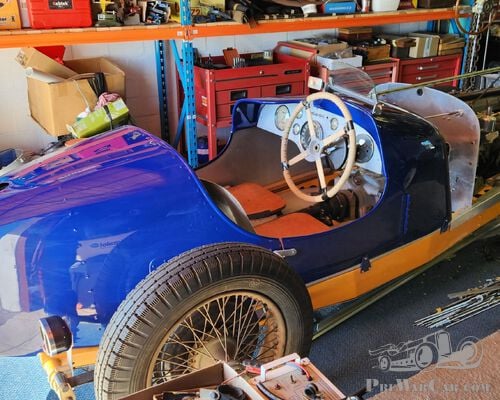
Riley TT Sprite
1935 6-cylinder TT Sprite replica. Chassis # 46A2722. Engine # 6A2722. Original Ulster Imp body. Restoration nearing completion. Engine, Ge..