The global magazine and marketplace for classic car enthusiasts, by enthusiasts.


Filter
Classic Delaunay-Belleville, Gladiator for sale - Delaunay-Belleville, Gladiator cars for sale
-

1931 Bugatti Type 46 'Superprofilée' Coupe
1931 Bugatti Type 46 'Superprofilée' Coupe Chassis no. 46491 Engine no. 345 One of two chassis purchased from Roland Bugatti by Richard Baudens in the 1950s & wearing its first coachwork ever fitted to the car. 5,359cc SOHC Inline 8-Cylinder Eng.. -
Riley TT Sprite
1935 6-cylinder TT Sprite replica. Chassis # 46A2722. Engine # 6A2722. Original Ulster Imp body. Restoration nearing completion. Engine, Gearbox and Diff have been rebuilt.Requires aluminium bonnet (material supplied), wiring, seat upholstery and fettling to finish.Comes with many spares including complete pre-select and m.. -
Mercedes Benz 500K Cabriolet A
For sale is an original 1936 Mercedes-Benz 500K Cabriolet A. This vehicle is one of the few remaining examples with a spare wheel on the rear and stands out for its high level of originality. The Cabriolet is in very good condition and has been meticulously maintained. It is an authentic vehicle, not a replica.. -
1931 Nash 4 door special sedan
Model: series 870, model 877-1560, 4-door special saloon Colour: dark blueInterior: beige fabricEngine: 8-cylinder in-line, 227.5 cubic inches, 78 hpTransmission: manual, 3 gearsCondition: unrestoredPrice: € 25,000 Description:Incredibly beautiful unrestored car in superb condition. .. -
1938 Rolls Royce Phantom 3 Windovers Limousine
1938 Rolls Royce Phantom 3 Windovers LimousineChassis number: 3-CM-33Registration number: DUR255A pleasingly proportioned Rolls Royce Phantom 3 with coachwork by Windovers. The coachwork is rakish & quite streamlined when compared with some of the more ponderous coachwork found on these Phantom 3's. This is a low mileag.. -
Chevrolet Fleetmaster 'Woodie' Station Wagon
Chevrolet Fleetmaster 'Woodie' Station Wagon ***in absolute new state***European Car Registration in EU-Netherlands reg.no. DZ-87-00Chassis no. CL8434• The most expensive Chevrolet of its day• Imported from South Africa• Original right-hand drive model• Partially renovated in 2013 Footnote.. -
Mercedes Benz 320D convertible 4 door
Arie-Jean Engineering are proud to offer this incredibly rare Mercedes Benz 320D convertible 4 door in stunning condition. Extensively restored approx. 20 years ago in Berlin, Germany with very little use since (photographic record available). This W142 sports a powerful 6 cylinder 3. 2 Engine and desirable overdrive. (Rated at 78bhp, top speed.. -
1931 Rolls-Royce Phantom II Continental DHC
-In excellent condition with recent work by ourselves-Unique Park Ward DHC coachwork-Equipped with overdriveLike all Phantoms, the Continental was built for high-speed touring, offering a breath-taking ability to cover long distances in sublime comfort at high speed.Of the 1400 Phantom IIs produced, only 280 Continent.. -
Te koop Morgan Aero 1927
De Morgan Aero is geproduceerd van 1920 tot rond 1933. Dit voertuig met chassisnummer B718 is van 1927. De driewieler is in goed rijdbare en in originele staat, video’s hierover zijn het bewijs. De aandrijving (koppeling & bak) en dynamo zijn op kwalitatief gezien technisch verantwoorde wijze enigszins aangepast, waarmee de technische betrou.. -
1939 Daimler E4 Labourdette
1939 Daimler E4 "Light Eight" , body "Labourdette"Not restored, complete.Aluminum body made by "Labourdette"The chassis was commenced in 1938 and completed in March 1939 before being fitted with the body by Labourdette, which was known as a 'Vutotal' design. Very interesting, unique car, ideal for a project "Concourse d'Ele..


Delaunay-Belleville
France, 1904 – 1950
SA des Automobiles Delaunay-Belleville, St. Denis, Seine
The first cars made by the celebrated firm of locomotive and marine boiler makers Delaunay-Belleville appeared at the Paris Salon of 1904, when a beautifully-built, expensive machine was shown. It was designed by Marius Barbarou, formerly of Benz, and later of Lorraine-Dietrich. Three 4-cylinder Delaunay-Belleville models were available for 1905, in 16, 24, and 40hp sizes. They had separately-cast cylinders, T-head engines, full-pressure lubrication, 4-speed gearboxes and chain drive. The range of fours was extended to five Delaunay-Belleville models between 10 and 40hp by 1907, when 15 and 40hp sixes were introduced. The larger Delaunay-Belleville models were chain-driven until 1910 when shaft drive was standardized on all models. In 1909 there was a small 10CV six of great refinement. The Delaunay-Belleville sixes were both smoother and more reliable than other early examples, the very rigid crankshaft largely eliminating vibration.
Up to 1914 the Delaunay-Belleville was regarded by many as the best car in the world, and was favoured by buyers who valued quiet, unostentatious dignity. The Delaunay-Belleville cars were never entered in competitions and were usually chauffeur-driven. Among royal customers ws Tsar Nicholas II of Russia who had a number of Delaunay-Belleville, including the 70hp chain-driven six known as the Delaunay-Belleville model SMT (Sa Majesté le Tsar).
One of the features of the Delaunay-Belleville was the round radiator and bonnet, and this was continued on the post-war Delaunay-Belleville cars, although in accordance with fashion the radiator was slightly pointed. The 1922 Delaunay-Belleville range consisted of a 10/12 and 14/16hp four, and three sixes from a 14/16 to a massive 40/50 of 8-litres capacity and using dual ignition. The Delaunay-Belleville P.4B 2.6-litre of 1922 to 1929 had a single ohc engine, while from 1926 a range of push-rod ohv fours and sixes was offered. However, the Delaunay-Belleville marque had lost its pre-war cachet, which had been taken over by Hispano-Suiza and Rolls-Royce, and during the 1930s it lost its individuality as well. In 1931 Continental 4 or 4½-litre straight-8 engines from America were available in the 21CV 6-cylinder Delaunay-Belleville chassis. With greater and more silent power, these Delaunay-Belleville cars were cheaper than the French-engined cars. The eights were still theoretically available in 1936, but by that time the main Delaunay-Belleville model was the 2.3-litre 6-cylinder Delaunay-Belleville R.16. This represented a further loss of individuality, as it closely resembled the Type 230 Mercedes Benz, although it had a longer stroke engine. It reappeared after World War 2 with a Cotal electric gearbox, and modernized ‘waterfall’ grille and was listed up to 1950. In the same early post-war years the Delaunay-Belleville factory which had made 70hp cars for the Tsar was turning out the 425cc Rovin minicar.
Source: Georgano, encyclopedia of motorcar; TRN
The information is written with the greatest of care. However, if you have any suggested amendments please contact us at office@prewarcar.com
Gladiator
France, 1896 – 1920
(1) Societé Gladiator, Pré-St. Gervais, 1896 – 1909
(2) Societé Gladiator, Puteaux, Seine, 1910 – 1920
The original Gladiator firm was founded by Aucoc and Darracq in 1891 to make cycles, but Gladiator was bought out in 1896 by a British group with which Harvey Du Cros was concerned. This new group proceeded to amalgamate with Clément, from which concern Adolphe Clément himself subsequently resigned in order to launch the Clément-Bayard business; to complicate matters, the Clément-Gladiator combine also made Clément cars which were of very similar design to their Gladiator cars. Gladiator’s first car was a simple little voiturette of 4hp with a single-cylinder horizontal engine mounted in a tubular frame, cycle-type wire wheels, and handlebar steering, but by 1899 the Gladiator car firm were making 2½hp and 3½hp Aster-engined Gladiator machines with transversely-mounted power units at the front, wheel steering, and pedal control for the 2-speed gear. Final drive was by chain, and the Gladiator make was introduced to England by S.F. Edge’s Motor Power Co, who marketed the Gladiator at £118,15s in 1900. Edge continued to sponsor the Gladiator until his preoccupation with Napier affairs caused him to discard both the Gladiator make and the Regent. A more conventional Gladiator 6½hp single, still Aster-powered, was available in 1901, in which year an 18hp 4-cylinder Gladiator racing voiturette contested the Paris-Berlin: almost the last serious competition attempt by Gladiator, though a single-cylinder chain-driven Gladiator voiturette ran in L’Auto’s first light-car race in 1905, and Gladiator cars also started in the early Tourist Trophies. Late in 1901 came a conventional Gladiator 12hp car with armoured wood frame, side-chain drive, and a vertical-twin aiv Aster engine, selling for £395. A wide range of Gladiator cars, from a 3½hp quad to 4-cylinder types, was available in 1902, and a Mercédès style of bonnet was found on the 2.2-litre twin in 1903, though it still housed a tubular cooler. The little Gladiator 6hp was rather expensive at £300 in England. 4-cylinder Gladiator models were available both in 2.1-litre and 2.7-litre forms, with engines said to be made by Gladiator themselves: the bigger 16hp had mechanically-operated side valves and only a single camshaft. Mechanically-operated valves were found on all Gladiator models save the 12hp twin in 1904, and it was hard to sort out the Cléments from the Gladiator cars, though the former were turning to bevel drive while Gladiator adhered to chains. A 4-litre Gladiator 28hp 4-cylinder with high tension magneto was listed in 1905, but smaller cars, including another four of 3-litres’ capacity, continued to use Aster units, and at the bottom of the Gladiator range was a very archaic 9hp 1.7-litre, still with automatic inlet valve, rear-mounted water tank, and sprag.
All the Gladiator models of a very complicated 1906 range now had mechanically-operated valves, the 12/14hp 4-cylinder Gladiator had shaft drive in conjunction with a 4-speed gearbox, and frames could be of either armoured wood or pressed steel, though the latter variant was found in the English Gladiator catalogue, but not the French one. The largest Gladiator four was of 4.8-litres, but during the year a chain-driven 5.5-litre 38bhp Gladiator six made its appearance. Magneto ignition was standard in 1907 on Gladiator car for sale, and for 1908 it was announced that certain Gladiator models were to be built in England by Austin. How many were actually made is problematic, but the 1908 and 1909 Gladiator catalogues showed three nominally British type, the Gladiator 18/24hp and 40hp 4-cylinder, and the 60hp 6-cylinder, which were uncommonly like their Austin counterparts. (Swift, in which Harvey du Cros had an interest as well, were making Cléments at the same time in Coventry). On top of these variants, Pré-St. Gervais offered 4-cylinder Gladiator cars of 2.2, 3.7, 4.8, 5.8 and 6.3-litres. The smallest of these, rated at 12/14hp, marked a reversion to the L-head configuration and had shaft drive, but all the other Gladiator cars were chain-driven T-headers on traditional lines like Gladiator had in the past. In 1909 Vinot et Deguingand acquired Gladiator, and production of Gladiator cars was transferred to Puteaux. All that in fact happened was that Gladiator now had another alter ego: the Gladiator cars looked like Vinots, shared the Vinot’s technical specification, and even their prices, though there were no 6-cylinder ‘Vinot’ Gladiators, chain drive was not offered after 1910 except on cars bearing the Vinot name, and it was announced in 1911 that Gladiator cars for sale were not to share the vertical gate change. However, as a result of the new association the 1912 Type-AL Gladiator (a designation shared with Vinot) came out with a monobloc engine and pressure lubrication. 1914 Gladiator models were, understandably, 4-cylinder machines with capacities of 1.7 litres, 2.2 litres, 2.7 litres and 4.1 litres, and both the 12hp and the long-stroke 15/20hp were once again offered in 1919-1920, the former costing £785 in England. After this, however, Vinot could no longer afford the luxury of a dual personality and Gladiator disappeared.
Source: Georgano, encyclopedia of motorcar; MCS
The information is written with the greatest of care. However, if you have any suggested amendments please contact us at office@prewarcar.com


Featured
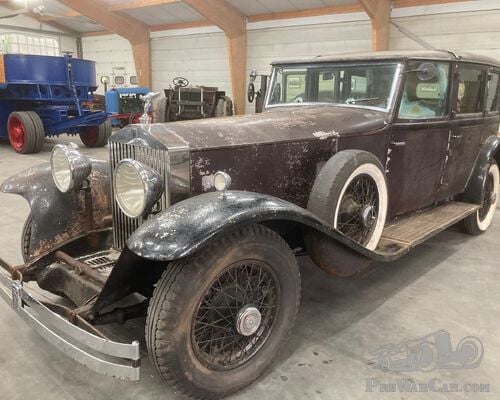
Rolls-Royce
Rolls-Royce Phantom ll chassisnummer 287 AJS. bouwjaar 1932, Links gestuurd, Brewster Keswick Sedance Towncar

K3 Replica on KN Chassis
"The K3 Magnette must rank in the history books as the most famous and successful of all the record breaking MGs. With only 33 examples produced durin..

Alfa 6C1750 Spider
Alfa 6C1750 Spider with complete history from delivery in 1930 to first owner in Firenze till today with copy Libretto/license plate all the years