The global magazine and marketplace for classic car enthusiasts, by enthusiasts.


Filter
Classic Ansaldo, DeSoto for sale - Ansaldo, DeSoto cars for sale
-

1921 Ansaldo type 4C rolling chassis
1921 Ansaldo type 4C rolling chassis. Complete engine and gearbox no 17634 and chassis no 1763. All components are in excellent condition including the 5 original wirespoked wheels and three of the beaded edge tyres. Good radiator. Suitable project to build a Special from. OHC engine. € 18500 negotiable. ..

Ansaldo
Italy, 1919 – 1936
(1) SA Ansaldo Automobili, Turin, 1919 – 1932
(2) Construzione e Vendita Automobili Ansaldo, Turin, 1932 – 1934
(3) Ansaldo – Ceva SA, Turin, 1934 – 1936
One of Italy’s biggest engineering groups, Ansaldo turned their idle aero-engine works over to Ansaldo car manufacture in 1919, their Soria-designed range being intended for volume production in competition with FIAT. The advanced 4-cylinder ohc engines contrasted with the 3-speed gearboxes, central change, wooden wheels, and austere, Chevrolet-like tourer bodywork, but even the basic 1.847cc Ansaldo 4A car was capable of 55mph, and by 1922 it had been joined by the 2-litre Ansaldo 4CS car for sale that managed 70mph on an output of 48bhp. FIAT, however, were making five times as many cars. In 1923 there came both four-wheel brakes and a six, the 2-litre Ansaldo 6A car with coil ignition. In 1926 there was even a cheap Ansaldo car for sale with 1½-litre, the Ansaldo 10 car with transverse front suspension. The 1927 Ansaldo sixes had 2.2-litre engines and four forward speeds; the latter, long with coil ignition, were found on the bigger fours by 1928. Unfortunately Soria’s resignation in 1927 left Ansaldo with no new ideas, though his final efforts reached the market in 1929 and were the company’s staples after 1930. The Ansaldo 18 for sale was merely an enlarged 2.8-litre six, but the Ansaldo 22 car for sale, was a large and luxurious 3½-litre pushrod straight-8 on an 11ft 2in wheelbase, distinguished by its disc wheels with quick-detachable rims. These were a product of Ruotificio Italiano, an Ansaldo subsidiary. In 1932 the CEVA concern was organized to take over the stock of 400 unsold Ansaldo 18 and Ansaldo 22 chassis, and these were still available, with restyled body work, as late as 1936.
Source: Georgano, encyclopedia of motorcar; MCS
The information is written with the greatest of care. However, if you have any suggested amendments please contact us at office@prewarcar.com
DeSoto
US, 1913 – 1916
DeSoto Motro Car Co, Auburn, Ind.
The DeSoto appears to have succeeded the Zimmerman. This was a large car with a 55hp, 6-cylinder engine, which was furnished with a compressed-air starter. The DeSoto model Six-55 five-seater touring car sold for $2185.
US, 1928 – 1960
Chrysler Motors Corp, Detroit, Mich.
The DeSoto was launched in 1928 as a 3.2-litre side valve six to compete with Oldsmobile, Pontiac and the cheaper Nashes. Styling and general design of the DeSoto were in line with the 1929 Chryslers, and at $885 for a DeSoto sedan 90.000 were sold in the first twelve months. A 3.4-litre straight-8 DeSoto on a 9ft 6in wheelbase was announced for 1930 as the world’s cheapest 8-cylinder car. However, DeSoto suffered badly in the Depression, and in 1932, when flexible rubber engine mountings and free wheels were made available, sales dropped to 26.000 DeSoto cars.
The DeSoto disappeared from the British market about this time, though certain ‘Chrysler’ models listed in England (the Mortlake, Croydon, and some of the Richmonds) were in fact DeSoto cars in all but name. A 6-cylinder version of Chrysler’s advanced unitary-construction Airflow, the SE-type with a 4-litre engine, was brought out in 1934, but was an unsuccessful as its bigger sister. Later DeSotos followed regular Chrysler lines closely though in later years there was a tendency for DeSoto to move into a higher price class than Dodge; by 1952 DeSotos started $300 higher than the companion make.
By 1939 the DeSoto cars for sale were being made with independent front suspension, hypoid back axles and column change. There was a choice at DeSoto of two 6-cylinder engines and three wheelbase lengths, the longest of these being reserved for seven-seater bodywork – DeSoto continued to offer a really roomy family car right up to 1954. A 4-speed semi-automatic Vacumatic transmission became an option in 1941, but DeSoto’s big post-war change of models did not take place until 1952, when the division followed Chrysler’s lead in adopting the oversquare ohv V8; the DeSoto version was of 4½-litre capcity and developed 16-bhp. With the advent of Chrysler’s ‘flight sweep’ styling in 1955, the side-valve sixes were dropped and the standard engine in a DeSoto was now a 4.8-litre eight, giving 185bhp in Firedome guise, and 200bhp in Fireflite form. Though this redesigning saved Chrysler sales generally, the slump in the medium-price class had an adverse effect on DeSoto and in 1959 the DeSoto division was merged with Plymouth. Last of the DeSotos were the 1961 models, unitary-construction cars with a choice of three engines: Plymouth’s 145bhp ohv ‘slant six’ as used in the Valiant, and V8s of 230 and 265bhp, the two former only in Canadian DeSotos. Production of DeSoto cars ceased in November 1960 after only a few had been delivered.
Source: Georgano, encyclopedia of motorcar; MCS
The information is written with the greatest of care. However, if you have any suggested amendments please contact us at office@prewarcar.com


Featured
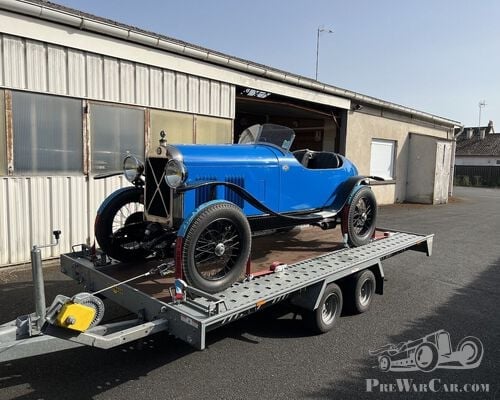
Salmson VAL 3 Séries 7
1927 Salmson VAL3 Series 7. Completely restored a few years ago, in very good overall condition, both bodywork and mechanics. Bordino-style bodywor..
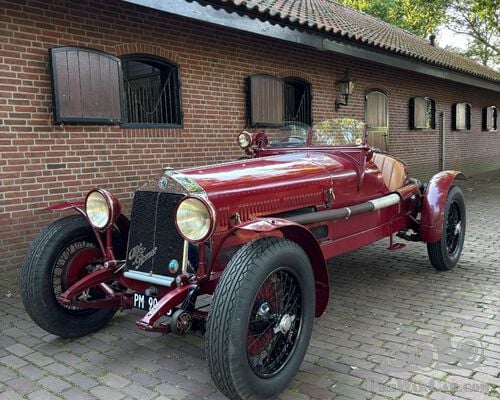
1930 Alfa Romeo 6C 1750 Spider
1930 Alfa Romeo 6C 1750 Spider with complete history from delivery to first owner in 1930 in Firenze till today with copy Libretto/license plate.
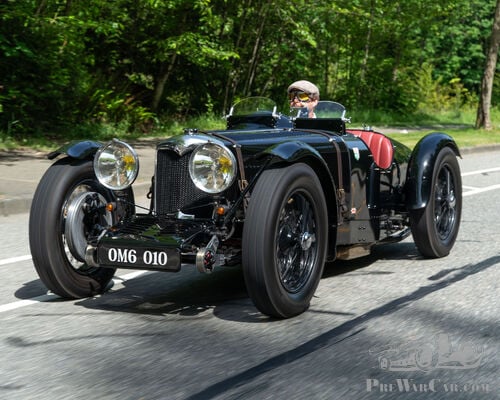
Riley 14/6 Special 1933
The ExperienceStep into the golden age of British motoring. This 1933 Riley 14/6 Special is a masterclass in pre-w..