The global magazine and marketplace for classic car enthusiasts, by enthusiasts.


Filter
Classic Armstrong Siddeley, DeSoto for sale - Armstrong Siddeley, DeSoto cars for sale
-

1936 Armstrong Siddeley 20/25 Cabriolet with Tickford coachwork by Salmons & Sons, Newport Pagnell
This exceptionally rare Armstrong Siddeley 20/25 Cabriolet with original Tickford coachwork by Salmons & Sons of Newport Pagnell was first registered in Devon in December 1936. It retains its original 3,760 cc overhead-valve six-cylinder engine and renowned Wilson pre-selector gearbox.The car underwent a comprehensive restoration in ..

Armstrong Siddeley
GB, 1919 – 1960
Armstrong Siddeley Motors Ltd, Coventry, Warwickshire
The Armstrong-Siddeley firm came into being through the fusion of Armstrong-Whitworth’s carmaking activities with Siddeley-Deasy of Coventry. Apart from the abortive Stoneleigh light car of 1922, their products were always solidly-built family vehicles emphasizing good workmanship, comfort and ease of driving rather than high high performance. Up to 1939 the Armstrong-Siddeley cars for sale were readily identifiable by their massive V-radiators (except on certain smaller and cheaper versions), multi-stud disc wheels (though wire was also used in the 1930s) and Sphinx mascots. The first Armstrong-Siddeley design was a 5-litre ohv bi-block six of 30hp. This was joined by a smaller but equally massive 2.3-litre ‘Armstrong-Siddeley 18’ in 1922, and by a 2-litre 4-cylinder ‘Armstrong-Siddeley 14’ – also ohv, but with the first of the flat radiators – late in 1923; this was quite cheap at £360. Front-wheel brakes were available on the 6-cylinder Armstrong-Siddeley cars in 1924, and these also had Monobloc engines by 1926. In 1928 a sv 1.9-litre 15hp six was introduced, followed by an even smaller one of 12hp and 1236cc in1929. Also in 1929 the Wilson preselector gearbox (already tried by Vauxhall) made its debut, first as an optional extra adding £35-£50 to the price, but as standard equipment on all types from 1933 on. The 1930 range consisted of the ‘Armstrong-Siddeley 12’, the ‘Armstrong-Siddeley 15’, a 2.9-litre ‘Armstrong-Siddeley 20’ in owner- and chauffeur-driven versions from £485, an the big ‘Armstrong-Siddeley 30’, now listed with formal coachwork only at £1450.
Armstrong Siddeley production was always on a modest scale, running at about 1.000 a year; one of the best seasons was 1932, at the height of the Depression. An interesting departure for 1933 was the sporting 5-litre Siddeley Special with hiduminium alloy engine. This 90mph machine was catalogued from £950 upward, and some 140 Armstrong-Siddeley cars were sold over the next four seasons, while in 1934 there was a handsome Armstrong-Siddeley sports coupé on the latter (1.4-litre) 12hp chassis for ‘daughters of gentlemen’. After the ‘Armstrong-Siddeley 12’ was dropped at the end of 1936, all Armstrong Siddeleys were ohv sixes and in 1939 these came in 1.7-litre, 2-litre, 2.4-litre, 2.9-litre and 3.7-litre sizes, generally with formal saloon or limousine bodywork. Despite the ‘unsporting’ character of the Armstrong-Siddeley cars, he company’s preselector boxes found many applications on competition machines, noted users being E.R.A., H.W.M. and Connaught. The last Burney Streamlines of 1932-33 used the 20hp Armstrong Siddeley engine.
Armstrong Siddeley were among the first makers to announce a programme after World War 2. These Armstrong-Siddeley cars used the pre-war 16hp 2-litre (enlarged to 2.3 litres in 1949) engine in a new independent front suspension chassis with advanced and attractive styling. For the first time in many years a sliding-type gearbox (with synchromesh) was available as an alternative to the Wilson. The various models were named after famous aircraft produced during the war by the parent Hawker Siddeley Group: Armstrong-Siddeley Hurricane, Armstrong-Siddeley Lancaster, Armstrong-Siddeley Typhoon and, from 1949-1950, the Armstrong-Siddeley Whitley. In 1953 the firm went over to a square 3.4-litre engine with hemispherical head, the result being the Armstrong-Siddeley Sapphire with a choice of synchromesh or electrically-selected preselector. A twin-carburetor 100mph version followed in 1954, automatic transmission was optional on the 1955 Armstrong-Siddeley models for sale and power-assisted steering in 1956 when the range was extended by a brace of smaller Armstrong-Siddeley models. These were the ‘Armstrong-Siddeley 234’ for sale with a 4-cylinder 2.3-litre engine based on the Armstrong-Siddeley Sapphire, and the ‘Armstrong-Siddeley 236’ for sale using the old long-stroke six of similar capacity. Neither sold (or looked) well and they lasted only a couple of seasons. Last of all came the 4-litre Armstrong-Siddeley Star Sapphire, made only with automatic gearbox, though like the latter 3.4-litre cars, it was offered as a limousine as well as a saloon. In the meantime, Hawker Siddeley had amalgamated with another aircraft group, Bristol. The Bristol cars were taken over by an independent company, but Armstrong Siddeley were less fortunate and the last Armstrong-Siddeley Sapphire left the works in the summer of 1960.
Source: Georgano, encyclopedia of motorcar; MCS
The information is written with the greatest of care. However, if you have any suggested amendments please contact us at office@prewarcar.com
DeSoto
US, 1913 – 1916
DeSoto Motro Car Co, Auburn, Ind.
The DeSoto appears to have succeeded the Zimmerman. This was a large car with a 55hp, 6-cylinder engine, which was furnished with a compressed-air starter. The DeSoto model Six-55 five-seater touring car sold for $2185.
US, 1928 – 1960
Chrysler Motors Corp, Detroit, Mich.
The DeSoto was launched in 1928 as a 3.2-litre side valve six to compete with Oldsmobile, Pontiac and the cheaper Nashes. Styling and general design of the DeSoto were in line with the 1929 Chryslers, and at $885 for a DeSoto sedan 90.000 were sold in the first twelve months. A 3.4-litre straight-8 DeSoto on a 9ft 6in wheelbase was announced for 1930 as the world’s cheapest 8-cylinder car. However, DeSoto suffered badly in the Depression, and in 1932, when flexible rubber engine mountings and free wheels were made available, sales dropped to 26.000 DeSoto cars.
The DeSoto disappeared from the British market about this time, though certain ‘Chrysler’ models listed in England (the Mortlake, Croydon, and some of the Richmonds) were in fact DeSoto cars in all but name. A 6-cylinder version of Chrysler’s advanced unitary-construction Airflow, the SE-type with a 4-litre engine, was brought out in 1934, but was an unsuccessful as its bigger sister. Later DeSotos followed regular Chrysler lines closely though in later years there was a tendency for DeSoto to move into a higher price class than Dodge; by 1952 DeSotos started $300 higher than the companion make.
By 1939 the DeSoto cars for sale were being made with independent front suspension, hypoid back axles and column change. There was a choice at DeSoto of two 6-cylinder engines and three wheelbase lengths, the longest of these being reserved for seven-seater bodywork – DeSoto continued to offer a really roomy family car right up to 1954. A 4-speed semi-automatic Vacumatic transmission became an option in 1941, but DeSoto’s big post-war change of models did not take place until 1952, when the division followed Chrysler’s lead in adopting the oversquare ohv V8; the DeSoto version was of 4½-litre capcity and developed 16-bhp. With the advent of Chrysler’s ‘flight sweep’ styling in 1955, the side-valve sixes were dropped and the standard engine in a DeSoto was now a 4.8-litre eight, giving 185bhp in Firedome guise, and 200bhp in Fireflite form. Though this redesigning saved Chrysler sales generally, the slump in the medium-price class had an adverse effect on DeSoto and in 1959 the DeSoto division was merged with Plymouth. Last of the DeSotos were the 1961 models, unitary-construction cars with a choice of three engines: Plymouth’s 145bhp ohv ‘slant six’ as used in the Valiant, and V8s of 230 and 265bhp, the two former only in Canadian DeSotos. Production of DeSoto cars ceased in November 1960 after only a few had been delivered.
Source: Georgano, encyclopedia of motorcar; MCS
The information is written with the greatest of care. However, if you have any suggested amendments please contact us at office@prewarcar.com


Featured
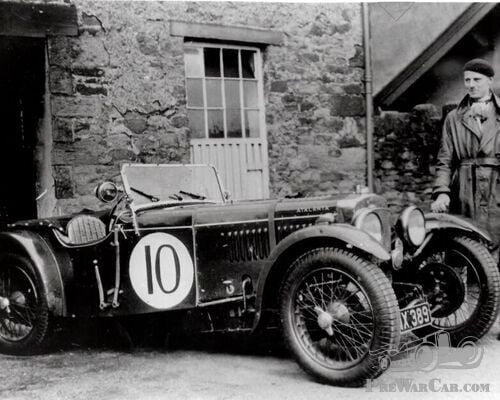
Fraser Nash TT Replica
AHX 389 ( chassis no. 2073, engine no. 10367).An important and correct short-chassis TT Replica with known history from new. Ex. H. P..
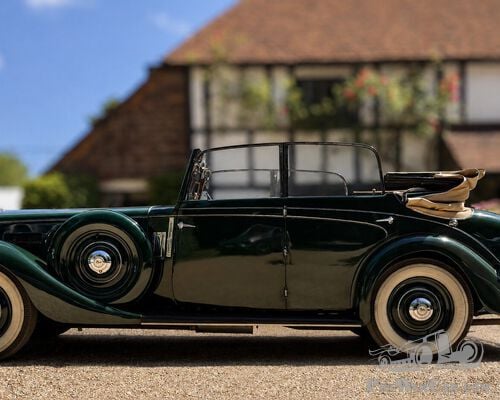
1936 Armstrong Siddeley 20/25 Cabriolet with Tickford coachwork by Salmons & Sons, Newport Pagnell
This exceptionally rare Armstrong Siddeley 20/25 Cabriolet with original Tickford coachwork by Salmons & Sons of Newport Pagnell was first reg..
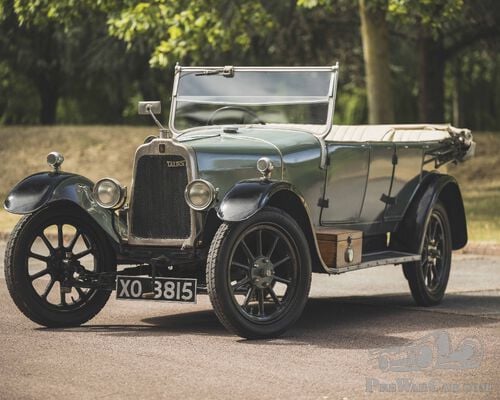
Rare RHD, low miles & great history file
This is an ONLINE-ONLY AUCTION at THE MARKET. The price shown here is the lower estimate. To see all the details, description, 250+ high-res photog..