The global magazine and marketplace for classic car enthusiasts, by enthusiasts.


Filter
Classic Austro Daimler, DeSoto for sale - Austro Daimler, DeSoto cars for sale
-

Austro Daimler AD6 Restoration project
Austro Daimler AD6 open tourer restoration project. More details on application...Looking also for all spare parts of AD six cylinder 6-17 or ADV.

Austro-Daimler
Austria, 1899 – 1936
(1) Österreichische Daimler Motoren AG, Wiener-Neustadt, 1899 – 1934
(2) Steyr—Daimler-Puch AG, Wiener-Neustadt, 1934 – 1936
Austria’s most famous motor car, the Austro-Daimler, was born when Daimler of Cannstatt established a factory in Vienna for the manufacture of about 100 of its Daimler cars annually. The Austro-Daimler was a copy of its German parent. In 1906 the Austro-Daimler concern became a separate financial entity, and a year earlier, Ferdinand Porsche had replaced Paul Daimler at Wiener-Neustadt as director. A new era began, for Porsche was a designer with original ideas. He did not exercise them at once; the two 1909 Austro-Daimler models for sale were large well-made fours with side valves in a T-head and a choice of chain or live-axle drive. World-wide fame came to the Austro-Daimler company with their 1910 models, especially the Austro-Daimler 22/80ps model originally designed to win the Prince Henry Tour of that year. It accomplished this very convincingly. The five large valves per cylinder – one inlet, four exhaust – were actuated by a single overhead camshaft. A combination of well-shaped combustion chambers and light reciprocating parts made for an engine of an efficiency never before seen in a catalogued, non-racing car. Its 5.7-litres produced 95bhp. Even Porsche, however, felt that so much power could not be safely transmitted by a live axle, and chain drive was used initially. The Austro-Daimler 22/80’s small brother, the Austro-Daimler 16/18ps, had a side-valve L-head engine. After it had swept the board in the Austrian Alpine Tour of 1911, the Austro-Daimler 16/25ps Alpine variant was also for sale. In 1914 the range consisted of these three cars, the sv Austro-Daimler 20/30ps, and the luxurious Austro-Daimler 35/60ps also with side valves. Both Austro-Daimler and Daimler sold the Lohner-Porsche, the name given to the electric and petrol-electric cars designed by Porsche before he went to Wiener-Neustadt. The Vienna Austro-Daimler firm was Austria’s largest manufacturer of motorcars.
Immediately after World War 1 a few cars were assembled in Liège from pre-war Austro-Daimler parts by M. Klinkenhammers, and sold under the Alfa-Legia. On their home ground the company returned to high-grade fast tourers. As well as the old ‘Austro-Daimler 16/18’ and ‘Austro-Daimler 20/30’, they made the new Austro-Daimler AD617 for sale, a 6-cylinder car of 4.4-litres with a single overhead camshaft, that was succeeded in 1923 by its development, the Austro-Daimler ADV17/60ps for sale, which was the same but for its front wheel brakes. Four years earlier, Porsche had maintained his reputation for really exciting design by producing the Sascha-type Austro-Daimler, a 1100cc – later 1½-litre – racing voiturette. Its four cylinders, like the six of the Austro-Daimler AD617, were of aluminium, with detachable steel liners. There were two overhead camshafts, however, and dry sump lubrication. The power output was 50bhp. Four-wheel brakes were, of course, fitted.
Although Porsche left Vienna in 1923 to return to Daimler, he was mainly responsible for the new ADM type, which was offered alongside the Austro-Daimler ADV17/60 from that year. The Austro-Daimler ADM1 was basically similar, but had a smaller engine of 2½-litres, and its rounded radiator was a departure for the hitherto traditional Austro-Daimler V-shape. It was sold in sports from in 1925 as the Austro-Daimler ADMII. After 1926, the old Austro-Daimler ADV17/60 was dropped and the ADM engine was enlarged to three litres by increasing the bore. This Austro-Daimler ADMIII in sports form developed 100bhp at 400rpm, and could do more than 100mph. Porsche’s successor, Karl Rabe, designed the even more advanced ADR type. Its tubular backbone chassis and swing-axle independent rear suspension so resembled that of the Tatra that legal action was taken against Austro-Daimler. The Austro-Daimler ADR was available in sports or normal form. At first, the Austro-Daimler ADR used the old ADMIII engine, but the Austro-Daimler ADR6 Bergmeister of 1929, one of the most glamorous Austro-Daimler built, had a new 3.6-litre power unit providing 120bhp. This car was made until production ceased shortly after the Steyr-Daimler-Puch amalgamation in 1934. The Austro-Daimler ADR8, the firm’s first and last 8-cylinder car, designed for more formal bodies, had disappeared in 1933 after a life of three years.
Source: Georgano, encyclopedia of motorcar; TRN
The information is written with the greatest of care. However, if you have any suggested amendments please contact us at office@prewarcar.com
DeSoto
US, 1913 – 1916
DeSoto Motro Car Co, Auburn, Ind.
The DeSoto appears to have succeeded the Zimmerman. This was a large car with a 55hp, 6-cylinder engine, which was furnished with a compressed-air starter. The DeSoto model Six-55 five-seater touring car sold for $2185.
US, 1928 – 1960
Chrysler Motors Corp, Detroit, Mich.
The DeSoto was launched in 1928 as a 3.2-litre side valve six to compete with Oldsmobile, Pontiac and the cheaper Nashes. Styling and general design of the DeSoto were in line with the 1929 Chryslers, and at $885 for a DeSoto sedan 90.000 were sold in the first twelve months. A 3.4-litre straight-8 DeSoto on a 9ft 6in wheelbase was announced for 1930 as the world’s cheapest 8-cylinder car. However, DeSoto suffered badly in the Depression, and in 1932, when flexible rubber engine mountings and free wheels were made available, sales dropped to 26.000 DeSoto cars.
The DeSoto disappeared from the British market about this time, though certain ‘Chrysler’ models listed in England (the Mortlake, Croydon, and some of the Richmonds) were in fact DeSoto cars in all but name. A 6-cylinder version of Chrysler’s advanced unitary-construction Airflow, the SE-type with a 4-litre engine, was brought out in 1934, but was an unsuccessful as its bigger sister. Later DeSotos followed regular Chrysler lines closely though in later years there was a tendency for DeSoto to move into a higher price class than Dodge; by 1952 DeSotos started $300 higher than the companion make.
By 1939 the DeSoto cars for sale were being made with independent front suspension, hypoid back axles and column change. There was a choice at DeSoto of two 6-cylinder engines and three wheelbase lengths, the longest of these being reserved for seven-seater bodywork – DeSoto continued to offer a really roomy family car right up to 1954. A 4-speed semi-automatic Vacumatic transmission became an option in 1941, but DeSoto’s big post-war change of models did not take place until 1952, when the division followed Chrysler’s lead in adopting the oversquare ohv V8; the DeSoto version was of 4½-litre capcity and developed 16-bhp. With the advent of Chrysler’s ‘flight sweep’ styling in 1955, the side-valve sixes were dropped and the standard engine in a DeSoto was now a 4.8-litre eight, giving 185bhp in Firedome guise, and 200bhp in Fireflite form. Though this redesigning saved Chrysler sales generally, the slump in the medium-price class had an adverse effect on DeSoto and in 1959 the DeSoto division was merged with Plymouth. Last of the DeSotos were the 1961 models, unitary-construction cars with a choice of three engines: Plymouth’s 145bhp ohv ‘slant six’ as used in the Valiant, and V8s of 230 and 265bhp, the two former only in Canadian DeSotos. Production of DeSoto cars ceased in November 1960 after only a few had been delivered.
Source: Georgano, encyclopedia of motorcar; MCS
The information is written with the greatest of care. However, if you have any suggested amendments please contact us at office@prewarcar.com


Featured
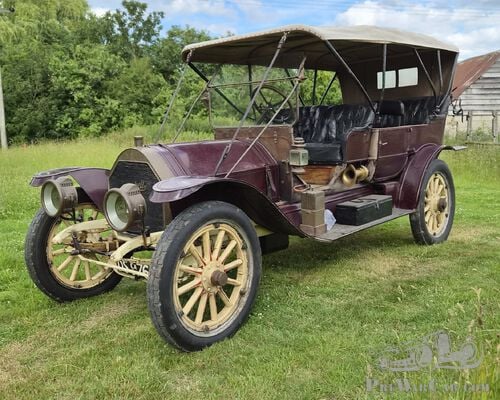
1910 Mitchell Model S - 50HP Six Cylinder
Based in Racine, Wisconsin and being the largest wagon manufacturer in the USA, Mitchell-Lewis produced their first motor car in 1903. Sales grew ..
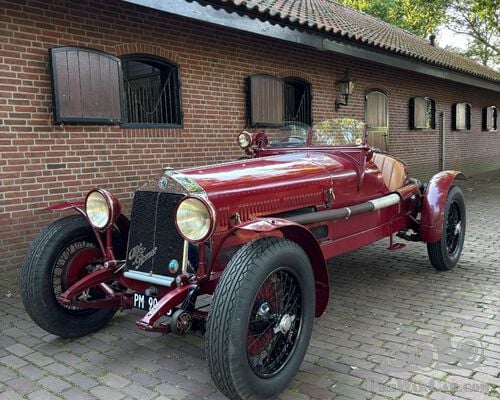
1930 Alfa Romeo 6C 1750 Spider
1930 Alfa Romeo 6C 1750 Spider with complete history from delivery to first owner in 1930 in Firenze till today with copy Libretto/license plate.
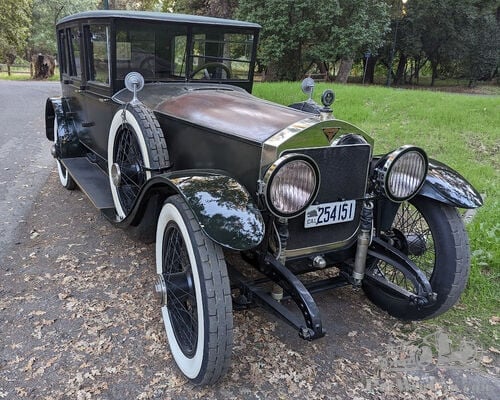
1916 Simplex, Crane model 5
1916 Simplex, Crane MODEL 5CUSTOM MADE HISTORIC PRESERVATION VEHICLE – READY TO TOUR!This Simplex recently completed th..