The global magazine and marketplace for classic car enthusiasts, by enthusiasts.


Filter
Classic Berliet, DeSoto for sale - Berliet, DeSoto cars for sale
-

Berliet de 1937 prête à rouler
Cette auto a été entièrement révisé pour rouler sans problème, elle n’a aucune corrosion, les ailes, le capot et le couvercle de coffre ont été sablés et repeint en époxy.l’interieur est d’origine en très bon état les jantes repeintes en époxyles 5 pneus sont neufsélectricité refaite la carte grise est normale ..

Berliet
France, 1895 – 1939
Automobiles M. Berliet, Lyons
Marius Berliet started modestly in 1895 in a small workshop, his first cars having rear-mounted horizontal engines (easily removable as complete units), 4-speed gearboxes, and left-hand drive with wheel-steering. Even in 1899 annual output was only six Berliet cars. 1.2-litre horizontal-twin engines were being used in 1900. The following year Berliet took over the firm of Audibert-Lavirotte, M. Lavirotte continuing as commercial director. 2- and 4-cylinderBerliet cars with front vertical aiv engines, side chain drive, and armoured wood frames were made, the 4-cylinder design being adopted by T.C. Pullinger as the basis for the 12hp Sunbeam made at Wolverhampton. 1902 brought the emergence of a new type of Berliet on Mercedes lines, with mechanically-operated inlet valves, honeycomb radiator, and pressed-steel frame, and this theme was pursued for several years. Quite big Berliet cars were produced, among them an 8.6-litre Berliet 60hp and Berliet 80hp of over 11 litres’ capacity, and some models had overhead inlet valves in place of the more usual T-head configuration. In 1906 Bablot’s Berliet took 2nd place in the Tourist Trophy, and the American Locomotive Company started to built Berliets under licence under the name of Alco – hence the locomotive emblem introduced in 1909, and still found on present-day Berliet trucks.
The smallest Berliet model listed in 1907 was a 2.4-litre Berliet 14, but new that year were a 4-cylinder shaft-driven taxicab chassis and a 60hp 6-cylinder on accepted lines. 1908 saw an odd Berliet-Mixte, also a six with compressed-air starting and transmission, and shaft drive was now optional on both the Berliet 14 and the 3.8-litre Berliet 22 for sale. The big Berliet 60 in 4-cylinder guise had overhead valves. The 4-cylinder Berliet T.T. cars had pressure lubrication, which was catalogued in 1909, along with three small L-head models, an 8hp twin and two small fours of 1½ litres’ and 2.4 litres’ capacity. 6-cylinder Berliets had conventional gearboxes once more, and in 1911 the 6.3-litre 2-cylinder Berliet model was catalogued with shaft drive at £795. Shaft drive, thermosiphon cooling, and 4-speed gearboxes were universal in 1911, when a new L-head 4.4-litre Berliet 20/25 made its appearance for sale, and in 1912 both this and the Berliet 15hp car could be had with either monobloc or pair-cast cylinders. The 6-cylinder Berliet cars were available only to special order, and by 1914 only monobloc fours were listed. The range consisted of the 1½-litre Berliet 12 for sale, the 2.4-litre Berliet 15 for sale, the 3.6-litre Berliet 18 for sale, the Berliet 25 for sale, and the big 6.3-litre Berliet 40 (types U and R) for sale. De luxe models of the two latter types came with electric lighting and starting as standard.
If the 1914 Berliet cars were conventional, their post-war equivalents were dull, and the new 3.3-litre Berliet Type VB for sale followed American lines, with sv 4-cylinder engine in unit 3-speed gearbox, fixed disc wheels, and detachable rims. It sold in England for £755, and was followed by a very similar 2.6-litre Berliet 12CV car. Front wheel brakes were available in 1923, and the sv cars were still being made in 1925, though 1924 produced two new Berliet models with ohv engines, front-wheel brakes, 4-speed gearboxes, and detachable wire wheels: the 1.2-litre Berliet 10/20, and the big 23/70hp 4-litre Berliet Type VIG. The company also experimented with cross-country, and with imbert gas-producer plants, a line of development which was pursued until 1938. A 2½-litre ohv car with central change appeared in 1925, and in 1927 there came a small six, the Berliet 14/40hp of 1.8 litres’ capacity; this had side valves, pump cooling, a 4-bearing crankshaft, coil ignition, single-plate clutch, 3-speed gearbox and wooden wheels; there were also a bigger 4.1-litre 6-cylinder and a straightforward sv 4-cylinder 1½-litre, rated at 12/25hp. The Berliet 14/40 grew up into a 2-litre in 1929, but no 6-cylinder cars were made after 1932; there was, however, a large sv 3.3-litre 4-cylinder Berliet.
In 1933 came the Berliet Type 944, a more advanced design with X-braced frame, 4-speed silent 3rd gearbox, and a choice of cylinder capacities (1.6 litre and 2 litres). De luxe version had transverse independent front suspension. A saloon cost 24.900fr, and both ohv and sv versions were available, though only the former type was listed by 1936. Last of the line was the 2-litre Berliet Dauphine with with independent front suspension, rack-and-pinion steering, and synchromesh; towards the end it used the same saloon body as Peugeot’s 402. Private Berliet car production was not resumed after World War 2, though Berliet acquired another Lyons firm, Rochet-Schneider, and in 1964 they announced the appointment of Alvis Ltd as United Kingdom concessionaires for their all-wheel-drive military vehicles. The Berliet company came under Citroën ownership in July, 1967.
Source: Georgano, encyclopedia of motorcar; MCS
The information is written with the greatest of care. However, if you have any suggested amendments please contact us at office@prewarcar.com
DeSoto
US, 1913 – 1916
DeSoto Motro Car Co, Auburn, Ind.
The DeSoto appears to have succeeded the Zimmerman. This was a large car with a 55hp, 6-cylinder engine, which was furnished with a compressed-air starter. The DeSoto model Six-55 five-seater touring car sold for $2185.
US, 1928 – 1960
Chrysler Motors Corp, Detroit, Mich.
The DeSoto was launched in 1928 as a 3.2-litre side valve six to compete with Oldsmobile, Pontiac and the cheaper Nashes. Styling and general design of the DeSoto were in line with the 1929 Chryslers, and at $885 for a DeSoto sedan 90.000 were sold in the first twelve months. A 3.4-litre straight-8 DeSoto on a 9ft 6in wheelbase was announced for 1930 as the world’s cheapest 8-cylinder car. However, DeSoto suffered badly in the Depression, and in 1932, when flexible rubber engine mountings and free wheels were made available, sales dropped to 26.000 DeSoto cars.
The DeSoto disappeared from the British market about this time, though certain ‘Chrysler’ models listed in England (the Mortlake, Croydon, and some of the Richmonds) were in fact DeSoto cars in all but name. A 6-cylinder version of Chrysler’s advanced unitary-construction Airflow, the SE-type with a 4-litre engine, was brought out in 1934, but was an unsuccessful as its bigger sister. Later DeSotos followed regular Chrysler lines closely though in later years there was a tendency for DeSoto to move into a higher price class than Dodge; by 1952 DeSotos started $300 higher than the companion make.
By 1939 the DeSoto cars for sale were being made with independent front suspension, hypoid back axles and column change. There was a choice at DeSoto of two 6-cylinder engines and three wheelbase lengths, the longest of these being reserved for seven-seater bodywork – DeSoto continued to offer a really roomy family car right up to 1954. A 4-speed semi-automatic Vacumatic transmission became an option in 1941, but DeSoto’s big post-war change of models did not take place until 1952, when the division followed Chrysler’s lead in adopting the oversquare ohv V8; the DeSoto version was of 4½-litre capcity and developed 16-bhp. With the advent of Chrysler’s ‘flight sweep’ styling in 1955, the side-valve sixes were dropped and the standard engine in a DeSoto was now a 4.8-litre eight, giving 185bhp in Firedome guise, and 200bhp in Fireflite form. Though this redesigning saved Chrysler sales generally, the slump in the medium-price class had an adverse effect on DeSoto and in 1959 the DeSoto division was merged with Plymouth. Last of the DeSotos were the 1961 models, unitary-construction cars with a choice of three engines: Plymouth’s 145bhp ohv ‘slant six’ as used in the Valiant, and V8s of 230 and 265bhp, the two former only in Canadian DeSotos. Production of DeSoto cars ceased in November 1960 after only a few had been delivered.
Source: Georgano, encyclopedia of motorcar; MCS
The information is written with the greatest of care. However, if you have any suggested amendments please contact us at office@prewarcar.com



Featured
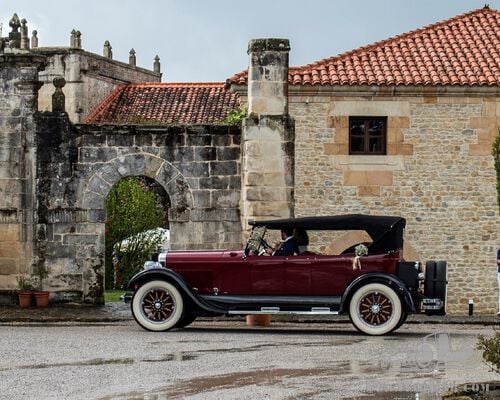
1925 Lincoln Model L Phaeton by Brunn - Excellent provenance
Retaining its original matching-numbers engine and chassis (both numbered 24576), the car benefits from an extensively documented history and..
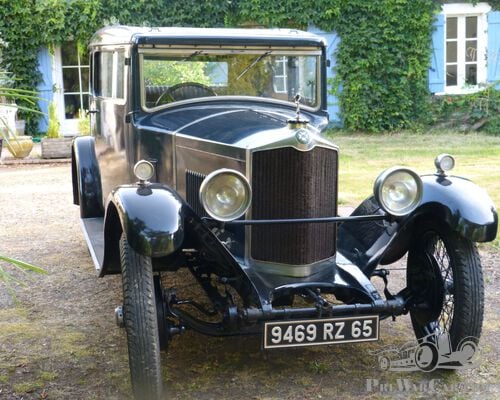
2-door 15.7hp six cylinder saloon
The car is a 6-cylinder 2-door saloon described as the "Sportsman's coach built coupé". Only three of this model are known to have survived. I have..
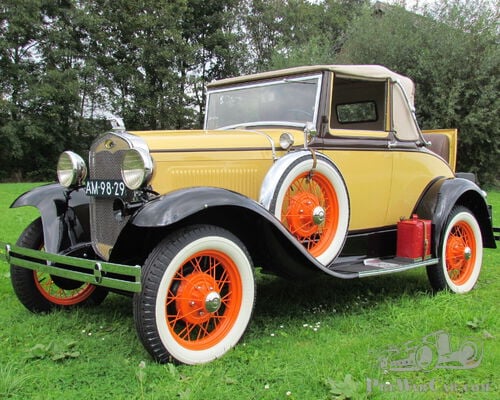
A Ford 68C Cabriolet
A fully restored Ford Model A, finished in its original factory colours and in very good condition. The car recently completed a 2,500-kilometre to..