The global magazine and marketplace for classic car enthusiasts, by enthusiasts.


Filter
Classic Brasier, DeSoto for sale - Brasier, DeSoto cars for sale
-

1914 Brasier Tourer 9A
Brasier were a French manufacturer who were in business from 1901 until 1930, when the company became victim of the great depression. This particular car began its life in France and is believed to have been used by the French army during the first world war. It was discovered on a farm in France in the 1970's before being brought to the ..

Brasier
France, 1897 – 1930
(1) Société des Anciens Etablissements Georged Richard, Ivry-Port, 1897 – 1905
(2) Société des Automobiles Brasier, Ivry-Port, 1905 – 1926
(3) Société Chaigneau-Brasier, Ivry-Port, 1926 – 1930
The first car made by Georges Richard (not yet named Brasier) was a frail machine on Benz lines, with belt drive and three forward speeds. By 1900, Richard was offering the Vivinus from Belgium under his own name – another voiturette, but a quieter, smoother-running one with a fair turn of speed. It was powered by a 6hp 2-cylinder engine, and it too was belt-driven. However, the 7½hp Georges Richard of 1901 had shaft drive, in the approved modern fashion of Darracq and Renault. With the arrival of the designer Brasier, who had worked for Mors, Georges Richard gradually ceased to be associated with voiturettes, but gained little originality. There were four new models in 1902, all called Richard-Brasiers, rated at between 10 and 40hp but they were of Panhard type in most respects. The smaller cars still had tubular chassis and not all Richard-Brasier models had chain drive, but all types had steel frames by 1904. In that year there were two twins and three fours, only the biggest of which, the 40hp, was chain-driven. In 1904 and 1905, Brasier’s cars won the Gordon Bennett Trophy for France, bringing worldwide fame to the name.
In 1905 Georges Richard left to make the Unic at Puteaux, and Brasier continued to offer his cars, now known simply as Brasiers. The Brasier remained conservative in design until 1912, with exposed valve gear and cylinders cast in pairs. In that year, a modern light Brasier car was introduced, with a 4-cylinder engine cast en bloc. Ivry-Port went on listing solid, unenterprising, relatively expensive Four-cylinder Brasiers for sale until 1927. They were brought up to date in 1923 by means of front wheel brakes and ohv engines, but this had become common practice, Brasier, in fact, was another famous old make whose popularity slowly declined, like so many in France at this time.
Reorganization at Brasier in 1926 at first brought no important innovations, apart from a change of name to Chaigneau-Brasier, and the introduction of a modern orthodox light car in the shape of the Chaigneau-Brasier 9CV. Then, in 1928, the new company revealed the outcome of its rethinking. This had been over- instead of under-enterprising, for the new car as a 3-litre, overhead-camshaft straight-8 with front wheel drive. With this car, and even more with the bigger Chaigneau-Brasier Type DG8 of similar design that followed in 1930, Chaigneau-Brasier committed the double error of plunging into the luxury market at a time of economic depression, and offering an unconventional design to a public that distrusted such things. Chaigneau-Brasier were not the only French firm to make the same simultaneaous, and fatal, mistakes, and they paid the same price.
Source: Georgano, encyclopedia of motorcar; TRN
The information is written with the greatest of care. However, if you have any suggested amendments please contact us at office@prewarcar.com
DeSoto
US, 1913 – 1916
DeSoto Motro Car Co, Auburn, Ind.
The DeSoto appears to have succeeded the Zimmerman. This was a large car with a 55hp, 6-cylinder engine, which was furnished with a compressed-air starter. The DeSoto model Six-55 five-seater touring car sold for $2185.
US, 1928 – 1960
Chrysler Motors Corp, Detroit, Mich.
The DeSoto was launched in 1928 as a 3.2-litre side valve six to compete with Oldsmobile, Pontiac and the cheaper Nashes. Styling and general design of the DeSoto were in line with the 1929 Chryslers, and at $885 for a DeSoto sedan 90.000 were sold in the first twelve months. A 3.4-litre straight-8 DeSoto on a 9ft 6in wheelbase was announced for 1930 as the world’s cheapest 8-cylinder car. However, DeSoto suffered badly in the Depression, and in 1932, when flexible rubber engine mountings and free wheels were made available, sales dropped to 26.000 DeSoto cars.
The DeSoto disappeared from the British market about this time, though certain ‘Chrysler’ models listed in England (the Mortlake, Croydon, and some of the Richmonds) were in fact DeSoto cars in all but name. A 6-cylinder version of Chrysler’s advanced unitary-construction Airflow, the SE-type with a 4-litre engine, was brought out in 1934, but was an unsuccessful as its bigger sister. Later DeSotos followed regular Chrysler lines closely though in later years there was a tendency for DeSoto to move into a higher price class than Dodge; by 1952 DeSotos started $300 higher than the companion make.
By 1939 the DeSoto cars for sale were being made with independent front suspension, hypoid back axles and column change. There was a choice at DeSoto of two 6-cylinder engines and three wheelbase lengths, the longest of these being reserved for seven-seater bodywork – DeSoto continued to offer a really roomy family car right up to 1954. A 4-speed semi-automatic Vacumatic transmission became an option in 1941, but DeSoto’s big post-war change of models did not take place until 1952, when the division followed Chrysler’s lead in adopting the oversquare ohv V8; the DeSoto version was of 4½-litre capcity and developed 16-bhp. With the advent of Chrysler’s ‘flight sweep’ styling in 1955, the side-valve sixes were dropped and the standard engine in a DeSoto was now a 4.8-litre eight, giving 185bhp in Firedome guise, and 200bhp in Fireflite form. Though this redesigning saved Chrysler sales generally, the slump in the medium-price class had an adverse effect on DeSoto and in 1959 the DeSoto division was merged with Plymouth. Last of the DeSotos were the 1961 models, unitary-construction cars with a choice of three engines: Plymouth’s 145bhp ohv ‘slant six’ as used in the Valiant, and V8s of 230 and 265bhp, the two former only in Canadian DeSotos. Production of DeSoto cars ceased in November 1960 after only a few had been delivered.
Source: Georgano, encyclopedia of motorcar; MCS
The information is written with the greatest of care. However, if you have any suggested amendments please contact us at office@prewarcar.com


Featured
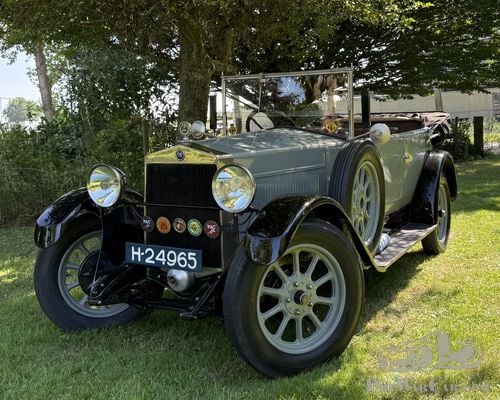
Fiat 509 Torpedo / Spider – Exceptionally Original and Complete
A Rare and Highly Original Example with Long-Term Dutch HistoryOffered for sale is an exceptionally original and remarkably complete Fiat 50..
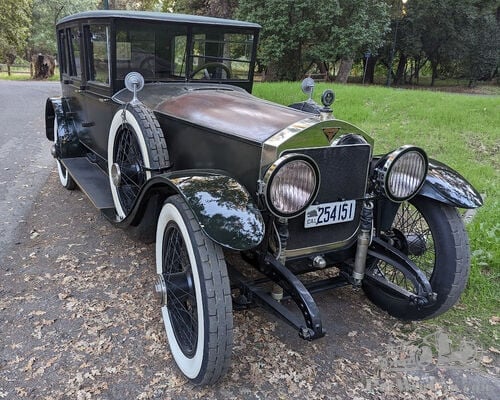
1916 Simplex, Crane model 5
1916 Simplex, Crane MODEL 5CUSTOM MADE HISTORIC PRESERVATION VEHICLE – READY TO TOUR!This Simplex recently completed th..
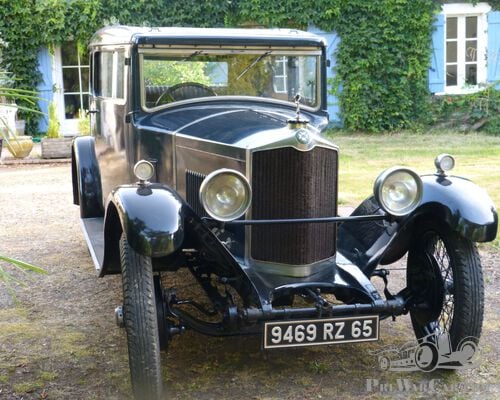
2-door 15.7hp six cylinder saloon
The car is a 6-cylinder 2-door saloon described as the "Sportsman's coach built coupé". Only three of this model are known to have survived. I have..