The global magazine and marketplace for classic car enthusiasts, by enthusiasts.


Filter
Classic Derby, DeSoto for sale - Derby, DeSoto cars for sale
-

1935 3 1/2 Litre Derby Bentley Park Ward sports saloon
1935 3 1/2 Litre Derby Bentley Park Ward sports saloon Registration number: Sweden CGK299 & UK BLU140Chassis Number B-153-CWPark Ward coach work. Vintage and Prestige are proud to be offering this 1935 3 1/2 Litre Derby Bentley Park Ward Sports Saloon for sale. Prior to us selling thi..

Derby
France, 1921 – 1936
B. Montet, Courbevoie, Seine; Saint-Denis, Seine
The Derby started life as a typical French voiturette of its period. The American-made V-twin motor-cycle engine that powered the Derby was soon replaced by a 4-cylinder, water-cooled Chapuis-Dornier unit of 900cc. Both Derby models had three forward speeds. The Chapuis-Dornier versions’ radiator was a copy of that of the successful 5CV Citroën. A variety of proprietary engines were fitted in the Derby in the ensuing years, including Chapuis-Dornier, Ruby, and S.C.A.P. Several sports versions were built, the most potent being the Derby Special. Its 1.100cc SCAP engine had three valves per cylinder, and was available with a Cozette supercharger. Though two touring 6-cylinder Derby cars with side-valve engines were introduced in 1928, the Derby make came to be associated primarily with sports cars. This was reinforced by the record-breaking activities of Miss Gwenda Stewart at Montlhéry track in her Derby-Miller, which started life in 1930 powered by a Miller racing engine, but came to include a majority of Derby-made components. The last Derby cars were the most interesting. The Derby L2 of 1931 had a small 6CV 4-cylinder engine that drove the front wheels, while the 11CV Derby L8 of 1933, also with front-wheel drive, used a 2-litre V8 engine. There was also a 1½-litre Derby car with the Meadows 4ED unit. The Derby was sold in England in the 1920s by Vernon Balls as the Vernon-Derby.
CDN, 1924 – 1927
Derby Motor Cars Ltd, Winnipeg, Man., and Saskatoon, Sask.
With headquarters in Winnipeg, and an assembly plant in Saskatoon, the Derby was a copy of the US Davis and even shared that car’s slogan, ‘Built of the Best’. With a 6-cylinder Continental engine the Derby sold for approximately $2000. It is unlikely that sales of these Derby cars reached 200 units.
Source: Georgano, encyclopedia of motorcar; TRN, GB
The information is written with the greatest of care. However, if you have any suggested amendments please contact us at office@prewarcar.com
DeSoto
US, 1913 – 1916
DeSoto Motro Car Co, Auburn, Ind.
The DeSoto appears to have succeeded the Zimmerman. This was a large car with a 55hp, 6-cylinder engine, which was furnished with a compressed-air starter. The DeSoto model Six-55 five-seater touring car sold for $2185.
US, 1928 – 1960
Chrysler Motors Corp, Detroit, Mich.
The DeSoto was launched in 1928 as a 3.2-litre side valve six to compete with Oldsmobile, Pontiac and the cheaper Nashes. Styling and general design of the DeSoto were in line with the 1929 Chryslers, and at $885 for a DeSoto sedan 90.000 were sold in the first twelve months. A 3.4-litre straight-8 DeSoto on a 9ft 6in wheelbase was announced for 1930 as the world’s cheapest 8-cylinder car. However, DeSoto suffered badly in the Depression, and in 1932, when flexible rubber engine mountings and free wheels were made available, sales dropped to 26.000 DeSoto cars.
The DeSoto disappeared from the British market about this time, though certain ‘Chrysler’ models listed in England (the Mortlake, Croydon, and some of the Richmonds) were in fact DeSoto cars in all but name. A 6-cylinder version of Chrysler’s advanced unitary-construction Airflow, the SE-type with a 4-litre engine, was brought out in 1934, but was an unsuccessful as its bigger sister. Later DeSotos followed regular Chrysler lines closely though in later years there was a tendency for DeSoto to move into a higher price class than Dodge; by 1952 DeSotos started $300 higher than the companion make.
By 1939 the DeSoto cars for sale were being made with independent front suspension, hypoid back axles and column change. There was a choice at DeSoto of two 6-cylinder engines and three wheelbase lengths, the longest of these being reserved for seven-seater bodywork – DeSoto continued to offer a really roomy family car right up to 1954. A 4-speed semi-automatic Vacumatic transmission became an option in 1941, but DeSoto’s big post-war change of models did not take place until 1952, when the division followed Chrysler’s lead in adopting the oversquare ohv V8; the DeSoto version was of 4½-litre capcity and developed 16-bhp. With the advent of Chrysler’s ‘flight sweep’ styling in 1955, the side-valve sixes were dropped and the standard engine in a DeSoto was now a 4.8-litre eight, giving 185bhp in Firedome guise, and 200bhp in Fireflite form. Though this redesigning saved Chrysler sales generally, the slump in the medium-price class had an adverse effect on DeSoto and in 1959 the DeSoto division was merged with Plymouth. Last of the DeSotos were the 1961 models, unitary-construction cars with a choice of three engines: Plymouth’s 145bhp ohv ‘slant six’ as used in the Valiant, and V8s of 230 and 265bhp, the two former only in Canadian DeSotos. Production of DeSoto cars ceased in November 1960 after only a few had been delivered.
Source: Georgano, encyclopedia of motorcar; MCS
The information is written with the greatest of care. However, if you have any suggested amendments please contact us at office@prewarcar.com


Featured
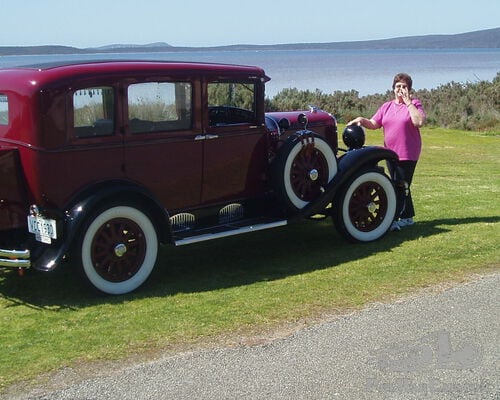
1930 Chrysler 66 Six-Wheel Equipped Royal Sedan
An exceptionally well restored and highly awarded Chrysler 66 Royal Sedan, with only two owners in nearly 97 years.The present owner ..
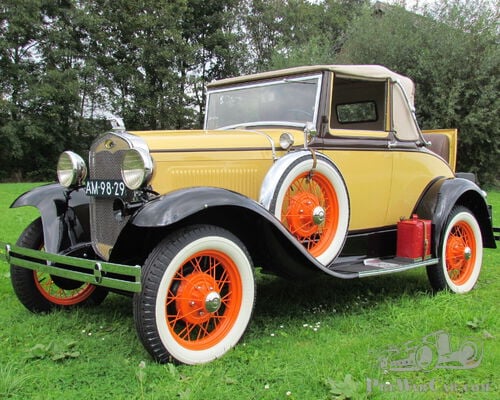
A Ford 68C Cabriolet
Een volledige gerestaureerde A Ford met originele fabriekskleuren en in zeer goede staat en heeft onlangs een toertocht van 2500km gereden in zuid ..
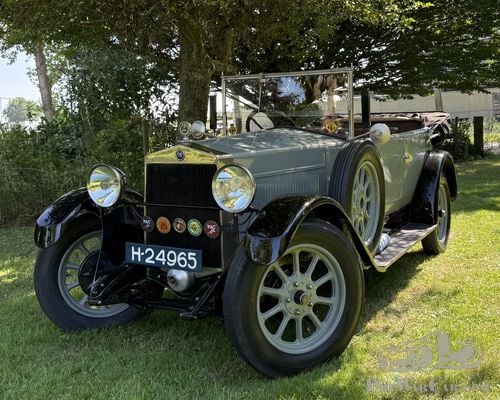
Fiat 509 Torpedo / Spider – Exceptionally Original and Complete
A Rare and Highly Original Example with Long-Term Dutch HistoryOffered for sale is an exceptionally original and remarkably complete Fiat 50..