The global magazine and marketplace for classic car enthusiasts, by enthusiasts.


Filter
Classic Gladiator, DeSoto for sale - Gladiator, DeSoto cars for sale
-

1904 Gladiator 14/20HP Limousine by Leon Molon
1904 Gladiator 14/20 HP Four-Cylinder Demi-LimousineCoachwork by Léon MolonRegistration no. NXI45Chassis no. 2471 Engine no. C569 • ‘Successfully participated in over 35 London-Brighton Runs’ A relatively short-lived French marque, Gladiator produced motor cars from around 1896 to 1920, lat..

Gladiator
France, 1896 – 1920
(1) Societé Gladiator, Pré-St. Gervais, 1896 – 1909
(2) Societé Gladiator, Puteaux, Seine, 1910 – 1920
The original Gladiator firm was founded by Aucoc and Darracq in 1891 to make cycles, but Gladiator was bought out in 1896 by a British group with which Harvey Du Cros was concerned. This new group proceeded to amalgamate with Clément, from which concern Adolphe Clément himself subsequently resigned in order to launch the Clément-Bayard business; to complicate matters, the Clément-Gladiator combine also made Clément cars which were of very similar design to their Gladiator cars. Gladiator’s first car was a simple little voiturette of 4hp with a single-cylinder horizontal engine mounted in a tubular frame, cycle-type wire wheels, and handlebar steering, but by 1899 the Gladiator car firm were making 2½hp and 3½hp Aster-engined Gladiator machines with transversely-mounted power units at the front, wheel steering, and pedal control for the 2-speed gear. Final drive was by chain, and the Gladiator make was introduced to England by S.F. Edge’s Motor Power Co, who marketed the Gladiator at £118,15s in 1900. Edge continued to sponsor the Gladiator until his preoccupation with Napier affairs caused him to discard both the Gladiator make and the Regent. A more conventional Gladiator 6½hp single, still Aster-powered, was available in 1901, in which year an 18hp 4-cylinder Gladiator racing voiturette contested the Paris-Berlin: almost the last serious competition attempt by Gladiator, though a single-cylinder chain-driven Gladiator voiturette ran in L’Auto’s first light-car race in 1905, and Gladiator cars also started in the early Tourist Trophies. Late in 1901 came a conventional Gladiator 12hp car with armoured wood frame, side-chain drive, and a vertical-twin aiv Aster engine, selling for £395. A wide range of Gladiator cars, from a 3½hp quad to 4-cylinder types, was available in 1902, and a Mercédès style of bonnet was found on the 2.2-litre twin in 1903, though it still housed a tubular cooler. The little Gladiator 6hp was rather expensive at £300 in England. 4-cylinder Gladiator models were available both in 2.1-litre and 2.7-litre forms, with engines said to be made by Gladiator themselves: the bigger 16hp had mechanically-operated side valves and only a single camshaft. Mechanically-operated valves were found on all Gladiator models save the 12hp twin in 1904, and it was hard to sort out the Cléments from the Gladiator cars, though the former were turning to bevel drive while Gladiator adhered to chains. A 4-litre Gladiator 28hp 4-cylinder with high tension magneto was listed in 1905, but smaller cars, including another four of 3-litres’ capacity, continued to use Aster units, and at the bottom of the Gladiator range was a very archaic 9hp 1.7-litre, still with automatic inlet valve, rear-mounted water tank, and sprag.
All the Gladiator models of a very complicated 1906 range now had mechanically-operated valves, the 12/14hp 4-cylinder Gladiator had shaft drive in conjunction with a 4-speed gearbox, and frames could be of either armoured wood or pressed steel, though the latter variant was found in the English Gladiator catalogue, but not the French one. The largest Gladiator four was of 4.8-litres, but during the year a chain-driven 5.5-litre 38bhp Gladiator six made its appearance. Magneto ignition was standard in 1907 on Gladiator car for sale, and for 1908 it was announced that certain Gladiator models were to be built in England by Austin. How many were actually made is problematic, but the 1908 and 1909 Gladiator catalogues showed three nominally British type, the Gladiator 18/24hp and 40hp 4-cylinder, and the 60hp 6-cylinder, which were uncommonly like their Austin counterparts. (Swift, in which Harvey du Cros had an interest as well, were making Cléments at the same time in Coventry). On top of these variants, Pré-St. Gervais offered 4-cylinder Gladiator cars of 2.2, 3.7, 4.8, 5.8 and 6.3-litres. The smallest of these, rated at 12/14hp, marked a reversion to the L-head configuration and had shaft drive, but all the other Gladiator cars were chain-driven T-headers on traditional lines like Gladiator had in the past. In 1909 Vinot et Deguingand acquired Gladiator, and production of Gladiator cars was transferred to Puteaux. All that in fact happened was that Gladiator now had another alter ego: the Gladiator cars looked like Vinots, shared the Vinot’s technical specification, and even their prices, though there were no 6-cylinder ‘Vinot’ Gladiators, chain drive was not offered after 1910 except on cars bearing the Vinot name, and it was announced in 1911 that Gladiator cars for sale were not to share the vertical gate change. However, as a result of the new association the 1912 Type-AL Gladiator (a designation shared with Vinot) came out with a monobloc engine and pressure lubrication. 1914 Gladiator models were, understandably, 4-cylinder machines with capacities of 1.7 litres, 2.2 litres, 2.7 litres and 4.1 litres, and both the 12hp and the long-stroke 15/20hp were once again offered in 1919-1920, the former costing £785 in England. After this, however, Vinot could no longer afford the luxury of a dual personality and Gladiator disappeared.
Source: Georgano, encyclopedia of motorcar; MCS
The information is written with the greatest of care. However, if you have any suggested amendments please contact us at office@prewarcar.com
DeSoto
US, 1913 – 1916
DeSoto Motro Car Co, Auburn, Ind.
The DeSoto appears to have succeeded the Zimmerman. This was a large car with a 55hp, 6-cylinder engine, which was furnished with a compressed-air starter. The DeSoto model Six-55 five-seater touring car sold for $2185.
US, 1928 – 1960
Chrysler Motors Corp, Detroit, Mich.
The DeSoto was launched in 1928 as a 3.2-litre side valve six to compete with Oldsmobile, Pontiac and the cheaper Nashes. Styling and general design of the DeSoto were in line with the 1929 Chryslers, and at $885 for a DeSoto sedan 90.000 were sold in the first twelve months. A 3.4-litre straight-8 DeSoto on a 9ft 6in wheelbase was announced for 1930 as the world’s cheapest 8-cylinder car. However, DeSoto suffered badly in the Depression, and in 1932, when flexible rubber engine mountings and free wheels were made available, sales dropped to 26.000 DeSoto cars.
The DeSoto disappeared from the British market about this time, though certain ‘Chrysler’ models listed in England (the Mortlake, Croydon, and some of the Richmonds) were in fact DeSoto cars in all but name. A 6-cylinder version of Chrysler’s advanced unitary-construction Airflow, the SE-type with a 4-litre engine, was brought out in 1934, but was an unsuccessful as its bigger sister. Later DeSotos followed regular Chrysler lines closely though in later years there was a tendency for DeSoto to move into a higher price class than Dodge; by 1952 DeSotos started $300 higher than the companion make.
By 1939 the DeSoto cars for sale were being made with independent front suspension, hypoid back axles and column change. There was a choice at DeSoto of two 6-cylinder engines and three wheelbase lengths, the longest of these being reserved for seven-seater bodywork – DeSoto continued to offer a really roomy family car right up to 1954. A 4-speed semi-automatic Vacumatic transmission became an option in 1941, but DeSoto’s big post-war change of models did not take place until 1952, when the division followed Chrysler’s lead in adopting the oversquare ohv V8; the DeSoto version was of 4½-litre capcity and developed 16-bhp. With the advent of Chrysler’s ‘flight sweep’ styling in 1955, the side-valve sixes were dropped and the standard engine in a DeSoto was now a 4.8-litre eight, giving 185bhp in Firedome guise, and 200bhp in Fireflite form. Though this redesigning saved Chrysler sales generally, the slump in the medium-price class had an adverse effect on DeSoto and in 1959 the DeSoto division was merged with Plymouth. Last of the DeSotos were the 1961 models, unitary-construction cars with a choice of three engines: Plymouth’s 145bhp ohv ‘slant six’ as used in the Valiant, and V8s of 230 and 265bhp, the two former only in Canadian DeSotos. Production of DeSoto cars ceased in November 1960 after only a few had been delivered.
Source: Georgano, encyclopedia of motorcar; MCS
The information is written with the greatest of care. However, if you have any suggested amendments please contact us at office@prewarcar.com



Featured
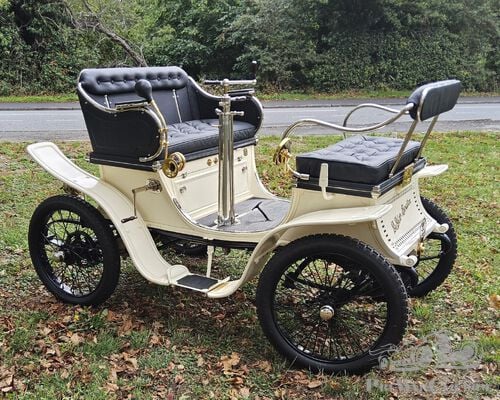
1902 De Dion Bouton Vis-a Vis 4.5 H.P. Reg No. Y123 V.C.C. Cert No. 1649
1902 De Dion Bouton Vis-à-vis 4.5 H.P.Reg. No. Y132 V.C.C. Cert No. 1649Beautifully presented and completely restored following an ex..
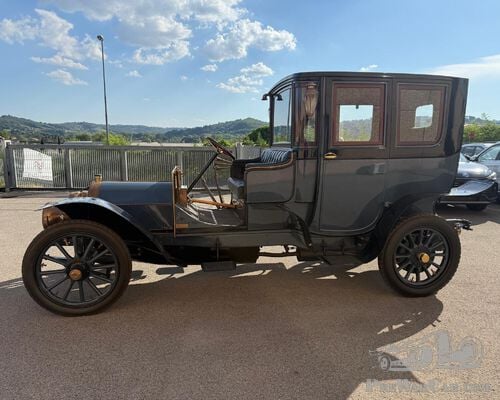
1906 FIAT BREVETTI COUPÉ DE VILLE Coachwork by Carrozzeria Italiana Cesare Sala, Milan
1906 FIAT BREVETTI COUPÉ DE VILLE Coachwork by Carrozzeria Italiana Cesare Sala, Milan Chassis No. 788 Coachwork No. 5699 Location: Siena, Tuscany..
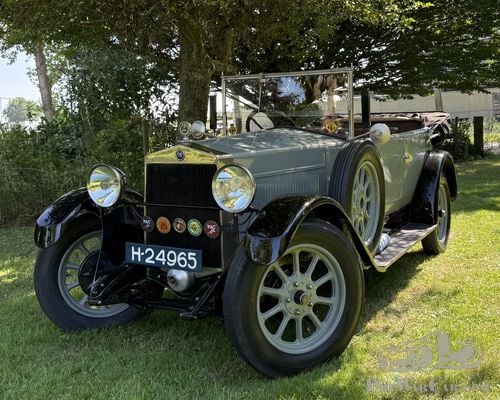
Fiat 509 Torpedo / Spider – Exceptionally Original and Complete
A Rare and Highly Original Example with Long-Term Dutch HistoryOffered for sale is an exceptionally original and remarkably complete Fiat 50..