The global magazine and marketplace for classic car enthusiasts, by enthusiasts.


Filter
Classic Hansa, DeSoto for sale - Hansa, DeSoto cars for sale
-

Two Hansa cars from 1937, offered together as a restoration project pair
OverviewTwo 1937 Hansa (Borgward) cars, stored indoors for decades, offered together. Both are largely complete: bodies (roof, doors, fenders, windscreen frame), chassis with front axle and radiator, wheels, interior (seats, steering wheel), plus engine and gearbox present on both cars. Condition is consistent with long-term dry storage —..

Hansa
D, 1906 – 1939
(1) Hansa Automobil – Gesellschaft mbH, Varel, 1906 – 1914, Bielefeld, 1913 – 1914
(2) Hansa-Lloyd-Werke AG, Varel, 1914 – 1929, Bremen, 1929 – 1931
(3) Hansa-Lloyd und Goliath-Werke Borgward & Tecklenborg, Bremen, 1931 – 1937
(4) Hansa Lloyd-Goliath-Werke Carl F.W. Borgward, Bremen, 1937 – 1939
The Hansa works were founded with the intention of producing small cars. The first was a Hansa 7/9ps car with a single-cylinder 720cc De Dion engine based on the French Alcyon. The Hansa appeared in 1906, and was sold under the name HAG. After a few more models with proprietary engines such as Fafnir the Hansa 6/14ps appeared in 1907 with a 4-cylinder engine of the Hansa company’s own design. A wide range of models was offered during the following years. Among them were the Hansa Types D (10/30PS, 2.612cc) and Hansa E (15/50PS, 3.815cc) of 1911 with overhead valves, a feature which was rare at that time. Hansa cars were produced in considerable numbers and Hansa cars were renowned for their high technical standard and their good workmanship.
In 1913 Hansa took over the Westfalia works at Bielefeld and Hansa cars were built there in 1913 and 1914. The Hansa Type F (2.515cc) took part successfully in the 1914 Austrian Alpine Trial. In 1914 Hansa merged with Lloyd, the firm adopting the name Hansa-Lloyd. The production of Hansa cars was carried on until World War 1. After the war Hansa concentrated on light and medium-sized cars which were marketed as Hansa. The Lloyd factory specialized in the heavier cars and commercials, which were sold as Hansa-Lloyds. Post-war models were the Hansa P 8/36PS with a 4-cylinder 2.063cc engine, also available in a short-wheelbase sports version, and two cars, a 13/60PS (6-cylinder, 3.262cc) and a 16/70PS (8-cylinder, 3.996cc) which were equipped with American Continental engines.
In 1929 Hansa was taken over by Borgward-Goliath. Production in the Varel works ceased and Hansa private cars were subsequently built only in Bremen. The Hansa Konsul, Hansa Senator, Hansa Matador and Hansa Imperator were family and prestige cars with 4-, 6-, and 8-cylinder engines with capacities up to 5.8-litres and outputs to 100bhp. The 3.2-litre Hansa Senator was an unusually large four for the period, and the Hansa Matador had a 2.6-litre Continental engine, and the combination of independent rear suspension and a backbone frame. In 1933 the small Hansa 400 was introduced. It had a 2-cylinder 2-stroke rear engine of 400cc and was later available with a 500cc engine. A new model, the Hansa 1100, with all independent suspension appeared in 1934. It was in production until 1939 and became very popular. Other models were the 6-cylinder ‘Hansa 1700’ (also available in a twin-carburettor sports version), the ‘Hansa 2000’ and the ‘Hansa 3500’ Privat.
After 1938 Hansa cars were marketed as Borgwards. In 1958 the Hansa name was revived for the flat-four Goliath; it had previously been used as a type name for some Borgwards.
Source: Georgano, encyclopedia of motorcar; HON
The information is written with the greatest of care. However, if you have any suggested amendments please contact us at office@prewarcar.com
DeSoto
US, 1913 – 1916
DeSoto Motro Car Co, Auburn, Ind.
The DeSoto appears to have succeeded the Zimmerman. This was a large car with a 55hp, 6-cylinder engine, which was furnished with a compressed-air starter. The DeSoto model Six-55 five-seater touring car sold for $2185.
US, 1928 – 1960
Chrysler Motors Corp, Detroit, Mich.
The DeSoto was launched in 1928 as a 3.2-litre side valve six to compete with Oldsmobile, Pontiac and the cheaper Nashes. Styling and general design of the DeSoto were in line with the 1929 Chryslers, and at $885 for a DeSoto sedan 90.000 were sold in the first twelve months. A 3.4-litre straight-8 DeSoto on a 9ft 6in wheelbase was announced for 1930 as the world’s cheapest 8-cylinder car. However, DeSoto suffered badly in the Depression, and in 1932, when flexible rubber engine mountings and free wheels were made available, sales dropped to 26.000 DeSoto cars.
The DeSoto disappeared from the British market about this time, though certain ‘Chrysler’ models listed in England (the Mortlake, Croydon, and some of the Richmonds) were in fact DeSoto cars in all but name. A 6-cylinder version of Chrysler’s advanced unitary-construction Airflow, the SE-type with a 4-litre engine, was brought out in 1934, but was an unsuccessful as its bigger sister. Later DeSotos followed regular Chrysler lines closely though in later years there was a tendency for DeSoto to move into a higher price class than Dodge; by 1952 DeSotos started $300 higher than the companion make.
By 1939 the DeSoto cars for sale were being made with independent front suspension, hypoid back axles and column change. There was a choice at DeSoto of two 6-cylinder engines and three wheelbase lengths, the longest of these being reserved for seven-seater bodywork – DeSoto continued to offer a really roomy family car right up to 1954. A 4-speed semi-automatic Vacumatic transmission became an option in 1941, but DeSoto’s big post-war change of models did not take place until 1952, when the division followed Chrysler’s lead in adopting the oversquare ohv V8; the DeSoto version was of 4½-litre capcity and developed 16-bhp. With the advent of Chrysler’s ‘flight sweep’ styling in 1955, the side-valve sixes were dropped and the standard engine in a DeSoto was now a 4.8-litre eight, giving 185bhp in Firedome guise, and 200bhp in Fireflite form. Though this redesigning saved Chrysler sales generally, the slump in the medium-price class had an adverse effect on DeSoto and in 1959 the DeSoto division was merged with Plymouth. Last of the DeSotos were the 1961 models, unitary-construction cars with a choice of three engines: Plymouth’s 145bhp ohv ‘slant six’ as used in the Valiant, and V8s of 230 and 265bhp, the two former only in Canadian DeSotos. Production of DeSoto cars ceased in November 1960 after only a few had been delivered.
Source: Georgano, encyclopedia of motorcar; MCS
The information is written with the greatest of care. However, if you have any suggested amendments please contact us at office@prewarcar.com


Featured
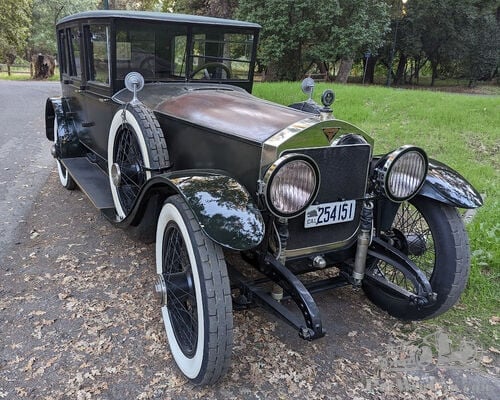
1916 Simplex, Crane model 5
1916 Simplex, Crane MODEL 5CUSTOM MADE HISTORIC PRESERVATION VEHICLE – READY TO TOUR!This Simplex recently completed th..
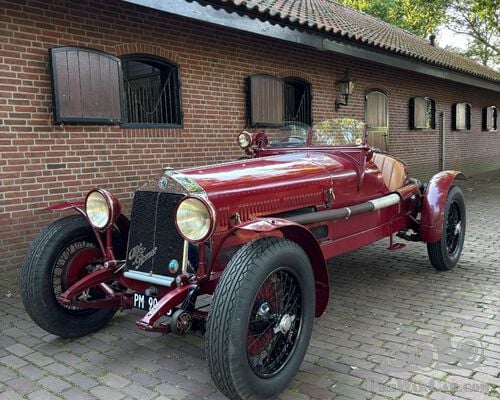
1931 Alfa Romeo 6C 1750 Spider
1931 Alfa Romeo 6C 1750 Spider with complete history from delivery to first owner in Firenze till today with copy Libretto/license plate.Del..
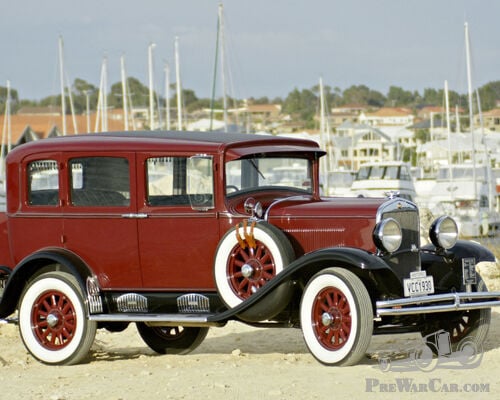
1930 Chrysler 66 Six-Wheel Equipped Royal Sedan
An exceptionally well restored and highly awarded Chrysler 66 Royal Sedan, with only two owners in nearly 97 years.The present owner ..