The global magazine and marketplace for classic car enthusiasts, by enthusiasts.


Filter
Classic Lanchester, DeSoto for sale - Lanchester, DeSoto cars for sale
-

1925 Lanchester 40hp with spectacular Skiff bodywork.
This unique Lanchester 6.2 litre, 6-cylinder car has teak & ash Skiff touring bodywork. Derived from George Lanchester's design which "follows in the beautiful lines of a racing boat", it is indeed eye-catching and built to the highest standards. Its two hoods fold away into the bodywork so as not to impede the eye-lines of the sloping tail...

Lanchester
GB, 1895 – 1956
(1) Lanchester Engine Co Ltd, Birmingham, 1895 – 1904
(2) Lanchester Motor Co, Birmingham, 1904 – 1931; Coventry, 1931 – 1956
The first Lanchester car was remarkable in that, like the first Benz, the Lanchester car was designed from the ground up as a motor car, not as an adaptation of the horse carriage, and in that the Lanchester car was a homogenous mechanical entity, owing nothing to the practice of the stationary engine and its power transmission. In the latter respect, the Lanchester car was unique: the power unit and belt transmission of the Benz were derived from stationary practice. Frederick Lanchester’s prototype was built in 1895 and improved upon two years later. Production Lanchester car models followed in 1900. The engine of these Lanchester cars, centrally mounted, was horizontally-opposed, air-cooled, 10hp twin; each piston and cylinder had its own crankshaft and flywheel assembly, which rotated in opposite directions. Smoothness unparalleled in other contemporary Lanchester cars resulted. By the standards of the day the engine was quiet. Epicyclic gears provided three forward speeds, with preselector control of the first and second. Engine and gearbox of the Lanchester cars had automatic lubrication. There was worm final drive. In accordance with the best modern practice, the suspension, by cantilever springs at front and rear, was soft while the unit construction of the chassis and body provided great stiffness. The steering of the Lanchester car was by a side lever which, like the wick carburetor, was apparently old-fashioned but was in practice extremely efficient. Water-cooled engines were offered as an option on Lanchester cars from 1902, and bigger, faster Lanchester cars were made in 1904. However, in that year the first model with a vertical 4-cylinder engine was introduced, the Lanchester 20hp, and the twins tailed off. The engine on this Lanchester car was moved forward to a position between the front-seat passengers, and it was given horizontal ohv’s and pressure lubrication. A 28hp six Lanchester car arrived in 1906. This and the 20hp four were replaced respectively by the Lanchester 38hp for 1911 and the Lanchester 25hp for 1912. On the original Lanchester cars, gearchanging and braking were effected by two levers, the only pedal being for the accelerator. By now, however, convention had demanded the substitution not only of a steering wheel, but also of the usual three pedals and gear lever, except that, of course, the epicyclic gears Lanchester cars, still enabled changed to be made without trouble or fuss. By 1912, Frederick’s brother George was in charge. Although Frederick’s design of the Lanchester car had gained a large and devoted following for the Lanchester car make, the public trend was increasingly towards convention, and George Lanchester’s cars were to follow it.
George Lanchester was responsible for the Lanchester Sporting Forty of 1914. Although only a handful were made, this Lanchester car was a landmark because it was the first Lanchester car to have its engine in the conventional position, covered by a bonnet (it was also the only Lanchester car to be called sports car, and to have an sv engine.) From it was developed the Lanchester Forty, which was at first the sole Lanchester car offered. Its six-cylinder, 6.2-litre engine was made in unit with its 3-speed epicyclis gearbox, and had an ohc. The springs, half-elliptic at the front and cantilever at the rear, were underslung on the Lanchester car. Worm final drive was retained. This Lanchester car was a very fast, very expensive car in the Rolls-Royce class, and its makers feld bound to wide their net of Lanchester cars. Late in 1923 there appeared the Lanchester Twenty-One, which was a scaled-down, simplified, modernized Lanchester Forty. The 6-cylinder engine of the Lanchester car was of 3.1-litres, it had a 4-speed sliding-pinion gearbox, and front wheel brakes were standard. In 1926 the bore was enlarged, to provide 3.3-litres. In this form the Lanchester car was sometimes known as the Lanchester Twenty-three. Alongside this Lanchester car, the Forty (with front wheel brakes from 1925) continued until 1929. It was replaced in that year by the Lanchester Thirty, which was an up-to-date Lanchester car design with a straight-8 engine of 4½-litres, still with ohc, and a normal 4-speed gearbox. Like the Forty, this Lanchester car was a massive and magnificent car ideal for high-speed cruising. The Twenty-Three was dropped in 1931, when the BSA group of companies, in which Daimler already provided a line of luxury cars, took over Lanchester cars, although the Thirty was still catalogued in 1932 as a Lanchester car. From now on, the name of Lanchester was applied to a line of much cheaper, smaller cars, beginning with the Lanchester 15/18hp. This Lanchester car had a 2½-litre, push-rod ohv, 6-cylinder engine designed by George Lanchester, hydraulic brakes, and the Daimler fluid flywheel. It was a good car in its class, but like most Lanchester cars to come, lost its character as the Lanchester Eighteen, with fixed cylinder head and mechanical brakes, and became a cut-price Daimler. The group complicated matters further by introducing a 4-cylinder 10hp Lanchester ar as a more expensive version of the contemporary sv BSA’s. This Lanchester car had a 1.2-litre and then a 1.4-litre ohv engine. Probably the best of the Lanchester cars at this period was the Lanchester Roadrider de Luxe 14hp of 1938, a small six with a detachable cylinder head and independent front suspension. A few straight-8 Lanchester cars were made from 1936 to 1939, but these were in fact 4½-litre Daimlers with Lanchester radiators. Four Lanchester cars were supplied to King George VI.
The first post-war Lanchester car was a 4-cylinder ten of 1.3-litres on pre-1939 lines, but with independent front suspension, like all Lanchester cars to come. It was replaced for 1952 by a new Lanchester Fourteen, with 2-litre, 4-cylinder engine and fluid flywheel. This Lanchester car was basically a Daimler Conquest with two fewer cylinders and was the last Lanchester car to qualify as a serious production car. In 1953 – 1954, a handful of Lanchester Dauphines were made. This was a true luxury car, consisting of a 6-cylinder Daimler engine in a Fourteen Lanchester car chassis, surmounted by a luxurious coachbuilt body by Hooper; price was an unrealistic £4.010. Finally, late in 1954, Lanchester produced a completely new and original design, which was also their last – the Lanchester Sprite. The engine was an ohv, 4-cylinder unit of 1.6-litres; there was independent front suspension on the Lanchester car, the brakes were hydraulic, but the Sprite incorporated unitary construction of body and chassis, and fully automatic Hobbs transmission instead of the fluid flywheel. The Sprite Lanchester car was never put into production, and the once-great and always respected name of Lanchester car died.
Source: Georgano, encyclopedia of motorcar; TRN
The information is written with the greatest of care. However, if you have any suggested amendments please contact us at office@prewarcar.com
DeSoto
US, 1913 – 1916
DeSoto Motro Car Co, Auburn, Ind.
The DeSoto appears to have succeeded the Zimmerman. This was a large car with a 55hp, 6-cylinder engine, which was furnished with a compressed-air starter. The DeSoto model Six-55 five-seater touring car sold for $2185.
US, 1928 – 1960
Chrysler Motors Corp, Detroit, Mich.
The DeSoto was launched in 1928 as a 3.2-litre side valve six to compete with Oldsmobile, Pontiac and the cheaper Nashes. Styling and general design of the DeSoto were in line with the 1929 Chryslers, and at $885 for a DeSoto sedan 90.000 were sold in the first twelve months. A 3.4-litre straight-8 DeSoto on a 9ft 6in wheelbase was announced for 1930 as the world’s cheapest 8-cylinder car. However, DeSoto suffered badly in the Depression, and in 1932, when flexible rubber engine mountings and free wheels were made available, sales dropped to 26.000 DeSoto cars.
The DeSoto disappeared from the British market about this time, though certain ‘Chrysler’ models listed in England (the Mortlake, Croydon, and some of the Richmonds) were in fact DeSoto cars in all but name. A 6-cylinder version of Chrysler’s advanced unitary-construction Airflow, the SE-type with a 4-litre engine, was brought out in 1934, but was an unsuccessful as its bigger sister. Later DeSotos followed regular Chrysler lines closely though in later years there was a tendency for DeSoto to move into a higher price class than Dodge; by 1952 DeSotos started $300 higher than the companion make.
By 1939 the DeSoto cars for sale were being made with independent front suspension, hypoid back axles and column change. There was a choice at DeSoto of two 6-cylinder engines and three wheelbase lengths, the longest of these being reserved for seven-seater bodywork – DeSoto continued to offer a really roomy family car right up to 1954. A 4-speed semi-automatic Vacumatic transmission became an option in 1941, but DeSoto’s big post-war change of models did not take place until 1952, when the division followed Chrysler’s lead in adopting the oversquare ohv V8; the DeSoto version was of 4½-litre capcity and developed 16-bhp. With the advent of Chrysler’s ‘flight sweep’ styling in 1955, the side-valve sixes were dropped and the standard engine in a DeSoto was now a 4.8-litre eight, giving 185bhp in Firedome guise, and 200bhp in Fireflite form. Though this redesigning saved Chrysler sales generally, the slump in the medium-price class had an adverse effect on DeSoto and in 1959 the DeSoto division was merged with Plymouth. Last of the DeSotos were the 1961 models, unitary-construction cars with a choice of three engines: Plymouth’s 145bhp ohv ‘slant six’ as used in the Valiant, and V8s of 230 and 265bhp, the two former only in Canadian DeSotos. Production of DeSoto cars ceased in November 1960 after only a few had been delivered.
Source: Georgano, encyclopedia of motorcar; MCS
The information is written with the greatest of care. However, if you have any suggested amendments please contact us at office@prewarcar.com


Featured
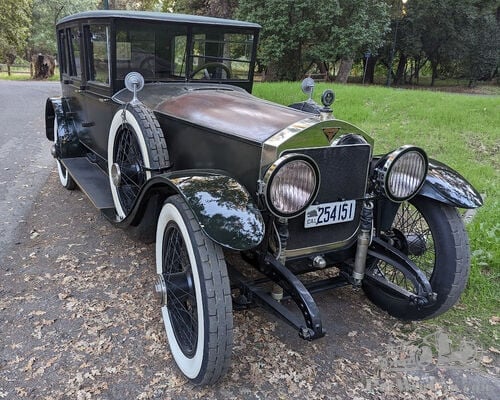
1916 Simplex, Crane model 5
1916 Simplex, Crane MODEL 5CUSTOM MADE HISTORIC PRESERVATION VEHICLE – READY TO TOUR!This Simplex recently completed th..
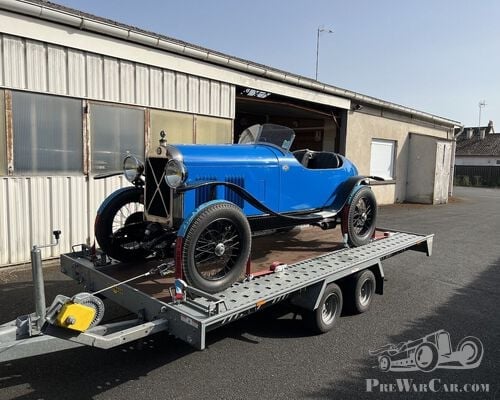
Salmson VAL 3 Séries 7
1927 Salmson VAL3 Series 7. Completely restored a few years ago, in very good overall condition, both bodywork and mechanics. Bordino-style bodywor..
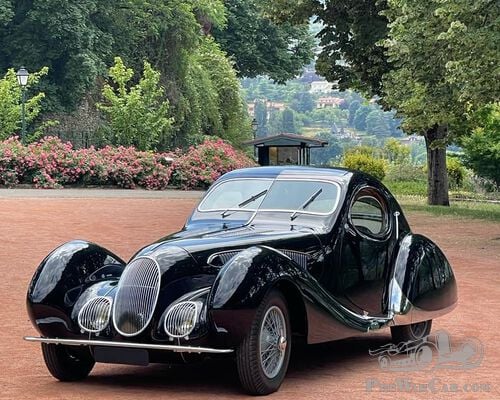
1939 Talbot-Lago T150C “Goutte d’Eau” — Iconic French Coachbuilt Masterpiece
Talbot-Lago T150C ‘Teardrop’ — An Icon of French Automotive Art There are motor cars that define an era. And then there are those tha..