The global magazine and marketplace for classic car enthusiasts, by enthusiasts.


Filter
Classic Maybach, DeSoto for sale - Maybach, DeSoto cars for sale
-

1934 Maybach Zeppelin DS8 Stromlinien Cabriolet - one-off body
Maybach was a technological leader in European vehicle manufacturing12-cylinder engine with 8-litre displacement and 200 hpUnique 8-speed shift regulator transmissionOnly 24 Maybach Zeppelin cars, including 2 chassis, still exist todayOne-of-a-kind bodyworkOriginal leather interior in excellent c.. -
1938 Maybach SW 38 Gläser Cabriolet
German first deliveryRare bodywork by Gläser, DresdenIn the same ownership for 15 yearsDocumented history in the Maybach Register The SW38 is widely regarded as one of the most elegant and technically impressive six-cylinder cars produced in Germany in the late 1930s. With its powerful engine,..


Maybach
D, 1921 – 1941
Maybach Motoren-Werke GmbH, Friedrichshafen
Wilhelm Maybach left the Daimler company in 1907. Together with Count Zeppelin he founded a factory primarily for the production of aero engines, especially for the Zeppeling air-ships. These engines were designed by Karl Maybach, Wilhelm’s son. After World War 1, Karl Maybach started to build a 22/70ps 5.7-litre 6-cylinder engine intended for motor cars. This Maybach engine was used by Spyker, but no other factories were interested, so Maybach decided to take up Maybach car production on his own. From the beginning Maybach cars aimed at a high quality car with outstanding driving comfort. The first Maybach Model W3 appeared at the 1921 Berlin Motor Show, and this Maybach car featured a very advanced 2-speed pedal-controlled transmission. This Maybach carmodel was produced until 1926. It was followed by the ohv Maybach Model W5 (for sale in 1926 – 1930) using a 27/120ps 7-litre engine in the same chassis, this being available with Maybach’s Schnellgang 2-speed auxiliary box, giving the Maybach car 4 forward speeds. The Maybach 12 of 1929 had a V12 7-litre engine, which was superseded one year later by the Maybach Zeppelin, also with V12 7-litre engine of 150bhp; after 1931 the Maybach car was also available with an 8-litre 200bhp engine. The Zeppelin range was listed until 1939. Maybach Zeppelin car chassis were also fitted with 6-cylinder engines of 7-litres capacity (already used in Maybach Model W5) and a new 5.2-litre engine developing 130bhp (the Maybach W6 and DSH models respectively). These Maybach cars retained beam axles to the end and were characterized by 7-speed boxes of great complexity. A Zeppelin chassis for the Maybach car cost the equivalent of £1.300 in Germany.
In 1935 a new 6-cylinder Maybach car was presented, starting the SW range. This was the Maybach SW35 with a 3.5-litre 140bhp engine. Engine capacity of this Maybach car was raised to 3.8-litres in the Maybach SW38 in 1936 and to 4.2-litres in the SW42 of 1940. Production of the Maybach car ceased in 1941. The Maybach Zeppelin shared with the Mercedes 770 the claim to be the most exclusive German car of the 1930s. This reputation was enhanced by Maybach cars high standards of material and finish, of comfort and quietness in running. No less well-made were the 6-cylinder Maybach cars which were in the first rank of German cars of this class. Maybach only built complete chassis for their Maybach cars, bodies being made by various firms to customers’ special requirements. Best known of these firms was Spohn of Ravensburg. Spohn aslo built aerodynamic bodies to Jaray designs for the Maybach Zeppelin in 1932 and 1934, and for the Maybach SW35 in 1935. These versions Maybach cars were produced only in very limited numbers. Maybach car production was not taken up again after World War 2. Altogether, some 2.000 Maybach cars are believed to have been made. In 1960 Maybach cars pooled their interests with Daimler-Benz in the manufacture of diesel engines for locomotives and ships.
Source: Georgano, encyclopedia of motorcar; HON
The information is written with the greatest of care. However, if you have any suggested amendments please contact us at office@prewarcar.com
DeSoto
US, 1913 – 1916
DeSoto Motro Car Co, Auburn, Ind.
The DeSoto appears to have succeeded the Zimmerman. This was a large car with a 55hp, 6-cylinder engine, which was furnished with a compressed-air starter. The DeSoto model Six-55 five-seater touring car sold for $2185.
US, 1928 – 1960
Chrysler Motors Corp, Detroit, Mich.
The DeSoto was launched in 1928 as a 3.2-litre side valve six to compete with Oldsmobile, Pontiac and the cheaper Nashes. Styling and general design of the DeSoto were in line with the 1929 Chryslers, and at $885 for a DeSoto sedan 90.000 were sold in the first twelve months. A 3.4-litre straight-8 DeSoto on a 9ft 6in wheelbase was announced for 1930 as the world’s cheapest 8-cylinder car. However, DeSoto suffered badly in the Depression, and in 1932, when flexible rubber engine mountings and free wheels were made available, sales dropped to 26.000 DeSoto cars.
The DeSoto disappeared from the British market about this time, though certain ‘Chrysler’ models listed in England (the Mortlake, Croydon, and some of the Richmonds) were in fact DeSoto cars in all but name. A 6-cylinder version of Chrysler’s advanced unitary-construction Airflow, the SE-type with a 4-litre engine, was brought out in 1934, but was an unsuccessful as its bigger sister. Later DeSotos followed regular Chrysler lines closely though in later years there was a tendency for DeSoto to move into a higher price class than Dodge; by 1952 DeSotos started $300 higher than the companion make.
By 1939 the DeSoto cars for sale were being made with independent front suspension, hypoid back axles and column change. There was a choice at DeSoto of two 6-cylinder engines and three wheelbase lengths, the longest of these being reserved for seven-seater bodywork – DeSoto continued to offer a really roomy family car right up to 1954. A 4-speed semi-automatic Vacumatic transmission became an option in 1941, but DeSoto’s big post-war change of models did not take place until 1952, when the division followed Chrysler’s lead in adopting the oversquare ohv V8; the DeSoto version was of 4½-litre capcity and developed 16-bhp. With the advent of Chrysler’s ‘flight sweep’ styling in 1955, the side-valve sixes were dropped and the standard engine in a DeSoto was now a 4.8-litre eight, giving 185bhp in Firedome guise, and 200bhp in Fireflite form. Though this redesigning saved Chrysler sales generally, the slump in the medium-price class had an adverse effect on DeSoto and in 1959 the DeSoto division was merged with Plymouth. Last of the DeSotos were the 1961 models, unitary-construction cars with a choice of three engines: Plymouth’s 145bhp ohv ‘slant six’ as used in the Valiant, and V8s of 230 and 265bhp, the two former only in Canadian DeSotos. Production of DeSoto cars ceased in November 1960 after only a few had been delivered.
Source: Georgano, encyclopedia of motorcar; MCS
The information is written with the greatest of care. However, if you have any suggested amendments please contact us at office@prewarcar.com


Featured
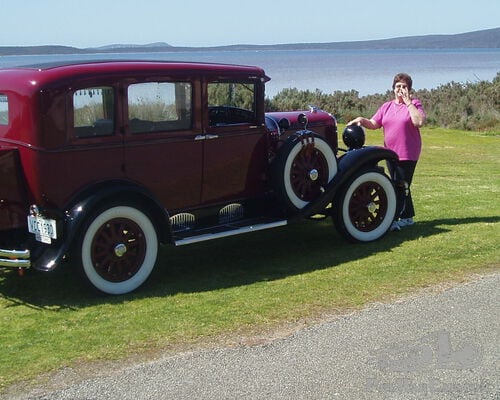
1930 Chrysler 66 Six-Wheel Equipped Royal Sedan
An exceptionally well restored and highly awarded Chrysler 66 Royal Sedan, with only two owners in nearly 97 years.The present owner ..
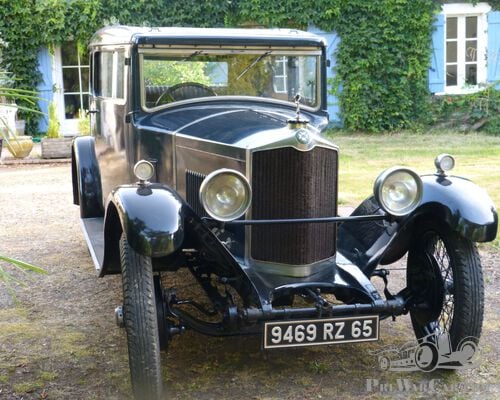
2-door 15.7hp six cylinder saloon
The car is a 6-cylinder 2-door saloon described as the "Sportsman's coach built coupé". Only three of this model are known to have survived. I have..
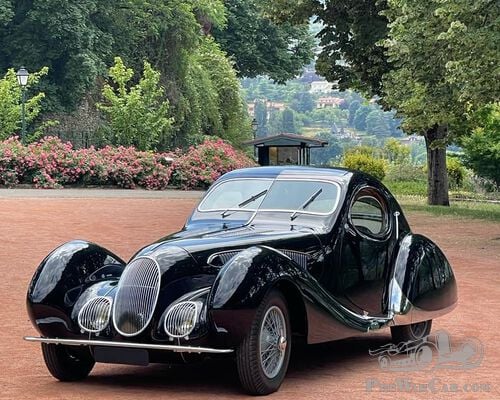
1939 Talbot-Lago T150C “Goutte d’Eau” — Iconic French Coachbuilt Masterpiece
Talbot-Lago T150C ‘Teardrop’ — An Icon of French Automotive Art There are motor cars that define an era. And then there are those tha..