The global magazine and marketplace for classic car enthusiasts, by enthusiasts.


Filter
Classic DeSoto, M.M.C. for sale - DeSoto, M.M.C. cars for sale
-

c. 1904 MMC 8 HP Rear-Entrance Tonneau | RM Sotheby's | The London Auction
To Be OFFERED AT AUCTION WITHOUT RESERVE at RM Sothebys' The London Auction event, 31 October 2026. Offered Without Reserve | £50,000 - £70,000 GBP Interesting known ownership historyBuilt by an obscure-but-interesting early British automakerIn prior family ownership for a remarkable 60 yearsFeatured in the 196..

DeSoto
US, 1913 – 1916
DeSoto Motro Car Co, Auburn, Ind.
The DeSoto appears to have succeeded the Zimmerman. This was a large car with a 55hp, 6-cylinder engine, which was furnished with a compressed-air starter. The DeSoto model Six-55 five-seater touring car sold for $2185.
US, 1928 – 1960
Chrysler Motors Corp, Detroit, Mich.
The DeSoto was launched in 1928 as a 3.2-litre side valve six to compete with Oldsmobile, Pontiac and the cheaper Nashes. Styling and general design of the DeSoto were in line with the 1929 Chryslers, and at $885 for a DeSoto sedan 90.000 were sold in the first twelve months. A 3.4-litre straight-8 DeSoto on a 9ft 6in wheelbase was announced for 1930 as the world’s cheapest 8-cylinder car. However, DeSoto suffered badly in the Depression, and in 1932, when flexible rubber engine mountings and free wheels were made available, sales dropped to 26.000 DeSoto cars.
The DeSoto disappeared from the British market about this time, though certain ‘Chrysler’ models listed in England (the Mortlake, Croydon, and some of the Richmonds) were in fact DeSoto cars in all but name. A 6-cylinder version of Chrysler’s advanced unitary-construction Airflow, the SE-type with a 4-litre engine, was brought out in 1934, but was an unsuccessful as its bigger sister. Later DeSotos followed regular Chrysler lines closely though in later years there was a tendency for DeSoto to move into a higher price class than Dodge; by 1952 DeSotos started $300 higher than the companion make.
By 1939 the DeSoto cars for sale were being made with independent front suspension, hypoid back axles and column change. There was a choice at DeSoto of two 6-cylinder engines and three wheelbase lengths, the longest of these being reserved for seven-seater bodywork – DeSoto continued to offer a really roomy family car right up to 1954. A 4-speed semi-automatic Vacumatic transmission became an option in 1941, but DeSoto’s big post-war change of models did not take place until 1952, when the division followed Chrysler’s lead in adopting the oversquare ohv V8; the DeSoto version was of 4½-litre capcity and developed 16-bhp. With the advent of Chrysler’s ‘flight sweep’ styling in 1955, the side-valve sixes were dropped and the standard engine in a DeSoto was now a 4.8-litre eight, giving 185bhp in Firedome guise, and 200bhp in Fireflite form. Though this redesigning saved Chrysler sales generally, the slump in the medium-price class had an adverse effect on DeSoto and in 1959 the DeSoto division was merged with Plymouth. Last of the DeSotos were the 1961 models, unitary-construction cars with a choice of three engines: Plymouth’s 145bhp ohv ‘slant six’ as used in the Valiant, and V8s of 230 and 265bhp, the two former only in Canadian DeSotos. Production of DeSoto cars ceased in November 1960 after only a few had been delivered.
Source: Georgano, encyclopedia of motorcar; MCS
The information is written with the greatest of care. However, if you have any suggested amendments please contact us at office@prewarcar.com
M.M.C.
GB, 1897 – 1908
(1) The Great Horseless Carriage Co Ltd, Coventry, Warwickshire, 1897 – 1898
(2) The Motor Manufacturing Co Ltd, Coventry, Warwickshire, 1898 – 1907
(3) The Motor Manufacturing Co (1907) Ltd, Clapham, London S.W., 1907 – 1908
The Great Horseless Carriage Company was formed by H.J. Lawson with grandiose plans to make cars and commercial vehicles in large numbers. Premises were secured in the Motor Mills at Coventry, adjoining the works of the Daimler Company. A very small number of cars was turned out in 1897, with engines, gearboxes and frames by Daimler, bodies and wheels by the Great Horseless Carriage Co. They had 4hp engines with tube ignition, chain drive and tiller steering. In 1898 the company was reoganized as the Motor Manufacturing Company(MMC), with George Iden, previously an engineer with the London, Brighton & South Coast Railway, as works manager. Two lines of development were followed: the Daimler-based MMC cars, and motorcycles and quads with MMC-built De Dion Bouton engines. In 1899 a new rang of MMC cars designed by Iden appeared; the MMC cars had rear-mounted horizontal 2-cylinder engines, and were made in various sizes such as the 4½hp MMC Princess two-seater, the 6hp MMC Sandringham Phaeton, or the 11hp MMC Balmoral charabanc.
During its lifetime the MMC car firm went through several reorganizations and changes of programme, and by 1901 the rear-engined MMC cars had been dropped, and replaced by a range of MMC cars with front-mounted vertical engines. These MMC cars were a 5hp with an MMC-De Dion engine, and 7, 10 and 12hp cars on Panhard lines. In 1902 the MMC car range was reduced to three, and an attempt was made to use interchangeable parts on MMC cars. The models were the 5½hp single MMC car, an 8hp twin, and a 12hp four. The MMC cars were lower in appearance, but still looked rather ungainly, with large gilled-tube radiators. For 1903 the same MMC car range was made, although the four was now a 20hp, sometimes called a 25hp MMC car. They now had lower bonnets, some with honeycomb radiators, and the MMC cars used the Iden constant-mesh gearbox. A very luxurious long wheelbase touring saloon MMC car on the 25hp chassis was shown at the 1903 Paris Salon.
In December 1903 Iden resigned, and later made cars under his own name, and there was little change in the 1904 MMC carmodels. On the 8hp single-cylinder MMC car, the buyer could have mechanical inlet valves as an alternative to automatic, but all MMC cars still used chain drive. In August 1905 the Motor Mills were sold to Daimler, and MMC cars moved to new premises at Parkside. An ambitious range of six MMC cars from a 9hp single to a 30/35hp four were listed, but few were made. Two years later the MMC car company was revived and moved to London, where they planned to make a new 6-cylinder 35/45hp MMC car, but only experimental models appeared. Alfred Burgess, the manager, then formed yet another company, still called MMC cars, with premises at Finchley, but this was only concerned with selling cars.
Source: Georgano, encyclopedia of motorcar; GNG
The information is written with the greatest of care. However, if you have any suggested amendments please contact us at office@prewarcar.com



Featured
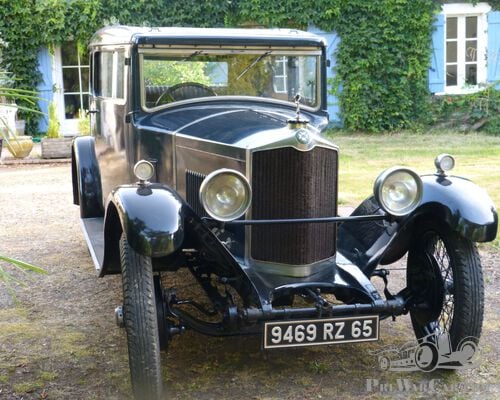
2-door 15.7hp six cylinder saloon
The car is a 6-cylinder 2-door saloon described as the "Sportsman's coach built coupé". Only three of this model are known to have survived. I have..
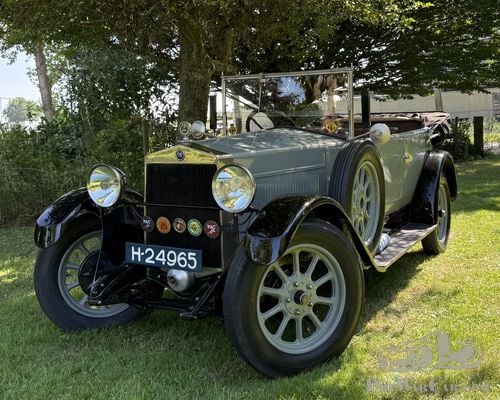
Fiat 509 Torpedo / Spider – Exceptionally Original and Complete
A Rare and Highly Original Example with Long-Term Dutch HistoryOffered for sale is an exceptionally original and remarkably complete Fiat 50..
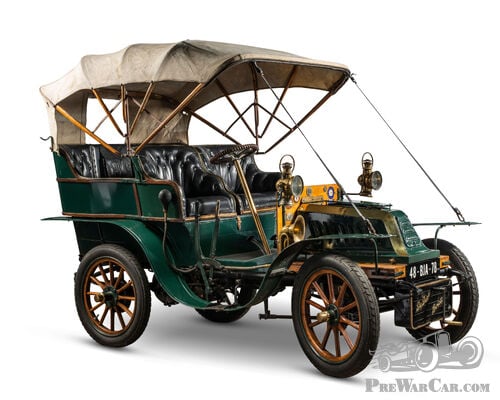
De Dion Bouton Type z in good running condition
De Dion Bouton Type Z from 1905. The car is in good condition, works and runs well. Serie number 36. Engine number 18190. French Carte grise.