The global magazine and marketplace for classic car enthusiasts, by enthusiasts.


Filter
Classic Mors, DeSoto for sale - Mors, DeSoto cars for sale
-

1902 Mors Model H Four Cylinder Rear Entrance Tonneau - VCC Dated
1902 Mors Model H 4 Cylinder Rear Entrance Tonneau Registration No. DY29Engine No. 8057VCC Dating Certificate. 2055 (1995) Emile Mors was right at the cutting edge of motor car development at the turn of the century and, from his Parisian base, built motor cars that were at the forefront in the major m..

Mors
France, 1895 – 1925; 1941 – 1943
(1) Société d’Electricité et d’Automobiles Mors, Paris, 1895 – 1907
(2) Société Nouvelle des Automobiles Mors, Paris, 1908 – 1943
Emile Mors was an electrical engineer, which may account for the ingenious ignition system (by low-tension coil and dynamo) found on his first Mors cars with aiv V4 engines, dry-sump lubrication, water-cooled heads and air-cooled barrels. These power units were rear-mounted, and the belt-and-pulley change-speed gear on the Mors car was in the Benz idiom. Production in 1898 was running at 200 Mors cars a year and front-mounted engines made their appearance on the Mors Petit Duc, an 850cc flat-twin with partial water cooling, cone clutch and final drive of the Mors car was by side chains. Steering was by handlebar and the Mors car cost £294 in England in 1900. The Mors car was still listed in 1901, though later examples were wheel-steered.
The Mors racing cars designed by Brasier at first rivalled and then surpassed the hitherto invincible Panhards, winning the Paris-st. Malo and Paris-Bordeaux in 1899, following this with victories of Mors cars in the Paris-Toulouse-Paris and Bordeaux-Périgeux-Bordeaux in 1900, and the Paris-berlin and Paris-Bordeaux in 1901. In 1902 the Mors 60hp 9.2-litre competition machines had shock absorbers and in 1903 capacity of the Mors car had gone up to 11.6-litres, with mechanically-operated overhead inlet valves and streamlined bodywork of the upturned-boat type. Gabriel won the Paris-Madrid race on one of these Mors cars, while the Hon. C.S. Rolls recorded 84,68mph over the kilometer at Welbeck on a similar Mors car. The 1904 racers saw a reversion to T-head power units, but this was the last year in which Mors cars made any impression on the circuits. Though Jenatzy drove a Mors car for the team in the 1908 Grand Prix, he took 9th place, and the 2½-litre Mors cars prepared for the cancelled 1914 Coupe de l’Auto never reappeared.
Though full water cooling was not adopted till 1902 on Mors cars, vertical 4-cylinder engines made their appearance late in 1899, followed in 1900 by low-tension magneto ignition. 1901 Mors cars had what amounted to one carburetter per cylinder, with a huge central float chamber. From 1902 onwards the Mors cars followed conventional lines; 1903 Mors carmodels retained the chain drive, but had mechanically-operated sv in a T-head, pressed-steel frames, Dubrulle lubrications and Mercedes-style honey-comb radiators. Brasier had already departed the Mors car company to work for Georges Richard. In 1904 Charles Schmidt, also of Mors cars, went to design European-style cars for Packard in America – this had no connection with the American Mors cars made from 1906 to 1909. Also new on Mors cars in 1904 was the ‘shouldered’ radiator shell which persisted on the Mors carmarque almost to the end. 4-cylinder Mors cars only were made in 1905; they came in 2.3-litre, 3.2-litre, 4.3-litre, 5.7-litre and 8.1-litre sizes, and the largest Mors car, rated at 40/52hp, had an auxiliary transverse spring at the rear and cost £1.224. In 1906 the aluminium water jacketing introduced on Mors cars in 1903 was abandoned, while cone clutches gave way to the contracting-band type which Mors cars never departed from. Ignition was now by high-tension magneto and options included the Huillier windscreen (patented by a Mors car company’s director) and compressed-air starting. A cab-over-engine petrol brougham was listed on the 17hp Mors car chassis. In 1907 L-head monobloc engines arrived with the small 10hp Mors car and 15hp models, which Mors cars also had shaft drive and pressure lubrication: at the top of the range was an 50hp 6-cylinder Mors car with gate change and low-tension magneto ignition and this Mors car sold at £1.375 in England.
The 1908 depression was a blow from which the Mors car company never really recovered, though the company was reconstructed under André Citroën’s management and in 1909 they made 2.000 Mors cars, sales being aided by bigger shaft-driven 2.5-litre and 3.7-litre models. Chain drive and make-and-break ignition were to persiste on the biggest Mors cars until 1912, though there was a shaft-driven 3.6-litre 6-cylinder Mors car in 1911 and the L-head monobloc 12/15hp with 4-speed gearbox was quite popular in 1913/1914. Poppet and Knight sleeve-valve models in great diversity were offered on Mors cars during the last two pre-World War 1 seasons, the latter coming in 2.1-litre, 3.7-litre, 4.4-litre and 7.2-litre sizes with engines by Minerva. By 1914 only the small Mors cars retained sv power units; Citroën double helical bevels were standard, and an sv sports 17/20hp Mors cars was offered with electric lighting. Only Minerva-built Knight engines were used in Mors cars after 1918, the radiators wearing a triple-S monogram as a riposte to Panhard’s double-S (for sans soupages). Mors cars, however, had fewer resources than their former rivals, and not even good looks and a 70mph performance (plus front wheel brakes in 1921) could save the 3.6-litre Sporting 20 Mors car. A 2-litre Mors car, also Minerva-engined, appeared in 1922, but by 1925 most, if not all the Mors car company’s facilities had been absorbed by Citroën. There was a brief renaissance by Mors cars with electric cars during World War 2, but the last vehicles to bear the name of Mors were the Speed motor scooters made from 1952 to 1956.
Source: Georgano, encyclopedia of motorcar; MCS
The information is written with the greatest of care. However, if you have any suggested amendments please contact us at office@prewarcar.com
DeSoto
US, 1913 – 1916
DeSoto Motro Car Co, Auburn, Ind.
The DeSoto appears to have succeeded the Zimmerman. This was a large car with a 55hp, 6-cylinder engine, which was furnished with a compressed-air starter. The DeSoto model Six-55 five-seater touring car sold for $2185.
US, 1928 – 1960
Chrysler Motors Corp, Detroit, Mich.
The DeSoto was launched in 1928 as a 3.2-litre side valve six to compete with Oldsmobile, Pontiac and the cheaper Nashes. Styling and general design of the DeSoto were in line with the 1929 Chryslers, and at $885 for a DeSoto sedan 90.000 were sold in the first twelve months. A 3.4-litre straight-8 DeSoto on a 9ft 6in wheelbase was announced for 1930 as the world’s cheapest 8-cylinder car. However, DeSoto suffered badly in the Depression, and in 1932, when flexible rubber engine mountings and free wheels were made available, sales dropped to 26.000 DeSoto cars.
The DeSoto disappeared from the British market about this time, though certain ‘Chrysler’ models listed in England (the Mortlake, Croydon, and some of the Richmonds) were in fact DeSoto cars in all but name. A 6-cylinder version of Chrysler’s advanced unitary-construction Airflow, the SE-type with a 4-litre engine, was brought out in 1934, but was an unsuccessful as its bigger sister. Later DeSotos followed regular Chrysler lines closely though in later years there was a tendency for DeSoto to move into a higher price class than Dodge; by 1952 DeSotos started $300 higher than the companion make.
By 1939 the DeSoto cars for sale were being made with independent front suspension, hypoid back axles and column change. There was a choice at DeSoto of two 6-cylinder engines and three wheelbase lengths, the longest of these being reserved for seven-seater bodywork – DeSoto continued to offer a really roomy family car right up to 1954. A 4-speed semi-automatic Vacumatic transmission became an option in 1941, but DeSoto’s big post-war change of models did not take place until 1952, when the division followed Chrysler’s lead in adopting the oversquare ohv V8; the DeSoto version was of 4½-litre capcity and developed 16-bhp. With the advent of Chrysler’s ‘flight sweep’ styling in 1955, the side-valve sixes were dropped and the standard engine in a DeSoto was now a 4.8-litre eight, giving 185bhp in Firedome guise, and 200bhp in Fireflite form. Though this redesigning saved Chrysler sales generally, the slump in the medium-price class had an adverse effect on DeSoto and in 1959 the DeSoto division was merged with Plymouth. Last of the DeSotos were the 1961 models, unitary-construction cars with a choice of three engines: Plymouth’s 145bhp ohv ‘slant six’ as used in the Valiant, and V8s of 230 and 265bhp, the two former only in Canadian DeSotos. Production of DeSoto cars ceased in November 1960 after only a few had been delivered.
Source: Georgano, encyclopedia of motorcar; MCS
The information is written with the greatest of care. However, if you have any suggested amendments please contact us at office@prewarcar.com



Featured
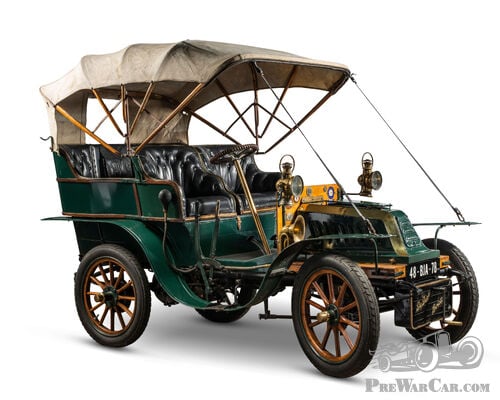
De Dion Bouton Type z in good running condition
De Dion Bouton Type Z from 1905. The car is in good condition, works and runs well. Serie number 36. Engine number 18190. French Carte grise.
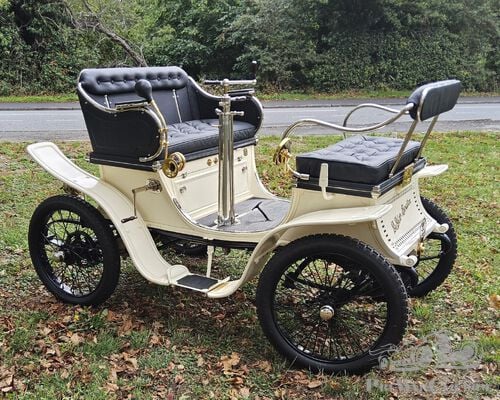
1902 De Dion Bouton Vis-a Vis 4.5 H.P. Reg No. Y123 V.C.C. Cert No. 1649
1902 De Dion Bouton Vis-à-vis 4.5 H.P.Reg. No. Y132 V.C.C. Cert No. 1649Beautifully presented and completely restored following an ex..
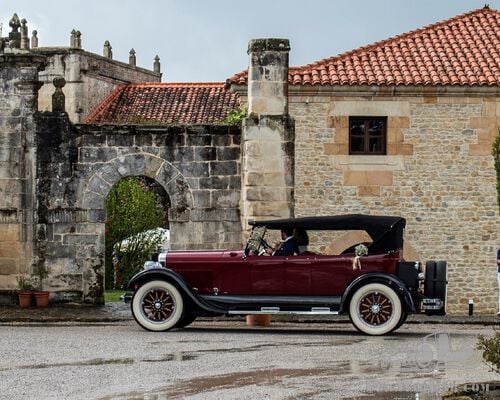
1925 Lincoln Model L Phaeton by Brunn - Excellent provenance
Retaining its original matching-numbers engine and chassis (both numbered 24576), the car benefits from an extensively documented history and..