The global magazine and marketplace for classic car enthusiasts, by enthusiasts.


Filter
Classic Rosengart, DeSoto for sale - Rosengart, DeSoto cars for sale
-

Rosengart LR4N2 1938 – Rare Pre-War French Saloon – Restoration Project
Na sprzedaż: Rosengart LR4N2 z 1938 roku Rzadki francuski samochód przedwojenny, projekt do renowacji. -
Rosengart LR2 Limousine 1929 / in good condition
Rosengart LR2 Limousine 1929 Company / History Rosengart was founded by Lucien Rosengart, a successful entrepreneur who had previously supplied components to manufacturers such as Peugeot and Citroën. Recognizing the enormous success of the small and affordable Austin 7 in England, he acquired the license rights in 19..


Rosengart
France, 1928 – 1955
(1) Automobiles L. Rosengart, Neuilly-sur-Seine, 1928 – 1937
(2) Société Industrielle de l’Ouest Parisienne, Paris, 1937 – 1955
The first Rosengart cars were made in the old Bellanger factory under the direction of Lucien Rosengart and Jules Salomon (the designer of the original Citroëns). The Rosengart cars were Austin Sevens built under licence, and differed from their British prototypes mainly in matters of styling: for example the ribbon radiator shells, not adopted by Birmingham until late 1930. Production had reached 28 Rosengart cars a day by the summer of 1930, and the Austin theme was continued by Rosengart cars until the end of pre-World War 2 production, though 1932 and subsequent Rosengart cars had a longer wheelbase and semi-elliptic rear suspension. By 1939, when a roadster Rosengart car could be bought for the equivalent of £78, the chassis had channel-section side members. In the 1932 range of Rosengart cars there was also a 1.100cc 20bhp 6-cylinder, which Rosengart car was virtually an elongated 5CV with 3-speed gearbox and vacuum-servo brakes. A line of fwd 4-cylinder sv Rosengart cars began in 1933, with transverse independent front suspensions, built under Adler licence and based on the German company’s 1.6-litre Trumpf. A more conventional rear-driven Rosengart car was sold ast he ‘8/40’.
Fwd Rosengart cars were still marketed in 1939, but by this time the Rosengart cars were based on the 11CV Citroën, from which they derived their 1.9-litre ohv engines, 3-speed synchromesh gearboxes, and hydraulic brakes. Sporting 2-door saloon Rosengart car and cabriolet bodies were mounted on a platform-type chassis. Similar bodies were used on the 1947 Super-Trahuit, but the Super-Traction fwd structure now housed a 95bhp 3.9-litre sv Mercury engine. Such a car was an unrealistic proposition in the prevailing economic climate, and 1952 brought Rosengart cars a return to the Austin Seven theme – the sv 747cc engine now gave 21bhp, and the Rosengart Ariette and Rosengart Artisane saloons had modern styling, transverse independent front suspension and hydraulic brakes. Speeds of 60mph were claimed on these Rosengart cars.
The last of the line of Rosengart cars, the Rosengart Sagaie of 1954, abandoned the old sv four in favour of a 40bhp, 750cc, ohv air-cooled flat-twin engine. Saloon and convertible models Rosengart cars were made, and it was said to do 70mph, but failed to compete with Renault and Panhard.
Source: Georgano, encyclopedia of motorcar; MCS
The information is written with the greatest of care. However, if you have any suggested amendments please contact us at office@prewarcar.com
DeSoto
US, 1913 – 1916
DeSoto Motro Car Co, Auburn, Ind.
The DeSoto appears to have succeeded the Zimmerman. This was a large car with a 55hp, 6-cylinder engine, which was furnished with a compressed-air starter. The DeSoto model Six-55 five-seater touring car sold for $2185.
US, 1928 – 1960
Chrysler Motors Corp, Detroit, Mich.
The DeSoto was launched in 1928 as a 3.2-litre side valve six to compete with Oldsmobile, Pontiac and the cheaper Nashes. Styling and general design of the DeSoto were in line with the 1929 Chryslers, and at $885 for a DeSoto sedan 90.000 were sold in the first twelve months. A 3.4-litre straight-8 DeSoto on a 9ft 6in wheelbase was announced for 1930 as the world’s cheapest 8-cylinder car. However, DeSoto suffered badly in the Depression, and in 1932, when flexible rubber engine mountings and free wheels were made available, sales dropped to 26.000 DeSoto cars.
The DeSoto disappeared from the British market about this time, though certain ‘Chrysler’ models listed in England (the Mortlake, Croydon, and some of the Richmonds) were in fact DeSoto cars in all but name. A 6-cylinder version of Chrysler’s advanced unitary-construction Airflow, the SE-type with a 4-litre engine, was brought out in 1934, but was an unsuccessful as its bigger sister. Later DeSotos followed regular Chrysler lines closely though in later years there was a tendency for DeSoto to move into a higher price class than Dodge; by 1952 DeSotos started $300 higher than the companion make.
By 1939 the DeSoto cars for sale were being made with independent front suspension, hypoid back axles and column change. There was a choice at DeSoto of two 6-cylinder engines and three wheelbase lengths, the longest of these being reserved for seven-seater bodywork – DeSoto continued to offer a really roomy family car right up to 1954. A 4-speed semi-automatic Vacumatic transmission became an option in 1941, but DeSoto’s big post-war change of models did not take place until 1952, when the division followed Chrysler’s lead in adopting the oversquare ohv V8; the DeSoto version was of 4½-litre capcity and developed 16-bhp. With the advent of Chrysler’s ‘flight sweep’ styling in 1955, the side-valve sixes were dropped and the standard engine in a DeSoto was now a 4.8-litre eight, giving 185bhp in Firedome guise, and 200bhp in Fireflite form. Though this redesigning saved Chrysler sales generally, the slump in the medium-price class had an adverse effect on DeSoto and in 1959 the DeSoto division was merged with Plymouth. Last of the DeSotos were the 1961 models, unitary-construction cars with a choice of three engines: Plymouth’s 145bhp ohv ‘slant six’ as used in the Valiant, and V8s of 230 and 265bhp, the two former only in Canadian DeSotos. Production of DeSoto cars ceased in November 1960 after only a few had been delivered.
Source: Georgano, encyclopedia of motorcar; MCS
The information is written with the greatest of care. However, if you have any suggested amendments please contact us at office@prewarcar.com


Featured
1929 Talbot K74 Limousine – Very comprehensive restoration project
For sale – 1929 Talbot K74 Limousine – Very comprehensive restoration projectAsking price: €19,950 A very rare 1929 Talbot K74..
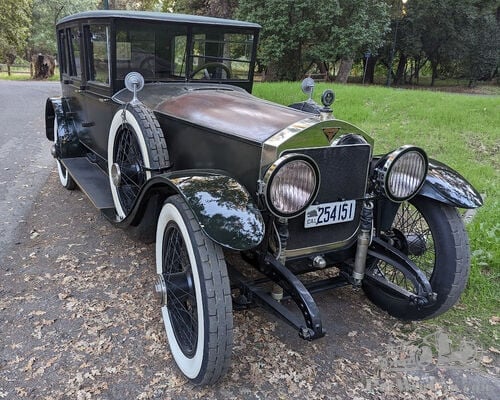
1916 Simplex, Crane model 5
1916 Simplex, Crane MODEL 5CUSTOM MADE HISTORIC PRESERVATION VEHICLE – READY TO TOUR!This Simplex recently completed th..
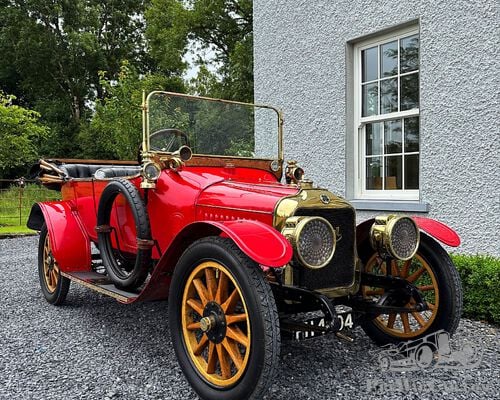
1914 Brasier
1914 Brasier Tourer 9ABrasier were a French manufacturer who were in business from 1901 until 1930, when the company became victim of the gr..