The global magazine and marketplace for classic car enthusiasts, by enthusiasts.


Filter
Classic Simplex, DeSoto for sale - Simplex, DeSoto cars for sale
-

1916 Simplex, Crane model 5
1916 Simplex, Crane MODEL 5CUSTOM MADE HISTORIC PRESERVATION VEHICLE – READY TO TOUR!This Simplex recently completed the 48th Modoc tour hosted by Rodney Flournoy. This five-day tour took place in the scenic northeast corner of California. The participants drove approximately 300 miles to a variety of beautiful destin..

Simplex
NL, 1899 – 1914
NV Maatschappij Simplex, Amsterdam
The first Simplex car was a belt-driven vis-à-vis made on Benz-lines, but by 1902 a new model Simplex car was introduced with a vertical single-cylinder Fafnir engine mounted at the front, wheel steering and single chain drive. Shaft drive came in soon on the Simplex car afterwards, and 1907 an 8hp 2-cylinder and 14/16hp 4-cylinder Simplex car were made. The largest model Simplex car was the 35hp 4-cylinder model of 1911, still with Fafnir engine. A considerable number of the smaller Simplex cars were sent, partly knocked down, to the Nederlands East Indies, and assembled there. Production of Simplex cars ceased with World War 1, and although a prototype 3-wheeler Simplex car with 10hp V-twin engine was shown in 1919, this Simplex car never went into production.
US, 1907 – 1917
Simplex Automobile Co Inc, New Brunswick, N.J.
After the 1907 bankruptcy of Smith & Mabley, the firm was taken over by Herman Broesel, who formed the Simplex Automobile Company. The best-known model of the new Simplex car company was the 50hp Simplex car, a massive chain-driven car of high quality whose 4-cylinder T-head engine had a capacity of 10 litres. The chassis price of the Simplex car was $4.500 and bodies were made for Simplex under contract by such firms as Quimby, Demarest, Holbrook and Brewster. In 1908 a stripped down version Simplex car won the 24 hour race at Brighton Beach, and famous drivers who drove for Simplex cars included George Robertson, Al Poole and Joe Tracy. The Simplex cars were designed by Edward Franquist who introduced a 38hp 7.8-litre shaft-drive model in 1911, and a 75hp 10-litre chain-drive roadster in 1912. By 1914 this Simplex car was the only chain-driven model in the range, and this Simplex car was said to be the last chain-driven American car. Some of these Simplex cars had a sharply-pointed V-radiator, although most Simplex cars used a flat, Mercedes-type radiator.
The 1914 Simplex car range consisted of the 38hp, 50hp and 75hp fours, and a 50hp six, but towards the end of that year a new Simplex car appeared with heralded a complete change in the Simplex car company. This was the 46hp L-head Simplex Crane Model 5, designed by Henry M. Crane who had replaced Franquist as chief designer of the Simplex cars after a company reorganization. The new Simplex car was a very high quality machine and carried beautiful coachwork, mainly by Brewster, but it lacked the sporting qualities of ìt predecessor. The Simplex car was made until 1917, and bodies were still being fitted to Crane chassis in 1921. By this time the Simplex car company had been bought by Hare’s Motors, and a re-organized company, the Crane-Simplex Company of New-York, made a few cars in 1923 and 1924.
France, 1920
The French Simplex car was quite a large open tourer with a bullnose radiator, but underneath the bonnet of the Simplex car there was a horizontal single-cylinder engine of 735cc. A special balance weight coupled to the connecting rod and to an eccentric was supposed to avoid vibration. Front wheel brakes were fitted on the Simplex car.
Source: Georgano, encyclopedia of motorcar; GNG
The information is written with the greatest of care. However, if you have any suggested amendments please contact us at office@prewarcar.com
DeSoto
US, 1913 – 1916
DeSoto Motro Car Co, Auburn, Ind.
The DeSoto appears to have succeeded the Zimmerman. This was a large car with a 55hp, 6-cylinder engine, which was furnished with a compressed-air starter. The DeSoto model Six-55 five-seater touring car sold for $2185.
US, 1928 – 1960
Chrysler Motors Corp, Detroit, Mich.
The DeSoto was launched in 1928 as a 3.2-litre side valve six to compete with Oldsmobile, Pontiac and the cheaper Nashes. Styling and general design of the DeSoto were in line with the 1929 Chryslers, and at $885 for a DeSoto sedan 90.000 were sold in the first twelve months. A 3.4-litre straight-8 DeSoto on a 9ft 6in wheelbase was announced for 1930 as the world’s cheapest 8-cylinder car. However, DeSoto suffered badly in the Depression, and in 1932, when flexible rubber engine mountings and free wheels were made available, sales dropped to 26.000 DeSoto cars.
The DeSoto disappeared from the British market about this time, though certain ‘Chrysler’ models listed in England (the Mortlake, Croydon, and some of the Richmonds) were in fact DeSoto cars in all but name. A 6-cylinder version of Chrysler’s advanced unitary-construction Airflow, the SE-type with a 4-litre engine, was brought out in 1934, but was an unsuccessful as its bigger sister. Later DeSotos followed regular Chrysler lines closely though in later years there was a tendency for DeSoto to move into a higher price class than Dodge; by 1952 DeSotos started $300 higher than the companion make.
By 1939 the DeSoto cars for sale were being made with independent front suspension, hypoid back axles and column change. There was a choice at DeSoto of two 6-cylinder engines and three wheelbase lengths, the longest of these being reserved for seven-seater bodywork – DeSoto continued to offer a really roomy family car right up to 1954. A 4-speed semi-automatic Vacumatic transmission became an option in 1941, but DeSoto’s big post-war change of models did not take place until 1952, when the division followed Chrysler’s lead in adopting the oversquare ohv V8; the DeSoto version was of 4½-litre capcity and developed 16-bhp. With the advent of Chrysler’s ‘flight sweep’ styling in 1955, the side-valve sixes were dropped and the standard engine in a DeSoto was now a 4.8-litre eight, giving 185bhp in Firedome guise, and 200bhp in Fireflite form. Though this redesigning saved Chrysler sales generally, the slump in the medium-price class had an adverse effect on DeSoto and in 1959 the DeSoto division was merged with Plymouth. Last of the DeSotos were the 1961 models, unitary-construction cars with a choice of three engines: Plymouth’s 145bhp ohv ‘slant six’ as used in the Valiant, and V8s of 230 and 265bhp, the two former only in Canadian DeSotos. Production of DeSoto cars ceased in November 1960 after only a few had been delivered.
Source: Georgano, encyclopedia of motorcar; MCS
The information is written with the greatest of care. However, if you have any suggested amendments please contact us at office@prewarcar.com


Featured
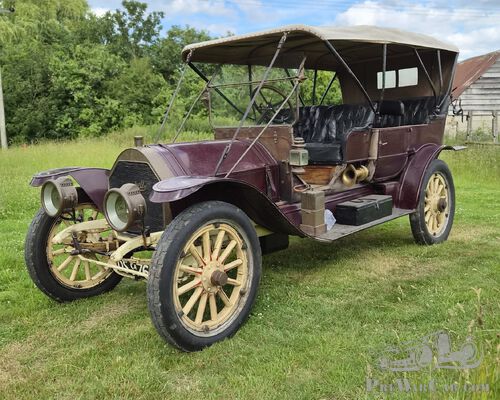
1910 Mitchell Model S - 50HP Six Cylinder
Based in Racine, Wisconsin and being the largest wagon manufacturer in the USA, Mitchell-Lewis produced their first motor car in 1903. Sales grew ..
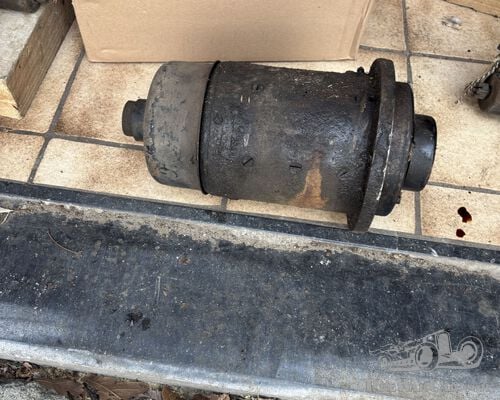
1929 Talbot K74 Limousine – Very comprehensive restoration project
For sale – 1929 Talbot K74 Limousine – Very comprehensive restoration projectAsking price: €19,950 A very rare 1929 Talbot K74..
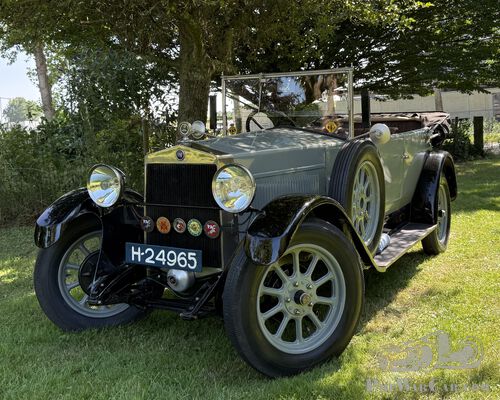
Fiat 509 Torpedo / Spider – Exceptionally Original and Complete
A Rare and Highly Original Example with Long-Term Dutch HistoryOffered for sale is an exceptionally original and remarkably complete Fiat 50..