The global magazine and marketplace for classic car enthusiasts, by enthusiasts.


Filter
Classic Stoewer, DeSoto for sale - Stoewer, DeSoto cars for sale
-

1924 Stoewer type D3 roadster
Rare opportunity to buy a vintage 1924 Stoewer type D3 roadster in fully restored condition. More than € 50K were spent in 2018 and 2019 on its restoration . Detailed work invoices come with the car. A video can be sent on request . Price € 64000 ex Eibergen Netherlands imported EEC.

Stoewer
D, 1899 – 1939
(1) Gebrüder Stoewer, Fabrik für Motorfahrzeuge, Stettin, 1899 – 1916
(2) Stoewer-Werke AG vorm. Gebr. Stoewer, Stettin, 1916 – 1939
The Stoewer car factory developed out of the Stoewer ironworks and was among the pioneers of the German car industry. After manufacturing motor cycles, tricycles and quadricycles for two years, Stoewer turned to cars in 1899. The first Stoewer car had a rear-mounted 2-cylinder engine. 4-cylinder Stoewer cars followed in 1901, and electric Stoewer cars were also produced. Best known were the 2-cylinder Type T Stoewer car (2.280cc and 3/12PS), the 4-cylinder Stoewer P4 (3.052cc and 11/22PS), the Stoewer G4 (1.500cc and 6/12PS) and the 6-cylinder Stoewer P6 (8.820cc and 34/60PS), evolved in the 1905-1907 period all Stoewer cars with shaft-drive. The Stoewer B1 of 6/16PS and the Stoewer B6 of 9/22PS which appeared in 1910 were also built by Mathis under licence. The G4 Stoewer car was the basis for the Stoewer B5, which Stoewer car in 1912 became famous by setting up a record at Brooklands with 67.7mph. The new range of Stoewer cars which appeared in 1913 was also based on successful earlier cars. They were the Stoewer C1 (6/18PS), Stoewer C2 (10/28PS) and C3 Stoewer car (6-cylinder and 19/45PS). Shortly before the outbreak of World War 1 the Stoewer car range was headed by the F4 Stoewer car with a 4-cylinder, 8.8-litre 33/100PS ohc engine. After the war an enormous Stoewer car appeared, the Stoewer D7, using a 6-cylinder 11.2-litre 42/120PS aero engine, as well as some conservative sv 4- and 6-cylinder Stoewer cars with rear wheel and transmission brakes. Front wheel brakes appeared on Stoewer cars in 1925. Stoewer introduced 8-cylinder Stoewer cars in 1928. These were the Stoewer Superior, Stoewer Marschall, Stoewer Gigant and Stoewer Repräsentant with engines ranging from 2-litres and 45bhp to 4.9-litres and 100bhp. The Stoewer car firm re-entered the economy class in 1931 with the V5, a front-driven Stoewer car with a V4 1.188cc engine, followed by the front-drive models R140 (1.369cc), R150 (1.488cc) and R180 (1.769cc). Another 8-cylinder was the front wheel drive Greif V8 with a 2.488cc engine, which was replaced by the conventional 6-cylinder 3.609cc Arcona Stoewer car in 1938. In 1934 the 1½-litre 4-cylinder Stoewer car and 2½-litre V8 Stoewer car were shown at the Brussels Salon by Monsieur Dewaet under the name D.S. (Dewaet-Stoewer). The Greif Junior was built under Tatra licence with an opposed 4-cylinder 1.474cc engine. It succeeded the Röhr Junior. In the middle of the range was the Stoewer Sedina with a 4-cylinder engine of 2.4-litres.
Production of private Stoewer cars was given up at the outbreak of World War 2 in 1939. The Stoewer car factory was destroyed during the war and production of Stoewer cars was not resumed.
Source: Georgano, encyclopedia of motorcar; HON
The information is written with the greatest of care. However, if you have any suggested amendments please contact us at office@prewarcar.com
DeSoto
US, 1913 – 1916
DeSoto Motro Car Co, Auburn, Ind.
The DeSoto appears to have succeeded the Zimmerman. This was a large car with a 55hp, 6-cylinder engine, which was furnished with a compressed-air starter. The DeSoto model Six-55 five-seater touring car sold for $2185.
US, 1928 – 1960
Chrysler Motors Corp, Detroit, Mich.
The DeSoto was launched in 1928 as a 3.2-litre side valve six to compete with Oldsmobile, Pontiac and the cheaper Nashes. Styling and general design of the DeSoto were in line with the 1929 Chryslers, and at $885 for a DeSoto sedan 90.000 were sold in the first twelve months. A 3.4-litre straight-8 DeSoto on a 9ft 6in wheelbase was announced for 1930 as the world’s cheapest 8-cylinder car. However, DeSoto suffered badly in the Depression, and in 1932, when flexible rubber engine mountings and free wheels were made available, sales dropped to 26.000 DeSoto cars.
The DeSoto disappeared from the British market about this time, though certain ‘Chrysler’ models listed in England (the Mortlake, Croydon, and some of the Richmonds) were in fact DeSoto cars in all but name. A 6-cylinder version of Chrysler’s advanced unitary-construction Airflow, the SE-type with a 4-litre engine, was brought out in 1934, but was an unsuccessful as its bigger sister. Later DeSotos followed regular Chrysler lines closely though in later years there was a tendency for DeSoto to move into a higher price class than Dodge; by 1952 DeSotos started $300 higher than the companion make.
By 1939 the DeSoto cars for sale were being made with independent front suspension, hypoid back axles and column change. There was a choice at DeSoto of two 6-cylinder engines and three wheelbase lengths, the longest of these being reserved for seven-seater bodywork – DeSoto continued to offer a really roomy family car right up to 1954. A 4-speed semi-automatic Vacumatic transmission became an option in 1941, but DeSoto’s big post-war change of models did not take place until 1952, when the division followed Chrysler’s lead in adopting the oversquare ohv V8; the DeSoto version was of 4½-litre capcity and developed 16-bhp. With the advent of Chrysler’s ‘flight sweep’ styling in 1955, the side-valve sixes were dropped and the standard engine in a DeSoto was now a 4.8-litre eight, giving 185bhp in Firedome guise, and 200bhp in Fireflite form. Though this redesigning saved Chrysler sales generally, the slump in the medium-price class had an adverse effect on DeSoto and in 1959 the DeSoto division was merged with Plymouth. Last of the DeSotos were the 1961 models, unitary-construction cars with a choice of three engines: Plymouth’s 145bhp ohv ‘slant six’ as used in the Valiant, and V8s of 230 and 265bhp, the two former only in Canadian DeSotos. Production of DeSoto cars ceased in November 1960 after only a few had been delivered.
Source: Georgano, encyclopedia of motorcar; MCS
The information is written with the greatest of care. However, if you have any suggested amendments please contact us at office@prewarcar.com


Featured
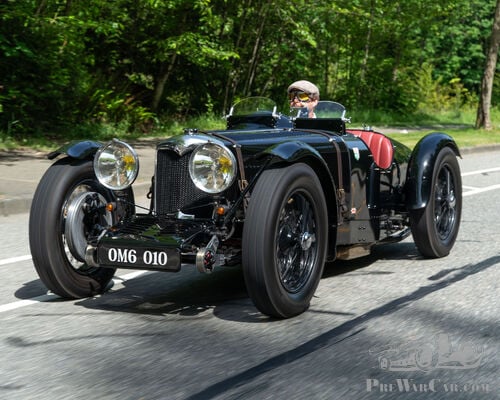
Riley 14/6 Special 1933
The ExperienceStep into the golden age of British motoring. This 1933 Riley 14/6 Special is a masterclass in pre-w..
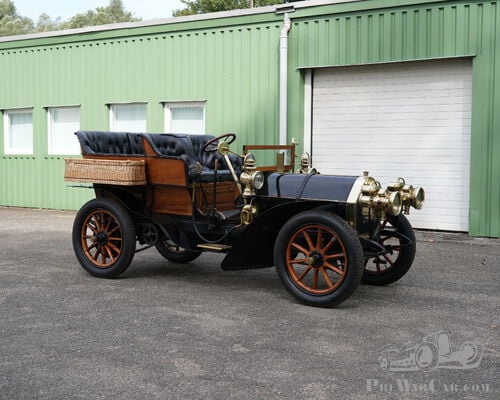
1904 Aster 16/20 HP Four-Cylinder Five-Seat Rear-Entrance Tonneau
Powerful four-cylinder engineFour-speed gearboxChain driveFive seatsMore than €100,000 recently invested
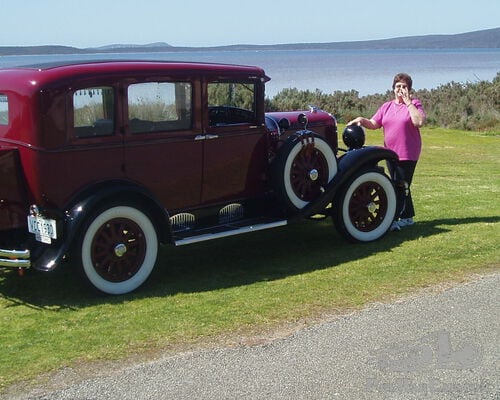
1930 Chrysler 66 Six-Wheel Equipped Royal Sedan
An exceptionally well restored and highly awarded Chrysler 66 Royal Sedan, with only two owners in nearly 97 years.The present owner ..