The global magazine and marketplace for classic car enthusiasts, by enthusiasts.


Filter
Classic Swift, DeSoto for sale - Swift, DeSoto cars for sale
-

1904 Swift 7HP - VCC Dated
1904 Swift 7HPRegistration No - BS8487Chassis No - 176Engine No - 2886 - VCC Dated - Electric starting- 4 seat London to Brighton vehicle - Rare English Marque- Many time London to Brighton Finisher - Ready for use Swift of Coventry gained and adapted its skills ..

Swift
GB, 1900 – 1931
(1) Swift Motor Co Ltd, Coventry, Warwickshire, 1900 – 1919
(2) Swift of Coventry Ltd, Coventry, Warwickshire, 1919 – 1931
Swift progressed from sewing-machines through bicycles, motor tricycles and quadricycles to cars. Their first Swift car was a voiturette with a tubular chassis, powered by an MMC single-cylinder engine of De Dion type, but with an original transmission system. There was direct drive on both the 2-forward speeds of the Swift car, provided by two rings of teeth on the crown wheel and two pinions. The design of the Swift car was unreliable, for the rear axle was unsprung and attached to a flexible chassis. This was soon dropped on the Swift car in favour of normal transmission, and the axle was sprung from 1903. These single-cylinder Swift cars, with various makers’ engines installed, were the only Swift car offerings until 1904, when an excellent Swift-made twin of 10hp was added. Bigger 3- and 4-cylinder Swift cars were made at the time, and in 1909 a short-lived single-cylinder 7hp Swift car, also sold by Austin was added, but most sales came from the 2-cylinder light Swift car. In 1912 this Swift car was replaced by a 7hp 2-cylinder cyclecar with shaft drive, made by the Swift Cycle Co Ltd. For 1914 the Swift Light Car, which Swift car was virtually the cyclecar with a pressed steel, in place of tubular, chassis, was offered by the Swift Motor Co Ltd. The Cycle Co made no further Swift cars, and the formation of Swift of Coventry in 1919 merged the two companies. An 1.100cc 4-cylinder Swift Ten replaced the 2-cylinder car in 1914. This Ten Swift car was continued after World War 1, with a new 2-litre Swift Twelve beside it. The latter Swift car had 4 forward speeds but was otherwise similar. After this, only 4-cylinder Swift cars were made, irrespective of current fashions. These Swift cars were immensely strong and simple, inefficient in terms of power output but not utility. The Swift Ten was redesigned on more modern lines in 1923. A slightly smaller engine with detachable head and coil ignition was made in unit on the Swift car with a 3-speed gearbox, though the model Swift car reverted to a magneto in 1925. As the 12/35hp Swift car, the Swift Twelve was brought up-to-date with the same features, becoming the 14/40hp Swift car in 1926. In the same year the Ten’s engine was enlarged to 1.200cc. Wire wheels were optional on Swift cars from 1927, and 4-speed gearboxes came in 1929. The 1930 Ten Swift car had a narrow ‘ribbon’ radiator shell, and was available with Swallow 2-door saloon coachwork as well as fabric saloon and tourer styles. This Swift car was supplemented in 1931 by the 8hp Cadet 2-door saloon which in its cheapest form the Swift car cost only £149. Swift cars could not compete with the mass-producers, however, and the Swift car make died shortly after.
CDN, 1911
Swift Motor Car Company of Canada Limited, Chatham, Ont.
One prototype Swift car, possibly based on the US Anhut, was produced by this Swift car firm of marine-engine builders.
Source: Georgano, encyclopedia of motorcar; TRN, HD
The information is written with the greatest of care. However, if you have any suggested amendments please contact us at office@prewarcar.com
DeSoto
US, 1913 – 1916
DeSoto Motro Car Co, Auburn, Ind.
The DeSoto appears to have succeeded the Zimmerman. This was a large car with a 55hp, 6-cylinder engine, which was furnished with a compressed-air starter. The DeSoto model Six-55 five-seater touring car sold for $2185.
US, 1928 – 1960
Chrysler Motors Corp, Detroit, Mich.
The DeSoto was launched in 1928 as a 3.2-litre side valve six to compete with Oldsmobile, Pontiac and the cheaper Nashes. Styling and general design of the DeSoto were in line with the 1929 Chryslers, and at $885 for a DeSoto sedan 90.000 were sold in the first twelve months. A 3.4-litre straight-8 DeSoto on a 9ft 6in wheelbase was announced for 1930 as the world’s cheapest 8-cylinder car. However, DeSoto suffered badly in the Depression, and in 1932, when flexible rubber engine mountings and free wheels were made available, sales dropped to 26.000 DeSoto cars.
The DeSoto disappeared from the British market about this time, though certain ‘Chrysler’ models listed in England (the Mortlake, Croydon, and some of the Richmonds) were in fact DeSoto cars in all but name. A 6-cylinder version of Chrysler’s advanced unitary-construction Airflow, the SE-type with a 4-litre engine, was brought out in 1934, but was an unsuccessful as its bigger sister. Later DeSotos followed regular Chrysler lines closely though in later years there was a tendency for DeSoto to move into a higher price class than Dodge; by 1952 DeSotos started $300 higher than the companion make.
By 1939 the DeSoto cars for sale were being made with independent front suspension, hypoid back axles and column change. There was a choice at DeSoto of two 6-cylinder engines and three wheelbase lengths, the longest of these being reserved for seven-seater bodywork – DeSoto continued to offer a really roomy family car right up to 1954. A 4-speed semi-automatic Vacumatic transmission became an option in 1941, but DeSoto’s big post-war change of models did not take place until 1952, when the division followed Chrysler’s lead in adopting the oversquare ohv V8; the DeSoto version was of 4½-litre capcity and developed 16-bhp. With the advent of Chrysler’s ‘flight sweep’ styling in 1955, the side-valve sixes were dropped and the standard engine in a DeSoto was now a 4.8-litre eight, giving 185bhp in Firedome guise, and 200bhp in Fireflite form. Though this redesigning saved Chrysler sales generally, the slump in the medium-price class had an adverse effect on DeSoto and in 1959 the DeSoto division was merged with Plymouth. Last of the DeSotos were the 1961 models, unitary-construction cars with a choice of three engines: Plymouth’s 145bhp ohv ‘slant six’ as used in the Valiant, and V8s of 230 and 265bhp, the two former only in Canadian DeSotos. Production of DeSoto cars ceased in November 1960 after only a few had been delivered.
Source: Georgano, encyclopedia of motorcar; MCS
The information is written with the greatest of care. However, if you have any suggested amendments please contact us at office@prewarcar.com


Featured
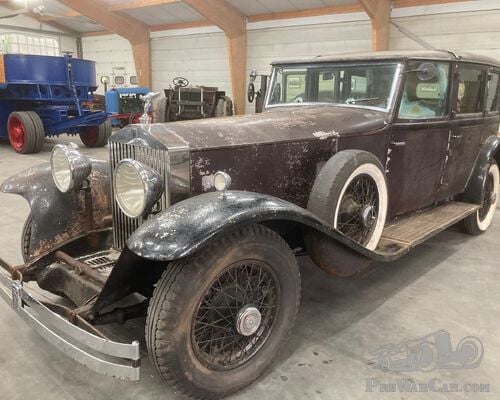
Rolls-Royce
Rolls-Royce Phantom ll chassisnummer 287 AJS. bouwjaar 1932, Links gestuurd, Brewster Keswick Sedance Towncar
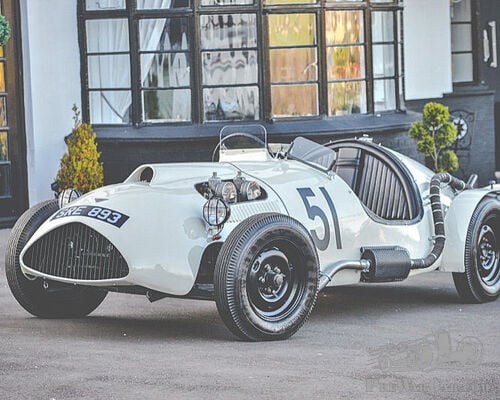
1933 Alvis 3.0 Special - One-Off Alloy Body | Period Competition Car | Featured in “Alvis – A Century of Drivers”
1933 Alvis 3. 0 Special - One-Off Alloy-Body | Period Competition Car | Featured in “Alvis – A Century of Drivers”
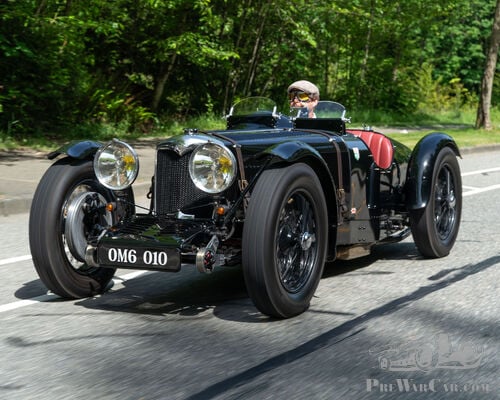
Riley 14/6 Special 1933
The ExperienceStep into the golden age of British motoring. This 1933 Riley 14/6 Special is a masterclass in pre-w..