The global magazine and marketplace for classic car enthusiasts, by enthusiasts.


Filter
Classic Dodge, DeSoto for sale - Dodge, DeSoto cars for sale
-

1926 Dodge Roadster
Offered due to trade-in:Unique 1926 Dodge Roadster.Originated from collection.Engine runs well. Comes with USA Title.Very original condition. -
1942 Dodge WC-Series Command Vehicle | RM Sotheby's | The Willy Michiels Collection
To Be OFFERED AT AUCTION WITHOUT RESERVE at RM Sothebys' The Willy Michiels Collection event, 8 - 15 September 2026. Offered Without Reserve | €8,000 - €12,000 EUR Popular military collectible; a Dodge Command vehicle was transport of choice for General Patton during World War IIFeatures numerous period military details includin.. -
1941 Dodge WC-12 ½-Ton 4x4 Military Truck | RM Sotheby's | The Hershey Auction
To Be OFFERED AT AUCTION WITHOUT RESERVE at RM Sothebys' The Hershey Auction event, 7 - 8 October 2026. Offered Without Reserve | $25,000 - $35,000 USD A well-known, award-winning second-series WC-12Restored to an exceptional standard by noted enthusiast John HedgepethBeautifully presented, with numerous authentic detai..


Dodge
US, 1914 to date
(1) Dodge Brothers, Detroit, Mich., 1914 – 1928
(2) Chrysler Corp, Detroit, Mich., 1928 to date
The brothers John and Horace Dodge, early Ford shareholders and builders of engines for the Ford Motor Co, produced their first Dodge car in November 1914. It was a conventional side valve Monobloc four of 3½-litres, developing 25bhp. The Dodge was noted for its 12-volt electrics, and ‘back-to-front’ gear change, features that were not discarded until 1926. The tough Dodge 4 won early acceptance by the American army after being used in General Pershing’s punitive expedition to Mexico in 1916, and the Dodge type was widely used in World War 1 as a staff car and ambulance. Also in 1916 Budd all-steel tourer bodywork was adopted; some saloons were also made in this year, using the same construction. The price of open Dodge cars was $785, and Dodge was fourth in overall US sales in 1916 with 70.700 Dodge cars delivered, following this up with a second place in 1920. The Dodge four was still the staple product in 1924, when 1.000 cars were being made a day. A new departure for Dodge in 1927 was a 3.7-litre side-valve six with internal-expanding hydraulic brakes.
In July 1928, Walter P. Chrysler paid $175.000.000 for the Dodge company. Discontinuation of the Dodge four, now developing 40bhp and fitted with front-wheel brakes, followed almost immediately, but for the next three years Dodges preserved their individual appearance. Though their cars were reckoned more expensive than DeSotos, Dodge offered a very cheap Dodge Standard 6 at $765 in 1929, their other models being the Dodge Victory at about $1.000, and a big Dodge Senior which paralleled Chrysler’s 75 at $1.675. A straight-8 was listed from 1930 to 1933. Free wheels were among the regular Chrysler improvements which appeared on the scene in 1932, followed by synchromesh gearboxes in 1933. In this year Dodge again took fourth place in sales, with 86.062 Dodge cars delivered. There were no Dodge versions of the Chrysler Airflow, but 1935 Dodge cars had the Airstream styling and side-valve 6-cylinder engines of 3.6-litre capacity. Overdrive, hypoid rear axles and independent front suspension made their appearance in the later 1930s, and Dodge cars of the 1940s were hard to distinguish from DeSotos or the de luxe Plymouths.
The expected ohv V8, publicized under the name Dodge Red Ram, materialized in 1952; it was a modest-sized 3.8-litre unit, and in 1955, when Chryslers were largely restyled, the Dodge cars were available both with the old 3.8-litre side-valve six and with V8s in three ratings up to 193bhp. By 1959 – the last year of the sv 6-cylinder – the most powerful eight disponed of some 345bhp, from 6.3-litres. Dodge has continued to offer more potent alternatives to the regular sedans, with a brisk Dodge Charger fastback coupé available in 1966. A ‘compact’ car, the Dodge Lancer, was listed in 1961, but this was vitually indistinguishable from the Plymouth Valiant. Regular 1967 Dodges had Chrysler’s unitary construction and alternator ignition introduced in 1960, and there were three basic ranges: the semi-compact Dodge Dart on a 9ft 3in wheelbase; the medium-sized Dodge Coronet; and the big Dodge Polara and Dodge Monaco on a wheelbase of 10ft 1in, with V8 engines of up to 7.2-litres’ capacity. The more sporting Dodge Charger coupé appeared in 1968, available with a 6.981cc hemi-head V8 of 425bhp; concealed wipers came on the 1969 Dodge models; and in 1970 the Dodge Challenger filled the gap between Dart and Coronet: standard engines were a 3.7-litre six or a 5.2-litre V8. There was a Dart sports coupé, the Dodge Demon, in 1971, but this was also the last year of the hemi-head engine and of convertibles in the Dodge range.
For 1973 there was the Dodge Dart on a 9ft wheelbase, the Dodge Challenger coupé, the Dodge Coronet and its sporting sister, the Dodge Charger, and the full-sized Dodge Polara and Dodge Monaco series. The Monaco had concealed headlamps. The biggest Dodge cars had V8 engines, automatic transmissions and power steering as standard. Electronic ignition was standard on all Dodge models, and all but the basic Darts had front disc brakes. Engines available were sixes of 3.245cc and 3.688cc, and V8s of 5.2, 5.6, 6.6 and 7.2 litres.
Since 1970 Dodge have been selling the Japancese Mitsubishi Colt as a small-car line in the USA.
Source: Georgano, encyclopedia of motorcar; MCS
The information is written with the greatest of care. However, if you have any suggested amendments please contact us at office@prewarcar.com
DeSoto
US, 1913 – 1916
DeSoto Motro Car Co, Auburn, Ind.
The DeSoto appears to have succeeded the Zimmerman. This was a large car with a 55hp, 6-cylinder engine, which was furnished with a compressed-air starter. The DeSoto model Six-55 five-seater touring car sold for $2185.
US, 1928 – 1960
Chrysler Motors Corp, Detroit, Mich.
The DeSoto was launched in 1928 as a 3.2-litre side valve six to compete with Oldsmobile, Pontiac and the cheaper Nashes. Styling and general design of the DeSoto were in line with the 1929 Chryslers, and at $885 for a DeSoto sedan 90.000 were sold in the first twelve months. A 3.4-litre straight-8 DeSoto on a 9ft 6in wheelbase was announced for 1930 as the world’s cheapest 8-cylinder car. However, DeSoto suffered badly in the Depression, and in 1932, when flexible rubber engine mountings and free wheels were made available, sales dropped to 26.000 DeSoto cars.
The DeSoto disappeared from the British market about this time, though certain ‘Chrysler’ models listed in England (the Mortlake, Croydon, and some of the Richmonds) were in fact DeSoto cars in all but name. A 6-cylinder version of Chrysler’s advanced unitary-construction Airflow, the SE-type with a 4-litre engine, was brought out in 1934, but was an unsuccessful as its bigger sister. Later DeSotos followed regular Chrysler lines closely though in later years there was a tendency for DeSoto to move into a higher price class than Dodge; by 1952 DeSotos started $300 higher than the companion make.
By 1939 the DeSoto cars for sale were being made with independent front suspension, hypoid back axles and column change. There was a choice at DeSoto of two 6-cylinder engines and three wheelbase lengths, the longest of these being reserved for seven-seater bodywork – DeSoto continued to offer a really roomy family car right up to 1954. A 4-speed semi-automatic Vacumatic transmission became an option in 1941, but DeSoto’s big post-war change of models did not take place until 1952, when the division followed Chrysler’s lead in adopting the oversquare ohv V8; the DeSoto version was of 4½-litre capcity and developed 16-bhp. With the advent of Chrysler’s ‘flight sweep’ styling in 1955, the side-valve sixes were dropped and the standard engine in a DeSoto was now a 4.8-litre eight, giving 185bhp in Firedome guise, and 200bhp in Fireflite form. Though this redesigning saved Chrysler sales generally, the slump in the medium-price class had an adverse effect on DeSoto and in 1959 the DeSoto division was merged with Plymouth. Last of the DeSotos were the 1961 models, unitary-construction cars with a choice of three engines: Plymouth’s 145bhp ohv ‘slant six’ as used in the Valiant, and V8s of 230 and 265bhp, the two former only in Canadian DeSotos. Production of DeSoto cars ceased in November 1960 after only a few had been delivered.
Source: Georgano, encyclopedia of motorcar; MCS
The information is written with the greatest of care. However, if you have any suggested amendments please contact us at office@prewarcar.com


Featured
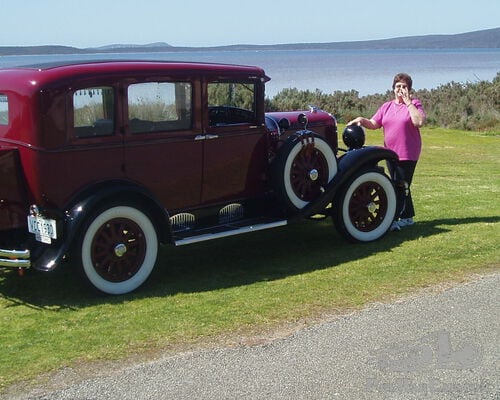
1930 Chrysler 66 Six-Wheel Equipped Royal Sedan
An exceptionally well restored and highly awarded Chrysler 66 Royal Sedan, with only two owners in nearly 97 years.The present owner ..
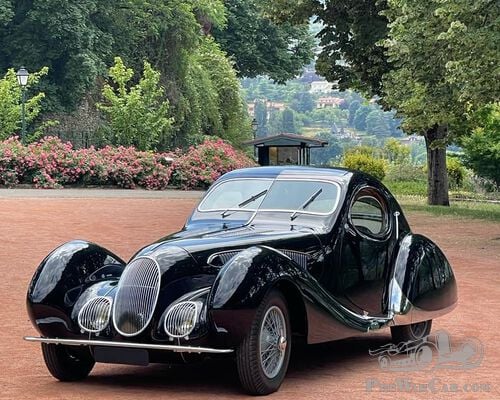
1939 Talbot-Lago T150C “Goutte d’Eau” — Iconic French Coachbuilt Masterpiece
Talbot-Lago T150C ‘Teardrop’ — An Icon of French Automotive Art There are motor cars that define an era. And then there are those tha..
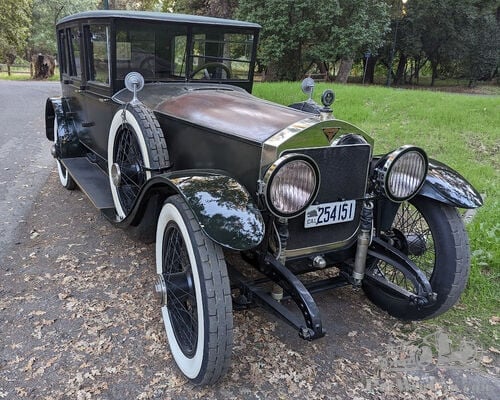
1916 Simplex, Crane model 5
1916 Simplex, Crane MODEL 5CUSTOM MADE HISTORIC PRESERVATION VEHICLE – READY TO TOUR!This Simplex recently completed th..